
Over 60 percent of tech startups report accelerated growth after joining AI-focused accelerator programs. For an american corporate employee or a recent grad eager to break into entrepreneurship, the difference between traditional support and these specialized programs is dramatic. This guide reveals how AI accelerator models, resources, and mentorship can shape your journey from concept to launch. You will discover real numbers, clear distinctions, and practical insights for choosing the right accelerator and avoiding costly missteps.
Table of Contents
- AI Accelerator Programs Defined And Debunked
- Key Types: Virtual, Corporate, And Hybrid Models
- How AI Accelerators Drive Startup Growth
- Risks, Costs, And What Founders Should Know
- Choosing The Right AI Accelerator For Your Venture
Key Takeaways
| Point | Details |
|---|---|
| AI Accelerators Propel Growth | AI accelerator programs provide targeted mentorship, technology access, and strategic networking, significantly enhancing startup growth and market readiness. |
| Diverse Models Exist | Startups can choose from virtual, corporate, or hybrid accelerators, each offering unique benefits suited to different needs and contexts. |
| Risk Assessment is Crucial | Founders should evaluate regulatory risks, financial commitments, and technical challenges when engaging with AI accelerators to ensure alignment with their strategic goals. |
| Strategic Selection Matters | Choosing the right AI accelerator requires careful consideration of technical expertise, network quality, and program flexibility to maximize the startup’s potential for success. |
AI Accelerator Programs Defined and Debunked
AI accelerator programs represent strategic initiatives designed to catapult early-stage startups into technological and entrepreneurial success. Unlike traditional business support models, these programs blend targeted mentorship, cutting-edge technological resources, and focused development strategies to transform promising startup concepts into market-ready solutions. Advanced technological platforms have transformed how entrepreneurs approach innovation, creating structured pathways for rapid growth and validation.
These programs typically operate through intensive, time-limited experiences where selected startups receive comprehensive support. According to Google’s Accelerator Impact Report, these initiatives provide critical advantages for emerging companies:
- Concentrated mentorship from industry experts
- Direct access to advanced technological resources
- Structured guidance for product development
- Networking opportunities with potential investors
- Tailored strategies for market entry
The core distinction between traditional business accelerators and AI-focused programs lies in their specialized approach to technological innovation. While general accelerators offer broad business support, AI accelerators specifically target startups leveraging artificial intelligence as a core competitive advantage. They understand the unique challenges of developing AI-driven solutions, from complex algorithm design to navigating rapid technological shifts.
Pro Tip: Research and apply to multiple AI accelerator programs simultaneously to maximize your chances of acceptance and compare different support offerings.
Key Types: Virtual, Corporate, and Hybrid Models
AI accelerator programs have evolved to offer diverse models that cater to different startup needs and technological landscapes. Emerging accelerator structures demonstrate the flexibility required in supporting innovative entrepreneurial ventures across various contexts and geographical boundaries.
Three primary models have emerged in the AI accelerator ecosystem:
- Virtual Accelerators: Completely online programs providing global accessibility
- Corporate Accelerators: Industry-specific programs backed by established companies
- Hybrid Accelerators: Blended models combining online and in-person support
Virtual accelerators represent a revolutionary approach, eliminating geographical constraints and enabling entrepreneurs worldwide to access world-class mentorship and resources. These programs leverage digital platforms to deliver comprehensive startup support, allowing founders to participate regardless of their physical location. Corporate accelerators, by contrast, offer deep industry connections and potential direct investment pathways through established technological organizations.
Hybrid models are particularly interesting, as they combine the best elements of virtual and in-person experiences. These programs provide flexible engagement models that can adapt to individual startup needs, offering both online learning modules and periodic in-person workshops or networking events. This approach recognizes that modern entrepreneurs require dynamic, personalized support strategies that can evolve with their rapidly changing technological landscapes.
Here’s a quick comparison of AI accelerator program models to guide your selection:
| Model Type | Distinguishing Feature | Ideal For |
|---|---|---|
| Virtual Accelerator | 100% online participation | Global teams, remote startups |
| Corporate Accelerator | Industry-backed opportunities | Startups seeking partnerships |
| Hybrid Accelerator | Mix of online and in-person | Startups needing tailored support |
Pro Tip: Carefully evaluate each accelerator model’s specific offerings and alignment with your startup’s unique technological and strategic requirements before applying.
How AI Accelerators Drive Startup Growth
AI accelerators are transformative engines that propel early-stage startups from promising concepts to market-ready innovations. Systematic startup support mechanisms have revolutionized how entrepreneurs navigate the complex landscape of technological development and commercial success.
The growth acceleration process typically involves multiple strategic interventions:
- Targeted Mentorship: One-on-one guidance from industry experts
- Technology Access: Cutting-edge tools and platform resources
- Strategic Networking: Connections with investors and industry leaders
- Funding Pathways: Direct investment and resource allocation
- Skill Development: Intensive training and capability enhancement
Entrepreneurs benefit from comprehensive support ecosystems that provide more than traditional funding models. These programs offer holistic development strategies, helping startups overcome critical challenges in product design, market positioning, and technological implementation. By combining technical mentorship with strategic guidance, AI accelerators create tailored pathways for startup growth that address specific innovation challenges.

The most successful AI accelerators understand that growth is not just about financial investment, but about creating robust ecosystems where startups can experiment, learn, and pivot quickly. They provide structured environments that compress years of potential learning into months of intense, focused development, giving entrepreneurs unprecedented opportunities to scale their technological innovations rapidly and strategically.
Pro Tip: Select AI accelerators that align not just with your technological domain, but with your specific growth stage and strategic vision.
Risks, Costs, and What Founders Should Know
AI accelerator programs present a complex landscape of opportunities and challenges that founders must carefully navigate. Emerging regulatory and technological risks demand strategic awareness and proactive planning from entrepreneurial teams seeking to leverage these innovative support ecosystems.
Founders should critically evaluate several key risk categories:
- Regulatory Uncertainty: Evolving legal frameworks for AI technologies
- Financial Investment: Significant upfront and ongoing development costs
- Technical Complexity: Advanced technological implementation challenges
- Ethical Considerations: Potential algorithmic bias and accountability issues
- Market Volatility: Rapid technological shifts and competitive pressures
The financial dimension of AI accelerator participation requires careful scrutiny. Comprehensive program assessments reveal that founders must consider not just direct monetary costs, but also potential equity dilution, time commitments, and alignment with long-term strategic objectives. Successful founders approach these programs as strategic investments, thoroughly evaluating the potential returns against the required resource commitments.
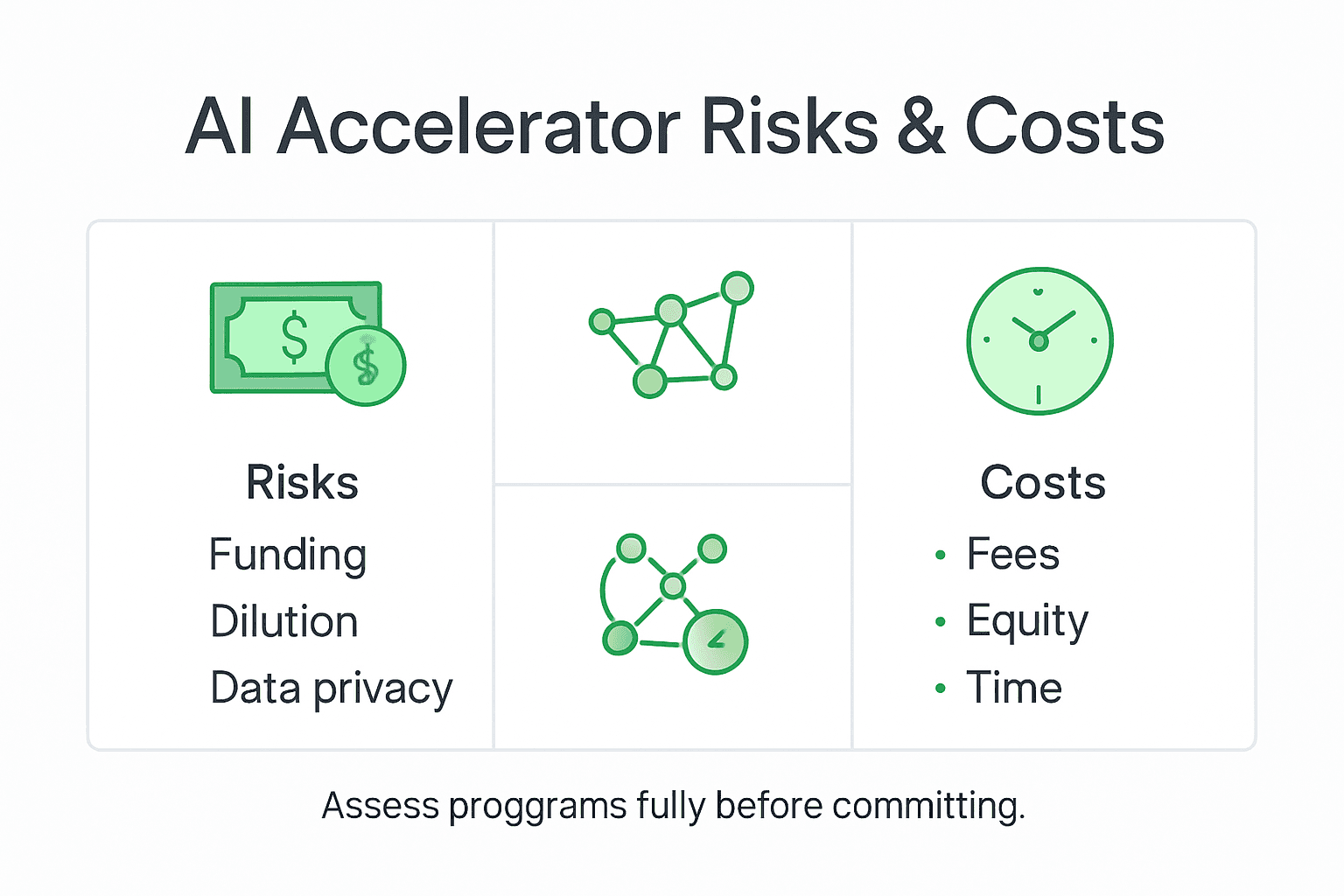
Beyond immediate financial considerations, founders must also recognize the deeper ecosystem risks. AI startups face unique challenges including complex technological development, potential regulatory constraints, and the need for continuous innovation. The most resilient entrepreneurs approach accelerator programs with a holistic perspective, understanding that success requires more than just technical prowess technical adaptability, strategic thinking, and a nuanced understanding of emerging market dynamics.
Pro Tip: Conduct thorough due diligence on potential AI accelerators, examining their track record, mentor network, and specific value propositions beyond standard funding offerings.
Choosing the Right AI Accelerator for Your Venture
Selecting the ideal AI accelerator requires strategic alignment between your startup’s unique vision and the program’s comprehensive offerings. Systematic program assessment strategies provide founders with a structured approach to evaluating potential accelerator partnerships that can dramatically influence their entrepreneurial trajectory.
Founders should critically examine several pivotal selection criteria:
- Technical Expertise: Depth of technological mentorship
- Network Quality: Caliber of investor and industry connections
- Funding Mechanism: Investment structure and equity expectations
- Program Flexibility: Adaptability to your specific startup needs
- Industry Specialization: Alignment with your technological domain
The evaluation process extends beyond surface-level program features. Successful founders recognize that the right accelerator functions as a strategic partner, not merely a temporary funding source. This means deeply understanding each program’s culture, mentorship philosophy, and track record of supporting startups similar to your venture. Investors and mentors should demonstrate not just theoretical knowledge, but practical experience in navigating the complex AI technological landscape.
Review these practical factors to help you select the right AI accelerator for your venture:
| Selection Factor | Why It Matters | Impact on Startup Success |
|---|---|---|
| Technical Expertise | Ensures deep platform guidance | Accelerates robust solutions |
| Network Quality | Opens high-value connections | Increases investment likelihood |
| Program Flexibility | Matches changing business needs | Supports rapid strategic pivots |
| Industry Alignment | Delivers relevant sector insights | Boosts product-market fit |
Potential applicants must also consider their startup’s specific stage of development. Early-stage AI ventures might prioritize foundational technical guidance and seed funding, while more mature startups could seek advanced networking opportunities and sophisticated scaling strategies. The most effective accelerator relationships emerge from precise matching between a startup’s current capabilities and the program’s specialized support mechanisms.
Pro Tip: Schedule informal conversations with previous accelerator participants to gain unfiltered insights into program dynamics and actual founder experiences.
Accelerate Your AI Startup Journey with siift.ai
The article highlights the intense challenges founders face in navigating AI accelerator programs, especially the need for clear strategic guidance, technological mentorship, and adaptable business models. Entrepreneurs seeking to fast-track their AI innovations often grapple with choosing the right program, aligning with expert mentors, and overcoming market complexity. siift.ai’s Intelligent Business Canvas directly addresses these pain points by offering an intuitive AI-powered strategy platform that guides startups step-by-step through ideation, validation, and go-to-market tactics. This approach helps you avoid common pitfalls such as unclear growth strategies, market misalignment, and investment risks discussed in the article.
If you want to transform your startup ideas into market-ready solutions without the uncertainty and pressure that come with traditional accelerators, the siift.ai Intelligent Business Canvas delivers personalized feedback and prioritized actions to systematically de-risk your founder’s journey. Discover how to align with the best accelerator programs by using the structured insights and growth plans available at siift.ai. Ready to gain clarity and accelerate your AI venture success? Start your journey today on siift.ai and unlock the tailored strategic support you need now.
Frequently Asked Questions
What are AI accelerator programs?
AI accelerator programs are strategic initiatives aimed at helping early-stage startups leverage artificial intelligence to achieve rapid growth and development through targeted mentorship, access to technology, and networking opportunities.
How do AI accelerators differ from traditional business accelerators?
AI accelerators specifically focus on supporting startups that use artificial intelligence as a competitive advantage, providing specialized resources and mentorship tailored to address the unique challenges of AI development, unlike traditional accelerators that offer broader business support.
What types of models are available for AI accelerator programs?
The primary models include virtual accelerators, which are completely online; corporate accelerators, which are backed by established companies; and hybrid accelerators, which combine both online and in-person support to cater to different startup needs.
What should founders consider when choosing an AI accelerator?
Founders should evaluate technical expertise, the quality of the accelerator’s network, funding mechanisms, program flexibility, and alignment with their industry to ensure the accelerator supports their specific growth needs and vision.
Recommended
- 7 Best Startup Accelerators Worldwide for New Founders | siift
- Startup Success Stories: Real Paths to Business Wins 2025 | siift
- blog | siift | Top Growth Strategies for Startups in 2025: Practical Steps for Beginners
- blog | siift | Startup Success Stories: Real Paths to Business Wins 2025
- Unleashing the Power of AI: Microsoft 365 Empowering Small Businesses - Cloudology