
Over 80 percent of new American startups face strategy setbacks before their third year in business. When so much rides on the right plan, even the sharpest entrepreneurs can struggle with fast-changing markets and unpredictable risks. The Business Model Canvas, empowered by artificial intelligence, now offers American founders smarter ways to map out, test, and refine their big ideas with data-backed confidence.
Table of Contents
- Defining Business Model Canvas With AI
- How AI Enhances Business Model Design
- Personalized Feedback And Action Prioritization
- Real-World Applications For New Founders
- Common Pitfalls And How AI Solves Them
Key Takeaways
| Point | Details |
|---|---|
| AI Enhances Business Models | Integrating AI into the Business Model Canvas allows for dynamic updates and real-time insights, empowering entrepreneurs to make informed strategic decisions. |
| Personalized Recommendations | AI-driven tools provide tailored feedback and action prioritization, facilitating a more context-specific approach to entrepreneurial challenges. |
| Mitigating Common Pitfalls | AI effectively addresses traditional challenges in entrepreneurship, such as market misalignment and resource misallocation, through objective data analysis. |
| Ongoing Strategy Optimization | Treat the Business Model Canvas as a living document, using AI insights for continuous validation and adaptation based on market trends. |
Defining Business Model Canvas With AI
The Business Model Canvas transforms abstract entrepreneurial ideas into concrete strategic roadmaps, and with artificial intelligence, this framework becomes even more powerful. Innovative AI technologies are revolutionizing how founders design, validate, and iterate their business concepts by providing unprecedented insights and predictive capabilities.
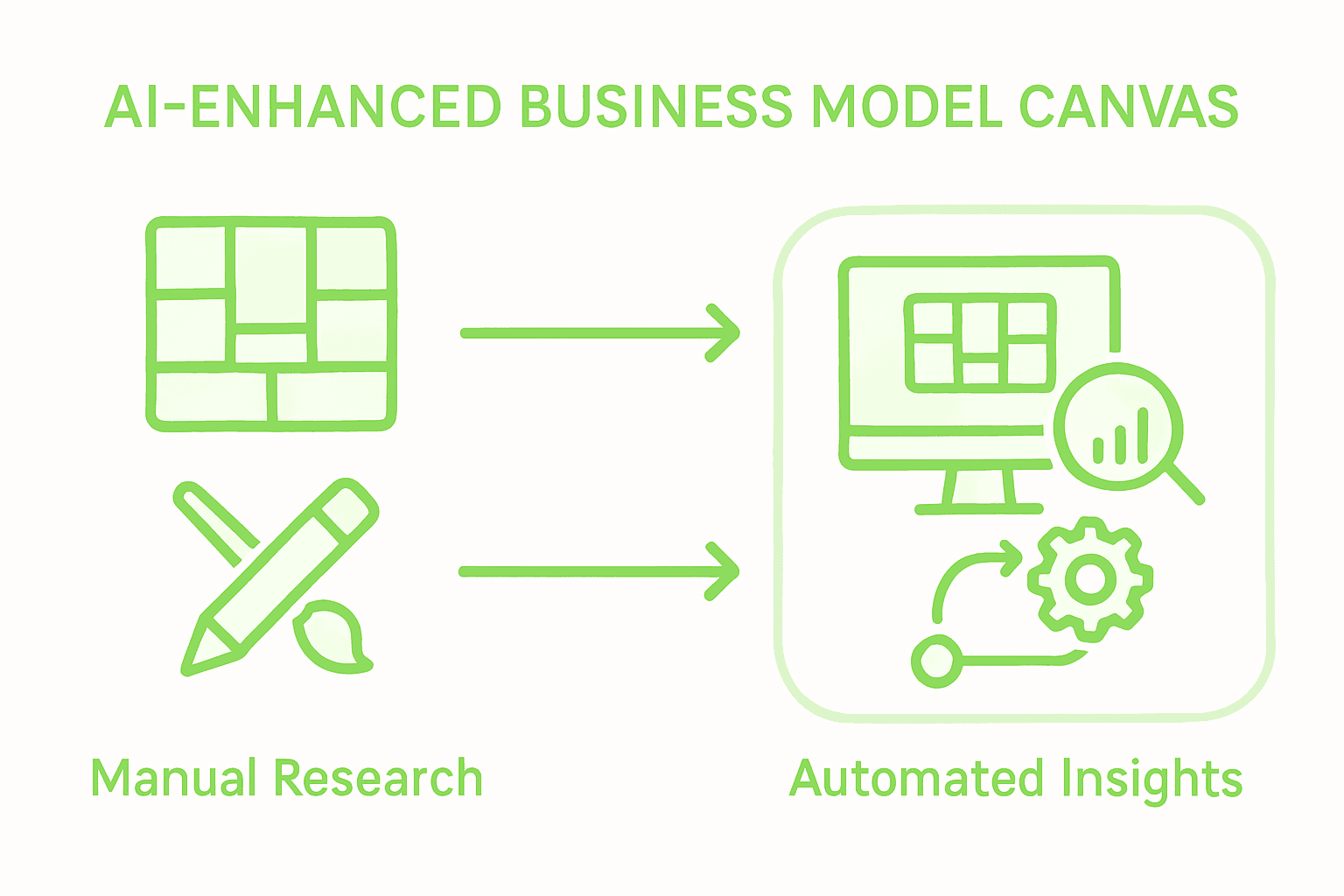
At its core, an AI-enhanced Business Model Canvas breaks down complex business strategies into nine fundamental building blocks: key partners, key activities, key resources, value propositions, customer relationships, channels, customer segments, cost structure, and revenue streams. Unlike traditional static models, AI-powered canvases dynamically adapt and learn, offering real-time recommendations based on market trends, competitive analysis, and predictive modeling.
The AI dimension introduces game-changing capabilities like automated competitive benchmarking, risk assessment, and personalized strategy optimization. By integrating machine learning algorithms, entrepreneurs can rapidly test hypothetical business scenarios, understand potential market responses, and refine their approaches with data-driven precision. This approach democratizes strategic planning, making sophisticated business modeling accessible to solopreneurs, indie hackers, and emerging founders who previously lacked advanced consulting resources.
Pro Tip: AI Strategic Modeling: Treat your initial Business Model Canvas as a living document. Use AI tools to continuously validate assumptions, update your strategy based on emerging data, and quickly pivot when market signals suggest necessary changes.
Quick Resource: Learn more about advanced business canvas techniques in our guide to business model strategies for 2025.
Here’s how AI capabilities strengthen key areas of the Business Model Canvas:
| Canvas Component | Traditional Approach | AI-Enhanced Approach |
|---|---|---|
| Market Analysis | Manual, time-intensive | Data-driven, real-time insights |
| Competitive Benchmarking | Periodic research | Ongoing automated comparisons |
| Customer Segmentation | Generalized assumptions | Granular, predictive segmentation |
| Risk Assessment | Reactive | Proactive, scenario simulation |
| Strategy Adaptation | Slow, infrequent updates | Continuous, dynamic optimization |
How AI Enhances Business Model Design
Artificial intelligence is fundamentally transforming business model design by introducing unprecedented levels of strategic insights and predictive capabilities. Generative AI technologies are reshaping traditional business landscapes, enabling entrepreneurs to develop more adaptive, intelligent strategies that respond dynamically to market changes and emerging opportunities.
The core enhancement AI brings to business model design lies in its ability to process complex datasets and generate nuanced recommendations. Machine learning algorithms can analyze historical business performance, market trends, competitive landscapes, and consumer behavior patterns to identify potential strategic opportunities that human analysts might overlook. By integrating AI-assisted learning approaches, founders can rapidly prototype and validate business concepts, reducing the time and resources traditionally required for market research and strategic planning.

AI-powered business model design tools offer several transformative capabilities. These include automated competitive benchmarking, risk assessment algorithms, predictive financial modeling, and personalized strategy optimization. Such technologies democratize advanced strategic planning, making sophisticated business modeling accessible to solopreneurs, indie hackers, and emerging founders who previously lacked enterprise-level consulting resources. The AI approach allows entrepreneurs to simulate multiple business scenarios, understand potential market responses, and refine their strategies with data-driven precision.
Pro Tip: Strategic AI Iteration: Treat your business model as a living document. Continuously feed new data into your AI tools, validate assumptions regularly, and be prepared to pivot quickly when emerging market signals suggest strategic adjustments.
Quick Resource: Explore more about cutting-edge AI tools designed specifically for founders to supercharge your business strategy.
Personalized Feedback and Action Prioritization
Artificial intelligence is revolutionizing entrepreneurial strategy by delivering unprecedented levels of personalized guidance through advanced scaffolding systems. Unlike traditional one-size-fits-all business planning approaches, AI-powered tools now provide tailored recommendations that adapt dynamically to each entrepreneur’s unique context, strengths, and potential challenges.
The core of personalized feedback lies in intelligent algorithmic analysis. Agentic AI approaches enable sophisticated, modular development frameworks that can deconstruct complex business concepts into actionable, prioritized steps. These systems analyze multiple dimensions of a business model simultaneously - including market potential, competitive landscape, resource requirements, and potential risks - to generate highly specific, contextually relevant strategic insights that traditional consulting methods could never match.
Intelligent action prioritization transforms how entrepreneurs approach strategic planning. AI tools can now rank potential initiatives based on projected impact, resource efficiency, and alignment with long-term business objectives. By simulating multiple scenarios and providing probability-weighted recommendations, these systems help founders make more informed decisions, allocate resources more effectively, and reduce the inherent uncertainty of early-stage venture development. The result is a more structured, data-driven approach to building sustainable business models that minimize wasted effort and maximize strategic potential.
Pro Tip: Iterative AI Feedback: Treat your AI-generated business recommendations as collaborative suggestions, not absolute directives. Regularly cross-reference AI insights with your domain expertise, industry knowledge, and intuitive understanding of your specific business context.
Quick Resource: Learn strategic techniques for validating your business idea to complement your AI-powered insights.
Real-World Applications for New Founders
AI-driven technologies are fundamentally transforming how new founders approach business development, offering unprecedented opportunities for small and medium enterprises to leverage cutting-edge strategic tools. By integrating intelligent systems into core business functions, entrepreneurs can dramatically enhance their decision-making capabilities, operational efficiency, and competitive positioning in increasingly complex market landscapes.
The practical applications of AI for new founders span multiple critical business domains. Intelligent business intelligence platforms enable founders to conduct rapid market research, analyze competitive landscapes, and generate predictive insights that would previously have required extensive consulting resources. These systems can help entrepreneurs identify market opportunities, understand customer behavior patterns, and develop more nuanced, data-driven strategies for growth and innovation.
Sustainable innovation strategies combining Business Intelligence, Design Thinking, and AI are empowering new founders to build more resilient and adaptive business models. By leveraging AI tools for scenario planning, risk assessment, and strategic modeling, entrepreneurs can simulate multiple business trajectories, understand potential challenges, and develop more robust go-to-market approaches. This approach transforms traditional trial-and-error entrepreneurship into a more systematic, intelligent process of strategic development.
Pro Tip: Strategic AI Integration: Start small by identifying one specific business process where AI can provide immediate value, such as market research or customer segmentation. Gradually expand your AI toolkit as you become more comfortable with these intelligent technologies.
Quick Resource: Explore proven growth strategies for startups to complement your AI-powered approach.
Common Pitfalls and How AI Solves Them
AI’s transformative potential in addressing traditional business modeling challenges represents a breakthrough for new entrepreneurs struggling with strategic uncertainties. Traditional business development approaches are plagued by cognitive biases, limited market insights, and inefficient decision-making processes that can dramatically increase startup failure risks. Artificial intelligence introduces a systematic approach to mitigating these inherent entrepreneurial challenges.
The most significant pitfalls new founders encounter include market misalignment, resource misallocation, and incomplete competitive analysis. Intelligent business modeling technologies can directly address these critical weaknesses by providing data-driven insights that transcend human limitations. AI systems can rapidly analyze complex market dynamics, simulate multiple business scenarios, and generate probabilistic recommendations that help founders make more informed strategic choices with reduced emotional and cognitive interference.
Generative AI technologies are revolutionizing business model design by introducing the IDEATe process - a comprehensive framework for identifying, developing, evaluating, and adapting entrepreneurial strategies. These intelligent systems can process vast amounts of market data, understand emerging trends, and provide nuanced strategic recommendations that would be impossible through traditional human analysis alone. By transforming subjective decision-making into an objective, data-driven process, AI helps founders minimize risk and maximize their venture’s potential for success.
Pro Tip: Strategic Risk Mitigation: Treat AI recommendations as sophisticated insights, not absolute directives. Always combine AI-generated strategies with your domain expertise, intuitive understanding, and contextual knowledge of your specific business environment.
Quick Resource: Explore key reasons businesses fail and how to prevent them to complement your AI-powered strategy development.
The following table compares common entrepreneurial pitfalls with how AI addresses them:
| Startup Pitfall | Traditional Challenge | How AI Provides a Solution |
|---|---|---|
| Market Misalignment | Guesswork, poor fit | Predictive market analysis |
| Resource Misallocation | Inefficient spending | Smart allocation recommendations |
| Incomplete Analysis | Missed competitor actions | Comprehensive, ongoing insights |
| Decision Bias | Emotional, subjective bias | Objective, data-driven choices |
| Slow Iteration | Delayed strategy updates | Rapid scenario testing, quick pivots |
Unlock the Power of AI to Transform Your Business Ideas Into Reality
The article highlights the challenge many founders face in turning abstract ideas into actionable, data-driven business models. Key pain points include market misalignment, slow iteration, and decision biases—problems that traditional approaches cannot fully solve. With concepts like AI-powered Business Model Canvas and personalized feedback, founders need a strategic partner that offers continuous validation and prioritized actions to reduce risk and blind spots.
Discover how siift.ai Intelligent Business Canvas addresses these challenges by guiding you step-by-step through ideation, validation, and go-to-market strategies. This intuitive AI platform delivers personalized insights and data-driven recommendations that help you avoid costly mistakes and pivot quickly when needed. Start your journey with trusted tools designed to empower founders with no pressure or gatekeepers. Don’t wait to bring your vision to life—explore how siift.ai can supercharge your business model today and turn your ideas into ventures you are proud to build.
Frequently Asked Questions
What is the Business Model Canvas?
The Business Model Canvas is a strategic management tool that outlines a company’s key components in a visual format, including elements like key partners, activities, resources, value propositions, customer relationships, channels, customer segments, cost structure, and revenue streams.
How does AI enhance the Business Model Canvas?
AI enhances the Business Model Canvas by providing real-time insights, automated competitive benchmarking, risk assessment, and personalized strategy optimization, allowing entrepreneurs to adapt their business models dynamically based on market data and trends.
What are the benefits of using AI for business model design?
The benefits of using AI for business model design include faster validation of business concepts, more accurate market analyses, data-driven decision-making, and the ability to simulate various scenarios, which reduces the risk and uncertainty associated with entrepreneurship.
How can I implement AI into my business modeling process?
You can implement AI into your business modeling process by utilizing AI-powered tools and platforms for market research, customer segmentation, and predictive analytics, allowing for continuous feedback and strategy adjustment based on emerging data.