

Over 80% of american startups fail before their fifth year, often because the path from idea to sustainable business is far from clear. If you want your venture to avoid this fate, you need more than passion and hustle. Clarity of vision, structured mapping, and smart use of AI are shaping how successful american entrepreneurs turn concepts into real-world results. Learn practical steps and fresh tools to give your idea a genuine shot at lasting growth.
Table of Contents
- Step 1: Define Your Business Vision With Clarity
- Step 2: Map Your Idea Using The Intelligent Business Canvas
- Step 3: Leverage AI Feedback To Refine Your Business Model
- Step 4: Prioritize And Execute Key Actions For Validation
- Step 5: Track Outcomes And Iterate Dynamically With AI Tools
Quick Summary
| Key Point | Explanation |
|---|---|
| 1. Define a Clear Business Vision | Craft a specific vision that aligns your capabilities with market opportunities, focusing on clarity and adaptability. |
| 2. Use the Intelligent Business Canvas | Map your business model utilizing nine key components to create a dynamic, actionable understanding of your strategy. |
| 3. Leverage AI for Business Model Feedback | Incorporate AI insights to uncover blind spots and improve your business model by iterating based on data-driven recommendations. |
| 4. Focus on Validation through Testing | Implement minimum viable experiments to validate your assumptions and refine your approach based on real-world feedback. |
| 5. Track Outcomes with AI Tools | Utilize AI-driven analytics for real-time insights and strategic adjustments, moving from static tracking to proactive management. |
Step 1: Define your business vision with clarity
Defining a clear business vision is about transforming your entrepreneurial spark into a compelling narrative that guides every strategic decision. Your vision serves as the north star that aligns your team, attracts investors, and creates a roadmap for sustainable growth.
According to an empirical study from arXiv, successful businesses distinguish themselves by effectively balancing internal resources and external market perspectives when articulating their vision. This means your vision should not just be a lofty statement but a pragmatic blueprint that connects your unique capabilities with market opportunities.
Start by asking yourself fundamental questions: What problem are you solving? Who are you solving it for? What makes your solution unique? Your vision needs three core elements:
- A clear problem statement that demonstrates market need
- Your distinctive approach to solving that problem
- The long term impact you want to create
ProTip: Avoid generic statements. Instead of saying “We want to be the best,” specify exactly how you’ll create value. For example, “We help small business owners leverage AI to reduce operational costs by 30% without sacrificing quality.”
Remember that your business vision is a living document. As you validate your idea and learn more about your market, you’ll refine and sharpen this vision. The key is to start with clarity and remain adaptable.
Step 2: Map your idea using the Intelligent Business Canvas
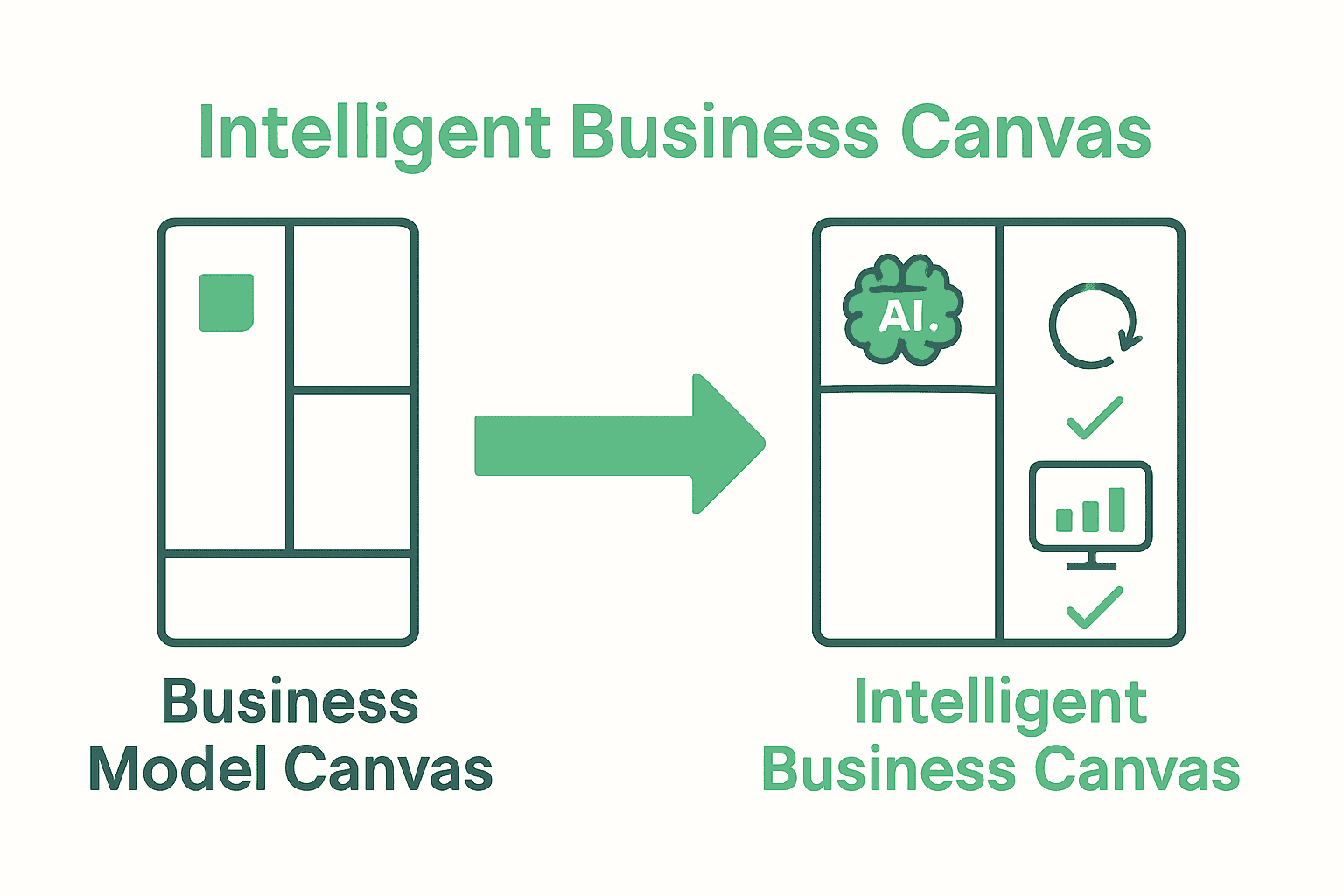
The Intelligent Business Canvas is your strategic blueprint that transforms abstract ideas into a structured, actionable business model. By systematically mapping out key components, you create a comprehensive snapshot of how your business will generate value and sustain itself.
According to Visual Paradigm, AI powered business canvas tools help entrepreneurs generate and refine strategies by mapping complex ideas into clear business models. This means you are not just creating a static document but developing a dynamic framework that adapts as your understanding deepens.
Traditional business model canvases can feel tedious and manual but the Intelligent Business Canvas takes a different approach. You will map out nine critical building blocks:
- Value Proposition: What unique solution are you offering?
- Customer Segments: Who exactly are your target customers?
- Revenue Streams: How will you make money?
- Cost Structure: What are your key expenses?
- Customer Relationships: How will you interact with customers?
- Channels: How will you reach your customers?
- Key Partners: Who are your critical collaborators?
- Key Activities: What core actions drive your business?
- Key Resources: What assets are essential to your success?
ProTip: Dont just fill in these sections generically. Use specific insights from your market research and be brutally honest about your capabilities and constraints.
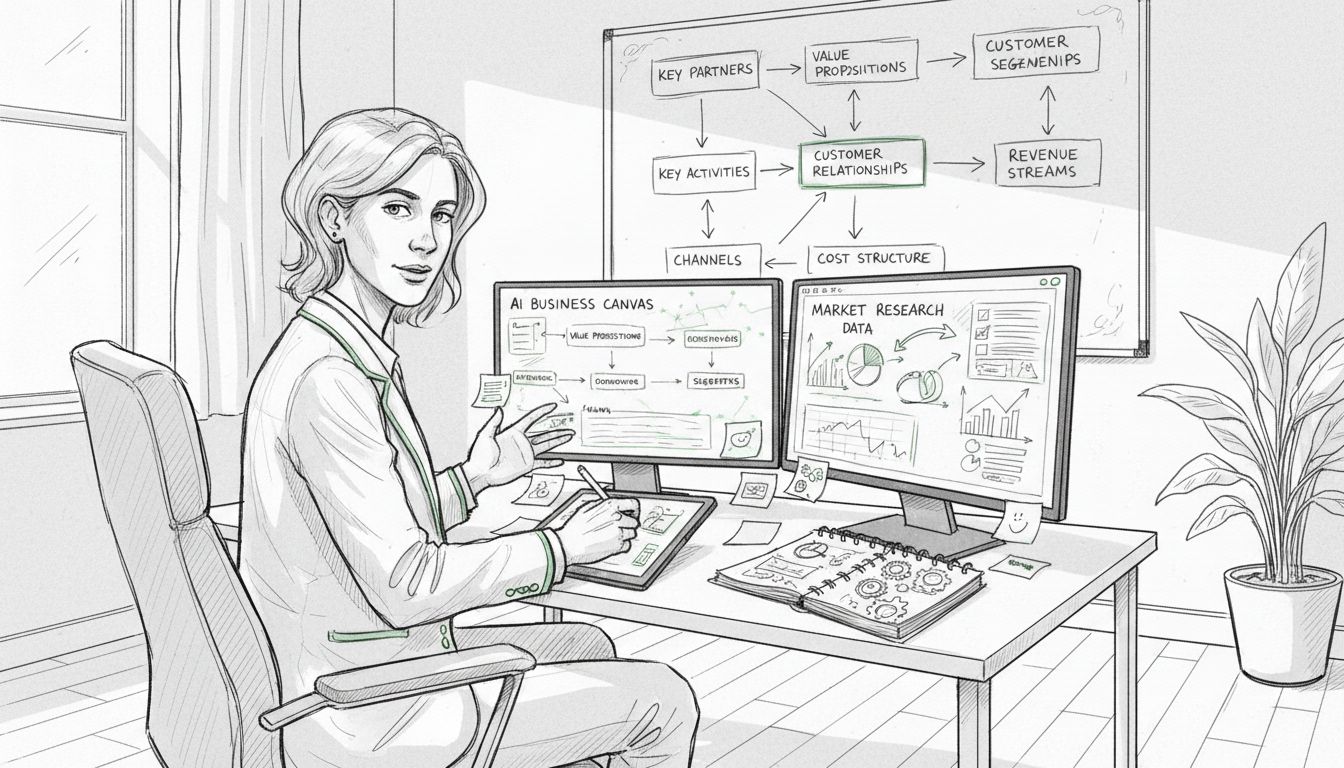
The magic of the Intelligent Business Canvas lies in its ability to reveal interconnections between different aspects of your business model.
 As you map out each section, youll start seeing how your value proposition links to revenue streams and how customer segments inform your channels.
Step 3: Leverage AI feedback to refine your business model
AI feedback transforms your initial business canvas from a static document into a dynamic strategy tool that continuously adapts and improves. This step is about using intelligent analysis to uncover hidden insights and potential blind spots in your business model.
According to FunBlocks, AI Business Model Analyzers can provide strategic analysis and innovation recommendations that help entrepreneurs refine their business strategies. Similarly, Convoboss offers AI powered tools that generate customized business model canvases, enabling more sophisticated strategic planning.
To leverage AI feedback effectively, follow these key steps:
- Upload your current business canvas to an intelligent analysis platform
- Request comprehensive strategic analysis
- Review AI generated insights and recommendations
- Identify potential gaps or opportunities in your current model
- Compare AI suggestions against your market research and domain expertise
- Iterate and update your business canvas based on actionable feedback
ProTip: Dont treat AI feedback as absolute truth. Use it as a strategic lens that highlights potential areas for improvement rather than a definitive roadmap.
The real power of AI feedback lies in its ability to provide objective, data driven perspectives that challenge your assumptions and reveal innovative approaches you might have overlooked. By integrating these insights, you transform your business model from a theoretical exercise into a robust strategic blueprint.
Step 4: Prioritize and execute key actions for validation
Validation is about transforming your business idea from a hypothesis to a proven concept through systematic testing and learning. This step is where you move from theoretical planning to real world evidence gathering.
According to Wikipedia, the Lean Startup methodology emphasizes prioritizing and executing key actions to validate business hypotheses through iterative testing and learning. Visual Paradigm further supports this approach by providing structured frameworks that help entrepreneurs systematically validate their business models.
To effectively prioritize and execute validation actions follow these strategic steps:
- Identify your most critical business assumptions
- Design minimum viable experiments to test these assumptions
- Develop rapid prototypes or mockups
- Collect quantitative and qualitative feedback
- Analyze results objectively
- Iterate or pivot based on validated learnings
ProTip: Focus on testing the riskiest assumptions first. These are typically around customer problem definition customer willingness to pay and potential market size.
Remember that validation is not about proving yourself right but about discovering the most accurate path forward. Each experiment provides valuable insights that help you refine your business model increasingly bringing you closer to a sustainable solution that truly meets market needs.
Step 5: Track outcomes and iterate dynamically with AI tools
Tracking business outcomes is no longer about static spreadsheets and manual reporting. With AI tools, you can transform your business tracking into a real time strategic intelligence system that adapts and provides actionable insights.
According to Visual Paradigm, AI powered canvas toolkits now support dynamic iteration by tracking outcomes and providing AI driven insights for continuous improvement. This means you can move beyond traditional performance tracking and embrace a more intelligent approach to business management.
To effectively track and iterate using AI tools follow these strategic steps:
- Connect your key business metrics to an AI tracking platform
- Set up real time dashboards with predictive analytics
- Enable automated performance alerts and anomaly detection
- Integrate multiple data sources for comprehensive insights
- Use AI recommendations to identify improvement opportunities
- Regularly review and adjust your strategic approach based on AI generated insights
ProTip: Dont view AI tools as a replacement for human judgment. Instead think of them as an intelligent assistant that provides objective data and highlights potential blind spots in your strategy.
The future of business tracking is not about collecting data its about transforming data into strategic intelligence. AI tools help you move from reactive reporting to proactive strategy optimization ensuring your business remains agile and responsive to emerging opportunities.
Build a Smarter Business Plan with AI Guidance
The article highlights how defining a clear vision, mapping your ideas methodically, and leveraging AI for feedback can transform your business plan from a mere concept into a validated, actionable strategy. If you find yourself overwhelmed by complex frameworks or worried about missing blind spots during validation and iteration, you are not alone. The key pain points include navigating the nine critical building blocks, prioritizing validation actions, and dynamically tracking outcomes without bias or pressure.
This is where siift.ai Intelligent Business Canvas becomes your essential partner. It is a modern founder’s strategy platform that guides you step-by-step through ideation, validation, and go-to-market execution with personalized AI feedback. The platform helps uncover hidden insights and prioritize actions, taking the guesswork and friction out of turning your ideas into a viable business. By visiting siift.ai, you gain access to a dynamic strategic tool that grows with your vision and accelerates your journey from hypothesis to launch.
Ready to de-risk your founder’s journey and build your business plan smarter? Dive into systematic validation and real-time iteration with AI-driven support. Take your next step now by exploring how the Intelligent Business Canvas can simplify and strengthen your strategy.
Frequently Asked Questions
How do I define a clear business vision for my startup?
Defining a clear business vision involves articulating what problem you are solving, who your target audience is, and how your solution uniquely addresses that problem. Start by asking yourself these key questions and draft a concise statement that encapsulates your goals and long-term impact.
What components are essential in the Intelligent Business Canvas?
The Intelligent Business Canvas includes nine critical building blocks: Value Proposition, Customer Segments, Revenue Streams, Cost Structure, Customer Relationships, Channels, Key Partners, Key Activities, and Key Resources. Map out each block using specific market insights to create a comprehensive overview of your business model.
How can I use AI feedback to improve my business model?
To enhance your business model with AI feedback, upload your current canvas to a suitable platform, and request an analysis. Review the insights provided and compare them with your own market research to identify gaps and opportunities for refinement.
What steps should I take to validate my business idea?
To validate your business idea, first identify your critical assumptions and design experiments that will test them. Execute those tests, collect feedback, and adjust your model based on the findings to align better with market needs.
How do I track business outcomes effectively using AI tools?
Connect your key business metrics to an AI platform for real-time tracking and set up dashboards that provide predictive analytics and performance alerts. Regularly review the insights generated to proactively adjust your strategy and ensure continued alignment with your business goals.
Recommended
- blog | siift | Business Plan Essentials 2025: A Beginner’s Guide for New Founders
- blog | siift | What Is Business Validation? A Simple Guide for New Founders
- blog | siift | How to Validate Idea in 2025: A Simple Guide for New Founders
- blog | siift | Master Business Idea Validation: Steps to Success in 2025
- What Is Meal Planning? Simple Guide for Every Lifestyle 2025 - Dietium
- 7 Essential Management Consulting Tips for Small Businesses - Stratgetic IT Consultants for Accountants