

Did you know that up to 70 percent of buyers choose brands based on emotional connection, not just product details? Understanding the true difference between features and benefits can determine whether your message gets through or falls flat. This insight shapes how entrepreneurs attract loyal customers, build trust, and stand out in busy markets by focusing on what really matters to the people they serve.
Key Takeaways
| Point | Details |
|---|---|
| Understand Features vs. Benefits | Features are objective product characteristics, while benefits explain how those features improve customer experience. |
| Focus on Emotional Connection | Successful marketing resonates with customers by highlighting personal outcomes rather than just technical specifications. |
| Avoid Common Pitfalls | Entrepreneurs should refrain from overwhelming customers with details and ensure benefits are clearly articulated and meaningful. |
| Leverage Storytelling in Positioning | Positioning should combine features and benefits into a compelling narrative that reflects customer transformation and addresses pain points. |
Table of Contents
- Defining Features Vs Benefits In Business
- Key Differences And Why They Matter
- Practical Examples For Entrepreneurs
- Common Pitfalls And Misconceptions Explained
- Best Practices For Positioning Your Offer
Defining Features vs Benefits in Business
Understanding the core difference between features and benefits is essential for entrepreneurs wanting to effectively communicate their product’s value. According to the International Pole Industry Association, features represent the objective, measurable facts about a product, like technical specifications or physical attributes. Benefits, conversely, translate those features into compelling, customer-focused value propositions that directly answer the critical question: “What’s in it for me?”
Let’s break this down practically. A feature is a factual characteristic of your product or service, such as “waterproof design” or “24-hour battery life.” The corresponding benefit explains how that feature improves the customer’s life: “Stay connected anywhere without worrying about device damage” or “Work and play all day without charging interruptions.” Successful businesses don’t just list features they help potential customers understand the transformative impact those features can create.
To effectively communicate your offering, start by identifying your product’s core features, then translate each into a clear, emotionally resonant benefit. Consider these key translation strategies:
- Match every technical feature with a human-centered outcome
- Focus on solving specific customer pain points
- Use language that creates vivid mental images of improvement
- Emphasize emotional and practical gains
By mastering the art of converting features into benefits, you’ll create more compelling marketing messages that genuinely connect with your target audience.
 Learn more in our guide on purpose-driven business to understand how aligning features with meaningful benefits can transform your entrepreneurial approach.
Key Differences and Why They Matter
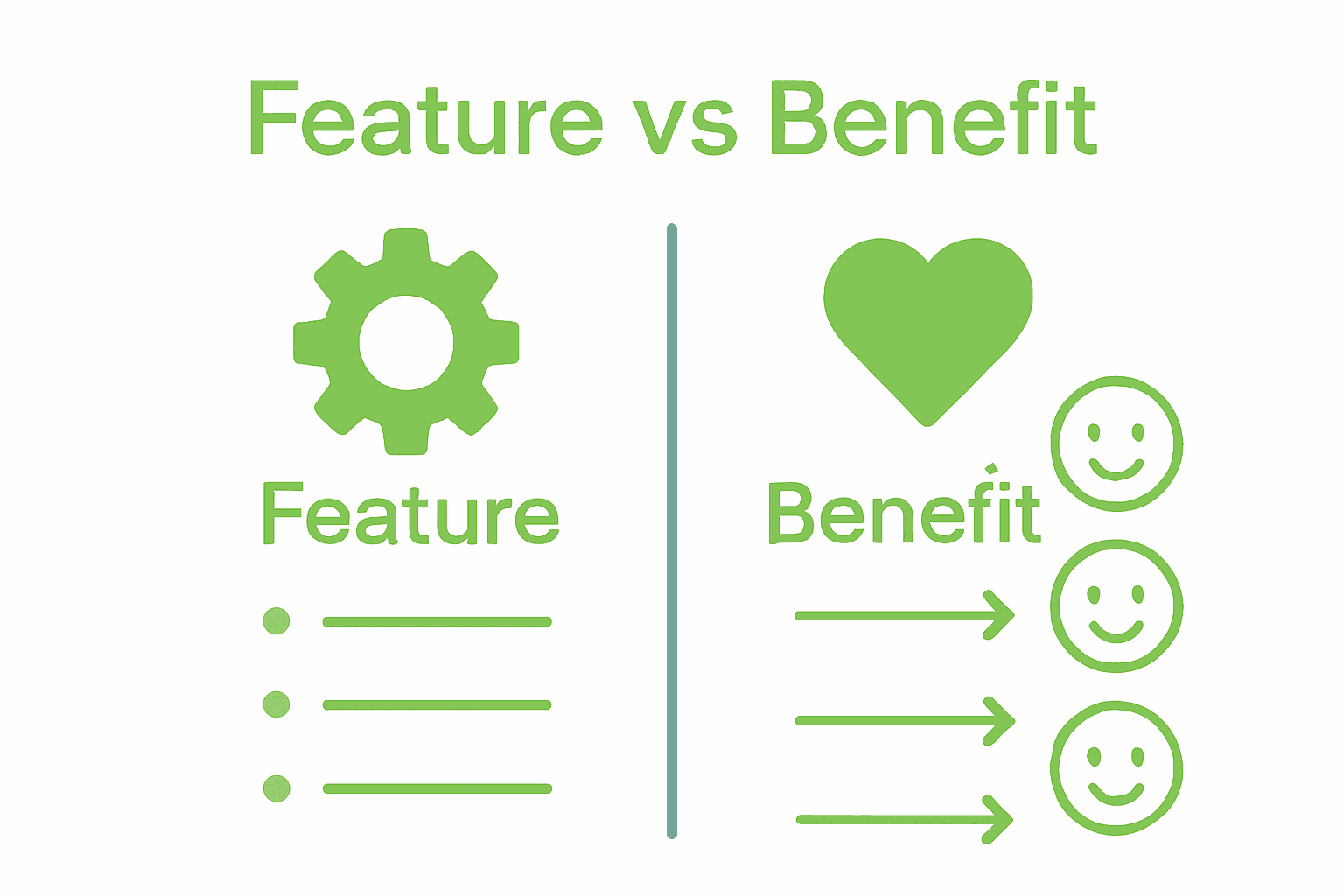
The fundamental distinction between features and benefits goes far beyond simple marketing rhetoric. According to Talentdu, features appeal to the logical side of decision-makers by explaining product specifics, while benefits tap into emotional drivers by illustrating how a product genuinely improves the user’s life. This nuanced approach is critical for entrepreneurs seeking to create compelling value propositions.
Logical Appeal vs Emotional Connection emerges as the core differentiator. Features provide the rational justification for a purchase technical specifications, dimensions, capabilities that give potential customers concrete information. Benefits, however, translate those specifications into meaningful personal outcomes. Think of features as the ingredients, and benefits as the delicious meal they create. A laptop’s 16GB RAM (feature) becomes “seamlessly run multiple complex projects without frustrating slowdowns” (benefit).
Here’s a summary comparing features and benefits for entrepreneurs:
| Aspect | Features | Benefits |
|---|---|---|
| Definition | Product facts/specifications | Customer-focused outcomes |
| Focus | Logical/rational appeal | Emotional/practical impact |
| Example (Tech) | 16GB RAM Waterproof design |
Fast multitasking No water damage |
| Universality | Same for all customers | Personal Context-specific |
| Role in Messaging | Inform & describe | Inspire & motivate |
| Common Pitfall | Listing too many details | Failing to personalize benefits |
Why does this matter for founders? Because successful products don’t just exist they solve problems and transform experiences. Consider these strategic differences:
- Features inform: Technical details that describe what something is
- Benefits inspire: Emotional and practical outcomes that show what something does for you
- Features are universal: Identical for every customer
- Benefits are personal: Unique to each individual’s context and needs
By understanding and articulating both features and benefits, you create a powerful narrative that speaks to both the head and heart of your potential customers.
 Learn more about business strategy in our guide on B2B and B2C differences to deepen your understanding of effective communication across different market segments.
Practical Examples for Entrepreneurs
Transforming features into compelling benefits is an art form that can dramatically improve how entrepreneurs communicate value. According to the Pole Industry Association, effective translation means moving beyond basic descriptions to highlight real-world transformations. For instance, what might seem like a simple weekend class becomes an opportunity for flexible scheduling, turning a feature into a life-changing benefit.
Let’s explore concrete examples across different business contexts. A software startup might list “AI-powered analytics” as a feature, but the true benefit is “make data-driven decisions in minutes, not weeks.” Similarly, a fitness app’s feature of “personalized workout tracking” translates to the benefit of “achieve your health goals without overwhelming complexity.” Each feature becomes a gateway to solving a specific customer problem or improving their daily experience.
Consider these strategic feature-to-benefit transformations:
- Technical Feature: 24/7 Customer Support Benefit: Peace of mind knowing help is always available
- Product Feature: Lightweight Design Benefit: Work comfortably anywhere without physical strain
- Service Feature: Customizable Modules Benefit: Adapt the solution exactly to your unique business needs
Mastering this skill requires empathy and deep understanding of your customer’s challenges. Discover insights from successful entrepreneurs to refine your approach to communicating product value. Remember, customers don’t buy features they buy solutions that make their lives easier, more efficient, or more enjoyable.
Common Pitfalls and Misconceptions Explained
Entrepreneurs often fall into predictable traps when distinguishing between features and benefits. According to Arnab Ray’s startup guide, one of the most significant mistakes is feature creep, where founders mistakenly believe that adding more features automatically increases product value. In reality, this approach can dilute the core value proposition, confuse potential customers, and ultimately erode the product’s focused appeal.
Another common misconception is treating features and benefits as interchangeable. Features are the “what” of your product technical specifications, design elements, or service attributes. Benefits are the “why” that truly motivate a customer to purchase. Many founders make the critical error of exclusively discussing features, forgetting that customers care most about how a product will improve their lives, solve their problems, or fulfill their desires.
Here are the most dangerous pitfalls entrepreneurs should avoid:
- Overloading customers with technical details
- Assuming customers understand the implicit value of features
- Neglecting emotional connections in product messaging
- Copying competitor feature lists without understanding unique value
- Failing to translate features into personal, meaningful benefits
Learn how to build a robust entrepreneurial mindset that helps you navigate these complex communication challenges. The most successful founders don’t just sell products they sell transformative experiences that resonate deeply with their target audience’s aspirations and pain points.
Best Practices for Positioning Your Offer
Positioning your product effectively requires a strategic approach to communicating features and benefits. According to Talentdu, the most successful entrepreneurs master the art of storytelling messaging by combining features and benefits in a compelling narrative. The recommended technique is simple yet powerful: introduce a feature, then immediately translate it into a meaningful benefit that resonates with your target audience.
Chris Koehl’s advanced positioning strategies offer entrepreneurs a nuanced framework for communication. This approach goes beyond basic feature listing, emphasizing the importance of creating a narrative that places the customer as the hero of their own transformation. By using data-driven storytelling, interactive demonstrations, and carefully segmented messaging, founders can create a powerful connection that transcends traditional marketing techniques.
Here are the most effective positioning strategies:
- Start with the customer’s perspective, not your product’s specifications
- Use clear, jargon-free language that speaks directly to pain points
- Develop narratives that show transformation, not just functionality
- Leverage social proof and real-world success stories
- Segment your messaging for different audience types
- Test and iterate your benefit-focused messaging
Learn how to pitch your ideas effectively and transform your product positioning from a list of features to a compelling story of customer transformation. Remember, the most successful offers don’t just describe what a product does they illustrate the journey of improvement and possibility.
Turn Features Into Lasting Benefits With AI-Powered Guidance
Are you struggling to bridge the gap between product features and the real benefits your customers want? Many founders face the pain of falling into the feature trap and missing the chance to connect on a personal level. Understanding the difference between listing a feature and demonstrating a benefit is more than a marketing trick. It is about building a product that truly changes lives.
With siift, you do not have to navigate this journey alone. Our intuitive AI guides you step by step as you apply the strategies covered in the Features vs Benefits guide. Get personalized feedback and practical next actions tailored to your business challenges. Ready to transform your product story and unlock new growth? Sign up at siift and start turning insight into action today. Your founder’s journey deserves clarity and impact—act now to make features work for you.
Frequently Asked Questions
What is the difference between features and benefits?
Features are the objective, measurable characteristics of a product, such as specifications or technical attributes. Benefits, on the other hand, explain how those features improve the customer’s life by addressing their specific needs or pain points.
Why are benefits more important than features in marketing?
Benefits connect emotionally with potential customers and emphasize the value that a product brings to their lives, making it essential for creating compelling marketing messages that resonate.
How can I effectively translate product features into benefits?
Start by identifying the core features of your product and then articulate how each feature translates to a specific benefit that addresses customer pain points or enhances their experience.
What are common mistakes entrepreneurs make when discussing features and benefits?
Common mistakes include overloading customers with technical details, assuming they understand the value of features, neglecting emotional connections, and failing to personalize benefits to resonate with individual needs.
Recommended
- blog | siift | Understanding Founder Market Fit: Key Concepts Explained
- blog | siift | Business Plan Essentials 2025: A Beginner’s Guide for New Founders
- blog | siift | Understanding Founder Mode: Your Guide to Entrepreneurship
- blog | siift | How to Find Cofounders in 2025: Proven Steps for Students & Innovators
- Mastering the Product Marketing Approach: Proven Strategies to Elevate Your Brand