

Launching a startup demands more than just a bold idea. Studies reveal that founders with self awareness and a clear sense of purpose are far more likely to build thriving businesses. Whether you are eager to break free from the nine to five grind or chasing a vision you feel deeply about, understanding your unique entrepreneurial strengths is the real starting line. This guide takes you step by step through assessing founder potential, shifting your mindset, and matching your capabilities to powerful opportunities.
Table of Contents
- Step 1: Assess Whether You Have Founder Material
- Step 2: Distinguish Employee Mindset from Founder Mindset
- Step 3: Explore What Drives Your Meaningful Work
- Step 4: Validate Founder-Market Fit with Your Strengths
- Step 5: Compare Opportunities Using Founder Intelligence Tools
Quick Summary
| Key Point | Explanation |
|---|---|
| 1. Assess Your Founder Potential | Conduct a self audit focusing on traits like risk tolerance and passion for innovation to gauge your founder qualities. |
| 2. Shift from Employee to Founder Mindset | Embrace uncertainty and proactivity; develop a holistic view of business strategies to transition successfully into entrepreneurship. |
| 3. Discover Your Meaningful Work | Reflect on your passions and skills to identify work that aligns with your deepest motivation and potential impact. |
| 4. Validate Founder-Market Fit | Match your unique strengths with market needs to ensure your startup idea aligns with your capabilities and customer pain points. |
| 5. Use Founder Intelligence Tools | Leverage analytical tools to systematically assess market opportunities and make informed entrepreneurial decisions. |
Step 1: Assess Whether You Have Founder Material
Discovering if you truly have founder material requires honest self reflection and understanding of your core entrepreneurial traits. Research from arXiv suggests evaluating your potential through a systematic assessment of your skills, motivations, and alignment with potential startup ideas.
To determine if you have founder potential, start by conducting a comprehensive self audit. Analyze your personal characteristics across several key dimensions:
- Risk Tolerance: Are you comfortable making decisions with incomplete information?
- Problem Solving Skills: Can you creatively tackle complex challenges?
- Resilience: How quickly can you recover from setbacks?
- Learning Agility: Do you adapt rapidly and seek continuous improvement?
- Passion for Innovation: Are you driven to solve meaningful problems?
According to research exploring founder characteristics, successful founders demonstrate not just technical skills but also psychological adaptability. Your ability to pivot quickly, learn from failures, and maintain unwavering commitment distinguishes true entrepreneurial talent.
Warning: Self assessment is just the beginning. Potential founders must complement introspection with real world validation through market research, prototype development, and seeking feedback from potential customers and industry experts.
If this initial assessment reveals strong alignment with founder traits, you are ready to move forward into deeper exploration of your startup concept and market opportunity.

Step 2: Distinguish Employee Mindset from Founder Mindset
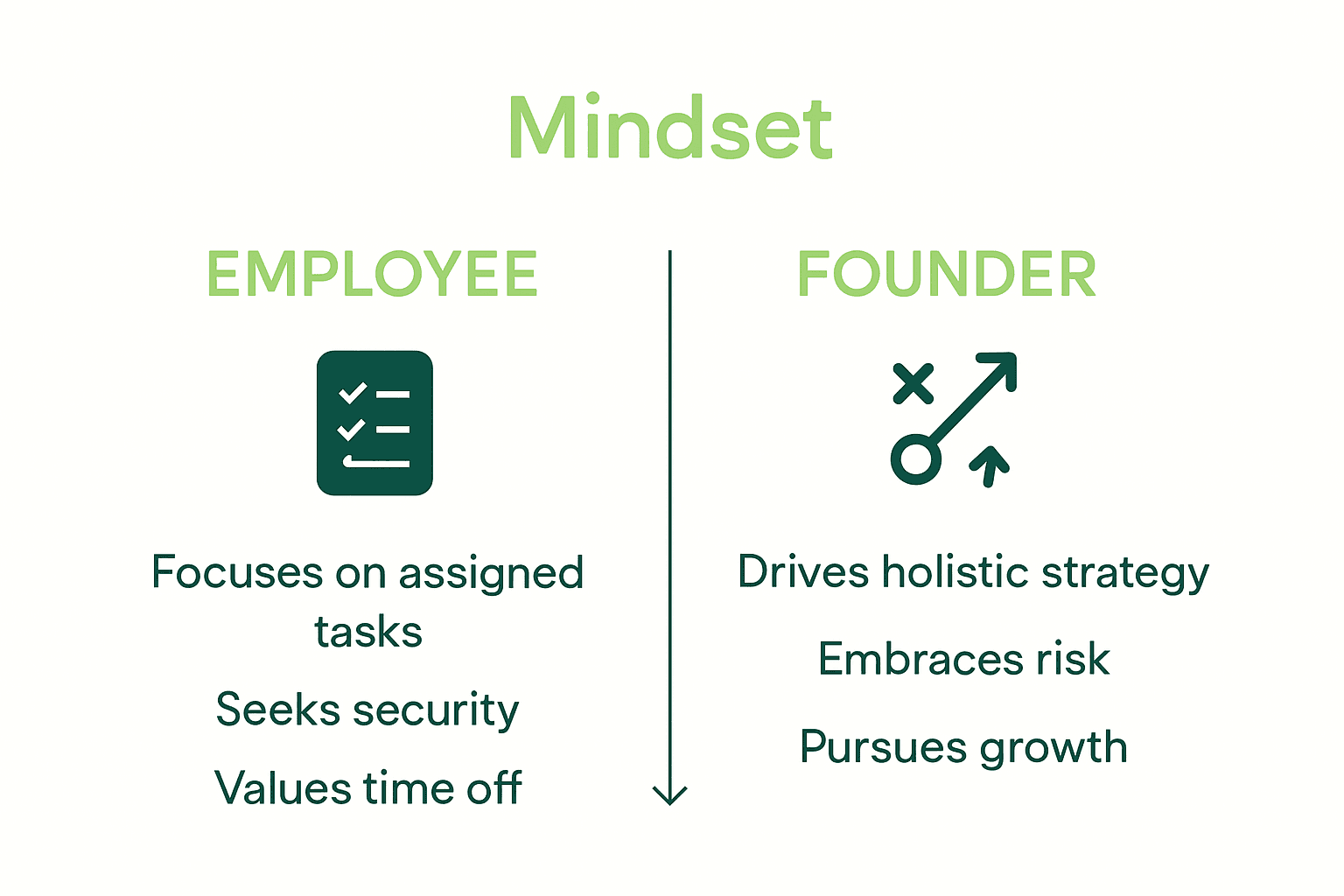
Bain research reveals critical differences between employee and founder mindsets that can dramatically impact organizational success. Understanding these distinctions is crucial for anyone aspiring to transition from an employee role to entrepreneurial leadership.
The core differences emerge in several key psychological and operational dimensions:
- Ownership Perspective: Employees typically focus on assigned tasks, while founders think about holistic business strategy and long term vision.
- Risk Tolerance: Employees seek stability, whereas founders embrace uncertainty and view challenges as opportunities for innovation.
- Decision Making: Employees often wait for direction, but founders proactively make strategic choices with limited information.
- Problem Solving: Employees solve immediate issues within defined parameters, while founders create systemic solutions that transform entire challenges.
According to global HR community research, the magic happens when these mindsets align. The key is not to eliminate differences but to understand and leverage the unique strengths each perspective brings.
Warning: Transitioning from an employee to a founder mindset requires fundamental psychological shifts. You must be willing to abandon comfort zones, embrace continuous learning, and develop an entrepreneurial identity that goes beyond traditional job descriptions.
This mindset transformation is your first critical step toward building a successful entrepreneurial journey.
Step 3: Explore What Drives Your Meaningful Work
Understanding the core motivations behind your entrepreneurial journey requires deep introspection and a nuanced approach to personal purpose. Research by Carol Dweck highlights how our mindset fundamentally shapes our perception of work and potential, making it crucial to explore what truly drives your professional aspirations.
To uncover your meaningful work, engage in a structured self exploration process:
- Reflect on Problems You Desperately Want to Solve
- Identify Experiences That Sparked Your Passion
- Recognize Skills Where You Feel Naturally Energized
- Examine Moments When You Lost Track of Time Working
- Consider the Impact You Want to Create Beyond Financial Success
Frontiers in Psychology research suggests that a growth mindset combined with understanding your personal strengths can dramatically enhance innovative behavior. This means your meaningful work emerges at the intersection of your unique capabilities, passionate interests, and potential to create genuine value.
Warning: Avoid the trap of chasing trendy industries or external validation. True meaningful work resonates from internal motivation and a genuine desire to solve significant challenges.
This exploration sets the foundation for identifying not just a business idea but a purpose driven entrepreneurial path that aligns with your deepest professional aspirations.
Step 4: Validate Founder-Market Fit with Your Strengths
Research from arXiv reveals a critical insight for entrepreneurs: successfully matching your unique strengths to market opportunities is more nuanced than simply having a good idea. Founder market fit requires a strategic alignment between your personal capabilities and the specific challenges within your chosen industry.
To validate your founder market fit, follow this systematic approach:
- Catalog Your Unique Professional Strengths
- Identify Market Problems Matching Those Strengths
- Conduct Deep Research on Potential Customer Pain Points
- Assess Your Technical and Emotional Competence in the Domain
- Create Preliminary Solution Prototypes That Leverage Your Expertise
Venture capital research suggests that certain founder characteristics dramatically increase startup success probability. This means your validation process should go beyond surface level market research and deeply explore how your personal attributes create a competitive advantage.
Warning: Founder market fit is not about forcing yourself into a market but discovering where your natural talents create meaningful solutions. Authenticity and genuine problem solving capability matter more than superficial trend chasing.
This validation process transforms your entrepreneurial journey from a speculative venture to a strategically aligned mission that maximizes your potential for success. Learn more about founder market fit concepts to refine your approach.
Step 5: Compare Opportunities Using Founder Intelligence Tools
Market Opportunity Navigator research provides a systematic framework for entrepreneurs to critically evaluate and select the most promising business opportunities. Understanding how to leverage intelligent tools can transform your decision making process from guesswork to strategic precision.
To effectively compare opportunities using founder intelligence tools, follow these strategic steps:
- Capture All Potential Market Opportunities
- Define Clear Evaluation Criteria
- Score Each Opportunity Against Multiple Dimensions
- Assess Market Size and Growth Potential
- Calculate Potential Return on Investment
- Evaluate Your Personal Competitive Advantage
Advanced research from arXiv introduces the Startup Success Forecasting Framework which combines machine learning and language models to predict startup potential. This means you can now use sophisticated technological tools to make more informed decisions about which opportunities are most likely to succeed.
Warning: While these tools provide incredible insights, they cannot replace your intuition and domain expertise. Always combine technological analysis with your personal understanding of the market and your unique capabilities.
By systematically comparing opportunities using intelligent tools, you transform your entrepreneurial approach from reactive to proactive. Explore the best AI tools for founders to enhance your decision making process.
Unlock Your Founder Mode with Smart, Step-by-Step Guidance
Are you ready to move beyond self-assessment and mindset shifts into real validation and growth? This article highlights key challenges founders face like aligning your unique strengths with the right market and using founder intelligence to compare opportunities objectively. If you feel overwhelmed by where to start or how to systematically launch your idea, you are not alone.
At siift.ai, we understand the emotional journey of transitioning from an employee mindset to full entrepreneurial ownership. Our intuitive AI platform helps you turn those founder traits into actionable steps with personalized feedback and new insights. By guiding you from ideation straight through validation and go-to-market strategy, siift.ai reduces risks that hold many founders back. Start using real tools that help you evaluate market fit, leverage your strengths, and choose the best opportunity without guesswork.
Take control of your founder mode today. Visit https://www.siift.ai/ and begin your smarter launch now. Don’t wait for clarity to come on its own — build it systematically with siift.ai and confidently bring your vision to life.
Frequently Asked Questions
How can I assess if I have founder material?
To assess if you have founder material, perform a self-audit focusing on key traits like risk tolerance, problem-solving skills, and resilience. Document your findings and reflect on how they align with your entrepreneurial aspirations.
What steps should I take to transition from an employee mindset to a founder mindset?
To transition from an employee mindset to a founder mindset, start by redefining your perspective on ownership and risk. Challenge yourself to take initiatives without waiting for direction, and actively seek opportunities to learn through failure and success.
How do I identify what drives my meaningful work?
Identify what drives your meaningful work by reflecting on problems you care about, skills that energize you, and experiences that sparked your passion. Write down your thoughts and look for common themes to guide your entrepreneurial goals.
What is founder-market fit and how can I validate it?
Founder-market fit means aligning your unique strengths with market opportunities. Validate it by cataloging your strengths, researching market problems that fit those strengths, and creating prototypes to address specific customer pain points.
How can I compare business opportunities effectively?
To compare business opportunities effectively, list all potential options and define clear evaluation criteria such as market size and growth potential. Score each opportunity against these criteria to identify which options are most promising and align best with your strengths.
What tools can help me make better entrepreneurial decisions?
Utilize founder intelligence tools that help you capture market opportunities and evaluate them based on defined criteria. Analyze each opportunity’s potential return on investment and your personal competitive advantage to guide your decision-making process.
Recommended
- blog | siift | Understanding Founder Mode: Your Guide to Entrepreneurship
- blog | siift | How to Find Cofounders in 2025: Proven Steps for Students & Innovators
- blog | siift | Understanding Founder Market Fit: Key Concepts Explained
- blog | siift | Founder Problems
- How to Develop a Brand Strategy for Business Growth
- 10 ChatGPT Prompts for Entrepreneurial Self-Discovery: Your 2025 Growth Guide | Kickass Online