

Over 60 percent of american startups stumble during their first two years, often because the early steps are rushed or unclear. Laying a solid foundation through careful planning sets you apart in a world where competition is fierce and resources are limited. This guide breaks down practical steps so you can move forward with confidence from idea to launch, ensuring your business stands on stable ground right from the start.
Table of Contents
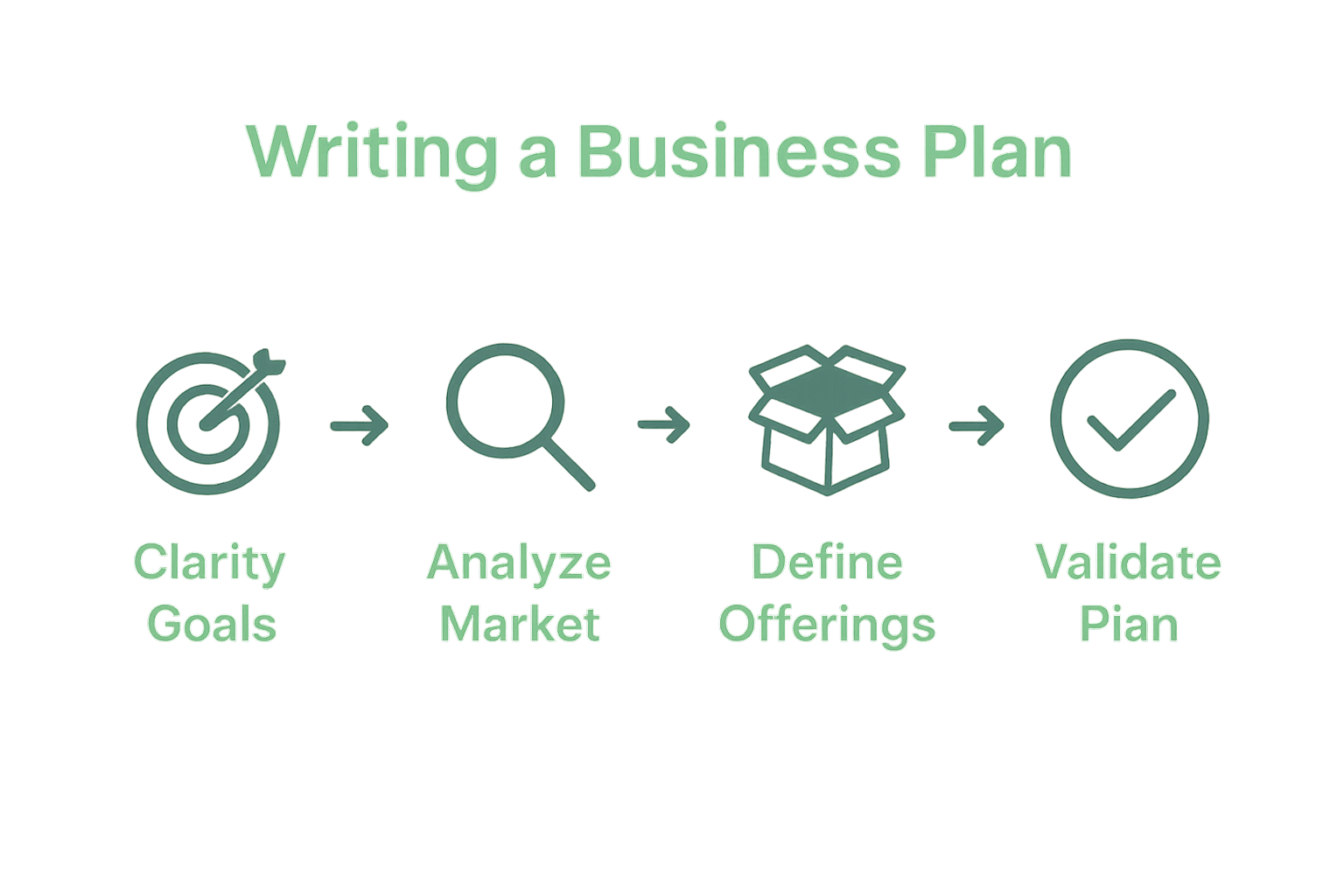
- Step 1: Clarify Your Business Idea and Goals
- Step 2: Analyze Market Needs and Potential
- Step 3: Define Products, Services, and Solutions
- Step 4: Map Out Operations and Revenue Streams
- Step 5: Validate Plan for Real-World Readiness
Quick Summary
| Key Point | Explanation |
|---|---|
| 1. Clarify Business Goals | Clearly define your business idea and set short, medium, and long-term goals to guide your journey. |
| 2. Conduct Thorough Market Research | Analyze your target market and competitors to validate your business idea and identify unique opportunities. |
| 3. Define Your Offerings Clearly | Clearly detail the products or services you will provide, focusing on their value and how they solve customer problems. |
| 4. Develop a Robust Operational Blueprint | Create a detailed plan mapping operations and potential revenue streams to ensure sustainable business growth. |
| 5. Validate Your Business Concept | Use feedback loops and external analysis to test your business plan and make necessary adjustments based on real-world insights. |
Step 1: Clarify Your Business Idea and Goals
Turning your entrepreneurial vision into a tangible business requires crystal clear goals and a well-defined idea. According to research from arxiv, successful entrepreneurs need an AI-empowered scaffold system that helps align their business concepts with precise learning objectives.
Starting with radical clarity means dissecting your core business concept into its most fundamental elements. Ask yourself: What specific problem does my business solve? Who exactly are my target customers? What unique value will I provide that differentiates me from existing solutions? Understanding Idea vs Opportunity becomes critical here the moment you start mapping out your business framework.
Research from uitm.edu.my highlights that a robust business plan allows entrepreneurs to objectively evaluate their proposed ventures and define strategic pathways. Break down your goals into three clear categories: short term (3-6 months), medium term (6-18 months), and long term (18-36 months). Each goal should be specific, measurable, actionable, relevant, and time bound. This systematic approach transforms abstract ideas into concrete milestones that guide your entrepreneurial journey.
Pro tip: Always validate your business idea with potential customers before investing significant resources. Conduct interviews, create landing pages, or develop minimum viable prototypes to gather real world feedback and refine your concept.
Step 2: Analyze Market Needs and Potential
Understanding your market is the foundation of a successful business strategy. According to research from cals.ncsu.edu, estimating market potential requires a systematic approach that involves defining target markets, analyzing competition, and carefully assessing overall market size to validate your business idea.
Start by conducting comprehensive market research that goes beyond surface level insights. Business Opportunity Analysis for First-Time Founders can help you dig deeper into understanding customer needs. Map out your ideal customer profile by considering demographics, psychographics, pain points, and purchasing behaviors. What problems are they experiencing that your business could solve? Where do current market solutions fall short?
Research from NerdWallet emphasizes that a thorough market analysis helps entrepreneurs identify potential barriers to entry, understand competitive landscapes, and recognize critical regulatory requirements. Develop a competitive matrix that compares your proposed solution against existing alternatives. Analyze competitors strengths and weaknesses, pricing strategies, market positioning, and potential gaps you can uniquely fill.

Pro tip: Validate your market research through direct customer interviews, surveys, and prototype testing. The most successful businesses are built on deep understanding of real customer needs and willingness to solve genuine problems.
Step 3: Define Products, Services, and Solutions
Transforming your business idea into concrete products and services requires strategic thinking and precise definition. According to Wikipedia, the Business Model Canvas provides an essential strategic management template that helps entrepreneurs define their value proposition, infrastructure, customer relationships, and financial framework.
Start by articulating the core problems your products or services will solve. Business SWOT Analysis Guide can help you map out your unique value proposition. Break down your offering into specific features, benefits, and differentiators. Consider how your solution addresses customer pain points in ways that existing market alternatives cannot. What makes your approach innovative? How will you deliver exceptional value?
Research from arxiv highlights the importance of analyzing economic feasibility by integrating business processes with service dominant models. Develop a detailed description of each product or service that includes pricing strategy, delivery mechanism, scalability potential, and long term development roadmap. Ensure your offerings are not just theoretically sound but practically executable.
Pro tip: Create minimum viable prototypes or service blueprints that allow you to test and refine your concepts before full scale development. The most successful businesses iterate rapidly based on real world feedback and customer insights.
Step 4: Map Out Operations and Revenue Streams
Designing a robust operational framework is critical for transforming your business concept into a sustainable venture. According to Wikipedia, a comprehensive feasibility study helps entrepreneurs assess the practicality of their project by examining operational and financial aspects that determine potential business success.
Begin by creating a detailed operational blueprint that outlines every critical process in your business. Business Canvas Model 2025 can help you visualize the key components of your business infrastructure. Map out your core workflows, identify necessary resources, personnel requirements, technology infrastructure, and potential supply chain dynamics. Consider both current operational needs and scalability potential for future growth.
Research from Wikipedia suggests using multifactorial analysis to evaluate your product portfolio and potential market opportunities. Develop multiple revenue stream strategies that diversify your income sources. This might include direct product sales, subscription models, licensing, consulting services, or affiliate partnerships. Calculate potential revenue projections, break even points, and profit margins for each stream. Ensure your financial model demonstrates both immediate monetization potential and long term sustainable growth.
Pro tip: Build financial flexibility into your operational plan. The most adaptable businesses can quickly pivot their revenue strategies in response to market changes and emerging opportunities.
Step 5: Validate Plan for Real-World Readiness
Transitioning from theoretical business planning to practical execution requires rigorous validation of your concept. According to research from arxiv, entrepreneurs success hinges on their ability to leverage knowledge and social networks to recognize genuine business opportunities and validate their strategic approach.
Begin by conducting a comprehensive external analysis that goes beyond surface level assumptions. Master Business Idea Validation can provide insights into thorough validation techniques. Use Wikipedia PEST analysis to systematically evaluate political, economic, social, and technological factors that could impact your business. Assess potential regulatory challenges, market trends, technological disruptions, and socioeconomic conditions that might influence your venture.
Develop a structured validation process that includes multiple feedback loops. Create minimum viable prototypes, conduct targeted customer interviews, run small scale pilot tests, and gather quantitative and qualitative data. Seek feedback from potential customers, industry experts, and mentors who can provide unbiased perspectives. Look for consistent patterns in the feedback that validate or challenge your initial assumptions. Be prepared to iterate and adapt your business plan based on real world insights.
Pro tip: Embrace radical candor during validation. The most successful founders view criticism as a gift that helps refine their business model rather than a personal attack.
Turn Your Business Plan Into Action with Confidence
Writing a business plan for the first time can feel overwhelming. The article highlights key challenges such as defining clear goals, analyzing market needs, and validating ideas in real-world settings. You need more than just theory — you need a systematic way to break down complex tasks, get personalized feedback, and avoid blind spots that commonly trip up new founders.
That is where siift.ai Intelligent Business Canvas comes in. This AI-powered platform helps you transform every step of your business plan into a focused, actionable strategy. From understanding whether your idea can truly become an opportunity to mastering business idea validation, siift.ai guides you with clear insights and prioritized tasks.
Don’t leave your founder’s journey to chance. Take control now with the top modern strategy platform designed for first-time founders. Visit siift.ai to start de-risking your business idea and confidently build a plan that leads to real success.
Frequently Asked Questions
What are the key components of a business plan for first-time founders?
A business plan should include an executive summary, market analysis, an overview of products or services, financial projections, and an operations plan. Start by outlining each section to create a structured framework for your plan, allowing you to focus on specific details over time.
How do I analyze market needs when writing my business plan?
To analyze market needs, conduct thorough market research to understand your target customers and competition. Identify customer pain points and assess how your offerings will meet those needs—this can help you validate your business idea and refine your strategies.
What steps should I take to validate my business idea before finalizing my plan?
Begin by creating a minimum viable product or prototype and conduct customer interviews to gather feedback. Collect data on potential customers’ reactions to your idea, allowing you to make informed adjustments to your business plan.
How can I set achievable goals in my business plan?
Divide your goals into short-term (3-6 months), medium-term (6-18 months), and long-term (18-36 months) objectives, ensuring they are specific, measurable, actionable, relevant, and time-bound. Create clear milestones for each timeframe to help track your progress effectively.
What should I consider when mapping out operations in my business plan?
Evaluate key processes, necessary resources, staff requirements, and technology needs that will support your business operations. Develop a detailed operational framework that accommodates scalability and flexibility to adapt as your business grows.
How do I incorporate financial projections into my business plan?
Include a financial model that outlines your revenue streams, cost structure, and projected profits over time. Use historical data or conduct market analysis to create realistic estimates; ensure you assess break-even points and potential profit margins to demonstrate viability.
Recommended
- blog | siift | Business Plan Essentials 2025: A Beginner’s Guide for New Founders
- blog | siift | Business Opportunity Analysis for First-Time Founders 2025
- blog | siift | Top Business Grants for Startups (2025): A Simple Guide
- blog | siift | What Is a Business Model? Simple Guide for Future Entrepreneurs 2025