

Did you know that nearly 20 percent of small businesses fail within their first year? Finding your purpose and knowing your audience is often the difference between lasting success and a quick stumble. Every strong business plan builds on these basics, shaping clear strategies that connect with real needs and spark genuine interest. This practical guide will help you define your direction and set the stage for business growth with confidence.
Table of Contents
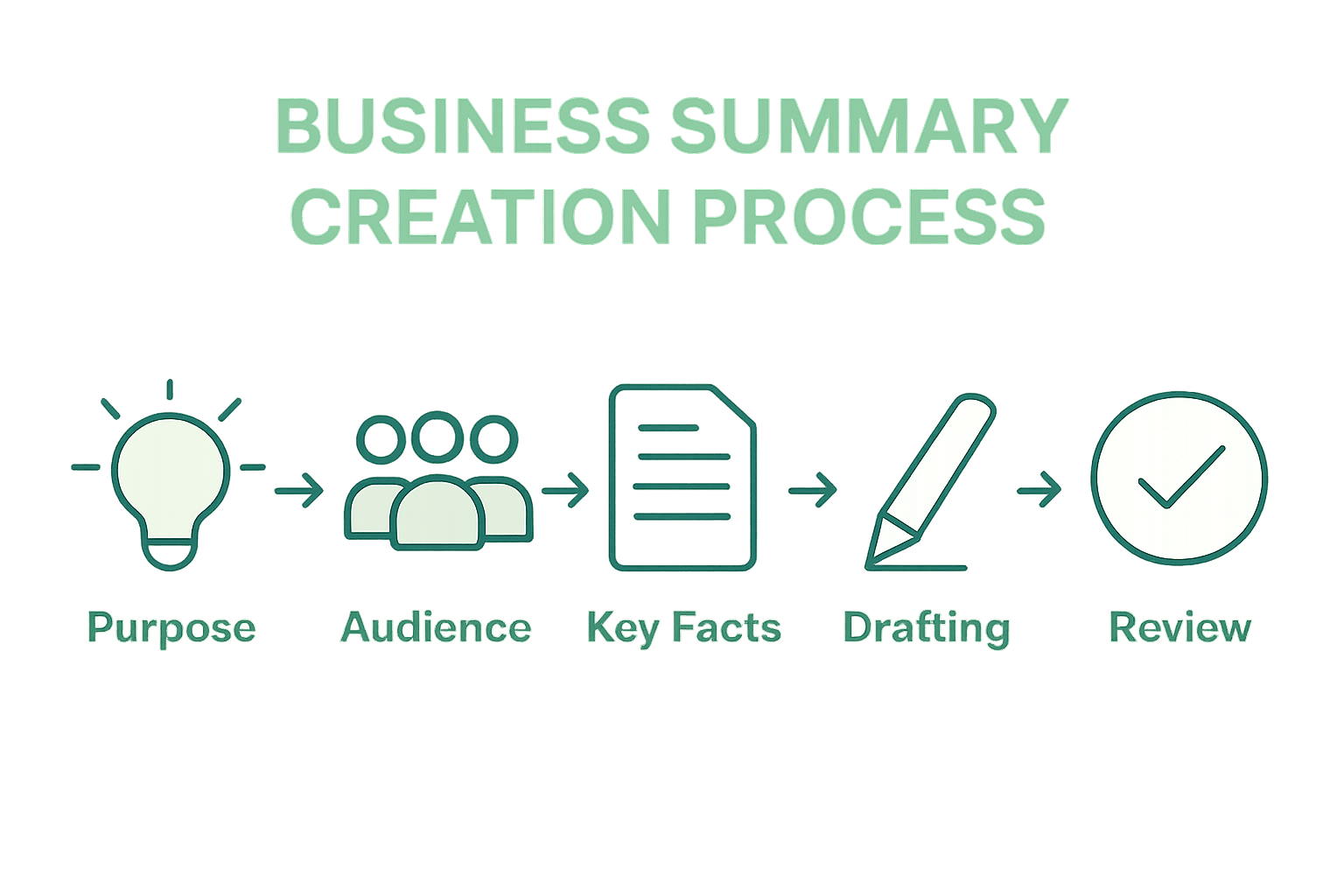
- Step 1: Identify Your Business Purpose And Audience
- Step 2: Organize Key Business Facts And Value Proposition
- Step 3: Draft A Concise Business Summary Statement
- Step 4: Refine Your Summary For Clarity And Impact
- Step 5: Review And Validate Your Business Summary
Quick Summary
| Key Point | Explanation |
|---|---|
| 1. Define your business purpose clearly | Establish a clear and valuable purpose to guide your business strategy and decision-making process. |
| 2. Understand your target audience deeply | Conduct thorough research to create detailed audience personas that outline their needs and challenges. |
| 3. Craft a unique value proposition | Develop a distinct value proposition that communicates how your business solution differs from competitors. |
| 4. Write a concise business summary | Create a succinct business summary that effectively encapsulates your core value and attracts interest. |
| 5. Validate your summary continuously | Regularly review and refine your summary based on feedback to ensure clarity and relevance to your audience. |
Step 1: Identify your business purpose and audience
Successfully launching a business starts with crystal clear purpose and audience identification. This crucial first step will set the foundation for everything that follows in your entrepreneurial journey.
According to research from Academique, determining your business purpose involves clarifying your core intent. Ask yourself fundamental questions: Are you solving a specific problem? Creating innovative solutions? Filling a market gap? Your purpose should be more than making money - it needs to represent genuine value for your potential customers.
Understanding your target audience requires deep research and empathy. As insights from Business University of Oregon suggest, you must evaluate their demographics, background knowledge, interests, and goals. Create detailed audience personas that go beyond basic demographics. What keeps your potential customers up at night? What challenges do they face that your business could solve?
Pro tip: Don’t try to appeal to everyone. The most successful businesses target a specific, well-defined audience. Narrow your focus and become exceptional at serving that particular market segment. Finding Your Niche in 2025: A Guide for New Entrepreneurs can help you refine this critical aspect of your business strategy.
Once you’ve clarified your purpose and audience, you’re ready to move to the next crucial step: validating your business idea against real market needs.
Step 2: Organize key business facts and value proposition
Now that youve defined your business purpose and audience, its time to crystalize your business concept by organizing key facts and crafting a compelling value proposition. This step transforms your initial insights into a structured blueprint for your entrepreneurial vision.
According to Wikipedia, the Business Model Canvas provides an excellent strategic management template for outlining essential business elements. Think of this as your business roadmap. You will want to capture critical components like your unique value proposition, target customer segments, distribution channels, and potential revenue streams. Break down each aspect systematically making sure every element connects logically and supports your overall business strategy.
A powerful value proposition is your business differentiator. As defined by Wikipedia, this is a clear statement identifying the specific benefits customers will receive from your product or service. Your value proposition should answer three key questions: What problem are you solving? How are you solving it differently from competitors? Why should customers choose you? Be direct, specific, and focus on tangible outcomes. Business Canvas Model 2025: Simple Guide for New Entrepreneurs can provide additional insights into crafting this critical component.
Pro tip: Avoid generic statements. Your value proposition must be unique, specific, and instantly communicative. Think laser focused clarity that makes potential customers sit up and take notice. A great value proposition feels like its speaking directly to your audiences most pressing needs.
With your key business facts and value proposition organized, youre now ready to validate your concept and prepare for the next stages of business development.

Step 3: Draft a concise business summary statement
Writing a compelling business summary statement is about distilling your entire business concept into a clear powerful snapshot that immediately captures attention and communicates your core value. Think of it as your business elevator pitch condensed into a few critical sentences.
According to research from Academique, drafting an effective summary requires determining the documents purpose and identifying your target audience. Your summary should be laser focused on communicating exactly what makes your business unique and valuable. Start by answering these fundamental questions: What problem does your business solve? Who are you solving it for? What makes your solution different from existing alternatives?
Insights from Business University of Oregon emphasize the importance of understanding your audiences background knowledge and goals when crafting your statement. Aim for clarity and concision. Your summary should be understandable to someone with zero prior knowledge about your business. Avoid industry jargon technical language or overly complex explanations. Business Plan Essentials 2025: A Beginner’s Guide for New Founders can provide additional guidance on refining your approach.
Pro tip: Treat your business summary like a movie trailer. You want to spark curiosity excitement and just enough intrigue to make someone want to learn more. Typically aim for three to four sentences that pack a punch and leave your reader wanting additional details.
Once youve drafted your business summary statement youre ready to start building out a more comprehensive business plan that brings your vision to life.
Step 4: Refine your summary for clarity and impact
Refining your business summary is like polishing a rough diamond transforming a good draft into a brilliant statement that captures the essence of your entrepreneurial vision. This step is about elevating your summary from basic description to a compelling narrative that truly resonates with your target audience.
According to Business University of Oregon, enhancing clarity and impact requires carefully evaluating the context and purpose while focusing intensely on understanding your audiences background knowledge and goals. This means ruthlessly eliminating any language that doesnt directly serve your core message. Read your draft out loud and ask yourself: Would someone completely unfamiliar with my business immediately understand what Im trying to communicate?
Research from Academique emphasizes ensuring that your documents purpose remains crystal clear and targeted. To achieve this, try the three filter test. First filter: Does this sentence explain what problem youre solving? Second filter: Does this explain how youre uniquely solving it? Third filter: Would this make someone want to learn more? If any sentence fails these tests remove or rewrite it. Your goal is a summary so sharp and compelling that it creates instant curiosity.
Pro tip: Get feedback from people who are not in your industry. If they cant explain your business back to you after reading your summary youve got more work to do. Clarity trumps cleverness every single time.
With a refined summary in hand youre now prepared to create a more comprehensive business plan that will serve as your strategic roadmap.
Step 5: Review and validate your business summary
Validating your business summary is the critical checkpoint that transforms your draft from a personal vision into a credible roadmap that can withstand external scrutiny. This is where you stress test your concept and ensure your summary is not just well written but strategically sound.
According to Business University of Oregon, reviewing your summary requires rigorously evaluating the context and purpose while focusing intensely on understanding how your audience will perceive and interact with your message. This means conducting a comprehensive review that goes beyond simple grammar and spelling checks. Ask yourself hard questions: Does this summary truly communicate the unique value of my business? Would a potential investor or customer find this compelling?
Research from Academique emphasizes the importance of ensuring your documents purpose remains crystal clear and precisely targeted. To validate effectively, seek feedback from diverse perspectives What Is Business Validation? A Simple Guide for New Founders recommends gathering input from mentors potential customers and peers who can provide objective insights. Look for patterns in their feedback and be prepared to make strategic revisions.
Pro tip: The best summaries are living documents. Dont view validation as a one time event but an ongoing process of refinement. Your business summary should evolve as your understanding of the market and your own concept deepens.
With a validated business summary you are now equipped to move forward confidently in developing a comprehensive business strategy.
Take Your Business Summary From Idea to Impact
Writing a clear and compelling business summary is a huge challenge for many new founders. As the article highlights, capturing your unique value and speaking directly to your target audience can feel overwhelming. If you want to avoid common pitfalls like unclear messaging or generic statements, you need structured guidance that keeps your purpose front and center.
That is where siift.ai can make a difference. Our founder’s intelligence platform walks you through each step of refining your business summary with personalized AI-powered feedback. You get actionable insights tailored to your specific market, helping you avoid blind spots and communicate with confidence. From clarifying your value proposition to validating your concept, siift.ai arms you with the tools to craft a summary that resonates and motivates.
Ready to transform your business summary into a powerful foundation for success? Visit siift.ai now to begin your step-by-step journey from idea to launch. Don’t let a vague summary hold you back. Get expert help today and make your entrepreneurial vision impossible to ignore.
Frequently Asked Questions
How do I start writing my business summary as a new founder?
Begin by clearly defining your business purpose and target audience. Outline what problem your business solves and who it serves, and then condense this information into a few impactful sentences.
What key elements should I include in my business summary?
Your business summary should include the problem your business solves, your target audience, and what sets your solution apart from the competition. Focus on creating a statement that is clear and compelling, aiming for three to four concise sentences.
How can I ensure my business summary resonates with my audience?
To resonate with your audience, understand their background and needs. Draft your summary, then share it with a few individuals outside your industry to gather feedback on clarity and impact.
What are common mistakes to avoid when writing a business summary?
Avoid using jargon and overly complex language that might alienate potential readers. Focus on clarity and directness, ensuring that each sentence serves a purpose related to your core message.
How often should I revise my business summary?
You should revisit and revise your business summary regularly, especially as your business evolves and you gain more insights about your audience. Schedule to review your summary every 3-6 months or after significant business changes.
How long should my business summary be?
Aim for your business summary to be around three to four sentences long. This length allows you to convey essential information succinctly while keeping the reader’s attention.
Recommended
- blog | siift | Business Plan Essentials 2025: A Beginner’s Guide for New Founders
- blog | siift | Business Opportunity Analysis for First-Time Founders 2025
- blog | siift | Business SWOT Analysis Guide 2025: Simple Steps for Beginners
- blog | siift | How to Pitch Ideas in 2025: A Guide for Aspiring Founders
- What Are The Essential Components of a Business Plan
- Owner-Led AI Adoption Tips for Small Businesses — Average Robot