
Most American startups fail not from lack of ambition but because critical business assumptions go unchecked. In a world where over 90 percent of new ventures never reach sustainable growth, founders crave smarter guidance and real-time support. The Intelligent Business Canvas uses advanced AI to give American entrepreneurs adaptive strategies, sharper feedback, and personalized insights so they can avoid common pitfalls and build ventures grounded in validated market needs.
Table of Contents
- Understanding the Intelligent Business Canvas
- AI-Driven Business Building Process Explained
- Personalized Feedback and De-Risking Your Startup
- Avoiding Blindspots and Common Founder Pitfalls
- Integrating External AI Tools and Agents
Key Takeaways
| Point | Details |
|---|---|
| AI-Powered Insights | The Intelligent Business Canvas utilizes AI to provide real-time feedback, enabling founders to validate assumptions and adapt business models dynamically. |
| Collaborative Approach | The methodology treats AI as a digital co-founder, fostering a symbiotic relationship between technology and human creativity. |
| Continuous Learning | Founders are guided through imagination shaping, reality testing, and rapid iteration, promoting a cycle of ongoing improvement. |
| Strategic Feedback | Personalized insights help entrepreneurs identify blindspots and mitigate risks, transforming challenges into manageable tasks. |
Understanding the Intelligent Business Canvas
The Intelligent Business Canvas represents a revolutionary approach to startup strategy, transforming traditional business modeling with AI-powered insights and continuous adaptation. Unlike static business plan templates, siift’s platform dynamically helps founders navigate complex entrepreneurial landscapes by providing real-time guidance and intelligent feedback.
At its core, the Intelligent Business Canvas is designed to solve a critical problem many entrepreneurs face: building businesses based on assumptions rather than validated market needs. By integrating AI-driven process optimization techniques, the platform enables founders to systematically deconstruct their ideas, challenge underlying assumptions, and develop more resilient business models. The system goes beyond simple template filling - it actively prompts users to think deeply about each business model component, offering contextual suggestions and potential blindspot alerts.
Key features that distinguish siift’s Intelligent Business Canvas include:
- Continuous Validation: Real-time market feedback integration
- Assumption Tracking: Persistent monitoring of core business hypotheses
- Adaptive Insights: Dynamic recommendations based on emerging data
- Collaborative AI: Guides founders without removing human agency
The platform’s patent-pending technology represents more than just a digital tool - it’s an intelligent co-founder that keeps entrepreneurs focused, honest, and strategically aligned. By maintaining human creativity at the center while providing sophisticated AI guidance, siift empowers founders to build viable businesses with unprecedented clarity and precision.
AI-Driven Business Building Process Explained
The AI-driven business building process represents a transformative approach to entrepreneurship, moving far beyond traditional linear business planning. At its core, this methodology reimagines how founders develop and validate their business concepts by leveraging advanced artificial intelligence technologies that provide dynamic, real-time insights and guidance.
Exploring the entrepreneurial transformation framework reveals a critical three-stage process that AI enables: imagination shaping, reality testing, and reality scaling. Unlike conventional startup methodologies, this approach treats AI as a digital co-founder, continuously challenging assumptions and providing nuanced feedback. The process isn’t about replacing human creativity but amplifying it through intelligent, data-driven perspectives that help founders make more informed decisions.
Key stages of the AI-driven business building process include:
- Imagination Shaping: Using AI to refine and stress-test initial business concepts
- Reality Testing: Systematically validating market assumptions and potential challenges
- Rapid Iteration: Quickly adapting business models based on emerging insights
- Continuous Learning: Integrating feedback loops that evolve with the business
The platform’s approach emphasizes a human-centered framework for responsible AI implementation, ensuring that technological capabilities complement rather than replace human entrepreneurial intuition. By combining sophisticated AI analysis with founder creativity, this process creates a symbiotic environment where technology serves as a strategic partner, helping entrepreneurs navigate complex business landscapes with unprecedented clarity and precision.
Personalized Feedback and De-Risking Your Startup
Personalized feedback represents the critical differentiator between successful startups and those destined to fail. In the unpredictable landscape of entrepreneurship, founders need more than generic advice - they require nuanced, contextual insights that address their specific business challenges and potential blindspots.

Examining the digital transformation strategies for risk mitigation reveals that AI-powered personalized feedback can fundamentally transform how entrepreneurs approach business development. By leveraging advanced algorithms that analyze market trends, competitive landscapes, and individual business models, founders can receive targeted recommendations that go beyond traditional mentorship or generic business guides.
Key components of effective startup de-risking include:
- Predictive Analysis: Identifying potential market challenges before they become critical
- Assumption Mapping: Systematically challenging underlying business hypotheses
- Continuous Validation: Real-time feedback mechanisms that adapt with your business
- Objective Insights: Unbiased recommendations based on data-driven intelligence
The ultimate goal of personalized feedback is not to replace human intuition but to augment it. Exploring human-AI collaboration techniques demonstrates that the most powerful approach combines technological insights with human creativity, creating a symbiotic relationship where AI serves as a strategic partner in navigating complex entrepreneurial landscapes. This approach transforms potential risks from insurmountable obstacles into manageable challenges, giving founders unprecedented clarity and confidence in their business journey.
Avoiding Blindspots and Common Founder Pitfalls
Startup failure isn’t just a possibility - it’s a statistical probability that haunts most entrepreneurs. The difference between success and failure often lies not in extraordinary talent, but in the ability to systematically identify and navigate potential business blindspots before they become catastrophic problems.
Understanding organizational development through constructive approaches reveals that successful founders don’t just avoid mistakes - they proactively build systems that transform potential weaknesses into strategic opportunities. This requires a nuanced approach that goes beyond traditional risk management, focusing instead on systematic self-reflection and continuous learning.
Common founder blindspots typically emerge in several critical areas:
- Market Validation: Falling in love with an idea without rigorous customer research
- Financial Planning: Underestimating burn rates and overestimating initial revenue
- Scalability: Creating solutions that work in small environments but cannot expand
- Team Dynamics: Neglecting interpersonal relationships and communication structures
Developing high-performing business processes through strategic AI implementation demonstrates that technology can be a powerful ally in identifying potential blindspots. By leveraging intelligent systems that provide objective, data-driven insights, founders can create robust mechanisms for continuous improvement and risk mitigation. The key is maintaining human creativity and intuition while using AI as a sophisticated diagnostic and strategic planning tool.
Integrating External AI Tools and Agents
Integrating external AI tools and agents represents a transformative strategy for entrepreneurs seeking to amplify their strategic capabilities without building everything from scratch. Modern founders understand that leveraging specialized AI technologies can provide unprecedented competitive advantages, allowing them to access sophisticated capabilities that would traditionally require extensive internal development.
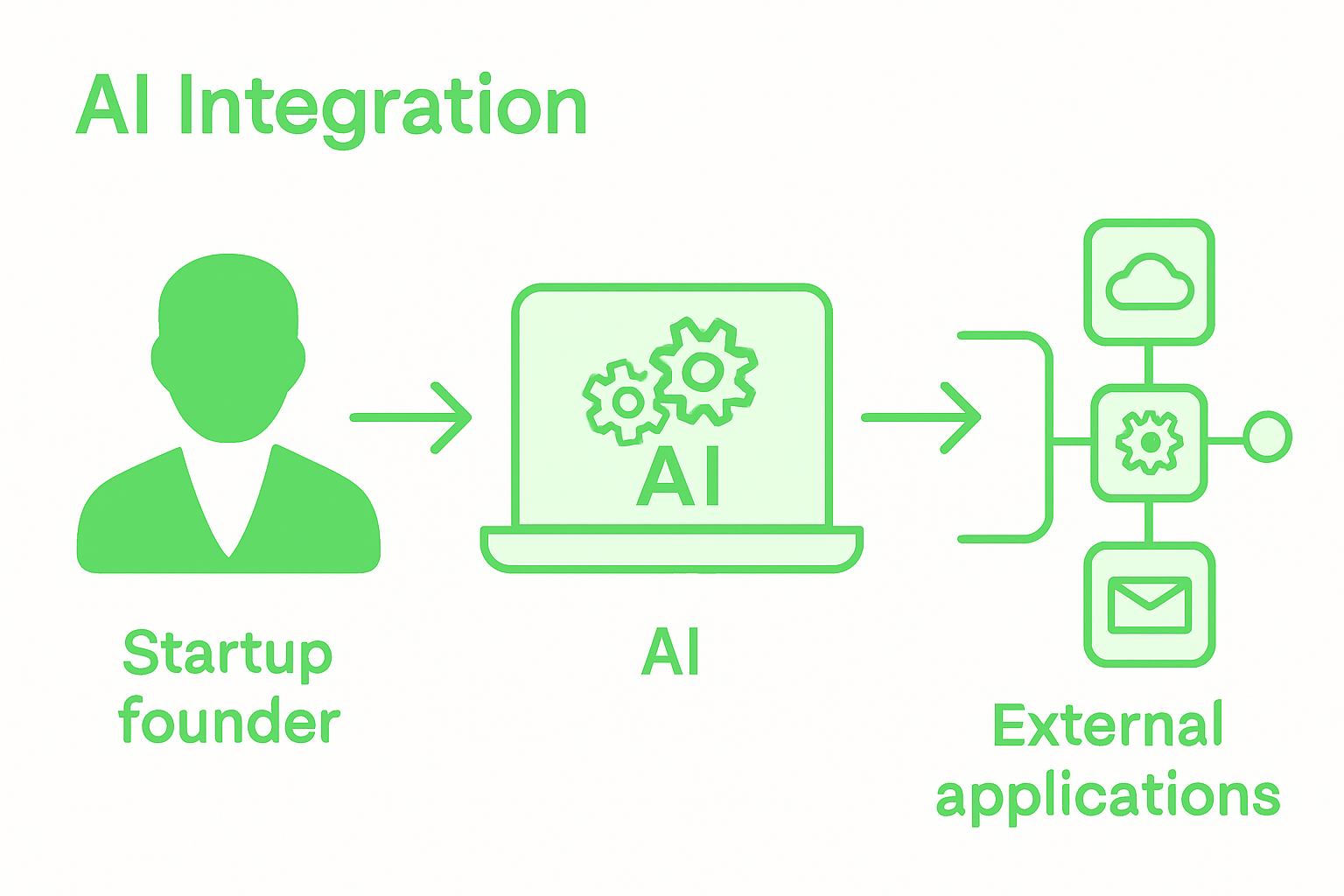
Exploring innovative approaches to technology integration reveals that successful technology adoption is less about collecting tools and more about creating a cohesive ecosystem where different AI agents can communicate and collaborate seamlessly. This requires a thoughtful approach that goes beyond simple tool stacking and focuses on strategic interoperability.
Key considerations for effective AI tool integration include:
- Compatibility: Ensuring tools can communicate and share data
- Workflow Optimization: Designing processes that leverage each tool’s strengths
- Security: Maintaining data privacy and protecting intellectual property
- Flexibility: Creating adaptable systems that can evolve with changing business needs
Understanding strategic resource composition and integration demonstrates that small teams can achieve remarkable outcomes by creatively combining external capabilities. The goal isn’t to replace human creativity but to create an intelligent infrastructure that amplifies founder insights, allowing entrepreneurs to focus on high-value strategic decisions while AI handles complex analytical and operational tasks.
Transform Your Startup Vision with AI-Powered Clarity
Building a viable business requires more than just passion and ideas—it demands continuous validation, risk reduction, and the ability to avoid common founder blindspots. The article highlights the challenges of assumption tracking, personalized feedback, and integrating AI as a strategic partner. If you are facing uncertainty around market validation or need real-time intelligent guidance to sharpen your business model, you are not alone.
At siift.ai, our Intelligent Business Canvas platform directly addresses these pain points. It offers an intuitive, step-by-step AI assistant that helps you validate your assumptions, get prioritized actions, and uncover potential blindspots before they hinder your progress. By blending human creativity with adaptive AI insights, siift provides a modern founder’s toolkit to de-risk your startup journey without any gatekeepers or bias.
Ready to turn your ideas into a viable business with confidence and clarity Visit siift.ai now and explore how our AI-driven business building process can guide you seamlessly from ideation to go-to-market. Don’t wait to build smarter with focused personalized feedback and continuous validation at your fingertips.
Frequently Asked Questions
What is the Intelligent Business Canvas?
The Intelligent Business Canvas is a dynamic startup strategy tool that utilizes AI-powered insights to help entrepreneurs develop and validate their business models in real-time, improving decision-making and reducing reliance on untested assumptions.
How does the AI-driven business building process work?
The AI-driven business building process involves three main stages: imagination shaping, reality testing, and reality scaling, enabling founders to refine their ideas, validate market assumptions, and rapidly adapt their business models based on data-driven insights.
What are the benefits of personalized feedback for startups?
Personalized feedback provides nuanced, contextual insights tailored to a startup’s unique challenges, helping founders identify potential risks, validate their ideas, and make informed decisions that can significantly reduce the likelihood of failure.
How can founders avoid common pitfalls and blindspots in their business?
Founders can avoid pitfalls by being proactive in systematizing market validation, financial planning, scalability, and team dynamics. Integrating AI tools can help diagnose potential blindspots and enhance self-reflection and continuous learning.