

Nearly 70 percent of startups struggle with wasted marketing spend before getting traction, yet many overlook a simple fix. When resources are tight, every marketing dollar matters. Minimum Viable Marketing offers a focused way to reach real customers, cut unnecessary costs, and help founders see faster results by testing what actually works.
Table of Contents
- Minimum Viable Marketing Defined and Explained
- Core Principles and Key Components
- Step-by-Step Minimum Viable Marketing Process
- Essential Channels and Tactics to Start
- Real-World Examples and Use Cases
- Common Pitfalls and How to Avoid Them
Key Takeaways
| Point | Details |
|---|---|
| Minimum Viable Marketing (MVM) | MVM is a strategic approach emphasizing targeted, cost-effective marketing by validating strategies with small audiences for continuous improvement. |
| Core Principles | MVM focuses on validation, incremental improvement, and selective channel selection to maximize marketing effectiveness while minimizing resource use. |
| Step-by-Step Process | The MVM process involves defining a clear brand story, launching small-scale experiments, collecting data, and optimizing based on feedback. |
| Common Pitfalls | Entrepreneurs should avoid metrics ambiguity, channel overload, and ignoring feedback to ensure effective execution of MVM strategies. |
Minimum Viable Marketing Defined and Explained
Minimum Viable Marketing (MVM) is a strategic approach that helps entrepreneurs and startups maximize their marketing efforts while minimizing resource expenditure. According to betterstory, it’s a streamlined methodology focused on executing essential marketing activities consistently to drive business growth without getting overwhelmed by numerous options and trends.
At its core, MVM is about smart, targeted marketing that prioritizes validation and incremental improvement. Digital Marketing Magazine highlights that this approach emphasizes testing marketing strategies with a small audience, gathering feedback, and gradually expanding successful elements. This process helps entrepreneurs:
- Reduce unnecessary marketing waste
- Achieve faster results
- Lower overall marketing costs
- Maintain flexibility in strategy
Thinking of MVM like a lean startup approach to marketing can help founders understand its power. Instead of creating complex, expensive marketing campaigns, you start small, measure results, learn quickly, and adapt. It’s about being strategic, not just busy. The goal is continuous improvement through targeted, data-driven iterations that help you understand what truly resonates with your potential customers. Learn more about business validation strategies in our comprehensive guide on idea validation.
Core Principles and Key Components
Minimum Viable Marketing operates on a set of strategic principles that differentiate it from traditional marketing approaches. Betterstory emphasizes that the core elements include crafting a compelling brand story, developing a focused converting website, and executing essential marketing activities with maximum impact.
According to Digital Marketing Magazine, the key principles revolve around validation, refinement, and strategic expansion. This means systematically testing marketing strategies with a small, targeted group and then iteratively improving based on real-world feedback. The core components typically include:
Here’s a summary of the core principles and key components of Minimum Viable Marketing:
| Principle/Component | Description | Why It Matters |
|---|---|---|
| Validation | Test strategies with a small audience | Reduces waste, speeds learning |
| Incremental Improvement | Refine based on feedback | Allows fast adaptation |
| Targeted Audience | Focus on ideal customer groups | Increases campaign effectiveness |
| Lean Content Strategy | Create simple, high-impact content | Saves time and resources |
| Data-Driven Feedback Loops | Use analytics to guide decisions | Improves accuracy and impact |
| Selective Channel Selection | Start with 2-3 essential marketing channels | Maximizes ROI, prevents overload |
- Targeted Audience Identification
- Lean Content Strategy
- Data-Driven Feedback Loops
- Incremental Marketing Experiments
- Cost-Efficient Channel Selection
The beauty of MVM lies in its adaptability and resource consciousness. Instead of investing massive budgets into untested marketing channels, entrepreneurs can start small, measure precisely, and scale strategically. This approach allows for rapid learning and minimizes financial risk.
IMAGE:descriptive_key_1] [Explore our guide on business idea validation to complement your MVM strategy, ensuring your marketing efforts align with genuine market demand.
Step-by-Step Minimum Viable Marketing Process
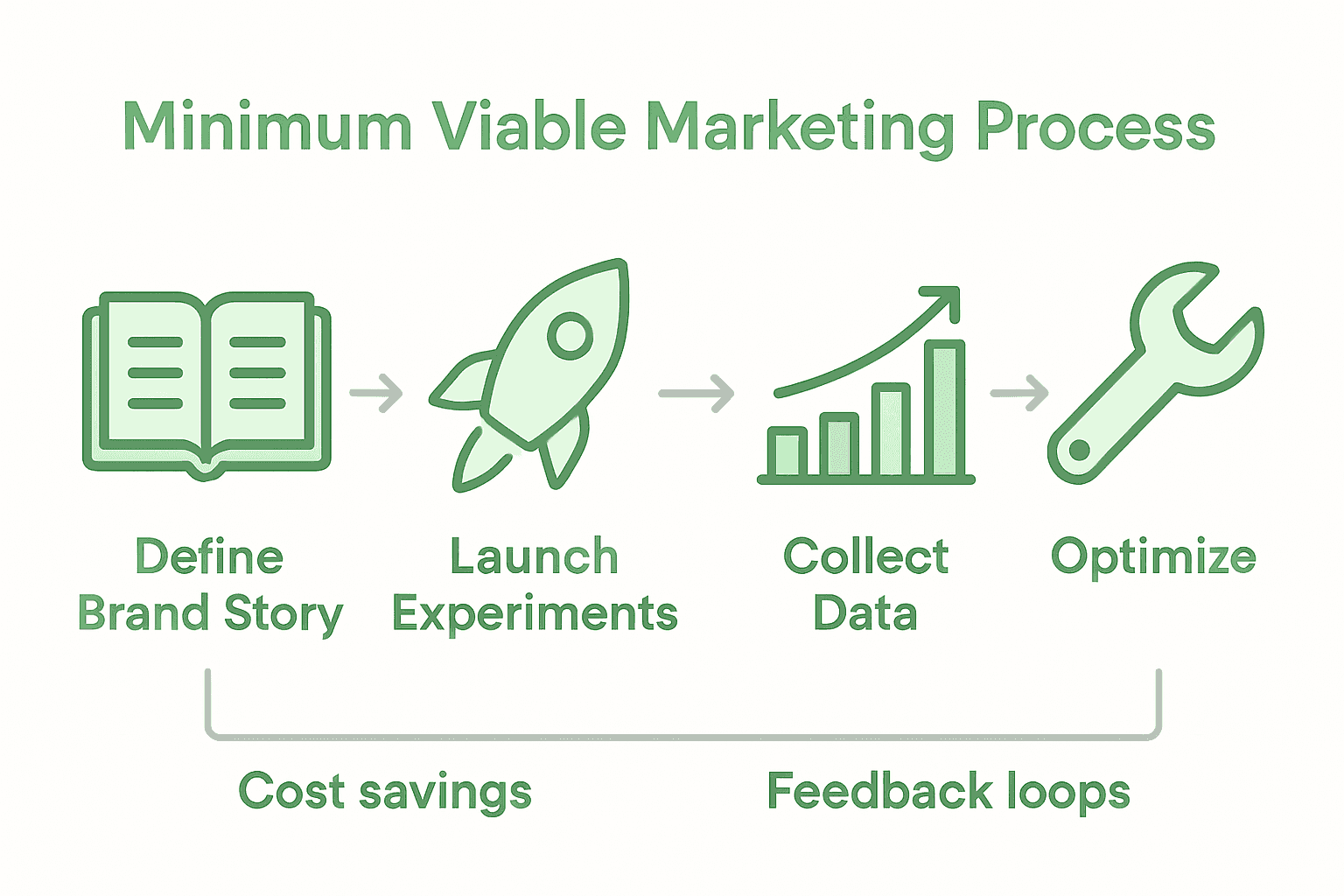
Minimum Viable Marketing demands a systematic approach to testing and refining marketing strategies. Digital Marketing Magazine outlines a clear process that involves validating marketing approaches with a small group, strategically discarding underperforming elements, and methodically expanding successful components.
According to Betterstory, the MVM process typically involves several critical stages:
- Define Clear Brand Story
- Create Focused Converting Website
- Identify Targeted Marketing Channels
- Launch Small-Scale Marketing Experiments
- Collect and Analyze Performance Data
- **Iterate and Optimize
 **
**
The process is fundamentally about learning and adapting quickly. Entrepreneurs start by developing a lean, targeted strategy that minimizes resource waste while maximizing potential insights. This approach allows for rapid experimentation and course correction.
Essential Channels and Tactics to Start
Minimum Viable Marketing prioritizes strategic channel selection over spreading resources thinly. Betterstory emphasizes focusing on core elements that deliver the highest return on investment, particularly a compelling brand story and a converting website.
Digital Marketing Magazine suggests testing new channels and tactics on a small scale to evaluate effectiveness. For most early-stage entrepreneurs, the most impactful channels typically include:
- Content Marketing: Blogging, YouTube tutorials
- Social Media: LinkedIn, Twitter for professional networks
- Email Marketing: Targeted, value-driven newsletters
- Search Engine Optimization (SEO): Organic content strategy
- Low-Cost Digital Advertising: Targeted social media and Google ads
The key is selective experimentation. Instead of trying to be everywhere, choose 2-3 channels where your target audience is most active and double down on creating high-quality, engaging content. Dive deeper into business validation strategies with our comprehensive guide to refine your marketing approach and maximize your initial efforts.
Real-World Examples and Use Cases
Minimum Viable Marketing transforms how startups and small businesses approach their marketing strategy. Digital Marketing Magazine highlights that MVM enables organizations to test radical new approaches without incurring massive campaign costs or risking alienation of target segments.
Betterstory emphasizes that MVM helps businesses grow by concentrating on the most impactful marketing activities. Consider these practical scenarios:
- Tech Startup Scenario: A software company launches a LinkedIn content series instead of expensive paid advertising, tracking engagement and refining messaging
- Freelance Consultant: Developing a targeted email newsletter to showcase expertise, using subscriber feedback to reshape service offerings
- E-commerce Brand: Creating Instagram Reels with product demonstrations, measuring view rates and conversion metrics
- Local Service Business: Implementing a Google My Business profile with strategic, value-driven posts to attract local customers
- Indie Product Launch: Using Twitter threads to explain product value and gather early user insights
The magic of MVM is its ability to transform limited resources into strategic marketing experiments. Explore our guide on business validation to further refine your marketing approach, ensuring every marketing dollar counts.
Common Pitfalls and How to Avoid Them
Minimum Viable Marketing requires precision and strategic thinking. Digital Marketing Magazine warns that the most critical pitfall is failing to measure results and evaluate performance against clear objectives. Without continuous measurement and learning, entrepreneurs risk wasting valuable resources.
Betterstory emphasizes the importance of focus, highlighting the dangers of spreading resources too thin across multiple channels. Here are the most common MVM traps to avoid:
- Lack of Clear Metrics: Not defining specific, measurable goals before launching marketing experiments
- Channel Overload: Trying to be active on every possible marketing platform simultaneously
- Ignoring Feedback: Failing to collect and incorporate audience insights
- Analysis Paralysis: Overanalyzing data instead of taking decisive action
- Inconsistent Execution: Launching sporadic marketing efforts without a consistent strategy
Successful MVM demands ruthless prioritization and a willingness to pivot quickly. Small, strategic experiments beat large, unfocused campaigns every time. Check out our guide on business validation to develop a more robust marketing approach, ensuring you stay focused and effective.
Discover Smarter Marketing with siift.ai
Struggling with how to make your marketing efforts truly effective without wasting time or money? The article on Minimum Viable Marketing highlights common challenges like validating strategies early, focusing on the right audience, and learning fast from real feedback. These are exactly the hurdles that can make or break a startup’s growth and can leave founders feeling overwhelmed or stuck.
siift.ai understands that your marketing journey begins with strong validation and lean experimentation. Our founder’s intelligence platform guides you step-by-step through ideation, validation, and launching your go-to-market strategy. By providing personalized feedback and prioritized actions, siift.ai helps you avoid channel overload and focus on what really works in your Minimum Viable Marketing approach.
Ready to turn your ideas into a compelling marketing strategy that resonates with your audience and drives real growth? Start now with siift.ai and explore how to validate your business ideas while avoiding common pitfalls. Don’t wait to transform uncertainty into confidence. Your smarter marketing journey begins here.
Frequently Asked Questions
What is Minimum Viable Marketing (MVM)?
Minimum Viable Marketing (MVM) is a strategic approach that emphasizes executing essential marketing activities in a streamlined manner. It focuses on validation and incremental improvement, helping businesses maximize their marketing efforts while minimizing resource expenditure.
How does Minimum Viable Marketing differ from traditional marketing approaches?
MVM differs from traditional marketing by prioritizing small-scale testing and feedback over large, expensive campaigns. It emphasizes data-driven iterations that allow businesses to learn quickly, adapt strategies, and reduce waste in their marketing efforts.
What are the key components of Minimum Viable Marketing?
The key components of MVM include validation through targeted audience testing, incremental improvement based on feedback, developing a lean content strategy, leveraging data-driven feedback loops, and careful channel selection to maximize return on investment.
How can I implement Minimum Viable Marketing in my business?
To implement MVM, define a clear brand story, create a focused and converting website, identify targeted marketing channels, launch small-scale experiments, collect and analyze performance data, and continuously iterate and optimize your strategies based on real-world feedback.
Recommended
- blog | siift | Master Business Idea Validation: Steps to Success in 2025
- blog | siift | Understanding Lean Startup Methodology for New Entrepreneurs
- blog | siift | Top Digital Product Ideas for Beginners in 2025
- blog | siift | Top Reasons Businesses Fail in 2025: A Guide for New Founders
- Mastering the Product Marketing Approach: Proven Strategies to Elevate Your Brand
- Understanding the Minimum Viable Website Concept - seo analytic