

More than 80 percent of the fastest-growing startups are built by teams instead of solo founders, highlighting the growing impact of multi-founder ventures. These partnerships let entrepreneurs tap into a wider pool of skills, networks, and ideas, making it easier to overcome challenges that might stop a single founder in their tracks. Unlocking the benefits of collaborative models means mastering new ways to split roles, balance projects, and handle risk while pushing your business forward.
Table of Contents
- Defining Multi-Founder Ventures and Core Models
- Founder Roles and Company Structures Compared
- Balancing Time, Focus, and Project Prioritization
- Legal, Financial, and Tax Considerations
- Common Pitfalls and Risk Mitigation Strategies
Key Takeaways
| Point | Details |
|---|---|
| Collaboration in Multi-Founder Ventures | Multi-founder ventures leverage strategic partnerships to enhance skills, networks, and resources, creating opportunities for growth and risk mitigation. |
| Dynamic Role Distribution | Successful multi-founder strategies involve careful balancing of roles and responsibilities, fostering collaboration while maintaining clear governance structures. |
| Effective Time Management | Successful entrepreneurs prioritize projects using frameworks like opportunity scoring and time-boxing to ensure effective engagement across multiple ventures. |
| Proactive Risk Management | Founders must anticipate challenges related to misalignment and resource management, implementing clear communication and governance strategies to navigate complexities effectively. |
Defining Multi-Founder Ventures and Core Models
Multi-founder ventures represent a strategic approach to entrepreneurship where two or more individuals collaborate to build and scale business initiatives together. According to prism, these collaborative models are characterized by strategic alliances between independent organizations, involving shared governance, resource pooling, and mutual risk distribution.
At their core, multi-founder models diverge from traditional solo entrepreneurship by creating synergistic partnerships where complementary skills, networks, and resources converge. Understanding how to effectively form these partnerships becomes critical for modern entrepreneurs seeking to maximize their startup’s potential. These ventures can take multiple structural forms:
- Parallel Ventures: Founders simultaneously develop multiple businesses
- Sequential Ventures: Founders build businesses sequentially, leveraging previous experiences
- Interconnected Ventures: Businesses share strategic resources or have symbiotic relationships
The fundamental strength of multi-founder strategies lies in risk mitigation and capability expansion. By distributing responsibilities across skilled partners, entrepreneurs can tackle more complex challenges, access broader networks, and potentially accelerate growth trajectories that would be challenging for individual founders to achieve independently.
Founder Roles and Company Structures Compared
Founder roles and company structures are dynamic ecosystems that require strategic alignment and intentional design. According to arxiv, successful startups excel by assembling novel combinations of modular organizational components, emphasizing the critical importance of flexible structural approaches in venture development.
In multi-founder ventures, role distribution becomes a nuanced art of balancing expertise, personality, and strategic vision. Choosing a business structure requires founders to consider several key organizational models:
- Complementary Role Structures: Founders with distinctly different skill sets
- Hierarchical Founder Models: Clear leadership with defined top-down responsibilities
- Collaborative Flat Structures: Equal decision-making power and shared accountability
Research from arxiv further illuminates the complexity of corporate networks, revealing that successful ventures leverage intricate multilayer connections through ownership links, board memberships, and strategic interdependencies. The most resilient multi-founder companies recognize that adaptable role definitions and transparent governance mechanisms are fundamental to navigating the unpredictable landscape of entrepreneurial ecosystems.
Balancing Time, Focus, and Project Prioritization
Multi-founder entrepreneurship demands sophisticated time management and strategic focus allocation across potentially competing ventures. According to arxiv, successful collaborative efforts leverage open collaboration principles that enable participants to manage time and priorities through loose coordination and shared strategic objectives.
Effective project prioritization requires founders to develop robust frameworks for decision-making and resource allocation. The most successful multi-venture entrepreneurs typically employ several key strategies:

- Opportunity Scoring: Systematically ranking projects based on potential impact, resource requirements, and strategic alignment
- Time-Boxing: Allocating specific time windows for each venture to prevent mission creep
- Parallel Processing: Developing complementary ventures that can leverage shared resources and expertise
Navigating founder challenges becomes critical when managing multiple simultaneous initiatives. The core challenge lies not in eliminating distractions, but in creating intentional systems that allow flexible yet disciplined engagement across different entrepreneurial efforts. Successful multi-founders treat their portfolio of ventures like a carefully curated investment strategy, continuously reassessing and reallocating time, energy, and resources based on evolving market opportunities and venture-specific momentum.
Legal, Financial, and Tax Considerations
Multi-founder ventures create complex legal and financial landscapes that require meticulous strategic planning. According to the private-collective model of innovation, entrepreneurs must carefully balance private investment with the broader implications of knowledge sharing and collaborative development.
Navigating the legal framework for multiple ventures demands sophisticated understanding of corporate structures, liability management, and tax optimization. Key considerations include:
- Entity Structure Selection: Choosing between LLC, C-Corp, or partnership models
- Ownership Distribution: Establishing clear equity agreements and ownership percentages
- Cross-Venture Liability Protection: Creating legal firewalls between different business entities
- Tax Optimization Strategies: Minimizing tax burden through strategic corporate planning
When to register a business becomes crucial in managing the legal complexities of multi-venture entrepreneurship. The triple helix model further illuminates the intricate interactions between entrepreneurial initiatives, emphasizing that successful multi-founder strategies require dynamic engagement with legal, financial, and regulatory ecosystems. Founders must develop adaptive frameworks that allow for strategic flexibility while maintaining rigorous compliance and financial discipline.
Common Pitfalls and Risk Mitigation Strategies
Multi-founder entrepreneurship presents a complex landscape of potential challenges that demand proactive and strategic risk management. According to the entrepreneurship ecosystem framework, success hinges on understanding the intricate interdependencies between various actors and their relationships in the entrepreneurial journey.
Founders navigating multiple ventures must anticipate and mitigate critical risks through comprehensive strategies:
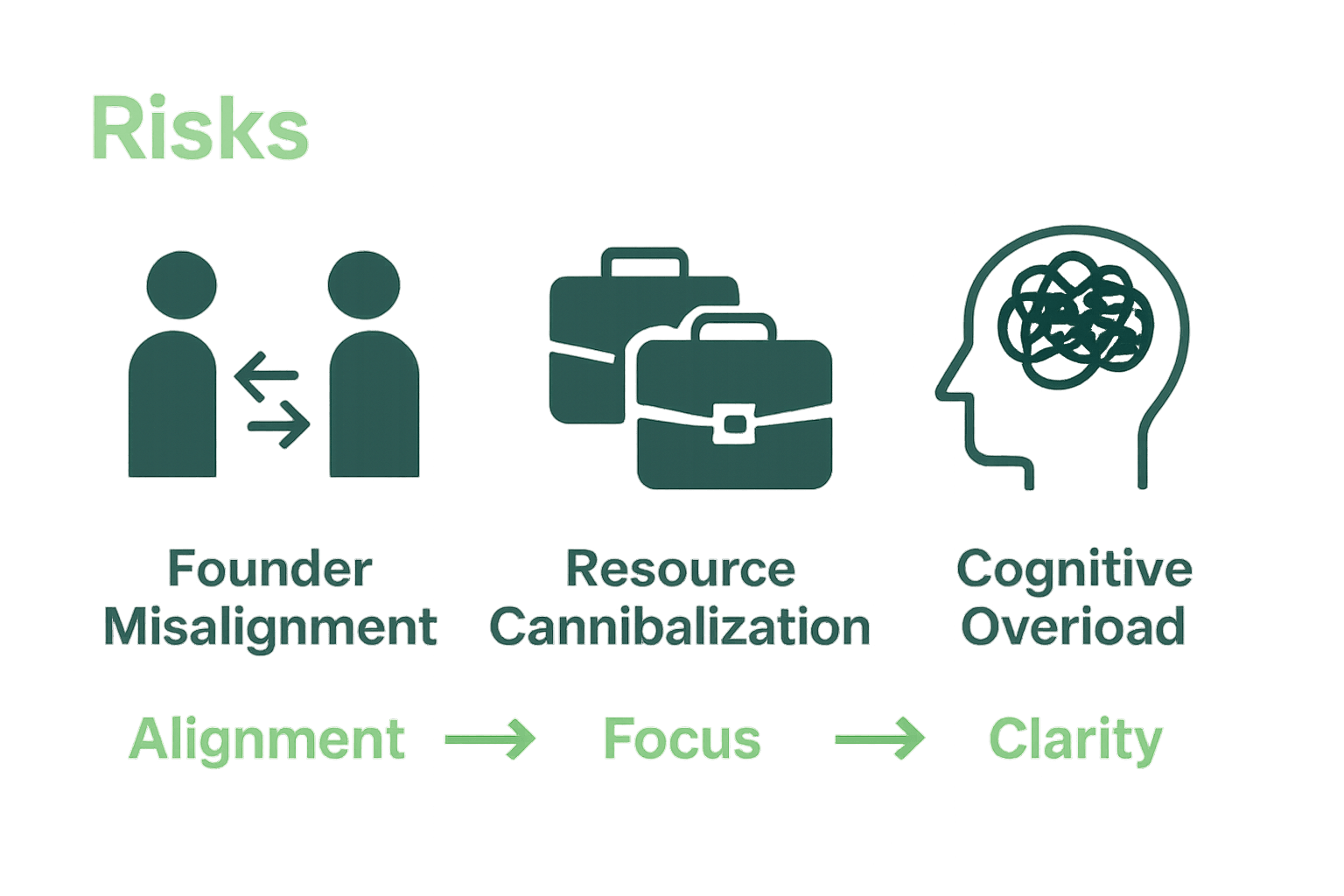
- Founder Misalignment: Establishing clear communication protocols and shared vision
- Resource Cannibalization: Implementing strict resource allocation and boundary management
- Emotional and Cognitive Overload: Developing personal resilience and delegation mechanisms
- Competitive Internal Dynamics: Creating transparent governance and conflict resolution frameworks
Understanding business risk becomes paramount in multi-venture strategies. The quadruple and quintuple innovation helix frameworks extend traditional risk management by incorporating broader ecological and societal considerations, emphasizing that successful risk mitigation transcends traditional financial and operational boundaries. Effective multi-founders develop adaptive ecosystems that can rapidly recalibrate strategies, redistribute resources, and maintain operational flexibility in the face of unpredictable market dynamics.
Unlock Success Across Multiple Ventures with Smart Strategy
Building multiple companies as described in the article presents unique challenges like balancing time, prioritizing projects, and defining founder roles. These critical pain points can create uncertainty and overwhelm even the most driven entrepreneurs. By using concepts like opportunity scoring and collaborative structures, founders can mitigate risks and maximize growth potential. But turning these ideas into actionable plans requires guidance that adapts to your evolving ventures.
That is where siift.ai Intelligent Business Canvas comes in. This cutting-edge AI platform offers personalized feedback and prioritized actions that help you map out your multi-founder ventures clearly and confidently. Whether you are juggling intersecting projects or aligning founder expertise, our step-by-step system de-risks your journey by giving you new insights without bias or pressure. Ready to manage your ventures with precision and turn complex strategies into real-world success? Explore how to choose a business structure that supports your multi-venture goals and learn when to register a business to protect your efforts.
Take control today and start building your multi-founder empire with confidence by visiting siift.ai. Your best business strategies begin here.
Frequently Asked Questions
What are multi-founder ventures?
Multi-founder ventures are collaborative business initiatives where two or more individuals work together to build and scale enterprises. These models feature shared governance, resource pooling, and mutual risk distribution.
How do founders manage time across multiple ventures?
Successful multi-venture entrepreneurs use strategies like opportunity scoring, time-boxing, and parallel processing to effectively manage their time and prioritize projects across different businesses.
What are some common legal considerations for multi-founder ventures?
Key legal considerations include entity structure selection (like LLC or partnership), ownership distribution and equity agreements, cross-venture liability protection, and tax optimization strategies to manage the complexities of multiple business entities.
What are some pitfalls to avoid in multi-founder entrepreneurship?
Common pitfalls include founder misalignment, resource cannibalization, emotional and cognitive overload, and competitive internal dynamics. Establishing clear communication, resource management, and conflict resolution mechanisms can help mitigate these risks.