
Roughly 80 percent of startups change their product or strategy before finding lasting success. Pivots like these often spark debate and stress among founders, yet they are rarely signs of failure. In reality, knowing when and how to pivot often separates startups that fizzle out from those that thrive. By clearing up myths and recognizing early signals for change, entrepreneurs can turn tough decisions into powerful growth opportunities.
Table of Contents
- Defining Startup Pivot And Common Myths
- Recognizing Key Signs A Pivot Is Needed
- Types Of Startup Pivots And Small Shifts
- Iterative Experimentation And Feedback Loops
- How Business Aspects Interconnect Systematically
- Enhancing Pivot Success With siift.ai Platform
Key Takeaways
| Point | Details |
|---|---|
| Understanding Pivots | Startups should view pivots as strategic opportunities for adaptation, not as failures. They reflect a deliberate response to market conditions and can enhance business resilience. |
| Indicators for Pivoting | Firms must pay attention to signs such as declining user engagement and negative feedback, which may indicate a need for strategic changes. Effective pivots can be triggered by measurable data, not just intuition. |
| Types of Pivots | Entrepreneurs should explore different pivot types—including customer need and technology pivots—to refine their business offerings strategically. Small adjustments can lead to significant improvements in market fit and growth potential. |
| Embracing Iteration | The startup journey relies on ongoing experimentation, where iterative feedback and Minimum Viable Products (MVPs) are crucial for learning and adaptation. Founders must remain flexible and open to change for optimal success. |
Defining Startup Pivot And Common Myths
A startup pivot represents a strategic redirection where entrepreneurs fundamentally modify their business concept, product offering, or core elements of their business model. According to research from understanding startup methodology, a pivot isn’t a failure but a calculated experiment to test new hypotheses about growth and market potential.
Contrary to popular belief, pivots aren’t emergency maneuvers signaling imminent collapse. As research from Greylock notes, pivots are actually an “integral part of the entrepreneurial process” - a natural mechanism for adaptation rather than a sign of strategic weakness. Successful founders view pivots as strategic learning opportunities, not setbacks.
Key characteristics of an effective startup pivot include:
- Maintaining core business values
- Leveraging existing resources and relationships
- Quickly testing new market assumptions
- Minimizing disruption to current operations
- Responding to genuine market signals, not temporary fluctuations
Understanding pivots requires recognizing them as deliberate, structured course corrections. They represent intelligent responses to evolving market conditions, not desperate last-resort tactics. By remaining flexible and data-driven, entrepreneurs transform potential challenges into strategic advantages.
Recognizing Key Signs A Pivot Is Needed
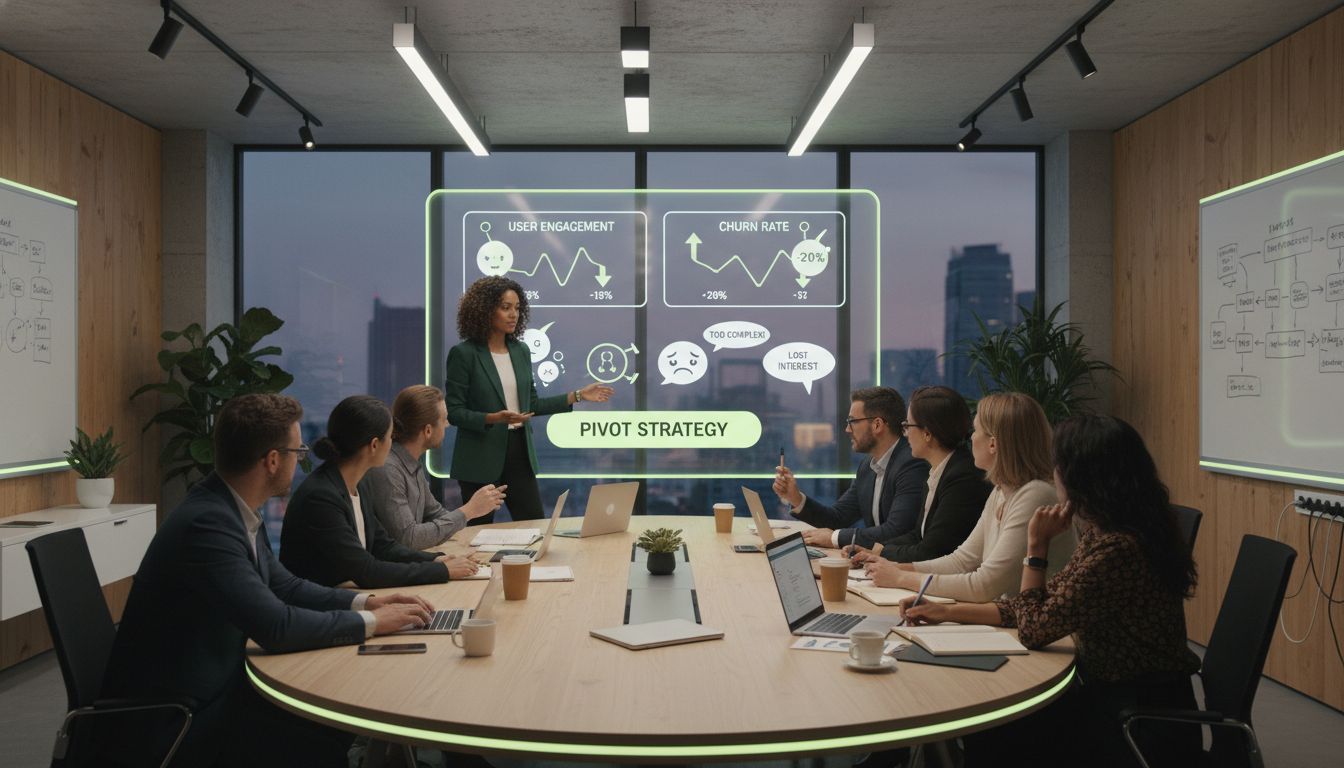
Recognizing the right moment to pivot is a critical skill for entrepreneurs. Customer feedback emerges as a primary indicator that something might need changing. According to research from what is a business pivot, negative customer reactions can signal fundamental flaws in your current business approach that demand strategic recalibration.
Startups should pay close attention to several key warning signs that suggest a potential pivot might be necessary. These include consistently low conversion rates, diminishing user engagement, customer churn above industry benchmarks, and revenue models that fail to generate sustainable income. Research indicates that flawed business models often become apparent through persistent market resistance or inability to achieve meaningful traction.
Critical signs a pivot might be needed include:
- Stagnant or declining user growth
- High customer acquisition costs
- Lack of product market fit
- Repeated negative user feedback
- Inability to differentiate from competitors
Successful pivoting isn’t about wholesale reinvention but strategic refinement. By maintaining a data-driven approach and staying attuned to market signals, entrepreneurs can transform potential setbacks into opportunities for meaningful innovation and growth.
Types Of Startup Pivots And Small Shifts
Startup pivots are rarely dramatic overhauls but more often strategic small shifts that refine a business’s core approach. According to research exploring startup methodologies, pivots come in multiple nuanced forms, with the startup success stories highlighting the importance of understanding these variations.
Research indicates several primary pivot types entrepreneurs might consider. The customer need pivot emerges as the most common, where startups adjust their product to more precisely address genuine market requirements. Other significant pivot types include customer segment pivots (changing target audience), zoom-in pivots (focusing on a specific feature), technology pivots (reimagining the underlying technical approach), and market zoom-in pivots (narrowing market focus).
Key pivot types to consider:
Here’s a comparison of common startup pivot types and their strategic focus:
| Pivot Type | Strategic Focus | Example Trigger |
|---|---|---|
| Customer Need Pivot | Align with actual user problems | Persistent negative user feedback |
| Customer Segment Pivot | Target new customer group | Lack of traction with current users |
| Zoom-In Pivot | Emphasize single feature | One feature outshines entire product |
| Technology Pivot | Change technical approach | Emerging disruptive technologies |
| Market Zoom Pivot | Focus on niche market | Broad appeal failing to convert |
| Side Project Pivot | Elevate secondary project | Side project shows rapid growth |
- Customer Need Pivot: Redesigning product to match real user requirements
- Customer Segment Pivot: Shifting target audience
- Zoom-In Pivot: Concentrating on a single product feature
- Technology Pivot: Changing technical implementation
- Market Zoom Pivot: Narrowing market focus
- Side Project Pivot: Transforming a secondary project into primary business
Successful pivoting isn’t about massive transformation but intelligent, incremental adaptation. By remaining flexible and closely observing market signals, entrepreneurs can make precise adjustments that dramatically improve their startup’s trajectory and potential for sustainable growth.
Iterative Experimentation And Feedback Loops
The startup journey is fundamentally an ongoing experiment, where entrepreneurs continuously test and refine their business hypotheses. By leveraging idea validation techniques, founders can transform uncertainty into strategic insight through systematic learning and adaptation.
Research highlights the critical role of Minimum Viable Products (MVPs) in this process. These streamlined initial versions allow entrepreneurs to gather real-world customer feedback quickly and cost-effectively. The goal isn’t perfection but learning - each iteration provides valuable data points that inform subsequent product development and strategic decisions.
Key components of effective iterative experimentation include:
- Rapidly creating low-fidelity prototypes
- Establishing clear hypothesis tests
- Collecting quantitative and qualitative feedback
- Measuring customer response objectively
- Implementing swift, decisive adjustments
- Maintaining psychological flexibility
Successful iteration requires embracing uncertainty as an opportunity. Entrepreneurs who view their startup as a continuous learning experiment, rather than a fixed blueprint, position themselves to discover unexpected opportunities and navigate market complexities with remarkable agility and resilience.
How Business Aspects Interconnect Systematically
Startups function as intricate ecosystems where every component influences another, creating a complex interdependent network. Understanding these systematic connections is crucial, especially when considering strategic shifts. By exploring business network dynamics, entrepreneurs can map out how changes in one area ripple across the entire organizational structure.
Research reveals that business aspects are not isolated elements but interconnected systems where modifications in one domain trigger cascading effects. Customer segments, revenue models, value propositions, and operational strategies are deeply intertwined. A seemingly minor adjustment in product positioning, for instance, can simultaneously impact marketing approaches, customer acquisition costs, and long-term growth trajectories.
Key interconnected business aspects include:
- Value Proposition and Customer Segments
- Revenue Model and Market Positioning
- Operational Efficiency and Customer Experience
- Product Features and Pricing Strategy
- Marketing Channels and Customer Acquisition
- Technical Infrastructure and Scalability
Successful entrepreneurs view their business as a living, breathing system. By recognizing these intricate connections, they can make precise, strategic adjustments that optimize performance across multiple dimensions, transforming potential challenges into opportunities for holistic growth.
Enhancing Pivot Success With siift.ai Platform
Navigating the complex landscape of startup pivots requires more than intuition - it demands strategic intelligence and systematic approach. By leveraging AI tools for founders, siift.ai transforms the traditionally unpredictable pivot process into a structured, data-driven journey of strategic discovery.
The platform’s unique Founder’s Compass systematically deconstructs entrepreneurial challenges by providing personalized insights that help founders understand their business ecosystem. Unlike traditional advisory platforms, siift.ai uses advanced AI to analyze multiple business dimensions simultaneously, identifying potential pivot opportunities and potential risks before they become critical.
Key capabilities of siift.ai’s pivot enhancement approach include:
- Real-time business model analysis
- Personalized pivot recommendation engine
- Hypothesis testing and validation tools
- Comprehensive market signal tracking
- Strategic scenario modeling
- Unbiased AI-powered feedback
What sets siift.ai apart is its commitment to empowering founders with intelligent, actionable insights. By transforming complex entrepreneurial challenges into clear, manageable steps, the platform ensures that pivots become opportunities for growth rather than moments of uncertainty.
Navigate Your Startup Pivot with Confidence Using siift.ai
Facing the challenge of when and how to pivot your startup can feel overwhelming. The article highlights key pain points like recognizing negative customer feedback, low user engagement, and flawed business models that call for a strategic shift. Understanding pivot types such as Customer Need Pivots or Market Zoom Pivots requires not just insight but also a guided, data-driven approach to avoid costly missteps.
That is where siift.ai becomes your essential partner. Our intuitive AI platform offers a personalized, step-by-step process to validate ideas, experiment iteratively, and receive clear pivot recommendations. You gain real-time analysis and market signal tracking that help you make informed adjustments with confidence. Don’t let uncertainty stall your progress. Explore how founder intelligence turns complex pivot decisions into actionable growth opportunities. Ready to transform your startup journey? Visit siift.ai now and take decisive action toward your next success.
Frequently Asked Questions
What is a startup pivot?
A startup pivot is a strategic redirection where entrepreneurs fundamentally modify their business concept, product offering, or core elements of their business model to better meet market needs and opportunities.
When should a startup consider pivoting?
A startup should consider pivoting when it experiences consistently low conversion rates, high customer acquisition costs, negative user feedback, or an inability to achieve product-market fit.
What are the different types of startup pivots?
Common types of startup pivots include customer need pivots, customer segment pivots, zoom-in pivots, technology pivots, market zoom pivots, and side project pivots, each addressing specific adjustments in strategy or focus.
How can startups use feedback loops to improve their pivot strategy?
Startups can use feedback loops by creating Minimum Viable Products (MVPs) to gather real-world customer feedback quickly, allowing for rapid iteration and refinement of business hypotheses based on actual market responses.
Recommended
- blog | siift | What is a Business Pivot? Understanding Its Importance
- blog | siift | Startup Success Stories: Real Paths to Business Wins 2025
- blog | siift | Top Growth Strategies for Startups in 2025: Practical Steps for Beginners
- blog | siift | 10 Essential Habits of Successful Entrepreneurs Explained
- Transform42 New
- 7 Essential Types of Business Websites Every Entrepreneur Should Know