
Most advice around product validation misses the mark, and that struggle hits aspiring American entrepreneurs just as hard as their international peers. The reality is that over 40 percent of founders fail to secure true product-market fit before running out of steam. For urban millennials hoping to launch a standout business with limited experience, identifying real customer demand feels like a maze. This guide cuts through confusion and shows how practical AI-driven methods can help you validate if your idea is one your market truly needs.
Table of Contents
- What Is Product-Market Fit Really About
- Different Approaches to Validating Fit
- Critical Signs of Real Market Demand
- Using Customer Feedback and Data Smartly
- Common Validation Pitfalls to Avoid
Key Takeaways
| Point | Details |
|---|---|
| Achieving Product-Market Fit | Focus on deep market research and continuous customer validation to ensure your product meets genuine market needs. |
| Utilizing Mixed Validation Methods | Combine qualitative and quantitative approaches to gain comprehensive insights into customer preferences and product viability. |
| Observing Market Demand Indicators | Track metrics like customer retention, organic growth, and unsolicited referrals to assess true market demand for your solution. |
| Leveraging Customer Feedback | Create structured feedback loops that integrate qualitative and quantitative insights to enhance your product continually. |
What Is Product-Market Fit Really About
Product-market fit represents the critical alignment between a product’s capabilities and a market’s genuine needs. At its core, this concept defines the moment when your solution becomes an essential must-have for customers, rather than just another nice-to-have option. Successful entrepreneurs understand that product-market fit goes beyond simply creating something functional - it means developing a solution that solves a specific problem so effectively that customers cannot imagine operating without it.
Understanding product-market fit requires deep market research and continuous customer validation. Typically, entrepreneurs reach this milestone when at least 40% of potential users express they would be deeply disappointed if the product disappeared. This metric reveals not just interest, but genuine customer dependency. Critically, product-market fit looks different for every business - what works for a software startup might dramatically differ from a physical product company.
The journey to achieving product-market fit involves persistent iteration, active customer listening, and willingness to pivot. Successful founders spend significant time understanding their target audience’s pain points, testing hypotheses, and refining their offering based on real-world feedback. Metrics like customer retention rates, user engagement, and organic growth become key indicators of whether you have truly solved a meaningful market problem.
Pro tip: Conduct at least 20-30 customer interviews before finalizing your product design to ensure you are solving a genuine market need and not just building something you personally find interesting.
Different Approaches to Validating Fit
Validating product-market fit requires a strategic blend of qualitative and quantitative research methods. Entrepreneurs can leverage multiple approaches to comprehensively assess potential market demand and product viability. Companies typically start by creating minimum viable products (MVPs) to test consumer reactions, which allows for rapid iteration and direct customer feedback before significant resource investment.

Qualitative techniques provide deep insights into customer needs and preferences. Founders can conduct in-depth interviews, ethnographic studies, and focus groups to understand underlying motivations and pain points. These methods go beyond surface-level survey responses, revealing nuanced perspectives about how potential customers might interact with a product. Market research techniques help uncover emotional and practical drivers that quantitative data might miss.
Quantitative validation methods offer empirical evidence of potential market success. Market research techniques like surveys, concept testing, and conjoint analysis help estimate precise market demand. Advanced approaches such as heat-testing online advertisements can provide real-world interest indicators, often more reliable than traditional survey responses. These methods help founders quantify potential market size, understand pricing sensitivity, and validate core product hypotheses.
Pro tip: Combine at least two validation methods—such as customer interviews and online concept testing—to create a more comprehensive understanding of your product’s market potential.
Compare common qualitative and quantitative validation methods:
| Validation Method | Type | Main Advantage | Typical Limitation |
|---|---|---|---|
| Customer Interviews | Qualitative | Deep insights into needs | May be subjective |
| Surveys | Quantitative | Data from large samples | Responses can lack context |
| Concept Testing | Quantitative | Estimates market reaction | May miss emotional drivers |
| Ethnographic Studies | Qualitative | Reveals true user behavior | Time-intensive process |
Critical Signs of Real Market Demand
Identifying genuine market demand requires a nuanced understanding of multiple economic and behavioral indicators. Real market demand is fundamentally driven by complex interactions between consumer income levels, preferences, and broader economic conditions, making it critical for entrepreneurs to look beyond surface-level metrics.
Several key signs indicate authentic market demand for a product or service. Customer acquisition cost becomes a primary signal, with low acquisition costs and high retention rates suggesting strong product-market alignment. Founders should also track leading indicators like organic user growth, unsolicited customer referrals, and repeat purchase rates. When potential customers voluntarily recommend your solution without direct incentives, it signals genuine value and market resonance.
Beyond quantitative metrics, qualitative signals provide crucial insights into market demand. Observe whether customers are willing to prepay for your product, invest time in providing detailed feedback, or make meaningful behavioral changes to integrate your solution. Passionate early adopters who actively engage with your product and provide constructive suggestions represent a powerful validation of potential market demand. These enthusiasts often become your most valuable product development partners, offering insights that traditional market research might miss.
Pro tip: Track your customer acquisition metrics closely, focusing on organic growth rates and unsolicited referrals as more reliable indicators of true market demand than traditional marketing conversion rates.
Here’s a summary of key metrics for assessing real product-market fit:
| Metric | What It Measures | Why It Matters |
|---|---|---|
| Customer Retention | Percentage of repeat users | Indicates consistent real value |
| Organic Growth Rate | Growth without paid marketing | Shows genuine demand and appeal |
| Unsolicited Referrals | Customers recommending freely | Reveals authentic enthusiasm |
| Prepayment Willingness | Customers paying before launch | Demonstrates strong market trust |
Using Customer Feedback and Data Smartly
Customer feedback is the lifeblood of product development, transforming raw insights into strategic improvements. Creating deliberate customer data feedback loops enables firms to continuously enhance their products through intelligent data collection, turning every customer interaction into an opportunity for refinement.
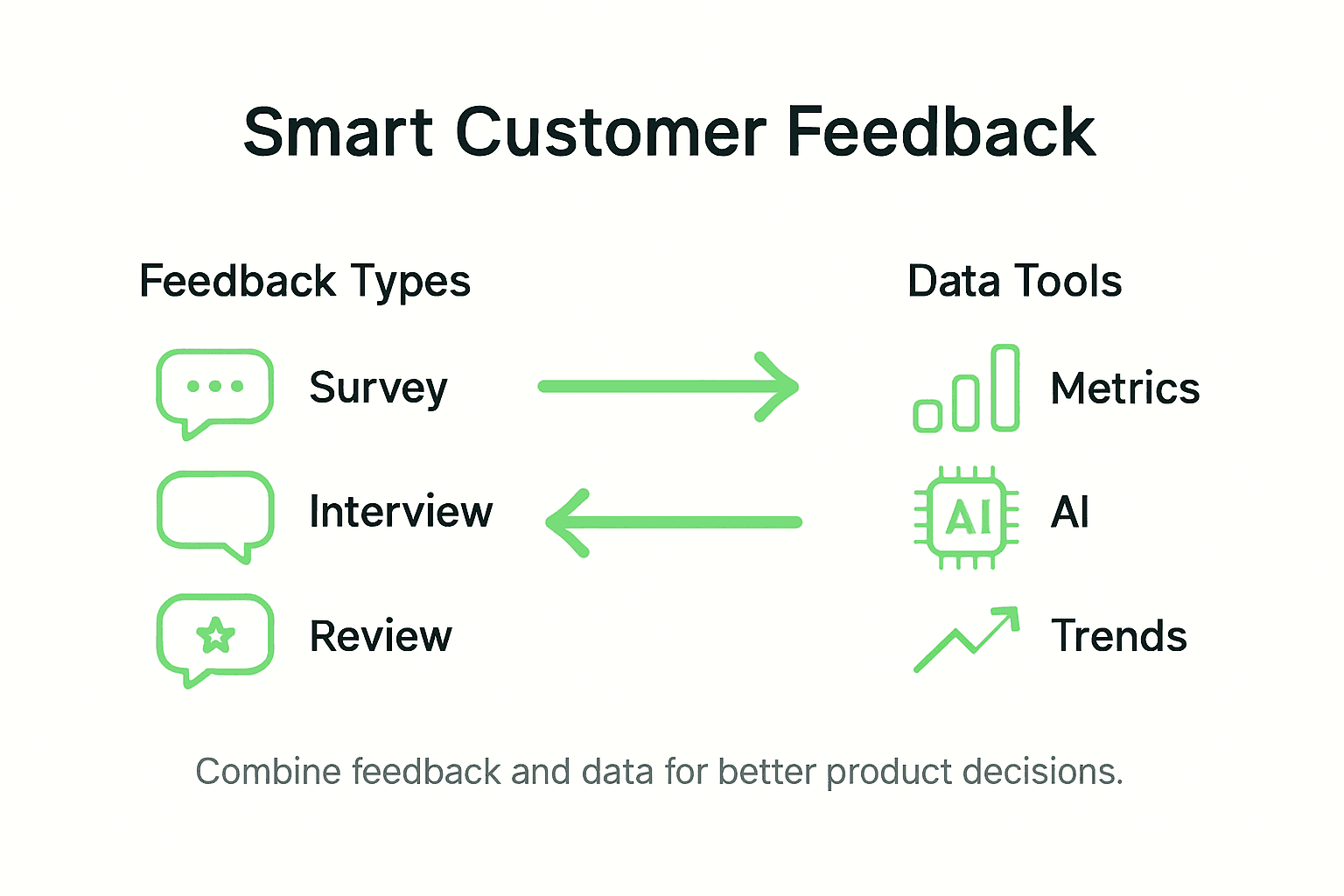
Successful founders understand that customer feedback goes beyond simple surveys. Effective data collection combines qualitative insights from interviews with quantitative metrics like net promoter scores and customer lifetime value. This holistic approach reveals not just surface-level opinions, but deep behavioral patterns and unmet market needs. Triangulation of data sources helps eliminate individual biases and provides a more comprehensive view of customer sentiment.
Advanced entrepreneurs leverage technology to create intelligent feedback mechanisms. Machine learning and AI can help analyze customer interactions, identifying subtle patterns that manual review might miss. By systematically collecting and interpreting customer data, startups can prioritize feature development, optimize user experience, and stay ahead of evolving market demands. The goal isn’t just to collect feedback, but to transform that feedback into actionable product strategies.
Pro tip: Design a structured feedback system that captures both quantitative ratings and open-ended qualitative responses, ensuring you collect comprehensive insights about your product’s performance.
Common Validation Pitfalls to Avoid
Founders frequently stumble into validation traps that can derail their product development journey. One critical mistake is relying exclusively on traditional market research methods that capture what customers say rather than what they actually do, creating a dangerous gap between perceived and actual market demand.
Confirmation bias often leads entrepreneurs to seek out information that validates their existing beliefs, undermining objective market assessment. Effective validation requires independent and comprehensive evaluation that goes beyond surface-level specifications, ensuring the product genuinely meets real-world user needs. Successful founders learn to challenge their assumptions, embracing data that might initially seem counterintuitive or uncomfortable.
Another significant pitfall involves misinterpreting early customer signals. Enthusiastic feedback from a small group of early adopters doesn’t necessarily translate to broader market viability. Entrepreneurs must differentiate between polite interest and genuine demand, looking for concrete indicators like willingness to pay, repeat usage, and organic referrals. The most dangerous trap is mistaking temporary excitement for sustainable market potential, which can lead to significant resource misallocation.
Pro tip: Implement a “stealth validation” approach by testing product concepts through real-world experiments that measure actual user behavior, not just stated preferences.
Achieve True Product-Market Fit with Confidence
The challenge of validating product-market fit lies in eliminating biases and truly understanding real customer demand. This article highlights the essential need for deep validation through multiple methods, careful customer feedback analysis, and avoiding common pitfalls like confirmation bias or mistaking early enthusiasm for lasting demand. Founders face emotional pressure to prove their ideas work but must focus on reliable metrics such as organic growth, retention, and willingness to pay.
siift.ai Intelligent Business Canvas is designed to tackle exactly these challenges. It guides you step-by-step through ideation, rapid validation, and go-to-market strategies with personalized feedback and prioritized actions. This AI-powered platform removes blindspots and provides unbiased insights to help you confidently test hypotheses and measure real market demand. Instead of guesswork, you get clear signals on where to pivot or persevere.
Get ahead of costly mistakes and speed up your journey from idea to product-market fit. Explore how siift.ai can empower your founder’s journey with data-driven clarity and strategic validation. Start using the Intelligent Business Canvas today to refine your business model and unlock genuine customer demand.
Frequently Asked Questions
What is product-market fit?
Product-market fit refers to the alignment between a product’s features and the actual needs of a market. It’s the point where a product becomes essential for customers, meaning they would be disappointed if it no longer existed.
How can I validate product-market fit for my product?
To validate product-market fit, use a combination of qualitative and quantitative research methods. Conduct customer interviews for deep insights, and utilize surveys or market testing to gather quantitative data on potential demand and customer preferences.
What are signs of real market demand for a product?
Key indicators of genuine market demand include low customer acquisition costs, high retention rates, organic user growth, unsolicited referrals, and customers willing to prepay for your product. These metrics demonstrate strong alignment with market needs and interest.
What common mistakes should I avoid during validation?
Avoid relying solely on traditional market research methods that may not capture customer behavior accurately. Be aware of confirmation bias, which can lead to skewed validation results. Instead, prioritize real-world testing and look for concrete metrics like repeat usage and willingness to pay.
Recommended
- blog | siift | Master Business Idea Validation: Steps to Success in 2025
- blog | siift | Understanding Founder Market Fit: Key Concepts Explained
- blog | siift | How to Validate Idea in 2025: A Simple Guide for New Founders
- blog | siift | Understanding Lean Startup Methodology for New Entrepreneurs
- Insurance Product Launch Steps for Fast Market Success - Digital Insurance Platform | IBSuite Insurance Software | Modern Insurance System