TL;DR:
- An elevator pitch is a brief, memorable introduction designed to spark a conversation rather than close a deal. It should be structured with an introduction, explanation, value proposition, and call to action, tailored to different audiences for maximum effectiveness. Successful pitches focus on specificity and genuine curiosity, delivered naturally to foster meaningful connections rather than rehearsed performance.
Most people hear “elevator pitch” and picture a sweaty sales monologue delivered to a skeptical stranger. That mental image is exactly wrong. An elevator pitch is simply a brief, memorable introduction of who you are and what you do, designed to start a conversation rather than close a deal. Used in networking, job interviews, and sales presentations, a great pitch is 30 to 60 seconds of clarity that opens doors. This guide covers what it really is, how to build one, and how to tailor it so it actually works.
Table of Contents
- Key takeaways
- What is an elevator pitch, and why it matters
- The core structure of an effective pitch
- Tailoring your pitch for different audiences
- Delivering your pitch with confidence
- Pitch frameworks and examples compared
- My take on the modern elevator pitch
- Ready to build a pitch that opens real doors?
- FAQ
Key takeaways
| Point | Details |
|---|---|
| A pitch is a conversation starter | Your goal is to spark curiosity, not deliver your full biography in 60 seconds. |
| Structure matters more than polish | A four-part framework — introduction, explanation, value, call to action — keeps you clear and memorable. |
| One size doesn’t fit all | Prepare at least two or three versions tailored to different contexts and audiences. |
| Delivery beats memorization | Practiced, natural delivery outperforms a word-perfect script every single time. |
| The call to action is the engine | Without a specific next step, even a great pitch fades into small talk. |
What is an elevator pitch, and why it matters
The term “elevator pitch” comes from a simple premise: if you stepped into an elevator with someone who could change your career or your business, how would you use that 60-second ride? The phrase entered professional vocabulary in the 1980s and has stuck around because the constraint is genuinely useful. It forces you to get clear on what matters most.
More formally, an elevator pitch (also called an elevator speech) is a brief professional introduction that explains who you are, what you do or want to do, and why it matters. It runs anywhere from 30 to 90 seconds depending on the context. That translates to roughly 75 to 200 words. Short enough to recite before the lobby doors open. Focused enough to actually land.
The purpose is not to impress someone into silence. It’s to prompt a follow-up question. As Harvard Catalyst frames it, a pitch is a teaser designed to make meaningful connections in 60 seconds or less. Teasers create curiosity. Curiosity starts conversations. Conversations create opportunities.
“Your elevator pitch is a handshake, not a contract. Its job is to get the other person to lean in, not to hand you a check.”
The contexts where a polished elevator speech pays off are broader than most people realize. You’ll use it at networking events, in job interviews when someone says “tell me about yourself,” during startup pitch competitions, in sales prospecting calls, and even on your LinkedIn headline. It’s one of the highest-leverage communication tools a professional or founder can own.
The core structure of an effective pitch
Here’s the honest truth: most people over-engineer their pitches. They cram in credentials, backstory, and buzzwords until the whole thing collapses under its own weight. A tight structure prevents that.
The four-part framework most career and communications experts rely on breaks down like this:
- Introduction: Your name and current role or context. Keep it one sentence. “I’m Maya, a second-year MBA student focused on supply chain sustainability.”
- Explanation: What you do or what problem you solve, in plain language. Skip the jargon. “I help consumer brands cut waste out of their sourcing process.”
- Unique value proposition: What makes you or your idea worth remembering. This is your differentiator. “I’ve reduced supplier lead times by 30% at two mid-size companies by using predictive inventory modeling.”
- Call to action: A specific, natural next step. “I’d love to set up a 20-minute call to explore whether your team has that problem too.”
This structure comes from guidance used by Grammarly, Rutgers, and MIT CAPD, and it works because it mirrors how humans actually process introductions. Identity first, relevance second, proof third, invitation fourth.
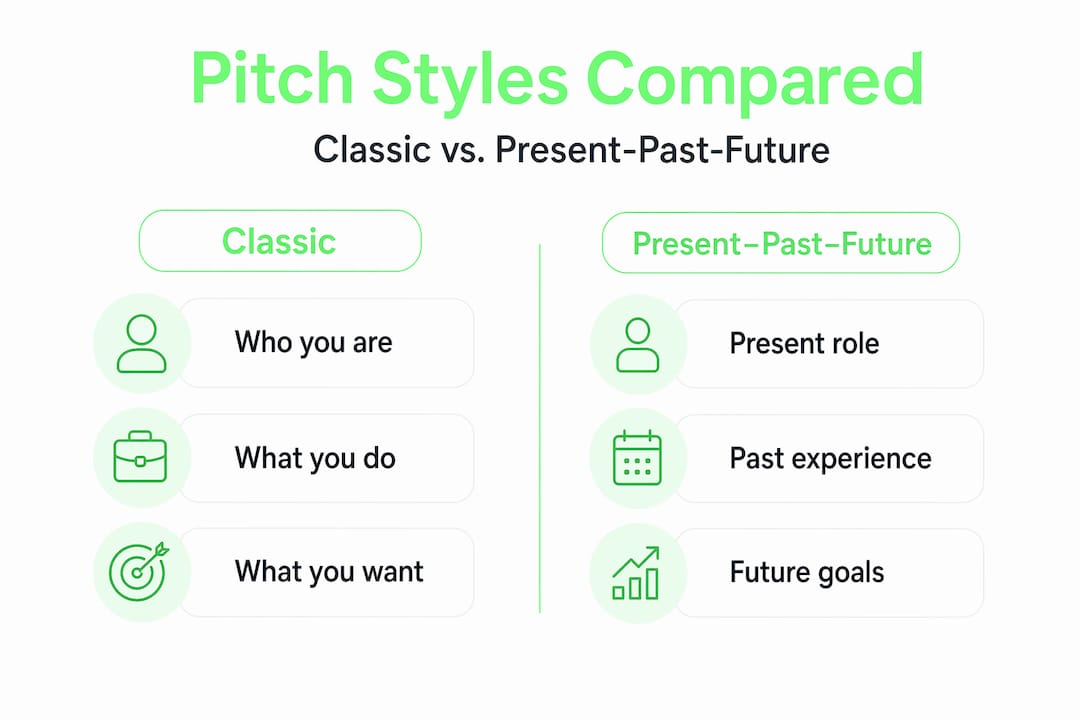
For students and early-career professionals, a Present–Past–Future format often works even better. Start with who you are now, add one memorable highlight from your past, then pivot to what you want next. It sounds more like a real person and less like a resume being read aloud.

Pro Tip: Time yourself reading your pitch out loud. If it takes more than 60 seconds at a conversational pace, cut it. Regular timing practice is the single fastest way to improve both confidence and clarity.
Whatever framework you choose, the call to action is the essential piece most people forget or soften into vagueness. “Let’s stay in touch” is not a call to action. “Can I send you my portfolio this week?” is.
Tailoring your pitch for different audiences
A pitch written for a recruiter at a job fair will fall flat in front of a potential investor. A founder pitch aimed at VCs will confuse a potential enterprise customer. The core content stays fairly stable, but the call to action and the “why it matters” framing shift depending on who is listening.
Think of it this way: you are not changing who you are. You’re changing what you choose to emphasize for the person in front of you.
Here’s a practical way to build multiple versions:
- Write your core pitch first. Nail the structure above before you start customizing. You need a strong foundation before you can build variations.
- Identify your top three contexts. For most professionals and founders, these are: networking events, job or investor meetings, and sales or partnership conversations.
- Rewrite the “why it matters” and call to action for each context. A recruiter wants to know what value you bring to their open role. An investor wants to know your traction and growth potential. A potential partner wants to know how collaboration benefits them.
- Practice each version separately. Don’t blend them in your head. Keep them clean and distinct so you can switch naturally based on cues from the conversation.
For networking event delivery, the tone should be warmer and more exploratory. You’re not selling anything yet. You’re finding out whether there’s a reason to talk more. Ask a question at the end instead of making a request.
Pro Tip: Keep a notes app on your phone with each pitch version saved. Before walking into any room, pull up the right version and read it once. Thirty seconds of intentional priming beats an hour of anxious rehearsal.
Delivering your pitch with confidence
Writing a great pitch and delivering one are two different skills. Here’s where most people stall. They memorize the words, step into the moment, and then freeze or rush because the real thing feels nothing like the practice mirror.
The delivery advice that actually makes a difference:
- Lead with a hook or question. Before you launch into your introduction, open with something that creates a bit of intrigue. “I work on a problem that costs retailers billions every year” beats “Hi, I’m an inventory analyst” every time.
- Watch for non-verbal feedback. If someone’s eyes drift or they shift their weight, you’ve lost them. Shorten, pivot, or ask a question to re-engage. Flexibility is a skill, not a failure.
- Avoid the info dump. More detail does not equal more credibility. Clarity does. Leave the listener wanting more, not less.
- End with a question or clear ask. Pitches designed to launch conversations that last beyond the initial 90 seconds always end with an invitation, not a period.
- Let silence work for you. After your call to action, stop talking. Let the other person respond. Filling the silence with more words is the number one way to undercut a strong finish.
The goal is a two-way exchange, not a broadcast. Think of your pitch as the opening sentence of a conversation, not the whole story.
Pitch frameworks and examples compared
Different situations genuinely call for different formats. Here’s a side-by-side look at two common approaches and when to use each.
| Pitch type | Best for | Structure | Example use case |
|---|---|---|---|
| Intro–Explanation–Value–CTA | Professionals, founders, sales | Who you are, what you do, differentiator, ask | Investor meeting, conference networking |
| Present–Past–Future | Students, early-career pros | Current role, one past highlight, future goal | Career fair, informational interview |
A few concrete elevator pitch examples to make this real:
- Student version: “I’m a junior at NC State studying environmental engineering. Last summer I designed a water filtration prototype that made it to the regional EPA competition. I’m looking for a summer internship where I can apply that kind of hands-on problem solving. Is your team hiring for 2026?”
- Founder version: “I’m building a tool that helps solo founders validate business ideas before they spend money building them. We’ve had 800 signups in the first six weeks without paid ads. I’m looking to connect with early-stage investors who back pre-seed SaaS. Are you in that world?”
- Professional version: “I run digital strategy for mid-size e-commerce brands. I recently took one client from $2M to $6M in annual revenue by rebuilding their paid media attribution model. I’m exploring new clients right now. Would it make sense to grab coffee this week?”
Each one is direct, specific, and ends with a clear next step. None of them sound like a rehearsed speech.
My take on the modern elevator pitch
I’ve seen hundreds of pitches, and the ones that land have almost nothing to do with polish. They have everything to do with specificity and genuine curiosity about the other person.
The most common mistake I see is treating the pitch as a performance rather than the start of a dialogue. People rehearse their lines so rigidly that when the actual human in front of them reacts unexpectedly, they freeze or barrel forward. A pitch that doesn’t respond to the room is just noise.
What I’ve learned is that the strongest pitches are modular. You have your core message committed to memory, and you adapt the framing and closing based on real-time signals. That’s not improvisation. It’s preparation applied intelligently.
Remote and async networking has also changed the equation. In 2026, your elevator pitch lives on your LinkedIn summary, your cold email opener, your conference bio, and your intro video. The principles don’t change, but the delivery medium does. Written pitches need to do the same work in half the words because people skim before they read.
My honest advice: stop trying to write the perfect pitch and start having more conversations. Every real interaction sharpens your message faster than any template will. The right pitch strategy for founders is the one you’ve tested on real people, not the one that sounds best in your head at 2 a.m.
— Samim
Ready to build a pitch that opens real doors?
Crafting a pitch is one thing. Knowing whether the business idea behind it is actually worth pitching is another. Siift is built for exactly that gap. As an agentic AI platform for founders and entrepreneurs, Siift guides you step by step through idea validation, go-to-market strategy, and investor-ready positioning. Whether you’re preparing your first pitch or your fifth, Siift helps you understand your value proposition clearly before you walk into any room. You can also explore Siift’s resources on pitch deck fundamentals and value proposition development to sharpen every layer of your story.
FAQ
What is an elevator pitch in simple terms?
An elevator pitch is a short, focused introduction of who you are and what you do, typically delivered in 30 to 60 seconds. Its purpose is to start a meaningful conversation, not to close a deal on the spot.
How long should an elevator pitch be?
Most experts recommend keeping it between 30 and 90 seconds, which translates to roughly 75 to 200 words. Timing your delivery out loud during practice is the most reliable way to hit that window consistently.
What should an elevator pitch include?
A solid pitch covers four things: who you are, what you do or what problem you solve, what makes you worth remembering, and a clear call to action. The Present–Past–Future structure is a strong alternative for students and early-career professionals.
Do you need different elevator pitches for different situations?
Yes. Preparing multiple versions tailored to networking, job interviews, and sales conversations significantly improves your results. The core content stays the same; the call to action and framing shift based on your audience.
What makes a bad elevator pitch?
The two most common failures are information overload and a weak or missing call to action. A pitch that tries to say everything says nothing, and a pitch that ends with “so yeah, that’s me” leaves the conversation nowhere to go.