
Over half of all american startups now consider artificial intelligence crucial to staying competitive. In a rapidly shifting tech environment, founders face challenges that differ from traditional business paths. Understanding the AI Business Model Canvas gives entrepreneurs a practical way to organize their thinking and turn complex technology into clear, actionable strategies. This guide offers a closer look at why the canvas matters and how it can help american companies shape smarter, more sustainable business models.
Table of Contents
- Defining The AI Business Model Canvas
- Core Components And Structure Explained
- Personalization And AI-Driven Insights
- Step-By-Step Usage For New Founders
- Common Mistakes And How To Avoid Them
Key Takeaways
| Point | Details |
|---|---|
| AI Business Model Canvas | This framework helps entrepreneurs strategically integrate AI into their business operations through nine interconnected components. |
| Personalization in Strategy | Leveraging AI for personalization can significantly enhance customer engagement and satisfaction by tailoring offerings to specific user needs. |
| Iterative Development | The AI Business Model Canvas should be treated as a living document, requiring continuous testing and refinement to adapt to changing market dynamics. |
| Common Pitfalls | Founders must avoid assumption overload and vague value propositions to ensure their business model is validated and actionable. |
Defining the AI Business Model Canvas
The AI Business Model Canvas represents a strategic evolution of traditional business modeling, specifically tailored to help entrepreneurs leverage artificial intelligence in their organizational design and strategy. Unlike conventional business planning frameworks, this canvas provides a dynamic roadmap for integrating AI technologies into core business operations and value propositions.
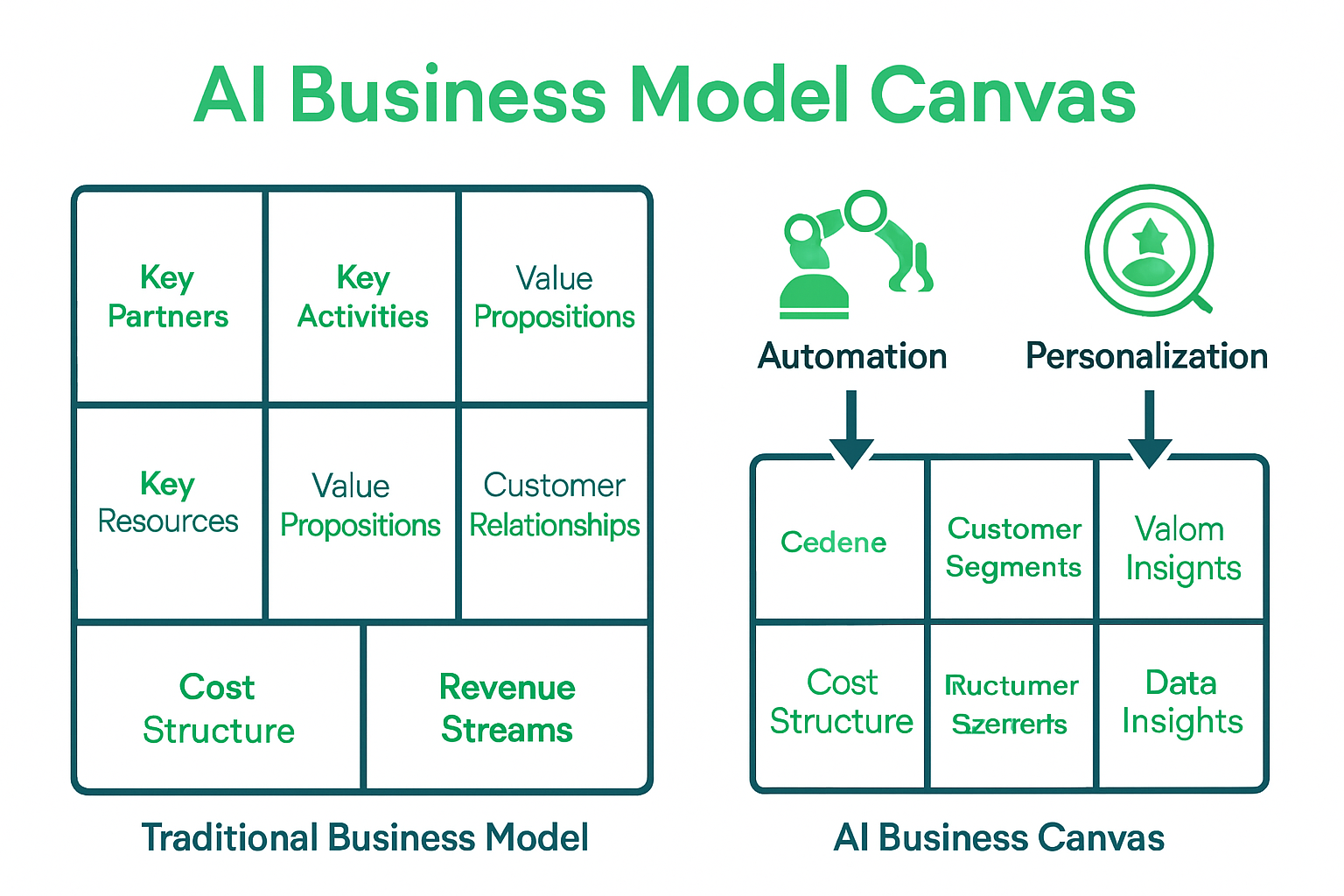
At its foundation, the AI Business Model Canvas breaks down complex business strategies into nine interconnected building blocks that reflect the unique dynamics of AI-powered enterprises. Drawing from Alexander Osterwalder’s original Business Model Canvas, this AI-specific version goes beyond traditional templates by emphasizing technological capabilities, data utilization, and algorithmic value creation.
The core components of the AI Business Model Canvas typically include:
- Customer Segments: Identifying specific audiences who will benefit most from AI-driven solutions
- Value Propositions: Articulating unique AI-powered benefits and differentiators
- Channels: Determining distribution mechanisms for AI products or services
- AI Infrastructure: Mapping technological resources, data pipelines, and machine learning capabilities
- Cost Structure: Analyzing AI development, deployment, and maintenance expenses
- Revenue Streams: Designing monetization strategies leveraging AI’s unique value generation
By providing a structured yet flexible framework, the AI Business Model Canvas enables founders to systematically explore how artificial intelligence can transform their business approach, creating innovative pathways for growth and competitive advantage.
Core Components and Structure Explained
The AI Business Model Canvas is a strategic visualization tool that breaks down complex business models into nine critical building blocks, providing entrepreneurs with a comprehensive framework for understanding and designing AI-powered business strategies. Unlike traditional planning documents, this canvas offers a dynamic, visual representation of how different organizational elements interconnect and generate value.
The nine essential components of the AI Business Model Canvas are meticulously designed to capture the unique dynamics of AI-driven enterprises. These interconnected building blocks include:
- Customer Segments: Identifying precise target audiences and their specific AI-related needs
- Value Propositions: Defining unique AI-powered solutions that differentiate your offering
- Channels: Mapping distribution and communication mechanisms for AI products
- Customer Relationships: Establishing engagement strategies for AI service delivery
- Revenue Streams: Designing monetization approaches specific to AI value generation
- Key Resources: Identifying technological, human, and data infrastructure requirements
- Key Activities: Outlining core processes for AI development and implementation
- Key Partnerships: Determining strategic collaborations for technological and market expansion
- Cost Structure: Analyzing investment requirements for AI development, deployment, and maintenance
The visual chart approach helps firms align their activities by illustrating potential trade-offs and strategic opportunities within their AI ecosystem. By providing a holistic view of the business model, founders can systematically evaluate how each component contributes to their overall AI strategy, enabling more intentional and adaptive organizational design.

Each component of the canvas is not just a static element but a dynamic interaction point that reveals deeper insights into how AI can transform traditional business approaches. Successful founders use this framework to constantly iterate, experiment, and refine their understanding of how technological capabilities can create unprecedented value for their target customers.
Personalization and AI-Driven Insights
Personalization represents the cutting edge of AI-powered business strategy, transforming how entrepreneurs understand and engage with their target markets. AI technologies are revolutionizing business model development by synthesizing massive amounts of data and generating unprecedented insights that enable hyper-targeted, dynamic business approaches.
The core power of AI-driven personalization lies in its ability to process complex data sets and generate actionable intelligence. Key personalization strategies include:
- Predictive Customer Segmentation: Using machine learning to identify nuanced customer profiles
- Dynamic Pricing Models: Adjusting pricing in real-time based on individual customer behaviors
- Customized Product Recommendations: Creating individualized offerings that match specific user preferences
- Adaptive User Experience: Tailoring interfaces and interactions to unique user needs
AI integration is fundamentally reshaping business processes, influencing everything from market research to product innovation. By leveraging advanced algorithms and machine learning techniques, founders can develop more responsive, intelligent business models that anticipate customer needs before they even emerge.
Successful AI-driven personalization goes beyond simple data collection. It requires a holistic approach that combines technological capabilities with deep human understanding. Entrepreneurs can leverage AI tools to create more empathetic, responsive business strategies that adapt in real-time to changing market dynamics, ultimately delivering unprecedented value to customers.
Step-by-Step Usage for New Founders
Creating an AI Business Model Canvas requires a systematic approach that transforms entrepreneurial ideas into actionable strategies. The Lean LaunchPad methodology provides a powerful framework for founders to propose and rigorously test their business hypotheses, making the canvas development process both strategic and iterative.
Here’s a comprehensive step-by-step process for new founders:
-
Customer Segment Mapping
- Identify target audience
- Create detailed customer personas
- Understand specific pain points and needs
-
Value Proposition Design
- Define unique AI-powered solutions
- Articulate clear differentiation
- Match solutions to customer needs
-
Prototype and Validate
- Develop minimum viable product
- Conduct user testing
- Gather and integrate feedback
-
Iterative Refinement
- Analyze performance metrics
- Adjust canvas components
- Continuously improve model
Successful founders recognize that the AI Business Model Canvas is not a static document but a dynamic tool for ongoing strategic development. Bootstrapping strategies become critical in transforming these initial conceptual frameworks into viable business models, requiring persistent adaptation and learning.
The real power of the AI Business Model Canvas lies in its ability to provide founders with a comprehensive, visual roadmap that bridges innovative thinking with practical execution. By systematically breaking down complex business strategies into manageable components, new entrepreneurs can navigate the challenging landscape of AI-driven innovation with greater confidence and clarity.
Common Mistakes and How to Avoid Them
Founders developing an AI Business Model Canvas often encounter critical pitfalls that can derail their strategic planning. Mistakes frequently stem from overloading non-essential assumptions and creating vague, unvalidatable hypotheses, which can compromise the entire strategic framework.
Key Mistakes to Avoid:
- Assumption Overload: Cramming too many unverified hypotheses into your canvas
- Vague Value Propositions: Failing to define precise, measurable customer benefits
- Neglecting Iterative Testing: Treating the canvas as a static document
- Overlooking Data Validation: Making claims without concrete evidence
- Ignoring Market Dynamics: Developing solutions in isolation from real-world constraints
Successful AI business modeling requires a disciplined approach to hypothesis testing and continuous refinement. Developing a robust business plan becomes crucial in transforming theoretical concepts into actionable strategies. Founders must embrace a mindset of constant learning, where each canvas iteration represents an opportunity to get closer to a validated, market-ready solution.
The most effective founders treat their AI Business Model Canvas as a living document. This means being willing to pivot, discard assumptions that don’t hold up, and continuously integrate new insights. By maintaining intellectual humility and a commitment to data-driven decision making, entrepreneurs can transform potential mistakes into powerful learning opportunities that ultimately strengthen their business model.
Unlock the Full Potential of Your AI Business Model Today
Building an effective AI Business Model Canvas is essential but challenging. This article highlights common hurdles founders face like vague value propositions and neglected iterative testing that can stall your AI venture before it truly starts. If you are ready to avoid those pitfalls and transform your AI strategy into a validated, data-driven business, you need more than theory. The key pain points you face require a personalized, step-by-step guide designed specifically for AI-driven innovation.
That is where siift.ai comes in. Our Intelligent Business Canvas is the perfect companion to the AI Business Model Canvas article you just read. It offers personalized feedback, new insights, and prioritized actions that help you iteratively validate your ideas and avoid assumption overload. Designed to remove blind spots and bias, siift.ai guides you through customer segmentation, value proposition crafting, and prototype refinement with confidence. Don’t let complexity hold you back when there is a smarter way to build your AI business model. See how you can bring your vision to life and get real-world traction with siift.ai. Start your journey now and turn your AI ideas into a viable, thriving business.
Frequently Asked Questions
What is the AI Business Model Canvas?
The AI Business Model Canvas is a strategic framework designed for entrepreneurs to integrate artificial intelligence into their business strategies, breaking down complex models into nine interconnected components.
What are the key components of the AI Business Model Canvas?
The nine essential components include Customer Segments, Value Propositions, Channels, Customer Relationships, Revenue Streams, Key Resources, Key Activities, Key Partnerships, and Cost Structure.
How do I create an AI Business Model Canvas?
To create an AI Business Model Canvas, start by mapping customer segments, designing your value proposition, prototyping and validating your ideas, and continuously refining the canvas based on feedback and performance metrics.
What common mistakes should I avoid when developing my AI Business Model Canvas?
Common pitfalls include assumption overload, vague value propositions, neglecting iterative testing, overlooking data validation, and ignoring market dynamics. It’s essential to treat the canvas as a living document that evolves with new insights.
Recommended
- blog | siift | Business Canvas Model 2025: Simple Guide for New Entrepreneurs
- blog | siift | Understanding Lean Canvas: A Comprehensive Guide
- blog | siift | What Is a Business Model? Simple Guide for Future Entrepreneurs 2025
- blog | siift | What is Lean Canvas? Understanding Its Importance and Use
- Success Exhibiting at IFEMA Madrid: The Ultimate Exhibitor Guide