

Over seventy percent of startups report forming partnerships to access resources they lack on their own. In today’s fast-moving markets, teamwork across businesses is quickly becoming a difference-maker for growth and innovation. By understanding how collaborative business models reshape value creation, entrepreneurs and leaders can tap into powerful ways to share risks, spark creativity, and reach new opportunities that solo efforts often miss.
Key Takeaways
| Point | Details |
|---|---|
| Collaborative Business Models | These models leverage the unique strengths of multiple players to co-create value and foster innovation beyond traditional boundaries. |
| Types of Collaboration | Different structures like strategic alliances and platform cooperatives offer tailored approaches to partnership based on specific organizational goals. |
| Operational Success | Effective daily operations require robust communication frameworks, clear goal-setting, and agile decision-making for seamless collaboration. |
| Legal and Financial Clarity | Clear agreements detailing resource sharing, financial responsibilities, and intellectual property rights are crucial for successful partnerships. |
Table of Contents
- Defining Collaborative Business Models
- Types And Structures Of Collaboration
- How Collaborative Models Operate Day-To-Day
- Legal And Financial Responsibilities Explained
- Common Pitfalls And How To Avoid Them
Defining Collaborative Business Models
Imagine a business strategy where multiple players come together, pooling their unique strengths to create something greater than what they could achieve alone. That’s the essence of a collaborative business model.
According to a scholarly study from the Journal of Open Business Models, collaborative business models are sophisticated ecosystems where value is co-created, delivered, and captured by practitioners operating beyond the traditional boundaries of a single organization. This approach fundamentally reimagines how businesses interact, breaking down silos and creating more dynamic, interconnected value networks.
Key characteristics of collaborative business models include:
- Shared value creation across multiple stakeholders
- Boundary-spanning capabilities that transcend organizational limits
- Flexible and adaptive partnership structures
- Mutual investment and risk-sharing mechanisms
- Emphasis on collective innovation and problem-solving
These models are particularly powerful for entrepreneurs and startups who might lack comprehensive resources. By strategically collaborating, smaller entities can access capabilities, networks, and expertise they couldn’t develop independently. Think of it like a professional superpower: when diverse skills combine, the potential for breakthrough solutions multiplies exponentially. Learn more about foundational business models to understand how collaborative approaches fit into broader entrepreneurial strategies.
Types and Structures of Collaboration
Collaborative business models aren’t one-size-fits-all. They’re like complex puzzle pieces that can interlock in fascinating ways, each structure offering unique advantages for different entrepreneurial goals. Strategic alliances and platform cooperatives represent two powerful yet distinctly different collaboration approaches that can revolutionize how businesses interact.
According to research from Wikipedia, strategic alliances are sophisticated agreements between independent organizations designed to share resources or knowledge while maintaining individual autonomy. These collaborations allow companies to strategically pursue mutual benefits without fully merging or losing their organizational identity. Think of it like professional dating - organizations can partner deeply without getting married.
Another innovative collaboration model is the platform cooperative, a democratically governed digital platform owned by its stakeholders, such as workers or users. Unlike traditional venture-capital-driven models, platform cooperatives offer an alternative structure where value and ownership are distributed more equitably. This approach transforms digital platforms from extraction machines into collaborative ecosystems where participants have genuine stakes.

Key collaboration structures include:
Here’s a comparison of common collaboration structures:
| Collaboration Structure | Governance & Ownership | Typical Benefits |
|---|---|---|
| Strategic Alliance | Separate entities | Shared resources Mutual benefits |
| Platform Cooperative | Stakeholder-owned | Democratic control Fair distribution |
| Joint Venture | Shared entity | Combined strengths Defined goals |
| Consortium Partnership | Group leadership | Resource pooling Risk sharing |
| Network Collaboration | Decentralized | Flexible access Broad expertise |
- Strategic Alliances
- Platform Cooperatives
- Joint Ventures
- Consortium Partnerships
- Network Collaborations
Entrepreneurs can mix and match these structures based on their specific goals, resources, and vision.
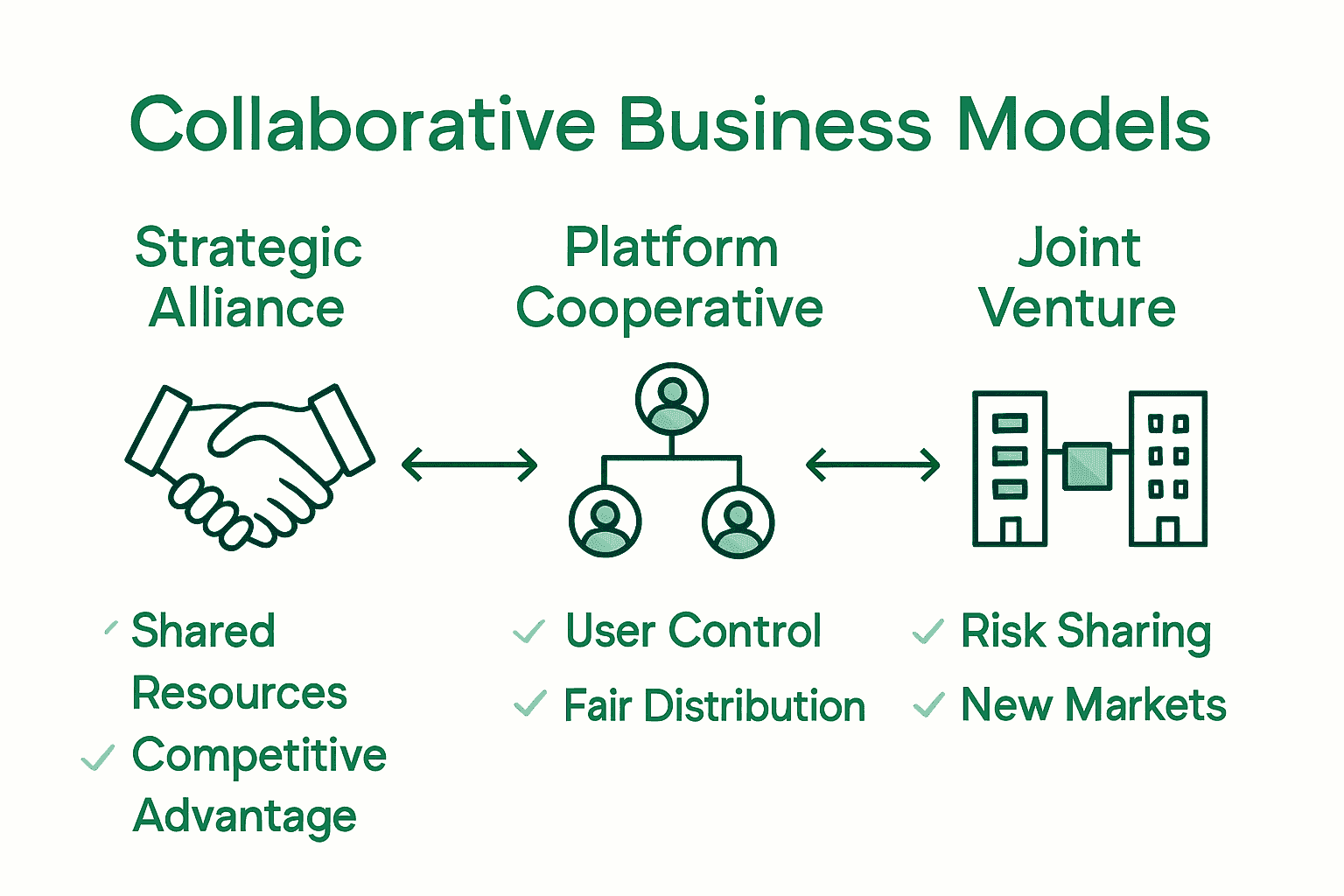 The magic happens when you understand each model’s unique strengths and align them with your strategic objectives. Explore startup business model fundamentals to deeper understand how these collaboration types can power your entrepreneurial journey.
How Collaborative Models Operate Day-to-Day
Running a collaborative business model isn’t about grand theories - it’s about practical, everyday interactions that transform potential into real-world results. Collaborative workflows are like intricate dance routines where each participant knows their steps, timing, and role in creating something remarkable.
At the core of daily collaborative operations are robust communication frameworks that ensure transparency, accountability, and shared understanding. This means regular check-ins, crystal-clear project management tools, and intentional mechanisms for sharing insights. Imagine a digital workspace where team members from different organizations can seamlessly share documents, track progress, and align their efforts in real time.
Successful day-to-day collaboration requires several critical operational elements:
- Shared digital infrastructure
- Transparent performance metrics
- Flexible role assignments
- Regular cross-organizational meetings
- Standardized communication protocols
- Mutual goal-setting processes
- Agile decision-making mechanisms
Technology plays a crucial role in enabling these collaborative interactions. Cloud-based platforms, collaborative project management software, and secure communication channels become the connective tissue that allows distributed teams to function as a unified organism. The magic happens when technology transforms potential friction points into smooth, productive exchanges.
VIDEO:video_content] [Learn more about startup collaboration strategies to see how leading entrepreneurs make these complex systems work seamlessly.
Legal and Financial Responsibilities Explained
Collaborative business models might sound like a dream, but they’re built on serious legal and financial foundations. Strategic partnerships require more than handshakes and good intentions - they demand carefully structured agreements that protect everyone’s interests and clarify expectations.
According to research on strategic alliances from Wikipedia, partners typically formalize their relationships through comprehensive contracts that meticulously define rights, governance, and resource sharing. These agreements aren’t just bureaucratic paperwork; they’re strategic documents that outline exactly how financial risks, responsibilities, and potential rewards will be distributed among participants.
Key legal and financial considerations in collaborative models include:
- Clear ownership rights for intellectual property
- Detailed revenue and profit-sharing mechanisms
- Risk allocation and mitigation strategies
- Performance-based compensation structures
- Exit clauses and partnership dissolution protocols
- Compliance with relevant industry regulations
- Transparent financial reporting requirements
Navigating these complex legal landscapes requires more than just legal expertise - it demands strategic thinking and proactive communication. Successful collaborations treat legal frameworks as living documents that can evolve with the partnership, ensuring flexibility while maintaining clear boundaries. Think of these agreements like relationship contracts: they protect everyone involved while creating space for genuine, productive collaboration. Dive deeper into understanding business model nuances to master the art of collaborative entrepreneurship.
Common Pitfalls and How to Avoid Them
Collaborative business models might sound perfect on paper, but they’re notorious minefields where well-intentioned partnerships can quickly unravel. Misaligned expectations are the silent killers of collaborative ventures, transforming promising relationships into frustrating, unproductive experiences.
The most fundamental pitfall is communication breakdown. Entrepreneurs often jump into collaborations with excitement, skipping critical conversations about core values, individual goals, and precise operational expectations. This leads to strategic misunderstandings that can fracture partnerships faster than you can say “collaborative nightmare.” Imagine two tech startups agreeing to collaborate, but one expects rapid innovation while the other prioritizes steady, incremental progress - recipe for conflict.
Key pitfalls to watch out for in collaborative models:
- Unclear role definitions
- Mismatched organizational cultures
- Unequal contribution and commitment levels
- Poor communication infrastructure
- Inadequate conflict resolution mechanisms
- Misaligned financial expectations
- Lack of trust and transparency
Successful collaboration requires more than good intentions. It demands proactive relationship management - treating your business partnership like a living, breathing entity that needs constant nurturing, honest communication, and mutual respect. Regular check-ins, transparent performance metrics, and clearly defined escalation processes can transform potential friction points into opportunities for deeper understanding and collective growth. Learn how to navigate complex startup dynamics and turn potential pitfalls into strategic advantages.
Transform Collaboration Challenges into Startup Success with siift
Building a collaborative business model can feel overwhelming, especially when you run into unmet expectations, legal red tape, or communication breakdowns. The article highlighted how misaligned goals, unclear roles, and everyday operational headaches can turn promising partnerships into sources of stress, not growth. With so many moving parts, finding a path that avoids common pitfalls and leads to true value co-creation is not always easy.
siift is designed to guide you through the entire journey of collaborative entrepreneurship. Our intuitive AI acts as your personal compass — whether you need clarity on partnership structures, expert insights into daily workflows, or step-by-step feedback on risk management. Discover exactly how to structure and grow your collaborative model by exploring our startup business model resources, or get personalized advice tailored to your project inside the siift app. Ready to turn collaboration into your startup’s superpower? Start transforming your founder journey with siift now and move from uncertainty to real business momentum.
Frequently Asked Questions
What is a collaborative business model?
A collaborative business model is a strategy where multiple organizations come together, sharing strengths and resources to create greater value collectively than they could alone. This approach fosters co-creation, value delivery, and risk-sharing among diverse stakeholders.
What are the key types of collaborative business models?
The key types of collaborative business models include strategic alliances, platform cooperatives, joint ventures, consortium partnerships, and network collaborations. Each type has its unique advantages and structures catering to different entrepreneurial needs.
How do collaborative business models operate on a daily basis?
Collaborative business models operate through structured workflows that emphasize robust communication, shared digital infrastructure, mutual goal-setting, and flexible role assignments. Regular meetings and transparent performance metrics are essential for maintaining alignment and productivity among different organizations.
What are common pitfalls in collaborative business models?
Common pitfalls in collaborative business models include unclear role definitions, misaligned cultural values, unequal contributions, poor communication, and inadequate conflict resolution strategies. Proactive relationship management is essential to overcome these challenges and ensure successful collaborations.
Recommended
- blog | siift | What Is a Business Model? Simple Guide for Future Entrepreneurs 2025
- blog | siift | Understanding the Startup Business Model: Key Insights
- blog | siift | Understanding the Difference Between B2B and B2C
- blog | siift | Business Canvas Model 2025: Simple Guide for New Entrepreneurs
- Understanding Blogging for Business: A Key to Growth
- Just because you can see each other doesn’t mean the silo is still not there - Berriault and Associates Consulting Group