

A startup business model explains how a new company creates value, reaches customers, and generates revenue through its products or services. Every startup founder talks about the importance of a big idea, but what turns an idea into a real business is the strategy behind it. Research shows that a clear business model can be the difference between thriving and failing. Most assume great ideas win on their own, yet the right business model is what helps startups turn ideas into sustainable businesses.
Table of Contents
Quick Summary
Takeaway | Explanation |
|---|---|
Create a solid value proposition | Clearly define the unique benefits your product offers to attract customers. |
Understand your target market | Identify the specific segment you aim to serve to tailor your approach effectively. |

| | Develop diverse revenue streams | Explore multiple ways to generate income to enhance financial stability and growth. | | Emphasize flexibility in your model | Treat your business model as a living document that evolves with feedback and market changes. | | Learn from successful archetypes | Analyze proven business models like subscription or freemium to innovate within your niche. |
What is a Startup Business Model and Why is it Important?
A startup business model is a strategic blueprint that defines how a new venture plans to create, deliver, and capture value in the marketplace. It serves as a comprehensive framework that outlines the fundamental mechanics of transforming an innovative idea into a sustainable and profitable enterprise. According to Harvard Business School Online, a business model encompasses several critical components that collectively determine a startup’s potential for success.
Defining the Core Elements
At its essence, a startup business model articulates several fundamental aspects of the business:
Value Proposition: The unique solution or benefit your product or service offers to customers
Target Market: The specific customer segment your startup aims to serve
Revenue Streams: How the business will generate financial income
Cost Structure: The primary expenses required to operate and deliver the value proposition
These elements work together to create a comprehensive strategy that guides decision making, resource allocation, and long-term growth planning. Our comprehensive guide on business models provides deeper insights into crafting an effective startup framework.
Why Business Models Matter
A well-designed business model is not just a theoretical exercise but a critical survival tool for startups. It helps entrepreneurs:
Validate the economic feasibility of their concept
Identify potential market opportunities
Attract investors by demonstrating clear strategic thinking
Create a roadmap for scaling and adapting the business
Without a robust business model, startups risk becoming another statistic in the high-failure rate landscape of entrepreneurship. Research from Oklahoma State University emphasizes that a business model serves as a “blueprint for operational and financial success”, transforming abstract ideas into executable strategies.
Ultimately, a startup business model is more than a document. It is a dynamic, living strategy that evolves with market conditions, customer feedback, and technological advances. Successful entrepreneurs view their business model as a flexible framework that can be refined and reimagined as the startup grows and learns.
The Fundamental Components of a Startup Business Model
A startup business model is a complex ecosystem of interconnected elements that work together to transform an innovative concept into a viable enterprise. Understanding these fundamental components is critical for entrepreneurs seeking to build sustainable and scalable businesses. Our comprehensive business model guide can help founders navigate these intricate dynamics.
Core Structural Elements
According to the U.S. Small Business Administration, successful startup business models typically encompass several key structural components:
Below is a summary table outlining the core structural elements typically found in a startup business model. This helps clarify the function of each element for better understanding.
Structural Element | Description |
|---|---|
Value Proposition | Unique problem your product or service solves |
Customer Segments | Specific target audience who will benefit most |
Revenue Streams | Methods of generating financial income |
Cost Structure | Essential expenses required to deliver your value proposition |
Key Resources | Critical assets and capabilities needed to operate |
Value Proposition: The unique problem your product or service solves
Customer Segments: The specific target audience who will benefit most
Revenue Streams: Methods of generating financial income
Cost Structure: Essential expenses required to deliver your value proposition
Key Resources: Critical assets and capabilities needed to operate
Strategic Relationship Mapping
Beyond basic structural elements, startup business models require understanding complex relationships between different organizational components. This includes defining key partnerships, identifying distribution channels, and establishing customer relationship strategies. These interactions create a dynamic framework that allows startups to adapt and evolve.
Successful entrepreneurs recognize that these components are not static blueprints but living strategies. Flexibility and continuous refinement are crucial. A robust business model anticipates potential market shifts, technological disruptions, and changing customer preferences.
The most effective startup business models demonstrate clear connections between each component. They show how value is created, delivered, and captured in a manner that is both economically viable and strategically sound. By meticulously designing and continuously updating these fundamental components, entrepreneurs increase their chances of building resilient and successful ventures.
How Startup Business Models Evolve Over Time
Startup business models are not static documents but living, breathing strategies that transform and adapt in response to market dynamics, customer feedback, and organizational learning. This continuous evolution is a critical survival mechanism for emerging businesses seeking sustainable growth. Our startup growth strategies guide provides deeper insights into navigating these transformative processes.
Stages of Business Model Transformation
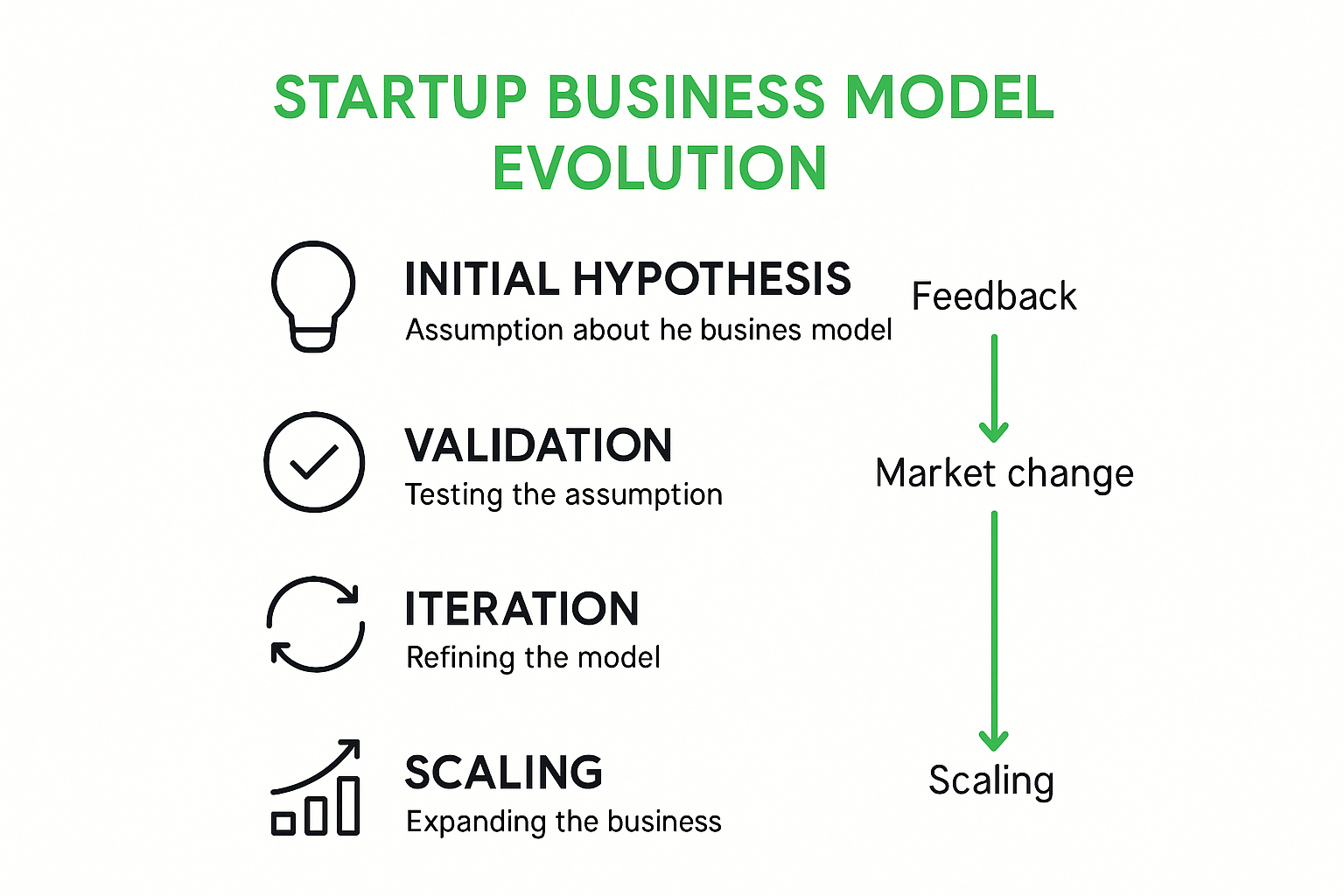
According to research published in the National Institutes of Health, startup business models typically undergo several evolutionary stages:
Initial Hypothesis Stage: The original business concept based on founders’ assumptions
Validation Stage: Testing and refining the initial model through market interaction
Iteration Stage: Making strategic pivots based on empirical evidence and feedback
Scaling Stage: Optimizing the model for sustainable growth and expansion
Driving Forces of Business Model Evolution
Multiple external and internal factors contribute to the ongoing transformation of a startup’s business model. External triggers might include technological disruptions, shifts in consumer behavior, or emerging competitive landscapes. Internal triggers often involve organizational learning, resource constraints, and strategic reassessments.
Successful startups approach business model evolution as a deliberate, data-driven process. They remain vigilant and adaptable, continuously monitoring key performance indicators, gathering customer insights, and being willing to make significant strategic adjustments. This flexibility distinguishes resilient startups from those trapped by rigid initial assumptions.
The most effective entrepreneurs view their business model as a hypothesis to be tested and refined, not a fixed blueprint. By embracing continuous learning and maintaining a growth mindset, startups can transform potential challenges into opportunities for innovation and strategic refinement.
Analyzing Real-World Examples of Successful Startup Business Models
Case studies of successful startups reveal nuanced strategies that transform innovative ideas into sustainable businesses. Our comprehensive business opportunity analysis guide can help entrepreneurs understand these complex dynamics more deeply.
Innovative Business Model Archetypes
According to research from the Yale School of Management, successful startup business models often fall into distinctive categories:
This table highlights the major types of startup business model archetypes and examples, making it easy to compare how each approach functions in the market.
Business Model Type | Description | Notable Examples |
|---|---|---|
Disruption Model | Reimagines and transforms existing industries | Uber, Airbnb |
Platform Model | Creates network effects for value | Facebook, Spotify |
Subscription Model | Provides services for recurring payments | Netflix, Dollar Shave Club |
Freemium Model | Offers a free tier with paid upgrades | Dropbox, Zoom |
Disruption Model: Companies like Uber and Airbnb that fundamentally reimagine existing service industries
Platform Model: Tech companies like Facebook and Spotify that create value through network effects
Subscription Model: Services like Netflix and Dollar Shave Club that generate recurring revenue
Freemium Model: Companies like Dropbox and Zoom that offer basic services for free with premium upgrades
Strategic Innovation in Practice
Examining these successful models reveals common threads of strategic innovation. Airbnb, for instance, didn’t just create a booking platform but reimagined hospitality by enabling individuals to monetize unused living spaces. Their business model transformed a traditional industry by solving multiple customer pain points simultaneously.
Similarly, Spotify disrupted music consumption by creating a value proposition that benefited both listeners and artists. Their platform model solved distribution challenges for musicians while providing consumers unprecedented access to diverse musical content. These examples demonstrate that successful startup business models are not just about technology but about fundamentally rethinking value creation and delivery.
The most effective startup business models share a critical characteristic: they solve real problems more efficiently and creatively than existing solutions. By deeply understanding customer needs and leveraging technological or strategic innovations, these companies create sustainable competitive advantages that transcend traditional industry boundaries.
Turn Your Startup Model Into Action With siift
Are you struggling to move from the “big idea” stage to a business that truly works? The article above highlights that many founders get stuck turning their value proposition, target market, and revenue streams into reality. Without a clear plan and regular feedback, it is easy to lose focus or miss out on growth opportunities. Every successful startup needs a business model that can adapt, and that means testing, refining, and constantly improving each element as outlined in the article.
siift is here to help you put theory into practice. With siift’s intuitive AI guidance, you receive step-by-step support and tailored feedback on your unique startup journey. Overcome indecision and uncertainty with prioritized actions designed to help you validate your model, adapt to market changes, and navigate every growth stage. Do not wait and risk missing your window for success. Join siift now and confidently transform your business model into a thriving company.
Frequently Asked Questions
What is a startup business model?
A startup business model is a strategic blueprint that outlines how a new venture plans to create, deliver, and capture value in the marketplace, covering aspects like value proposition, target market, revenue streams, and cost structure.
Why is a business model important for startups?
A business model is important as it validates the economic feasibility of a concept, identifies market opportunities, attracts investors, and creates a roadmap for scaling the business.
How do startup business models evolve over time?
Startup business models evolve through stages such as initial hypothesis, validation, iteration, and scaling, influenced by external and internal factors, requiring ongoing refinement and adaptation to market conditions.
What are some common types of startup business models?
Common types of startup business models include disruption models, platform models, subscription models, and freemium models, each solving customer problems in unique and innovative ways.
Recommended
blog | siift | What Is a Business Model? Simple Guide for Future Entrepreneurs 2025
blog | siift | Business Canvas Model 2025: Simple Guide for New Entrepreneurs
blog | siift | Top Reasons Businesses Fail in 2025: A Guide for New Founders
blog | siift | Business Plan Essentials 2025: A Beginner’s Guide for New Founders