Artificial intelligence is changing how startups build, operate, and scale.
From autonomous agents that execute workflows to AI systems that help teams analyze information, modern startups now have access to capabilities that previously required large teams and significant resources.
However, the biggest challenge for founders, entrepreneurs and startups is not simply getting AI to complete tasks.
The real challenge is knowing:
Which opportunities deserve attention?
Which customer signals should influence decisions?
How should teams prioritize limited resources?
How can different departments stay aligned as the company grows?
Which actions actually move the business toward growth?
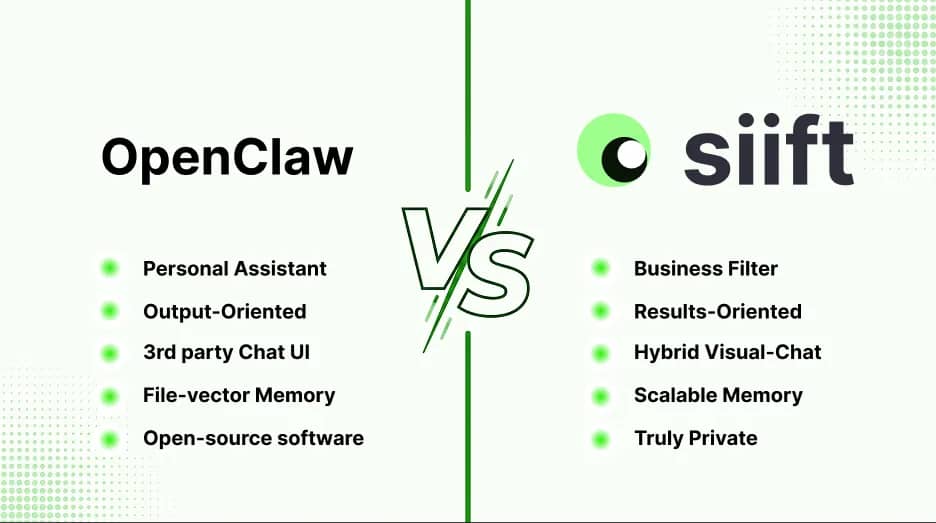
This is where the difference between Siift vs OpenClaw becomes important.
Although both platforms use AI, they solve different problems.
OpenClaw is an open-source AI agent framework designed for technically-savvy users who want to create customizable automation workflows, connect tools, and execute tasks through AI agents.
Siift is an AI Business Operating System designed for founders, founding teams, serious entrepreneurs, and growing startups that need strategic clarity, business context management, and coordinated execution.
The real difference lies in the role each platform plays. OpenClaw focuses on automating simple, well-defined personal tasks, while Siift focuses on more dynamic and long-horizon-intent strategic decision-making and business building workflows.
For startup teams, choosing between AI automation and an AI business operating system depends on whether they need faster execution, better strategic decisions, or both.
OpenClaw helps technical people automate tasks, with a blank-slate framework for generalist AI agents, and experiment with simple workflows.
Siift is the professional version of this, helping serious business builders decide which opportunities deserve attention, refine strategy, execute and iterate, and how to align activities across a business.
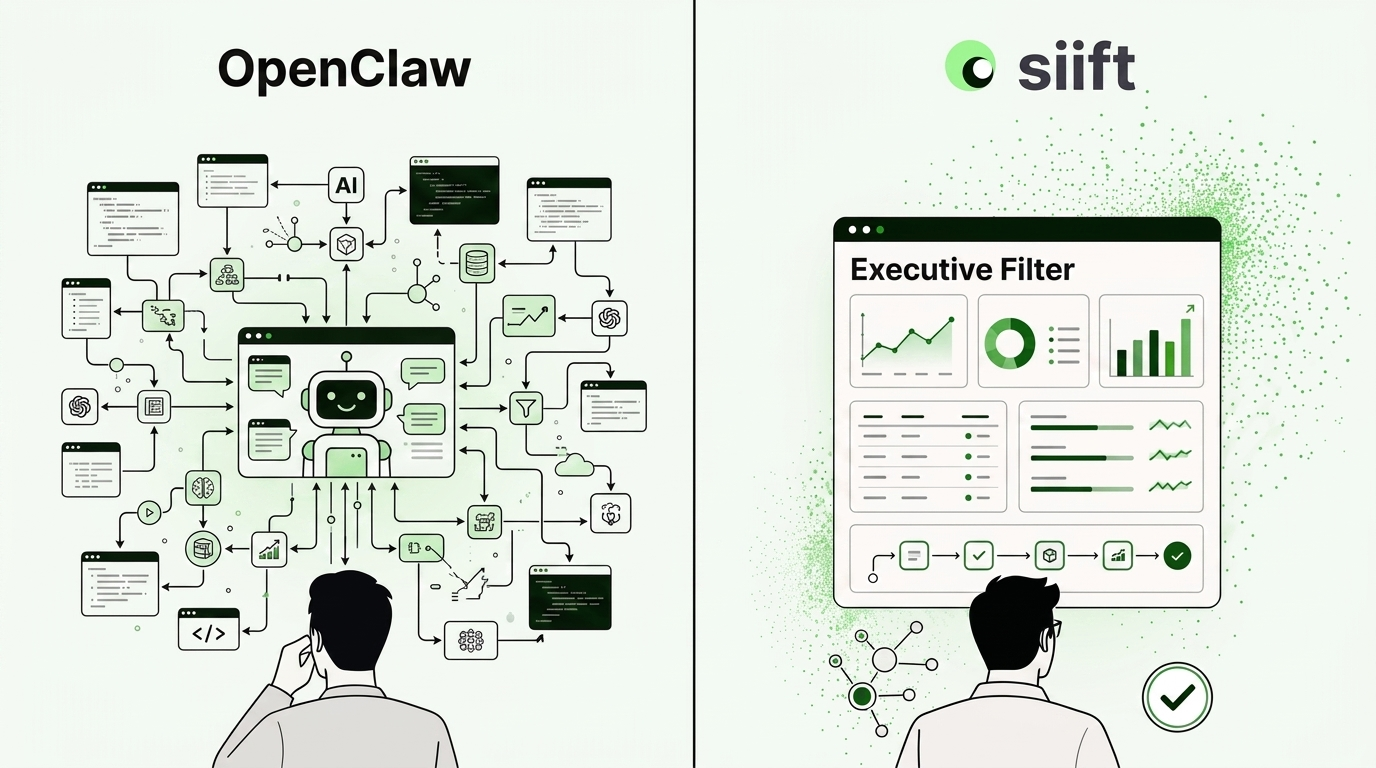
Siift vs OpenClaw Quick Comparison
Feature | Siift | OpenClaw |
|---|---|---|
Designed for | Founders, teams & startups | Tech-savvy consumers |
Main purpose | Business strategy & execution | AI agent automation |
Setup | Ready-to-use platform | Requires layers of technical setup |
Best for | Business building workflows, strategy, alignment, | Personalized workflows |
Context management | patent-pending scalable memory | limited markdown file system |
Pricing | Open Beta Deal $23/month instead of $47. Lock in the 50% lifetime discount while it lasts. | Free & open-source |
monthly subscription for turnkey solution | Open-source (plus user bares cost for hosting, infrastructure, and AI model costs) | No software subscription; user covers hosting, infrastructure, and AI model costs |
Why Startups Need More Than AI Automation
Automation alone does not solve a startup's biggest problem — deciding what to work on. AI agents can execute tasks quickly, but they can't tell a founder which customer signal matters, which market to enter first, or which feature to cut. That decision-making layer is where most startups actually lose time and money, not in execution speed.
The rise of AI agents has created a new opportunity for startups. Small teams can now automate technical work, research, content creation, analysis, and operational tasks at a scale that was previously impossible.
According to McKinsey’s State of AI 2025 survey, 62% of organizations reported that they are experimenting with AI agents, showing that companies are moving beyond traditional AI assistants toward more autonomous systems. However, most organizations are still in the early stages of scaling AI and capturing enterprise-level value.
However, automation alone does not solve one of the biggest startup problems: decision-making under uncertainty.
Startups operate with incomplete information.
Founders must make decisions about:
Market positioning
Customer needs
Product direction
Pricing
Growth channels
Team priorities
Generating more AI output does not automatically create better decisions, nevermind efficiency.
The value comes from having an AI system that understands context, prioritizes evidence, and helps teams focus on high-impact outcomes more efficiently and effectively.
This is the difference between an AI assistant and an AI operating system.
What Is OpenClaw?
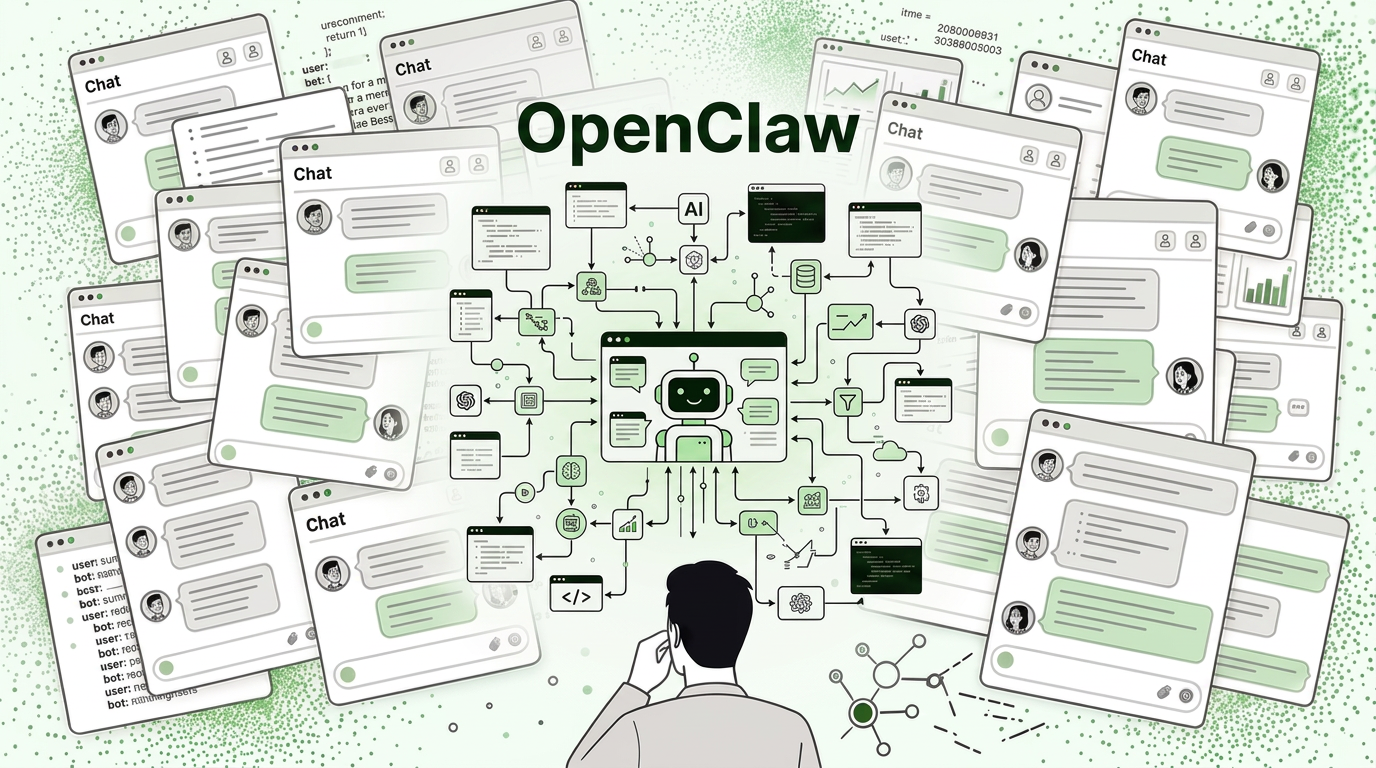
OpenClaw is an open-source AI agent platform built around proactive AI assistants. Instead of waiting for manual prompts, it can run scheduled heartbeat loops that allow agents to perform tasks automatically. It also integrates with messaging platforms such as WhatsApp, Telegram, Slack, Discord, Signal, and iMessage, making it especially useful for developers who want highly customizable automation workflows.
Technical teams can use OpenClaw to:
Connect AI models
Automate tasks
Create agent workflows
Integrate external tools
Execute commands
Build customized systems
For developers and technical teams, this level of control can be valuable.
OpenClaw follows an open-source approach where users have greater responsibility over setup, configuration, integrations, and workflow design.
This makes it attractive for:
Developers building custom AI agents
Technical teams experimenting with automation
Organizations that prefer self-managed systems
Users who want control over their AI infrastructure
However, because OpenClaw is intentionally flexible and developer-oriented, teams are responsible for designing their own business workflows, decision frameworks, and operational processes. Organizations looking for built-in startup guidance may prefer a platform designed specifically around business execution.
In fact, Autonomous agents can be extraordinarily token-inefficient. Research has found agentic tasks consuming roughly 1,000 times more tokens than conventional AI interactions, often without corresponding accuracy gains—while OpenClaw users have reported six-figure context payloads being processed for trivial recurring tasks, nevermind the “security dumpster fire” they can create.
OpenClaw provides flexibility for teams building customized AI-powered workflows. For teams searching for an OpenClaw alternative, the key question is whether they need a customizable AI agent platform to do specific, simple tasks they already have defined, or a more structured system designed around startup decision-making and business strategy.
The team still needs to decide:
Which workflows matter?
Which business goals should guide automation?
Which information should influence decisions?
How should the AI system support company growth?
What Is Siift?
Siift is an AI Business Operating System designed for founders, founding teams, serious entrepreneurs, and growing startups that need better focus and strategy management to achieve predefined goals.
As an AI operating system for startups, Siift helps teams manage business context, prioritize decisions, and connect strategy with execution.
Most AI tools are designed around answering questions, generating content, or completing isolated tasks.
Siift takes a different approach.
It is designed to help founders and founding teams organize, validate, and execute business strategy while keeping product, go-to-market, customer insights, and team priorities aligned throughout the company's growth journey by combining:
Best practices in Business frameworks
Strategy management
Executive Focus
AI-powered decision support
Context management
Team alignment
Workflow orchestration
Rather than generating more content or automating isolated tasks, siift is designed to help teams answer higher-value business questions: Which market should we pursue first? How valid is our strategy? Which customer feedback deserves action? What should our go-to-market strategy prioritize? Which initiatives create measurable business impact? This strategic management layer helps reduce uncertainty before execution begins.
As businesses grow, information becomes fragmented across:
Customer conversations
Product discussions
Market research
Sales insights
Team meetings
Strategy documents
Roadmaps
The challenge is no longer collecting information.
The challenge is knowing what information matters most and how it should influence decisions.
This is where Siift positions itself differently from general-purpose AI agents.
The Siift Advantage: Strategic Intelligence Over Automation Alone
Unlike traditional AI tools for founders that focus mainly on generating content or completing isolated tasks, Siift is designed as a strategic AI platform for startups focused on measurable business outcomes.
1. Anti-Slop Stance & Convograms: Filtering Noise Into Business Outcomes
Modern AI creates a new problem: information overload.
Teams can generate unlimited ideas, summaries, documents, and recommendations.
But more output does not always create more progress.
Siift is built around an Anti-Slop Stance.
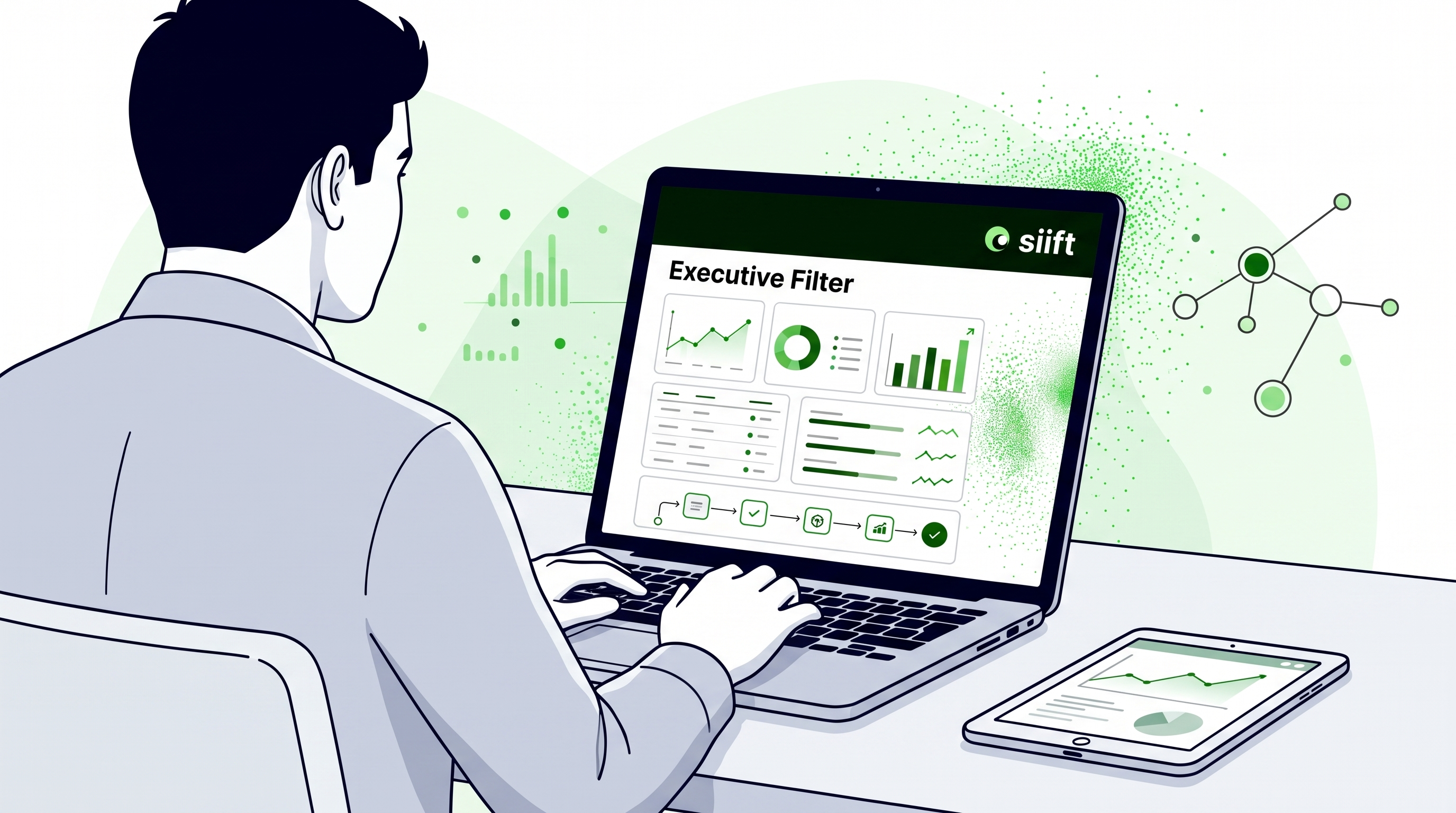
Instead of acting as a content generation engine, Siift works as an executive filter that helps teams focus on high-leverage decisions.
Through intent-defined conversation modes called Convograms, Siift structures interactions around specific business objectives.
Examples include:
Understanding customer problems
Refining positioning
Planning go-to-market strategy
Prioritizing business actions
Evaluating opportunities
The purpose is not to make users spend more time with AI.
The purpose is to help teams achieve measurable outcomes.
2. Master Context Engine & Truth Hierarchy
Startup decisions depend heavily on context.
A customer comment, market trend, sales signal, or product metric can completely change the direction of a company.
However, not all information has equal value.
A common challenge with AI systems is that they can store information without understanding which information should influence decisions more heavily.
Siift addresses this through its Master Context Engine and Truth Hierarchy.
Instead of treating every input equally, Siift prioritizes real-world validated signals such as:
Customer feedback
Market evidence
Traction indicators
Business results
Experiment outcomes
This helps prevent context rot—the situation where outdated assumptions continue influencing decisions even after new evidence appears.
For growing startups, maintaining accurate business context becomes increasingly important as more people, teams, and systems become involved.
3. Intelligent Business Canvas: One Operating View of the Company
Many startups operate across disconnected tools.
Strategy lives in documents.
Customer insights live in notes.
Tasks live in project management systems.
Product decisions live in separate conversations.
Over time, this creates operational fragmentation.
Siift addresses this through the Intelligent Business Canvas.
The Business Canvas organizes company knowledge into three connected areas:
Insights
Information that helps the team understand:
Customers
Market opportunities
Competitors
Business signals
Actions
Prioritized steps connected to business goals.
Instead of creating endless task lists, teams can focus on actions that create meaningful progress.
Assets
The company's accumulated knowledge, resources, and strategic materials.
Together, these create a unified business view where teams can understand:
What they know
What they need to do
What resources support execution
4. Top-of-Toolchain Executive Filter
A common misconception is that AI should replace every existing business tool.
That is not how modern companies operate.
Engineering teams need development platforms.
Marketing teams need marketing tools.
Sales teams need CRM systems.
Design teams need design software.
Siift is not designed to replace specialized tools.
Instead, it acts as a Top-of-Toolchain Executive Filter.
Through MCP and connectors, Siift can work across existing systems and consolidate important business context into a unified operating layer.
This allows leadership teams to maintain visibility without creating additional workspace complexity.
The result is not another disconnected productivity app.
It becomes a unified operating layer where leadership, product, marketing, sales, and operations can stay aligned around the same strategic context. Instead of adding another productivity tool, Siift helps eliminate workspace fragmentation while supporting coordinated execution across the company.
5. Privacy-First and Sustainable Business Model
For startups, business information is one of their most valuable assets.
Company strategies, customer research, product plans, and operational knowledge require strong protection.
Siift is designed around a privacy-focused approach.
The platform does not use customer intellectual property to train third-party AI models.
Instead, Siift focuses on helping companies use AI while maintaining control over their business knowledge.
This creates alignment between the platform and the companies using it.
The objective is not maximizing data collection.
The objective is helping businesses make better decisions.
How a Startup Might Use Siift: A Practical Example
Scenario: A 6-person SaaS startup is getting customer feedback from three channels — sales calls, support tickets, and a Slack community, but nobody on the team can tell which complaints are actually costing them revenue.
Without a business OS: The founder reads through notes manually every week, forms an opinion, and the product team builds based on gut feeling. Two months later, they discover the feature they built wasn't the one blocking upgrades.
With Siift's approach:
Feedback from all three channels is pulled into the Master Context Engine.
The Truth Hierarchy weighs validated signals (paying customers who churned) higher than casual community comments.
The Intelligent Business Canvas turns this into a prioritized Action: "Fix onboarding friction before adding new features."
The team executes with OpenClaw or their existing dev tools — Siift stays the strategic layer, not the execution layer.
Result (illustrative): Instead of three disconnected sources of noise, the founder has one prioritized, evidence-backed decision — made in hours, not weeks.
OpenClaw vs Siift: The Real Difference
The comparison between OpenClaw and Siift is not about which platform has more features.
They operate at different layers.
Area | OpenClaw | Siift |
|---|---|---|
Primary purpose | AI agent automation | AI Business Operating System |
Main users | Developers and technical teams | Founders, founding teams, startups |
Core strength | Custom automation | Strategic decision support |
Business framework | User-defined workflows | Built-in startup frameworks |
GTM planning | Not the primary focus | Core use case |
Context management | User-managed | Master Context Engine |
Team alignment | user must define | Business-wide views and SOPs |
Execution Focus | Technical workflows | Strategic and operational workflows |
Why Strategic AI Matters for Startup Growth
Strategic AI matters because speed without direction accelerates failure, not growth. A startup that automates the wrong workflow simply fails faster and with less runway left to recover. The real advantage of AI isn't how much work it removes — it's how much better the underlying decisions become.
The biggest opportunity with AI is not simply reducing manual work. It is helping teams make better decisions faster.
Startup Genome’s research, based on a dataset of more than 3,200 high-growth technology startups, found that approximately 70% of startups in their dataset showed signs of premature scaling. The research highlights why startups need disciplined prioritization and evidence-based decisions before scaling operations too quickly
This is especially important for startups.
Early-stage companies operate with limited resources. Every wrong decision has a higher cost.
A startup may spend months building a product, only to discover that the market problem was misunderstood.
CB Insights' analysis of more than 100 startup post-mortems identified lack of market need as one of the leading reasons startups fail. This highlights why founders need stronger validation, customer understanding, and strategic decision-making before investing heavily in execution.
This is why strategic context matters.
The question is not:
"How much work can AI automate?"
The better question is:
"How can AI help a company focus its limited resources on the decisions that create the most value?"
Which Tool Should Founders Choose?
The right choice depends on the startup's current needs.
Founders comparing Siift vs OpenClaw should first identify whether their biggest challenge is technical automation or building a repeatable business strategy.
There is no universal winner because the two platforms solve different problems. OpenClaw focuses on technical execution and customizable automation, while Siift focuses on helping founders and founding teams make better strategic decisions, align cross-functional teams, and execute a structured go-to-market strategy.
Choose OpenClaw If You Need:
Custom AI Automation
OpenClaw is a strong option for teams that want to create their own AI-powered workflows.
It fits teams that:
Have technical expertise
Want full control over AI agents
Need narrow, well-defined automations
Prefer self-managed infrastructure
Want to experiment with agent systems
For developers, flexibility is often the priority.
OpenClaw provides that flexibility.
Choose Siift If You Need:
Strategic Business Intelligence
Siift is designed for founders and startup teams who need help navigating business complexity.
It fits teams that need:
Market validation support
Go-to-market planning
Strategic prioritization
Team alignment
Business context management
Decision support
Efficient & Effective Inference
Fully-managed, enterprise-grade and truly private AI services
Instead of asking founders to build their own AI operating framework, Siift provides structured systems designed around startup execution.
Siift vs OpenClaw for Different Startup Stages
Startup Stage | Primary Challenge | Better Fit |
|---|---|---|
Idea Stage | Understanding market, customers, positioning | Siift |
Validation Stage | Testing assumptions and prioritizing opportunities | Siift |
MVP Development | Building technical workflows quickly | OpenClaw |
Early Growth | Aligning teams and improving execution | Siift |
Scaling Operations | Automating technical processes | Siift |
Can Founders Use Both Siift and OpenClaw Together?
Yes.
The two platforms can complement each other.
A growing startup may use:
Siift for:
Business strategy
Market understanding
GTM planning
Prioritization
Team alignment
OpenClaw for:
Technical automation
Custom agents
Developer workflows
Engineering experiments
The future of AI adoption will likely not be about finding one tool that replaces everything.
It will be about building a connected AI stack where each system handles the layer it is best designed for.
Example:
A SaaS founder receives customer feedback, competitor updates, and sales insights every week.
OpenClaw can help automate data collection and technical workflows.
Siift helps analyze business context, prioritize opportunities, and decide which actions should influence company strategy.
Together, they create a complete AI workflow: automation plus strategic intelligence.
Final Verdict: Siift vs OpenClaw
OpenClaw and Siift are not direct replacements for one another; they operate at different use-cases.
OpenClaw is an excellent choice for developers or hobbyists who want maximum flexibility to build, customize, and automate AI-powered workflows for simple, well-defined intent.
Siift is designed for founders, founding teams, serious entrepreneurs, and growing startups that need more than automation. It provides a structured operating system that connects business strategy, market intelligence, customer feedback, go-to-market planning, and execution into a single source of truth.
As AI becomes a core part of how companies operate, competitive advantage will increasingly come from making better decisions not simply generating more output.
For startups focused on long-term growth, aligned teams, and measurable business outcomes, Siift provides the strategic operating layer that helps transform ideas into disciplined execution while working alongside existing tools and AI agents.
If your goal is simply automating tasks, OpenClaw is a capable choice.
If your goal is building a scalable business with better strategy, stronger team alignment, and clearer execution, Siift is built for that mission.
Open Beta Deal: Save 50% for Life — Get Siift Focus for just $23/month instead of $47, plus an extra 50% lifetime discount while the offer lasts.
Frequently Asked Questions
What is the difference between Siift and OpenClaw?
OpenClaw is an open-source AI agent framework focused on customizable automation and technical workflows.
Siift is an AI Business Operating System designed for startup strategy, context management, prioritization, and team alignment.
Is OpenClaw an alternative to Siift?
They overlap in the broader AI space but solve different problems.
OpenClaw focuses on executing workflows. Siift focuses on helping businesses decide which workflows and actions should matter most.
Which is safer for startup data — Siift or OpenClaw?
Siift follows a privacy-first model and does not use customer data to train third-party AI models. OpenClaw, being open-source and self-hosted, gives teams full control over their data — but that also means the team is responsible for their own security setup, unlike Siift's managed approach.
Can I use OpenClaw and Siift together without conflicts?
Yes. They operate at different layers — Siift as the strategic/context layer, OpenClaw as the execution/automation layer. Teams typically connect them through integrations rather than replacing one with the other.
What is the best AI tool for a solo founder in 2026?
For a solo founder, the priority is usually clarity and prioritization over custom automation, since there's no team to build complex workflows for. A structured system like Siift tends to fit better at this stage; OpenClaw becomes more valuable once there's a technical team to maintain custom agents.
Does Siift require technical setup like OpenClaw does?
No. Siift is a ready-to-use platform designed for founders without requiring engineering setup. OpenClaw, as an open-source framework, requires configuration, hosting, and technical maintenance.
Build Your Startup With Strategic AI, Not Just More Automation
Building a startup requires more than generating more AI output. Teams need an AI system that helps them understand their market, prioritize opportunities, and execute with confidence.
It needs better context, better prioritization, and better decisions.
Discover how Siift helps founders and startup teams transform ideas into structured execution.
Compare Siift With Other AI Operating Systems for New Businesses
Choosing the right AI operating system can impact how founders plan, build, and scale their businesses. Explore these in-depth comparisons to understand how Siift compares with other AI platforms for business strategy, automation, productivity, and startup workflows.
Siift vs ChatGPT: Which AI Operating System Is Better for New Business Workflows?
Siift vs Claude: Which AI Assistant Is Better for Entrepreneurs and Startup Operations?
Siift vs Polsia: Which AI Platform Is Better for Business Planning and Execution?
Siift vs Hermes Agent: AI Agents vs AI Business OS for Startups
Siift vs. Buildpad: Best AI Operating System for Growing Startups
Siift vs Cofounder 2: Which AI Business OS Is Better in 2026?
Ready to move beyond disconnected AI tools?
Discover how Siift helps founding teams organize business context, prioritize opportunities, and turn strategy into measurable execution.