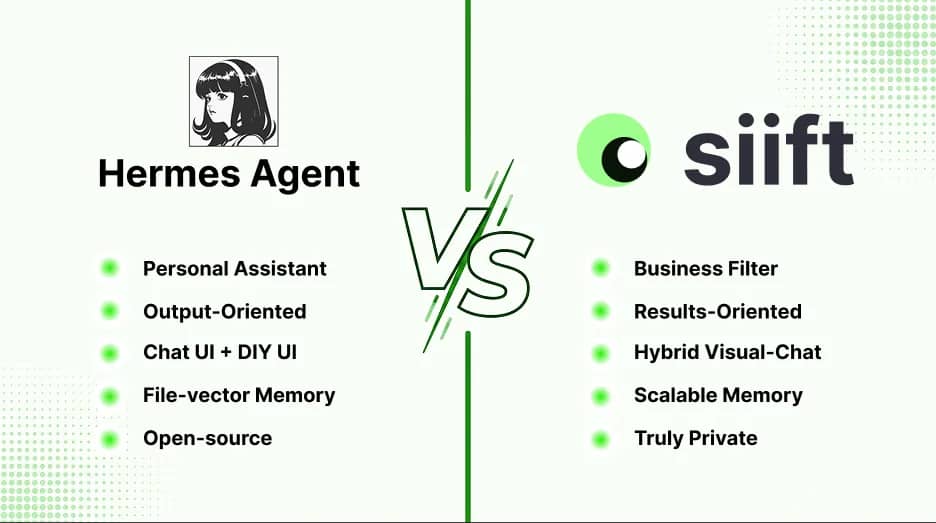
Self-Evolving Skills vs. Structured Business Intelligence: Why Founding Teams Need More Than a Smarter Agent
Hermes Agent, the self-improving agent from Nous Research, can write its own skills, grade them, and prune the ones that don't work — running the whole loop on a VPS that costs about as much as a coffee subscription. It's a genuinely impressive piece of open-source engineering, and it's earned real attention from developers and hardware partners alike.
While Hermes Agent focuses on autonomous technical execution, Siift approaches AI from a different angle: helping founding teams make better business decisions, validate ideas, and align execution.
But building a company takes more than an agent that keeps getting better at completing tasks.
Founding teams still need to know:
Does this idea have real customer demand?
Is our customer acquisition cost actually viable?
What does our go-to-market sequence look like?
Is everyone on the team looking at the same evidence?
This is the real difference between Hermes Agent and Siift.
Hermes Agent represents the self-evolving technical agent approach, a tool that gets sharper at how it executes.
Siift represents the structured business operating system approach built for founding team, serious entrepreneurs, and growing startups who need to get sharper at what they execute and why.
The comparison isn't which one writes better code or completes more tasks. It's:
Which system actually helps you build the right company?
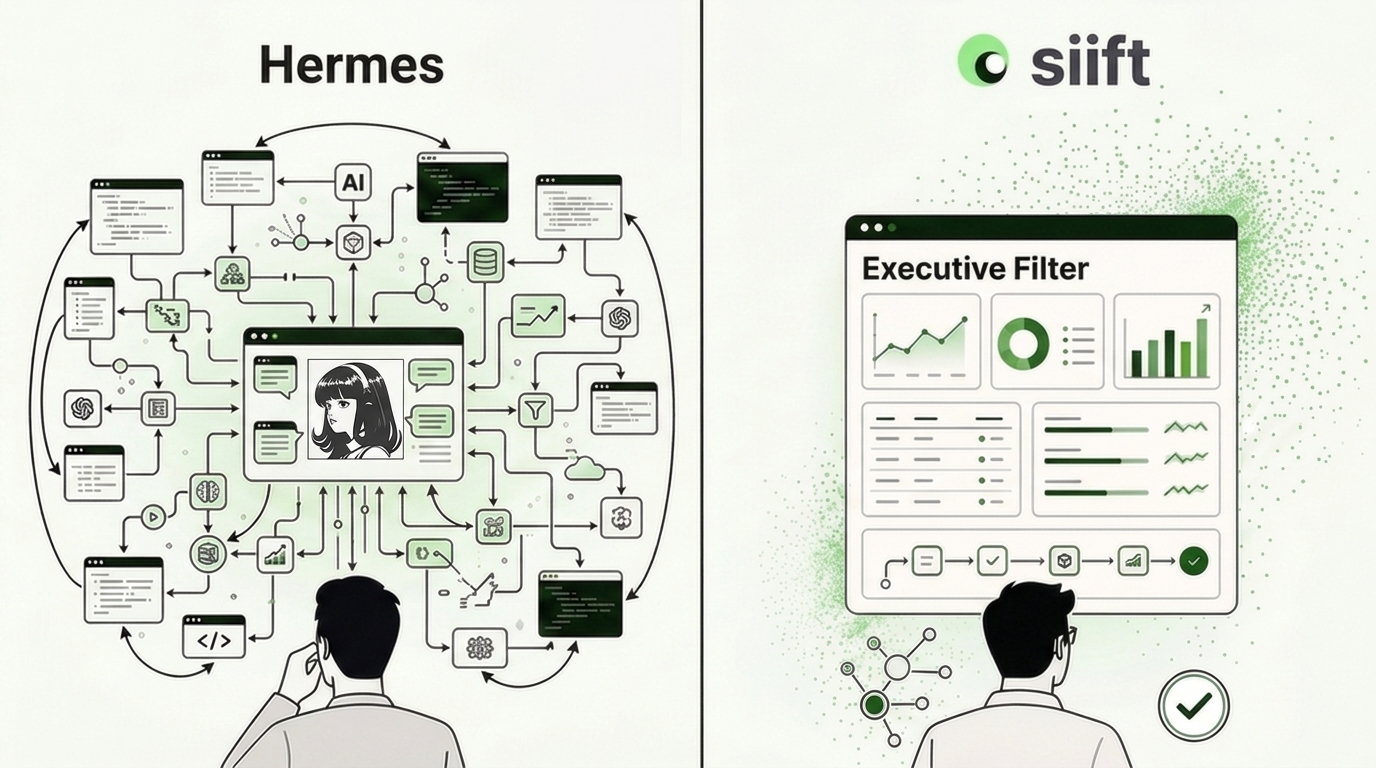
Quick Answer: Siift vs Hermes Agent
Hermes Agent is an open-source, self-evolving AI agent built for technical automation on infrastructure you manage. Siift is an AI business operating system built for founding teams, serious entrepreneurs, and growing startups who need validation, go-to-market strategy, and aligned execution, not just faster scripts.
Hermes Agent (Nous Research) | Siift (The New Business OS) | |
|---|---|---|
Designed for | Developers automating technical tasks | Founding teams, serious entrepreneurs & growing startups |
Core approach | Self-evolving skills, autonomous execution | Structured business intelligence & executive filter |
Setup | Self-hosted — VPS, Docker, or local, DIY | Two-click SaaS onboarding, no infrastructure to manage |
Memory | SQLite + local | Master Context Engine + Truth Hierarchy |
Interface | Chat via Telegram, Discord, Slack & similar | Intelligent Business Canvas (Insights / Actions / Assets) |
Collaboration | Single-user | Shared workspace for founders, partners & advisors |
Security | Entirely user-managed | Managed, enterprise-grade cloud infrastructure |
Pricing | starts at ~$5/month VPS up to local RTX hardware | Open Beta Deal: $23/month instead of $47. Lock in the 50% lifetime discount while it lasts. |
What Is Hermes Agent?
Hermes Agent is Nous Research's open-source, self-improving AI agent. Its headline feature is a closed learning loop: it writes new "skills" from experience, grades and curates them over time, and remembers across sessions — all running on infrastructure you choose, from a ~$5/month VPS up to local RTX hardware.
It's genuinely good at:
Automating scripts, scraping, and repetitive developer workflows
Generating and refining its own tools as it hits new tasks
Living inside the messaging apps a technical team already uses — Telegram, Discord, Slack, and 15+ others
Running provider-agnostic, so you're not locked into one model
For a technically capable builder, that's a legitimately strong execution layer.
But running a company is not only an execution problem. Before (and while) automating anything, a founding team still has to answer questions Hermes Agent was never designed to touch:
Is there real market demand for this?
Which customer segment should we prioritize?
What's our go-to-market sequence?
Are we — as a team — actually aligned on the answer?
Hermes Agent's skill library gets sharper the more you run it. It has no equivalent mechanism for getting your strategy sharper.
There's also a practical tradeoff worth naming plainly: running Hermes Agent on your own VPS is cheap, but managing server security, API key exposure, and container isolation becomes entirely your responsibility. For a solo side project, that's a reasonable trade. For growing businesses, this approach also comes with additional technical ownership. Managing infrastructure, security configurations, API keys, and deployment environments becomes part of the team's responsibility as operations scale.
The Problem: A Self-Driving Car With No Destination
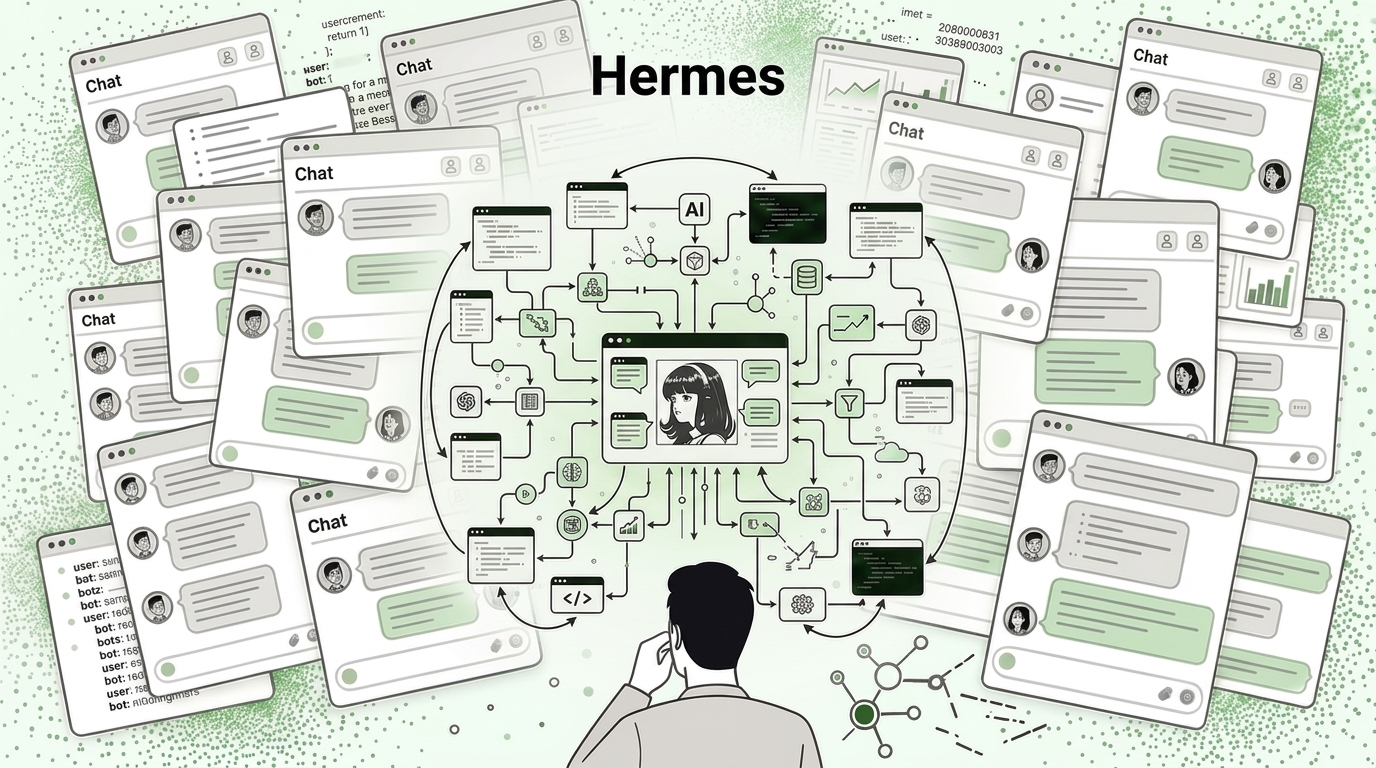
Hermes Agent's closed learning loop is built to optimize technical tasks, such as scraping a site faster, generating a cleaner script, and refining a tool it wrote last week. It has no concept of whether your product has market demand, whether your CAC is viable, or what your GTM strategy should look like.
It's a self-driving car with no destination.
This matters more than it sounds like. CB Insights' latest analysis of startup shutdowns — 431 VC-backed companies that failed since 2023 — found that poor product-market fit was the single biggest factor, cited in 43% of failures, ahead of running out of cash or bad timing. A faster execution engine doesn't fix that. If anything, it lets a team build the wrong thing more efficiently.
The same analysis found 23% of failures involved "not the right team" — skill gaps, misalignment, or an inability to execute together. That's the second problem with a Telegram-bot-shaped tool: Hermes Agent is primarily designed around individual technical workflows and developer-focused automation rather than shared business decision-making across a founding team. Each cofounder running their own side conversation with it means the team's context lives in scattered chat histories, not a shared source of truth.
Siift takes the power of agentic workflows and anchors them to proven entrepreneurial frameworks instead. Learn more about how Siift approaches business building as an AI Business Operating System designed for modern founders.
Siift: The Executive Filter for Founding Teams
Siift isn't a content generator, and it isn't trying to out-code Hermes Agent. It's an executive filter — designed to prevent cognitive overload and aimless "vibe-founding" by forcing focus on the milestones that actually move a business forward, for founders, founding teams, and growing startups alike.
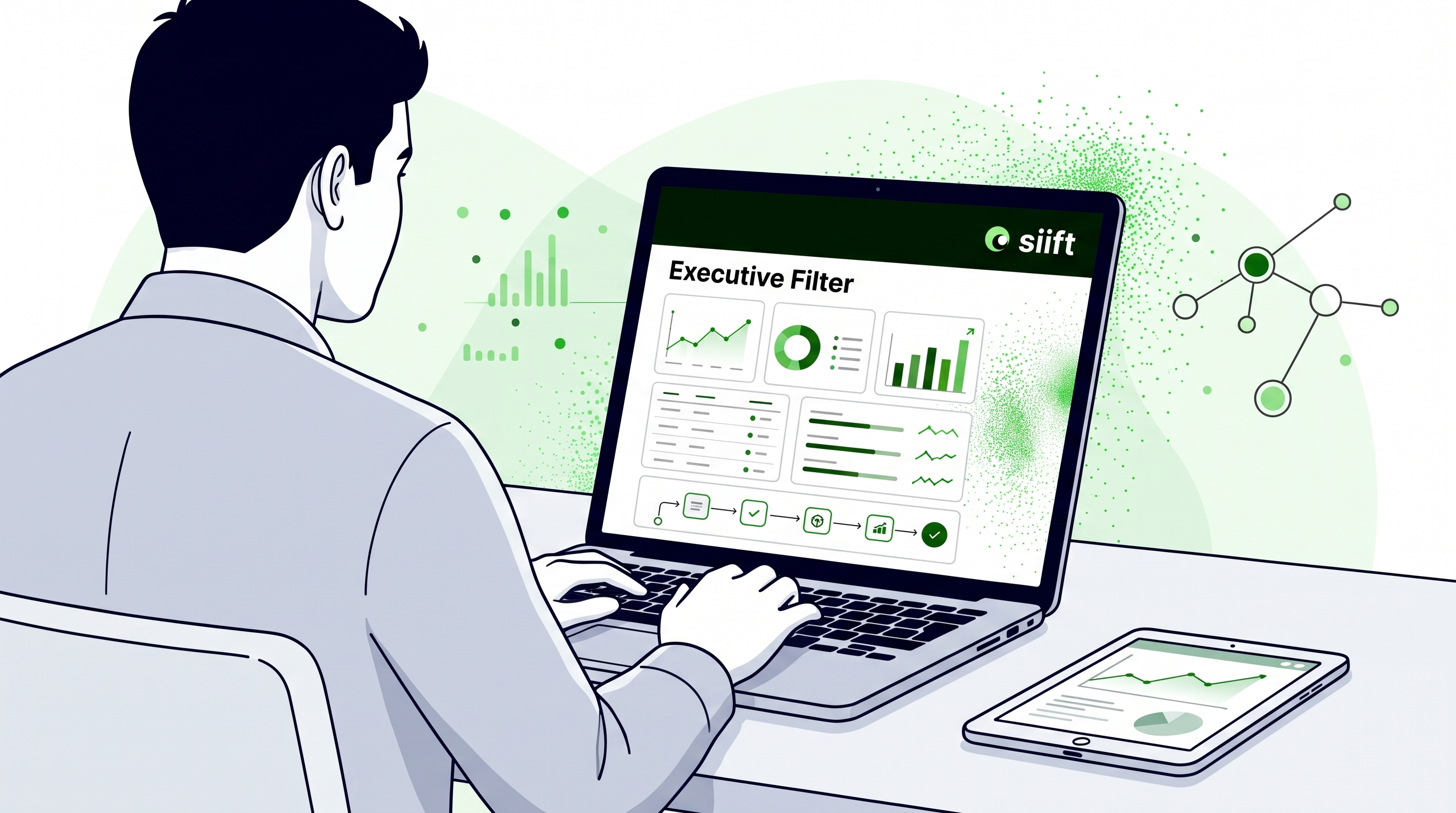
Here's how that plays out across the five things Siift is actually built around.
1. The Anti-Slop Stance & Convograms: Skills Aren't the Same as Progress
Hermes Agent measures its own success in skills generated and tasks completed. Siift measures success in validated business milestones.
Siift's Anti-Slop Stance exists specifically to resist the pull toward more output for its own sake: more ideas, more drafts, and more "busy" work. Instead, Convograms — intent-defined conversation modes for ideation, validation, go-to-market, and growth keep every session tied to a specific business objective, not an open-ended chat.
2. Master Context Engine & Truth Hierarchy: Beyond SQLite and a Markdown File
Hermes Agent's memory is genuinely clever for what it's built to do: SQLite plus a local MEMORY.md file, optimized for fast, task-level recall. It's built to remember how you like a script written, not to weigh which customer signal should change your roadmap.
Siift's Master Context Engine does the latter. It dynamically rebalances your business context, weighting real-world validated evidence — customer feedback, traction metrics — over unvalidated assumptions, so downstream decisions don't quietly rot on outdated context.
3. The Intelligent Business Canvas: One View Instead of Scattered Chats
Hermes Agent lives inside a chat window, one conversation at a time. There's no view of the business itself — just a growing library of skills and a task history.
Siift's Intelligent Business Canvas organizes everything into three views your whole team can see at once: Insights (validated learnings and customer signals), Actions (prioritized next steps), and Assets (the resources and materials behind them). It is deeply integrated into an AI chat and agentic orchestrator, without the workspace sprawl of a dozen disconnected tools.
4. Top-of-Toolchain Executive Filter: Orchestration Aimed at Business Goals
To be fair to Hermes Agent, it does support MCP it can connect to tools and chain technical tasks together. The difference is what that orchestration is for. Hermes Agent's connectors serve the next technical step. Siift's connectors serve the business.
Siift doesn't try to replace your specialized developer, design, or marketing tools — including Hermes Agent, if that's already part of your stack. Via MCP and connectors, it orchestrates tasks across your existing toolchain and consolidates the results back into one command center, so every automated action still rolls up to a business goal instead of sitting in isolation.
5. The Truly Private, Sustainable Token Business Model: Managed Doesn't Mean Exposed
Self-hosting Hermes Agent means you keep full control of your data — and you also inherit full responsibility for securing it. There's no vendor to trust, but no managed security either.
Siift takes the opposite trade, deliberately: a private, managed platform with a business model built not to need your data. Siift makes healthy margins on compute tokens, which means zero incentive to farm, monetize, or sell what you share with it. Siift never trains third-party models on your IP, and runs on hardened, enterprise-grade cloud infrastructure — so a growing team gets privacy and doesn't have to own the server.
Go-To-Market, Business Strategy & Team Alignment: The Gap Hermes Agent Leaves Open
This is the part a purely technical comparison misses, and it's where founding teams feel the difference most.
Go-to-market. Hermes Agent has no concept of positioning, channel prioritization, or launch sequencing — that's not a criticism, it's simply outside its scope. Siift's Convograms include a dedicated go-to-market mode, connecting customer insight directly to a sequenced plan instead of leaving GTM as a separate, manual exercise.
Business strategy. Automating a script faster doesn't tell you which market to enter first, or which feature to cut. Siift's Truth Hierarchy exists to keep those calls anchored to validated evidence — customer reality, not the loudest assumption in the room.
Team alignment. This is the one pure automation tools consistently miss. Hermes Agent is a single-user chat interface: great for one developer, silent on what happens when three cofounders each have their own instance and their own version of "what we decided." Siift is built as a collaborative hub where founders, partners, and advisors work from the same Business Canvas — so alignment isn't a side effect of someone remembering to forward a chat log.
A practical example:
Scenario: A four-person founding team uses Hermes Agent to scrape competitor pricing and auto-draft cold outreach every night — genuinely useful automation, and Hermes Agent is good at it.
Without a business layer: Each cofounder also runs their own side conversations with Hermes Agent on Telegram. Nobody has a shared view of which outreach segment is actually converting, and the Monday standup burns time re-explaining context instead of deciding what's next.
With Siift alongside Hermes Agent:
Hermes Agent keeps running the scraping and outreach scripts — it's genuinely good at this part.
Reply and conversion data flows into Siift's Master Context Engine.
The Truth Hierarchy weighs actual conversion signals above raw email volume.
The Intelligent Business Canvas turns this into one prioritized Action the whole team sees: "Segment B is converting 3x higher — reallocate outreach there before adding new segments."
Result: Hermes Agent keeps executing the grunt work. Siift makes sure the team is pointed at the right target, together.
From Customer Feedback to Business Decisions: Where Siift Fits
Building a startup is not only about completing more tasks — it is about making better decisions with the right context.
A founding team may collect customer interviews, analyze competitor movements, test pricing ideas, and experiment with acquisition channels. But without a structured system, these insights often remain scattered across documents, conversations, and disconnected tools.
Siift helps transform these signals into actionable business decisions.
For example:
A SaaS founding team receives feedback from early customers that a specific workflow is creating the most value. Instead of leaving that insight buried in meeting notes, Siift's Master Context Engine helps prioritize validated customer signals over assumptions.
The team can then use Convograms to explore positioning, refine their go-to-market approach, and identify the next highest-impact milestone.
Through the Intelligent Business Canvas, founders, partners, and advisors can align around the same:
Insights from customers and market feedback
Actions that move the business forward
Assets supporting execution
The result is not just faster automation — it is a clearer path from customer evidence to strategic execution.
Direct Feature Comparison: Hermes Agent vs Siift
Feature / Capability | Hermes Agent (Nous Research) | Siift (The New Business OS) |
|---|---|---|
Core Value Prop | Technical task automation and self-generating code-level skills | Strategic company building, validation, and GTM execution |
Go-To-Market Support | Not a focus — no positioning or launch guidance | Core use case — Convograms guide GTM planning |
Team Alignment | Single-user chat interface | Collaborative hub keeping founders, partners & advisors aligned |
Business Strategy | None — optimized for isolated technical tasks | Master Context Engine ties decisions to validated evidence |
Infrastructure & Security | Self-hosted on a VPS from about $5/month; security is entirely the user's responsibility | Fully managed, enterprise-grade secure cloud hosting |
Memory System | SQLite and local | Master Context Engine that dynamically reweighs business data based on validation |
Setup | DIY — VPS/Docker/local setup, coding skills required, developer-oriented | Two-click setup, guided onboarding, no infrastructure to manage |
Tool Orchestration | MCP-based, aimed at chaining technical/dev tools | MCP-based, aimed at consolidating your whole stack into one business command center |
Can Founding Teams Use Both Hermes Agent and Siift?
Yes — for technical teams, this is often the more realistic setup than picking one.
Hermes Agent can keep handling the execution layer: scraping, scripting, scheduled automations, anything that benefits from a self-improving skill library running on infrastructure you control.
Siift sits above that as the strategic layer, pulling in the results as validated signals, weighing them through the Truth Hierarchy, and turning them into prioritized Actions the whole founding team can see.
Automation gets faster. Siift makes sure it's pointed at the right target.
For founders exploring more AI workflows, see our guide on AI tools for startup founders.
Choose Hermes Agent If You Need:
A self-hosted, open-source automation agent
Full control over infrastructure and model choice
To automate scripts, scraping, or repetitive dev workflows
A tool that lives inside Telegram, Discord, Slack, or similar
Comfort managing your own server security
Hermes Agent is a strong choice for technical builders who want a capable, self-improving execution layer.
Choose Siift If You Need:
An AI business operating system for founding teams, serious entrepreneurs, and growing startups
Validation before you build, not just faster building
A structured go-to-market and business strategy layer
One shared, evidence-weighted view your whole team can work from
Managed, privacy-committed infrastructure with nothing to self-host
Siift is designed for teams who need a strategic and operational layer above their tools — not another agent to maintain.
Frequently Asked Questions
Is Siift an alternative to Hermes Agent?
Not a direct swap-in — they solve different problems. Hermes Agent is a technical automation tool; Siift is a business operating system. Many founding teams use an agent like Hermes for execution while using Siift as the strategic layer that decides what's worth automating in the first place.
Is Hermes Agent good for startups?
It's a strong choice for technically capable teams that want to automate scripts, scraping, or repetitive developer workflows on their own infrastructure. It wasn't built for market validation, GTM planning, or keeping a founding team aligned on strategy that requires a different kind of tool.
What is the best Hermes Agent alternative for founding teams?
It depends on the gap you're closing. If you need more technical agents, look at other developer-oriented frameworks. If the gap is business strategy, validation, and execution tracking across a team, Siift is built specifically for that.
Do I need to code to use Hermes Agent?
Some technical comfort helps. Running it typically means provisioning a VPS or container, managing API keys, and maintaining the environment yourself it's squarely aimed at developers and technical teams.
How is Siift different from Hermes Agent?
Hermes Agent is an open-source, self-improving agent that writes and refines its own skills to execute technical tasks. Siift is an AI business operating system with a Master Context Engine, Truth Hierarchy, and Intelligent Business Canvas, built to help founding teams validate ideas, plan go-to-market, and stay aligned while they execute.
Which is better for startups, Hermes Agent or Siift?
Hermes Agent is better for technical automation and developer workflows. Siift is better for founding teams that need business strategy, customer validation, go-to-market planning, and team alignment alongside AI execution.
Can a solo founder use Siift, or is it only for teams?
Solo founders can use Siift too, but it's increasingly built around founding teams, serious entrepreneurs, and growing startups who need to keep multiple people aligned on the same validated context not just one person's chat history.
Final Verdict: Siift vs Hermes Agent
Hermes Agent is a genuinely impressive piece of open-source engineering. It is an agent that writes, grades, and prunes its own skills while running on a VPS you control. For a technical team that wants to automate scripts, scraping, or repetitive dev workflows, it's hard to beat.
But self-evolving skills answer "how do we execute faster," not "are we executing the right thing." That second question is about real customer evidence, a sequenced go-to-market plan, and shared alignment across the founding team instead of being buried in one person's Telegram history. This is what Siift is built around.
Hermes Agent is a self-driving car. Siift is the destination, the map, and the rest of the team in the car with you.
The future of AI for startups is not choosing between automation and strategy. The strongest teams will combine powerful execution agents with a business intelligence layer that keeps every action connected to a validated goal.
Why Founding Teams Need Business Context, Not Just AI Automation
Modern startups are adopting AI agents faster than ever, but execution speed alone does not guarantee business success. Teams need systems that connect customer insights, strategy, and execution into one shared context.
Build the Business Around the Automation
Hermes Agent can automate the scripts. Siift makes sure your founding team is validating the right idea, sequencing the right go-to-market plan, and staying aligned while you do it.
Open Beta Deal — Siift Focus for just $23/month instead of $47. Lock in the 50% lifetime discount while it lasts. Explore Siift and start building with clarity, confidence, and a smarter AI business partner.
Compare Siift With Other AI Operating Systems for New Businesses
Siift vs ChatGPT: Which AI Operating System Is Better for New Business Workflows?
Siift vs Claude: Which AI Assistant Is Better for Entrepreneurs and Startup Operations?
Siift vs Polsia: Which AI Platform Is Better for Business Planning and Execution?
Siift vs OpenClaw: Which AI OS Is Better for Startups in 2026?
Siift vs. Buildpad: Best AI Operating System for Growing Startups
Siift vs Cofounder 2: Which AI Business OS Is Better in 2026?