Artificial intelligence (AI) is transforming how startups are built, shifting from experimental tools to core business infrastructure. According to McKinsey's State of AI research, 78% of organizations now use AI in at least one business function, reflecting the rapid adoption of AI for product development, operations, marketing, customer support, and decision-making.
As AI agents become more capable, founders are increasingly searching for answers to questions like "Siift vs Polsia," "Which AI platform is best for startup founders?" and "Should I use autonomous AI agents or a strategic AI operating system?" While AI can generate code, automate workflows, create content, and accelerate execution, building a successful startup requires more than speed—it requires making the right strategic decisions.
The biggest startup challenge is not:
"How fast can AI build?"
It is:
"Can AI help founders build the right thing?"
This is where Siift and Polsia take different approaches.
Polsia focuses on autonomous AI agents that can execute startup tasks and automate workflows.
Siift is an AI business operating system designed to help founders validate ideas, manage business context, prioritize decisions, and coordinate execution while keeping strategic control.
The difference is simple:
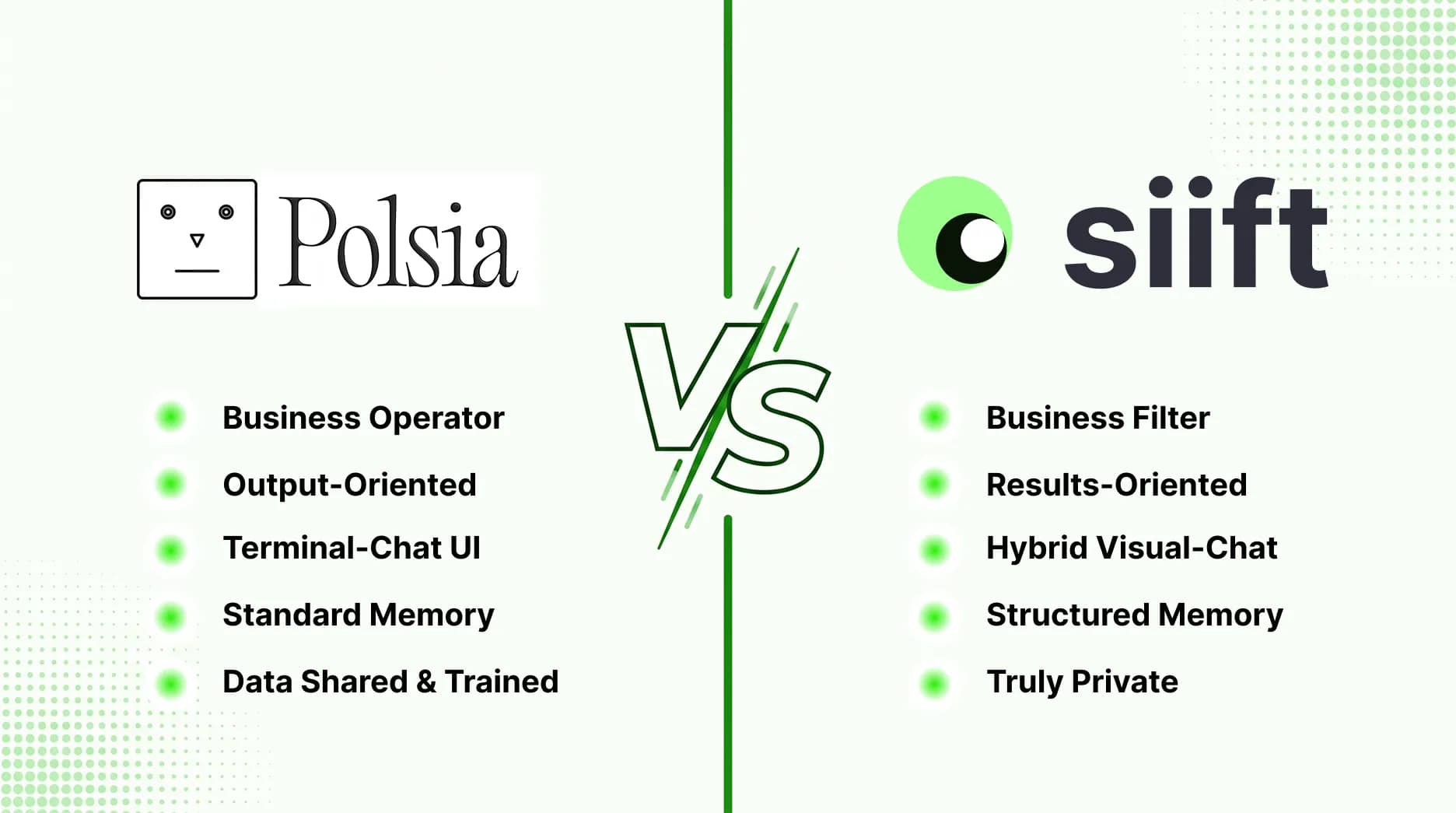
Polsia focuses on AI-powered business operations, using agentic workflows to execute configured tasks and interact with connected services.
Siift balances automation and agency for better results, while keeping humans in control.
Quick Answer: Siift vs Polsia
What is the difference between Siift and Polsia?
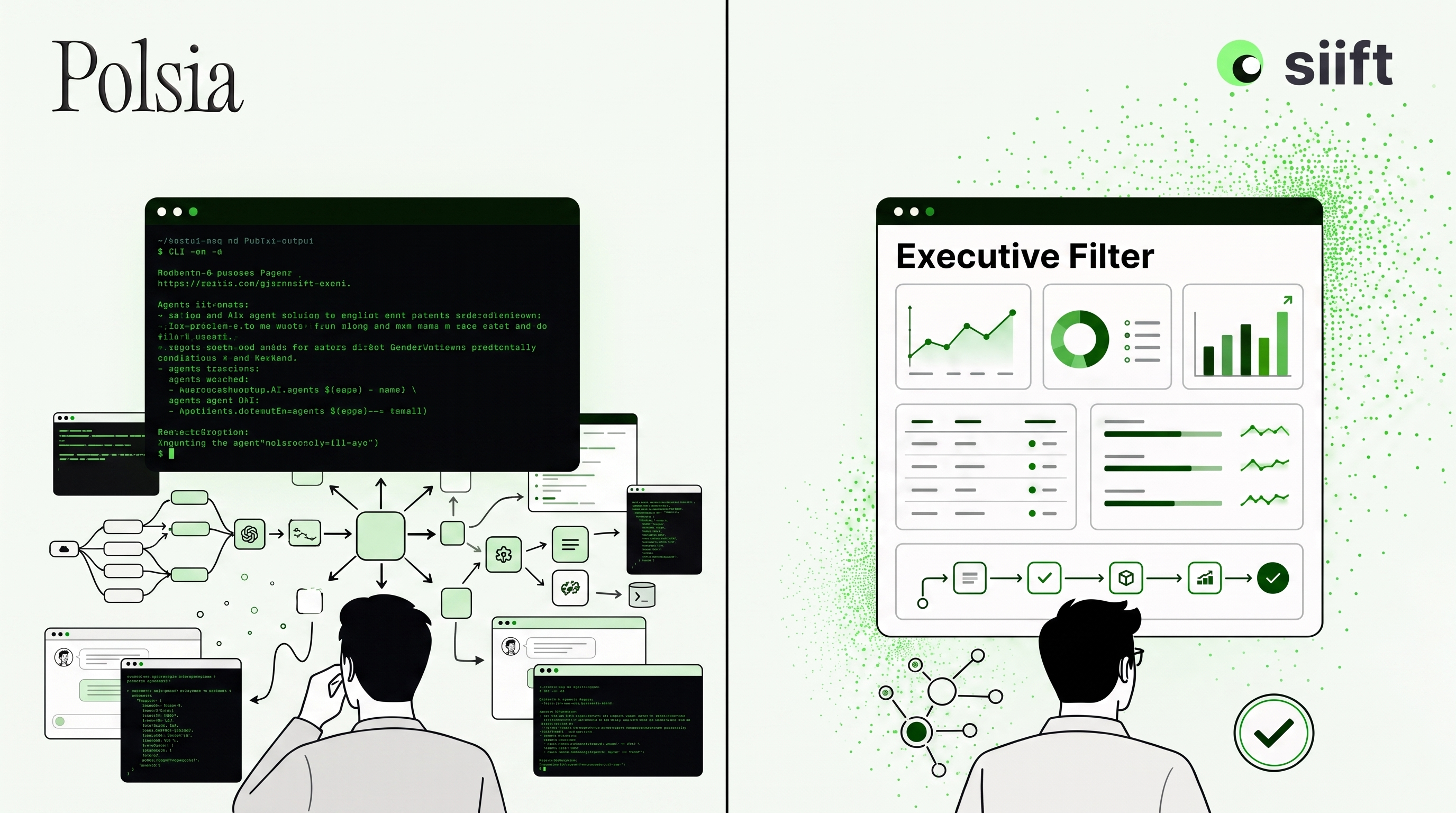
Polsia is an autonomous AI agent platform focused on executing startup tasks, while Siift is a founder-focused AI operating system built around validation, context management, and strategic execution.
Founders choosing between them should consider one key question:
Do they need AI that mainly produces output, or AI that helps them make better outputs?
What Is Polsia?
Polsia represents the autonomous AI agent approach to startup building.
The idea is that founders can give AI systems goals and allow agents to handle multiple execution tasks, including:
Building applications & generating code
Planning and conducting marketing
Automating operations like outreach or support
Deciding business strategy
This approach can be valuable for rapid experimentation.
However, startups are not only execution problems.
Before building, founders need answers to important questions:
Is there real customer demand?
Is this problem worth solving?
What is our unique value proposition?
Which features matter most?
What activities should be prioritized?
Without a strategic map and a feedback loop, faster execution can simply create more mistakes, not more learning.
The Problem With Autonomous AI: Activity Is Not Always Progress
The promise of autonomous AI is powerful.
Give an AI system a goal, and it starts working.
But startups require judgment, not only execution.
A company can create:
More code
More features
More content
More automated workflows
…and still fail because it did not solve a meaningful market problem in a logical way.
This challenge is reflected in startup failure data. According to CB Insights' analysis of startup post-mortems, 42% of startups fail because there is no market need for their product. This highlights why validating customer demand before scaling execution is critical for founders.
Founders can use a structured startup validation framework to test assumptions before investing heavily in development.
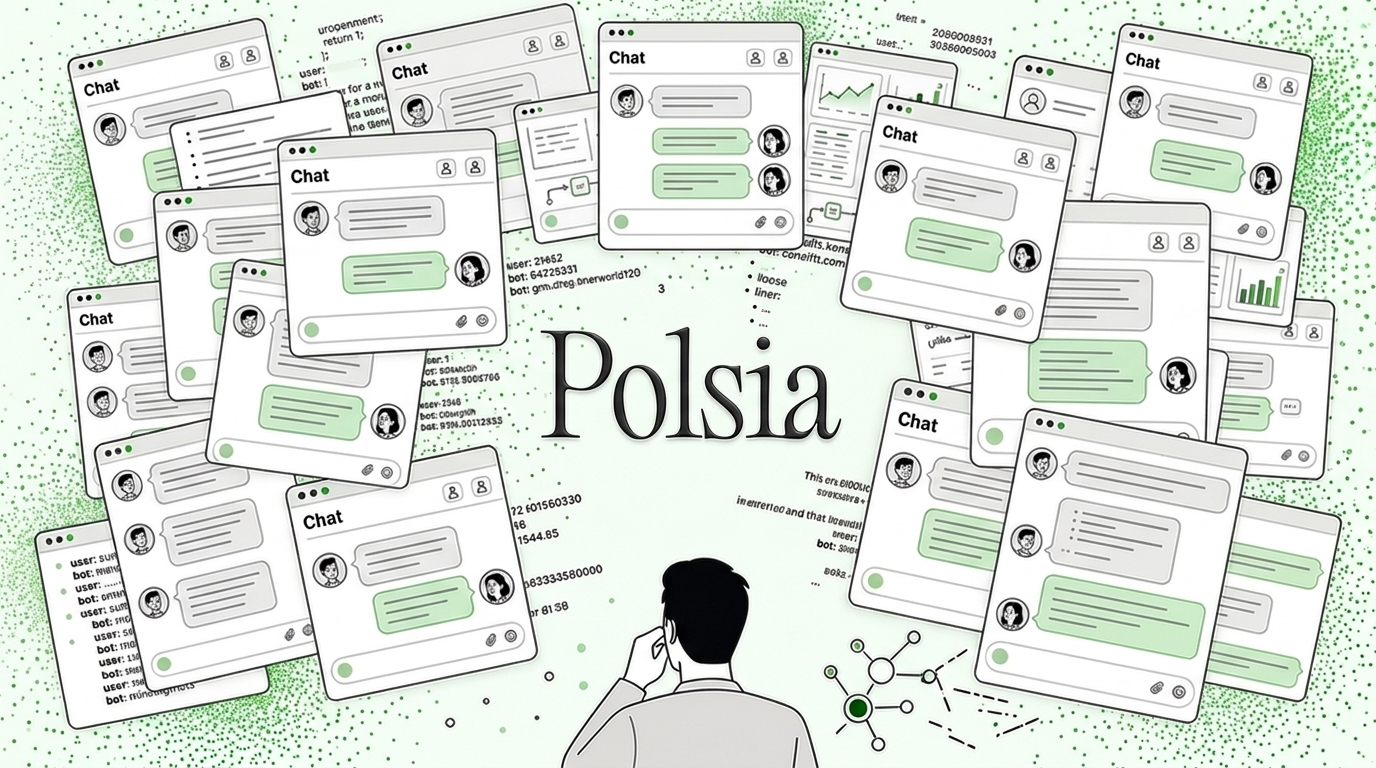
This creates the Autopilot Theatre problem.
Everything appears active, the system is “busy”
But busy-ness does not always equal progress.
The best AI systems should help founders focus on measurable outcomes, not just generate more output.
Siift: The Executive Filter for Founders
Siift takes a different approach.
As more founders build companies with smaller teams, AI systems are becoming less about replacing people and more about increasing the team’s leverage.
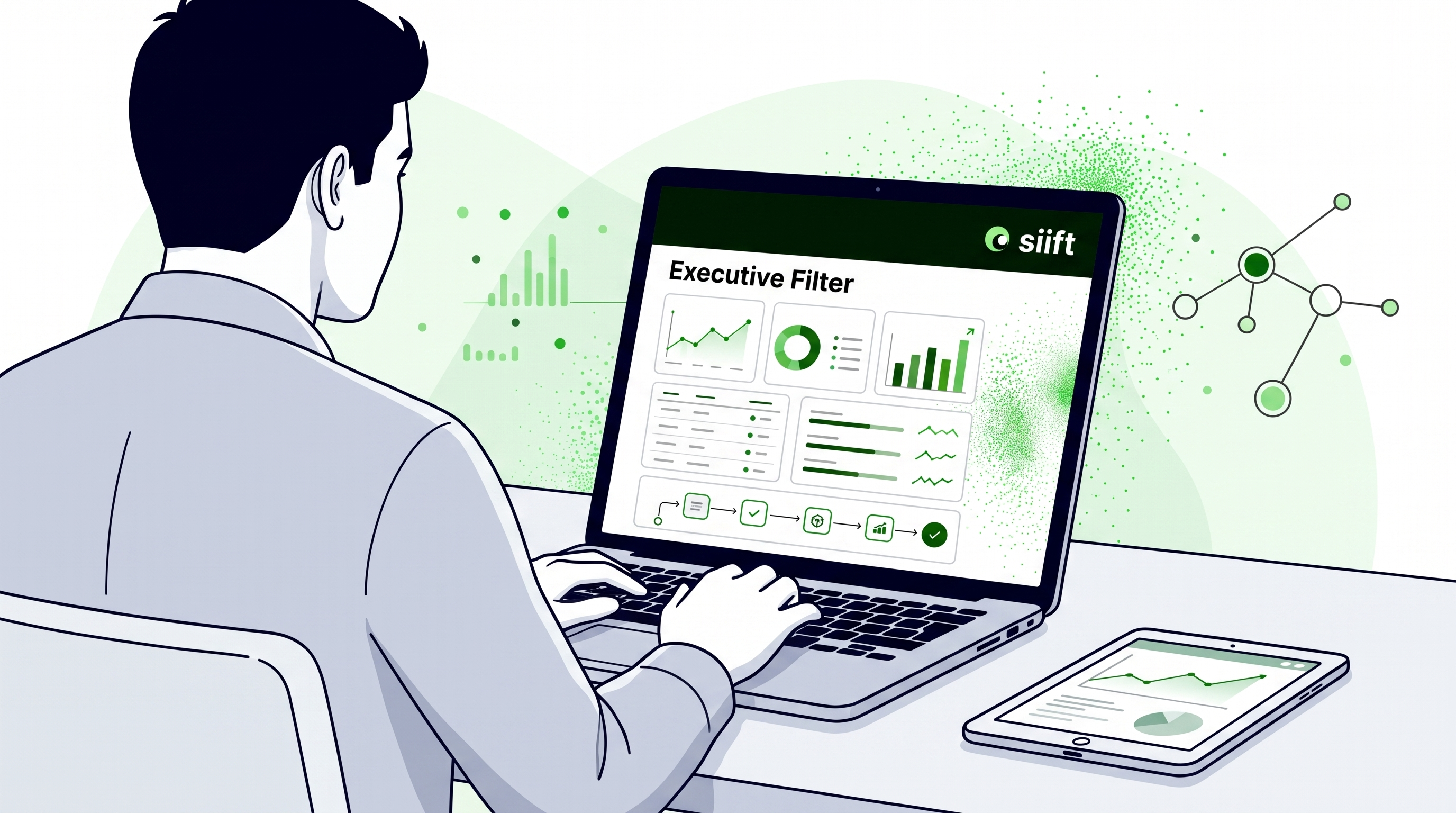
Instead of trying to replace founding teams with autonomous agents, Siift works as an executive filter.
Its purpose is to remove noise and help founders focus on:
Validated strategy
Deeper thinking
Derisking high-impact decisions
Focusing on current milestones
Getting real business results
Siift follows an Anti-Slop philosophy.
Modern AI can generate unlimited ideas, suggestions, and content.
But more information does not always create better decisions.
Siift is designed to help founders avoid the cognitive overload and cognitive debt that can come with highly autonomous systems, and instead focus on the key signals and actions that can create measurable results.
Convograms: Turning AI Conversations Into Focused Progress
Traditional AI conversations often become scattered.
A founder starts with one question, explores multiple directions, and loses focus.
Siift solves this through Convograms.
Convograms are long-horizon intent-defined conversation modes designed around specific goals.
Instead of random AI discussions, founders can focus on:
Business Ideation
Idea Validation
Building a Product or Service
Go To Market
Scaling or Growth
This transforms AI from a general assistant into a proactive, structured business thinking partner.
Siift Master Context Engine: Better Decisions Through Better Context
One of the biggest problems with AI tools is context rot.
As a business grows, old thinking becomes unimportant - and important information becomes fragmented:
Business strategy
Market research
Validation learnings
Go To Market plans
Customer feedback
Product decisions
Without strong context management, AI can make recommendations based on outdated or incomplete information, and essentially cannot learn the way humans naturally do.
Siift addresses this with its Truth Hierarchy system.
This system uses a patent-pending bottoms-up context management methodology, prioritizing:
Real world evidence
Validated assumptions
Feedback signals
Real business outcomes
Above:
Individual ideas
AI outputs
Unverified information
Weak sources or citations
This helps founders make decisions based on reality instead of speculation or superficial data.
Intelligent Business Canvas: A Clear View of the Startup
Most founders do not need another place to store information.
They need clarity, confidence & leverage.
Siift introduces the Intelligent Business Canvas, organizing startup knowledge into three practical views:
Insights
Important business knowledge including:
Market signals
Validation results
Customer feedback
Actions
The highest-impact next steps:
Strategic priorities
Experiments
Execution milestones
Assets
Important business resources:
Documents
Research
Business knowledge
Instead of scattered tools and disconnected conversations, founders get a clearer picture of their company's current state.
Siift vs Polsia: Feature Comparison
Siift vs Polsia: Feature Comparison
Capability | Polsia | Siift |
|---|---|---|
Core approach | AI-powered business operations platform with agentic workflows | AI business operating system for founders |
Primary focus | Business planning, execution and automation | Validation, business context, decision support and execution |
AI approach | AI agents can execute configured workflows and tasks | AI acts as an executive filter and strategic layer |
Human control | Users configure permissions, integrations, budgets and supervise agent actions | Human-in-the-loop approach with founder control over key decisions |
Context management | Context used across business operations and configured workflows | Master Context Engine designed to organize and retain business context |
Business view | AI agents and business workflows | Intelligent Business Canvas with Insights, Actions and Assets |
Integrations | Connected services and integrations, including MCP-related functionality | MCP and integrations designed to work with an existing business stack |
Automation | Strong emphasis on autonomous business task execution | Focuses on guided execution and decision support alongside automation |
Validation | Business planning and execution capabilities | Explicit focus on validating ideas, assumptions and business direction |
Pricing | See current Polsia pricing for the latest plans | Free tier plus paid plans; see current Siift pricing for the latest offers |
Note: Features, integrations and pricing can change over time. Review each platform's current documentation and pricing before making a purchasing decision.
Top-of-Toolchain Executive Filter: AI That Works With Your Tools
Siift does not try to replace every tool founders already use with a jack-of-all-trades approach.
Businesses rely on specialized systems:
Developer tools
Knowledge bases
Marketing & Sales tools
Back-office tools
Through MCP and connectors, Siift works as a strategic layer above these tools.
The goal is:
Keep your existing stack, and find the best tools for specific jobs
Connect and summarize important information into siift
Improve decision-making with siift’s guidance
Build a scalable, master context engine that compounds leverage over time.
Siift provides management and orchestration without forcing founders into a closed ecosystem.
Privacy and Founder Data Protection
Business information can include sensitive product plans, customer information, research, financial information and intellectual property. When evaluating AI business platforms, founders should review each provider's current privacy and data-handling documentation.
Polsia
Polsia publishes a Privacy Notice describing how it collects, uses and discloses information associated with its services. Its Terms also explain that the platform can perform AI-driven workflows and agentic actions based on user configurations, permissions, integrations, budgets and other settings.
For details on how Polsia handles user data, see its Privacy Notice, Terms of Service, and Subprocessors documentation.
Siift
Siift states that privacy is a core part of its product approach and is designed to protect sensitive user information and intellectual property.
For current details, founders should review Siift's Privacy Policy and Terms of Service before connecting sensitive business data.
Bottom line: Privacy requirements vary by business. Founders should evaluate the specific data practices, security controls, subprocessors, retention policies and contractual terms of any AI platform before connecting sensitive company information.
Who Should Choose Polsia?
Polsia may be a good fit for founders who are primarily looking for:
AI-powered business execution using AI agents to handle configured business workflows and tasks.
Automation delegating parts of business operations to AI-driven workflows.
Rapid experimentation moving quickly from an idea into planning, building and execution.
Agentic workflows giving AI agents defined permissions, integrations and instructions so they can take actions on the founder's behalf.
A more autonomous operating model — founders who want AI to take a more active role in executing business tasks.
Polsia's current Terms describe its platform as an AI-powered business operations service capable of executing a variety of AI-driven workflows, including formulating business plans, creating content, executing tasks and interacting with third-party services. Users remain responsible for configuring and supervising those actions.
If your priority is automation and agentic execution, Polsia's approach may align with that workflow.
If your priority is validation, structured business context, decision support and keeping strategic control, Siift takes a different approach.
Who Should Choose Siift?
Siift is designed for entrepreneurs and startups who want:
Scalable Context Management
A scalable AI-native business context system that learns and surfaces key signals and strategic learnings.
Following Entrepreneurial Best Practices
Avoid building based only on assumptions, follow proven methods like validation and ecosystem expertise.
Operational Control & Visibility
Use AI as leverage while keeping important aspects human-driven, maintaining operation visibility into all workflows, sharing data with key stakeholders, and not relying on one platform for all your workflows.
Privacy, Data Control & Ownership
Siift takes a privacy-focused approach to protecting business information and intellectual property. Its Terms of Service state that users retain rights to their Inputs and Outputs, and that Inputs and Outputs are not shared with third parties unless users explicitly opt in.
For the specific data-handling terms, founders should review Siift's Privacy Policy and Terms of Service.
Better Business Outcomes
Focus on results and tangible progress, with more effective and efficient AI workflows.
Frequently Asked Questions
Is Siift a Polsia alternative?
Yes. Siift is an alternative for founders who want an AI business operating system focused on validation, business context, and strategic execution.
Which AI platform is better for serious entrepreneurs and startups?
It depends on the goal. Polsia focuses on autonomous execution, while Siift focuses on founder decision-making and business intelligence.
Can AI agents build successful startups?
AI agents can accelerate development, but successful startups still require human judgement and support in things like customer validation, strategic decisions, relationship building and market understanding.
Should founders automate before validating?
No. Automation increases speed, but validation ensures founders are building something customers actually need. Automating too early can be inefficient and may lead founders to invest resources before they have validated the underlying demand.
Final Verdict: Siift vs Polsia
The future of startup AI is not about removing founders from the process.
It is about making founders more effective.
Polsia represents an automation-first approach.
Siift represents a human-first approach.
For entrepreneurs who want AI that combines validation, business strategy, workflow orchestration, and strategic control, Siift is designed around that approach to building companies with AI.
The best AI platform is not the one that creates the most quantity in output.
It is the one that facilitates quality outputs that get results.
Build Smarter With AI That Understands Your Business
Stop building faster in the wrong direction.
Siift helps founders validate ideas, align stakeholders on business context, prioritize high-impact actions, and orchestrate Automations without losing control.
Move beyond AI-generated output and start building with an AI operating system designed around real business progress.
Explore Siift's current plans and pricing to see which option fits your business needs.
Compare Siift With Other AI Operating Systems for New Businesses
Choosing the right AI operating system can impact how founders plan, build, and scale their businesses. Explore these in-depth comparisons to understand how Siift compares with other AI platforms for business strategy, automation, productivity, and startup workflows.
Siift vs ChatGPT: Which AI Operating System Is Better for New Business Workflows?
Siift vs Claude: Which AI Assistant Is Better for Entrepreneurs and Startup Operations?
Siift vs Openclaw: Which AI Platform Is Better for Business Planning and Execution?
Siift vs. Buildpad: Best AI Operating System for Growing Startups
Siift vs Hermes Agent: AI Agents vs AI Business OS for Startups
Siift vs Cofounder 2: Which AI Business OS Is Better in 2026?
Explore Siift and build your new business with clarity, confidence and leverage.