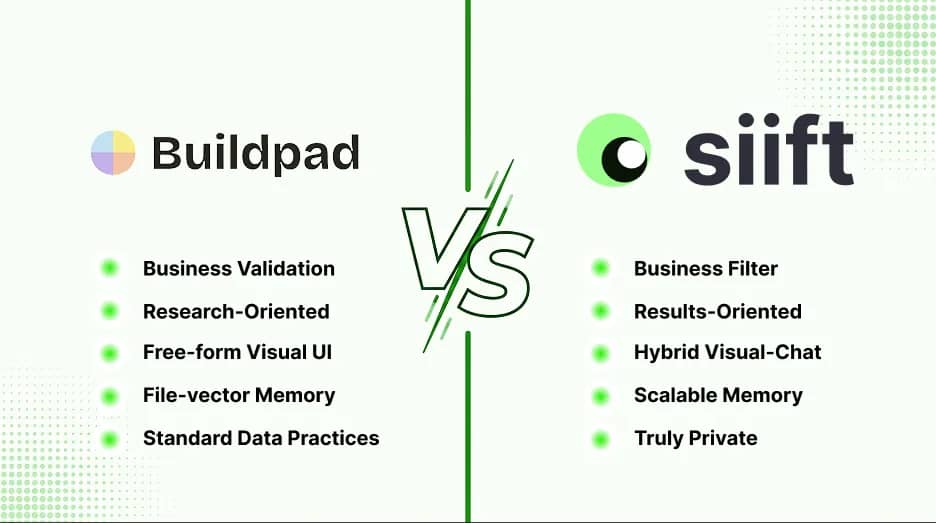
Siift vs Buildpad comes down to one core difference: Buildpad (formerly AICofounder.com) aim to replace a founder's entire toolkit for research, writing, site building and file hub in one app ~ while siift is the executive filter that sits above the tools a growing team already uses.
Early-stage founders now have more AI options than ever, and the default instinct is to pick one app and ask it to do everything: draft the plan, write the copy, build a rough site, store the files. That instinct makes sense when it's one person testing one raw idea. It breaks down the moment there's more than a notebook's worth of business to run, a go-to-market motion to design, a strategy to defend to a co-founder or an investor, and a small team that all needs to be working from the same facts.
That shift matters more than it used to. Solo founders now make up a rising share of new startups, but when it comes to the companies that actually raise capital and scale, Carta's Founder Ownership Report found solo founders made up 35% of companies incorporated in 2024 but just 17% of the startups that closed a VC round that same year. Put simply: going solo is easier than ever to start, and harder than ever to scale alone. This is where Siift and Buildpad take genuinely different approaches.
Buildpad focuses on being a native, all-in-one AI workspace for going from idea to launch.
Siift is an AI business operating system built for founding teams and serious entrepreneurs who need to validate opportunities, build a business strategy, executve go-to-market activities and scale — without losing control or context due to AI limitations.
Quick Answer: Siift vs Buildpad
Buildpad is a phased, all-in-one AI chat tool that helps a founder research, write and build a first version natively inside one app. Siift is a top-of-toolchain AI operating system that orchestrates your existing tools and keeps go-to-market, strategy and team context connected as your company grows.
At a Glance
If you want... | Choose |
|---|---|
An all-in-one AI workspace for early idea validation | Buildpad |
Filter information and automate workflows across your tools to build and growing a business | Siift |
Native research, writing, and landing page creation | Buildpad |
Go-to-market & business strategy | Siift |
Shared or scalable context across a growing business | Siift |
AI orchestration across your existing tools | Siift |
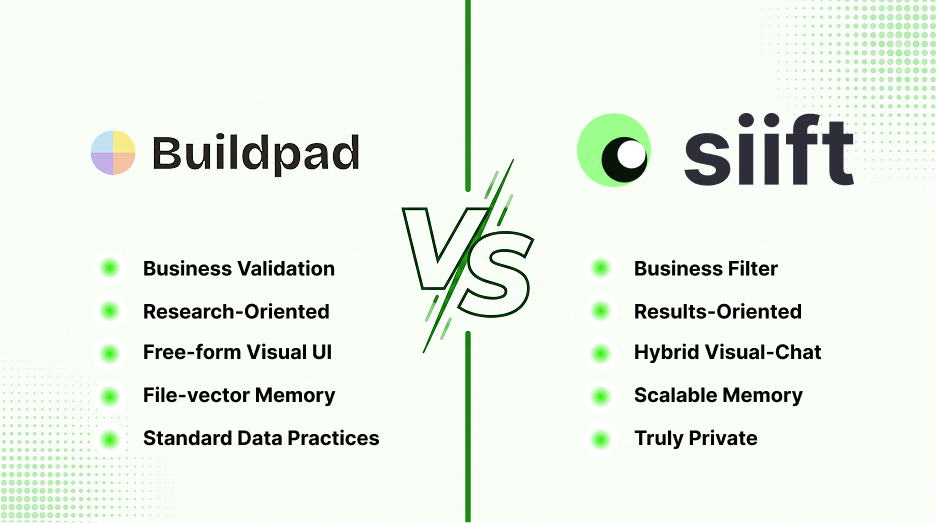
Siift vs Buildpad: Key Differences at a Glance
Category | Buildpad (formerly AICofounder.com) | Siift (The New Business OS) |
|---|---|---|
Core approach | All-in-one native builder — research, writing, basic sites, files | Top-of-toolchain “executive filter” |
Best fit | Testing a single business idea to launch | One person exploring multiple business ideas, or a team collaborating on one idea |
Ecosystem strategy | Bundles native, general-purpose tools | Orchestrates your best-in-class tools via third-party connectors |
Memory & context | standard vector+markdown memory | Scalable, Dynamic Context via Truth Hierarchy & siift table technologies |
Core UI focus | free-form notes, multi-phase document tracking | Intelligent Business Canvas — Insights, Actions, Assets |
Go-to-market support | General research and drafting | Holistic GTM system — Positioning, ICPs, channel tests, traction loop |
Team alignment | Free-form UI collaboration | RBAC, structured workspace of master context across founding team and stakeholders |
Data practices | Industry standard data policy | Explicitly “Truly Private”. No selling user data, no third-party model training |
What Is Buildpad?
Buildpad is a phased AI chat tool built around the idea of an "AI cofounder" a guided path from idea, to research, to positioning, to a first build. It briefly rebranded around the term "AI cofounder" and ran as aicofounder.com for several months in 2026, then reverted back to the Buildpad name; the old domain now redirects to buildpad.io. If your team has bookmarked links or old research under either name, it's the same product and team either way.
The pitch is straightforward: one native workspace that walks a founder through the early stages of building something, without needing to open five different tools. For a single founder validating a first idea, that simplicity is genuinely useful.
Buildpad's Jack-of-All-Trades Risk
Buildpad tries to be a founder's full stack researcher, writer, basic site builder and file hub, all built natively into one app. That breadth is also its ceiling.
Being the researcher, the copywriter, the site builder and the file cabinet all at once means every one of those jobs is done to a "good enough" native standard, not a best-in-class one. A founder can get a rough landing page and a rough plan out of Buildpad, but at some point most growing teams still end up in Figma, a real site builder, a CRM, or a specialized GTM tool anyway and now that work is disconnected from everything Buildpad already knew about the business.
Siift starts from a different assumption: it doesn't try to reinvent your tool stack. It works as your top-of-toolchain command center, organizing focus and orchestrating specialized, best-in-class tools so the business actually moves instead of asking one native app to be everything.
Siift vs Buildpad: The Core Difference
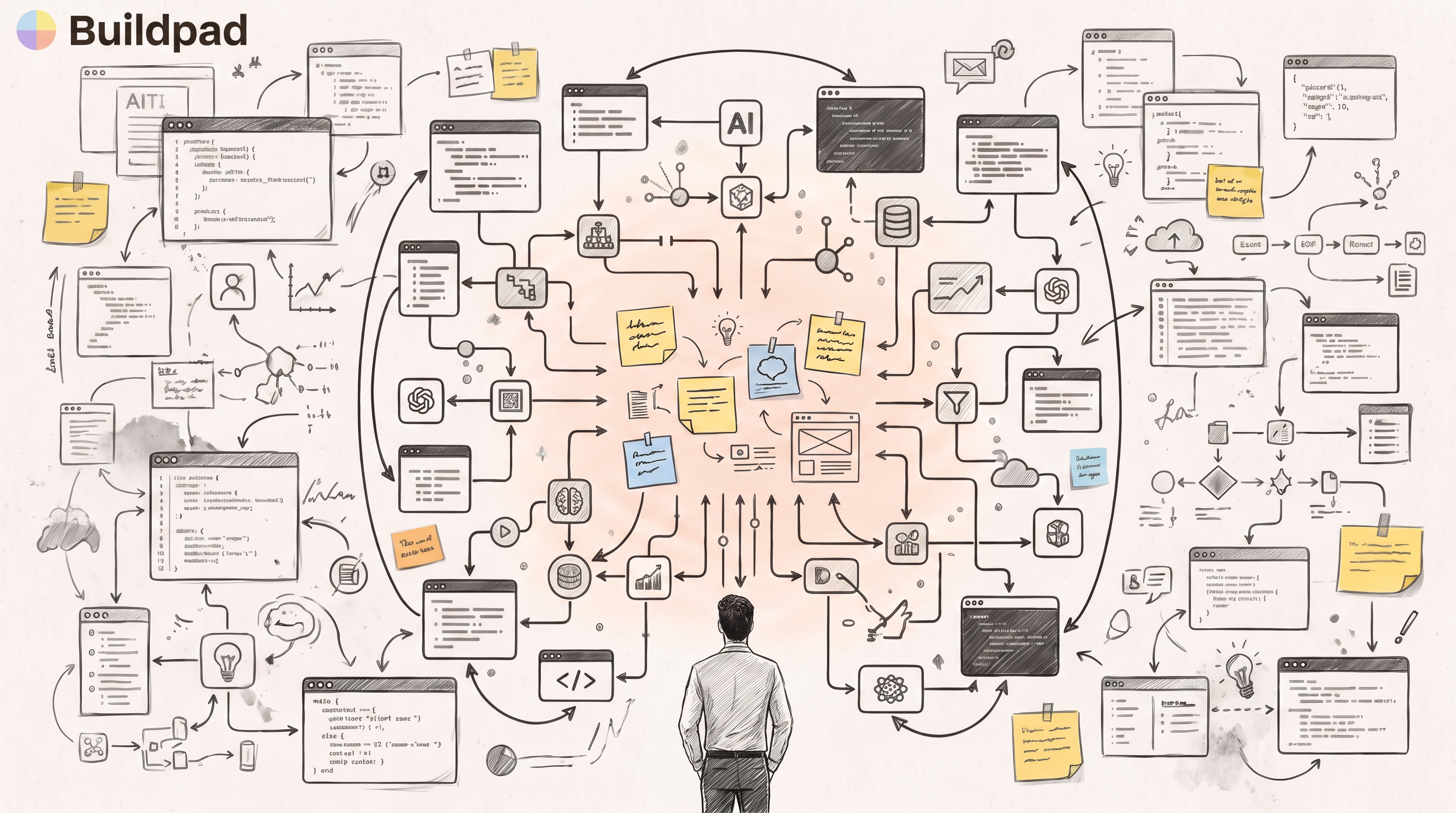
Buildpad is a closed, native workspace: it drafts plans, builds simple sites, and stores everything inside one-user chat-based thread.
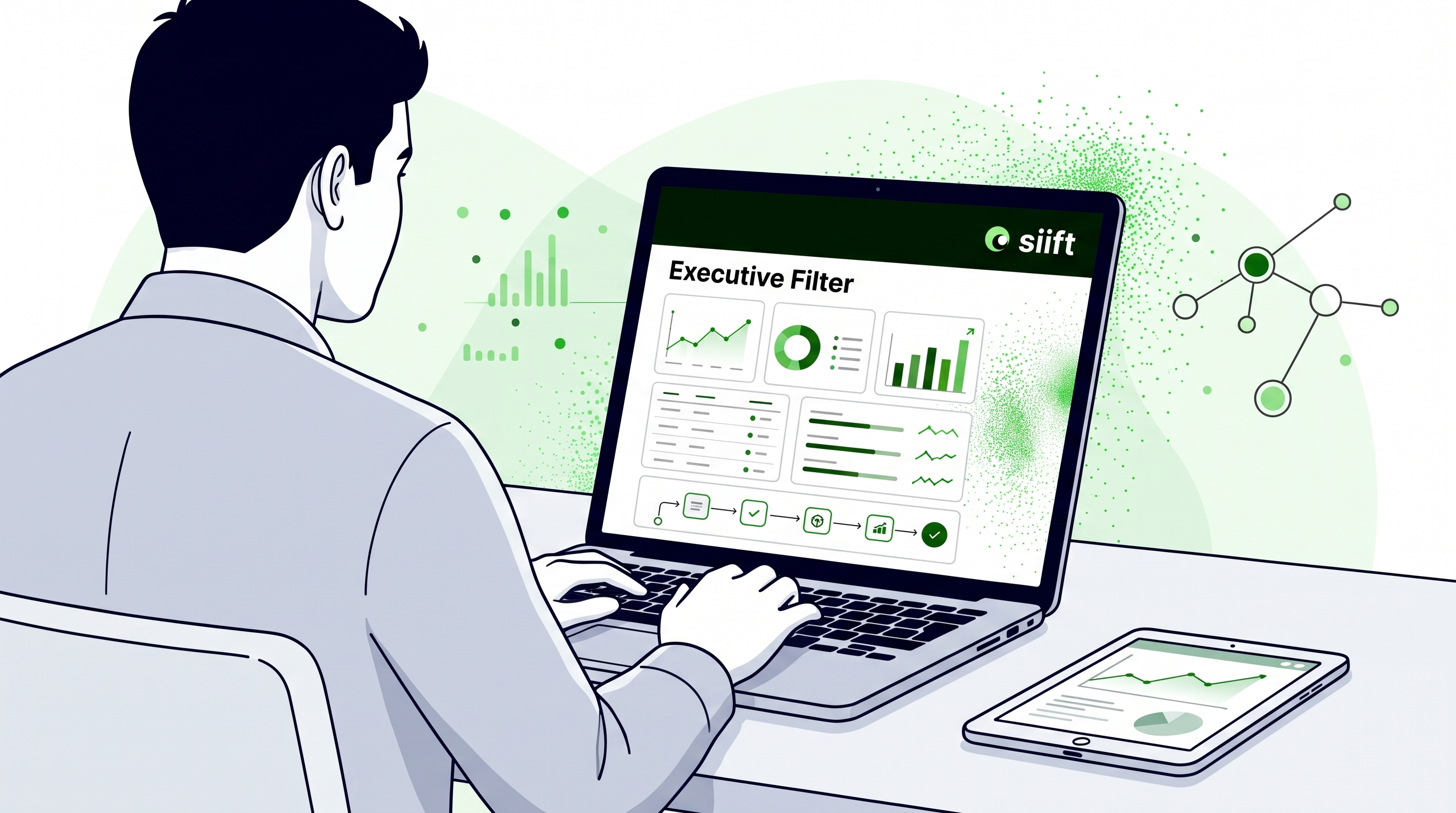
Siift is a high-level executive filter. It uses an Intelligent Business Canvas to organize business data into Insights, Actions and Assets, while integrating natively with the specialized tools your team already relies on.
1. A Fixed Phase Pipeline vs. Intent-Defined Convograms
Buildpad's phases idea, research, positioning, build, launch are a single linear track. That's helpful the first time through, but a growing business doesn't move in a straight line: it needs to validate, go to market, and revisit strategy in parallel and iteratively, often in the same week. Siift's Convograms are intent-defined conversation modes built around a specific objective ideation, validation, go-to-market, scaling so a founding team can drop into the mode the business actually needs right now instead of restarting a fixed pipeline from the top.
2. Bundled, General-Purpose Tools vs. Top-of-Toolchain Orchestration
A tool built to research, write, design and store files natively is optimized to do a little of everything not to be the best option for any one of those jobs. Siift takes the opposite position: it doesn't compete with Figma, GitHub, or a specialized CRM. Through MCP and connectors, it acts as the master orchestrator, directing the specialized tools your team already prefers and consolidating the resulting data back into one source of truth. This is Siift's Top-of-Toolchain Executive Filter in practice.
3. A Flat Workspace vs. Focused Situational Awareness
Dumping chats, drafts, decisions and files onto one flat, linear thread feels organized at first. As a business grows past the idea stage, that same thread turns into noise it's hard to tell what's validated, what's still an assumption, and what actually needs attention this week. Siift's Intelligent Business Canvas is a dense, deliberately filtered UI that cleanly separates Insights, Actions and Assets, so a founding team has a shared, single view of the highest-leverage thing to do next not a longer scroll to read through.
Pros and Cons
Buildpad
Pros
Simple guided workflow for validating new ideas
Native AI research, writing, and basic landing page generation
Easy onboarding for solo founders
Everything stays inside one workspace
Cons
Primarily designed around individual founder workflows
Native tools prioritize convenience over specialized depth
Limited shared strategic context for growing teams
Does not act as an orchestration layer across existing business tools
Siift
Pros
Shared Intelligent Business Canvas for founding teams
Truth Hierarchy keeps decisions based on validated evidence
MCP orchestration connects existing tools and workflows
Dedicated systems for validation, go-to-market, and business strategy
Privacy-first approach with a sustainable business model
Considerations
Desktop-first experience rather than a simple chat-based builder
Better suited for startups building long-term operating systems rather than only testing initial ideas
Where a Native Builder Runs Out: Go-to-Market, Strategy & Team Alignment
A native writer, researcher and site builder can help you describe a business. It doesn't help you run one. The moment a startup moves from "what should we build" to "how do we get this in front of real customers, defend the strategy, and keep a growing team aligned," a single-thread chat tool reaches its ceiling fast and this is the gap most all-in-one builders, Buildpad included, leave open.
Go-to-Market: From a Launch Checklist to a Learning Loop
A launch checklist is not a go-to-market strategy, and generic research and drafting isn't either. CB Insights' most recent analysis of failed venture-backed companies found that 43% cited poor product-market fit as a root cause — not a lack of a product, but a lack of a validated path to the people who'd actually buy it.
Siift's go-to-market system is built to close that gap instead of just describing it: it turns customer research into a focused ideal customer profile, sequences channel experiments based on how your specific buyer already discovers and evaluates options (not a generic tactics list), and feeds conversion, revenue and customer signals back into the same business context. The plan keeps changing for a reason — because new evidence came in — not from panic or novelty.
Business Strategy: A System, Not a Slide Deck
Generating more AI output doesn't create more clarity — it just creates more to sort through. Siift's business strategy layer maps the customer, problem, value proposition, channels, economics and traction into one connected model, then applies the Truth Hierarchy to weigh validated evidence over assumptions and confidently-worded guesses. That's the Anti-Slop Stance in practice: the goal is a defensible next move, not a longer strategy document.
Team Alignment: Getting Every Builder Off a Different Assumption
This is the piece a single-user chat tool structurally can't solve, and it's where the "solo founder" framing breaks down fastest. Research by Harvard Business School's Noam Wasserman — drawn from a decade of surveys covering close to 10,000 founders — is widely cited for a sobering finding: co-founder and founding-team conflict, not product or market failure, is the most common reason high-potential startups fail. Misalignment isn't usually about the product. It's about people quietly operating from different context.
Siift's Master Context Engine gives every builder on the team — not just the founder typing into a chat window — the same evidence-weighted view of the business, so product, growth and operations decisions are made from shared ground truth instead of a founder becoming the only human router for context. Paired with the go-to-market and strategy systems above, this is exactly the layer Siift is built for now that the company is positioning toward founding teams and growing startups, not just solo builders working alone in a single thread.
The Privacy and Data Ownership Check
Storing sensitive customer feedback, financial models and code inside a closed platform's cloud carries real risk if that platform trains on user data or is vague about how it's used. Buildpad doesn't publicly detail its data-training policy, so teams evaluating it should ask directly before storing sensitive business information there.
Siift is explicit instead of silent on this: its Truly Private, Sustainable Token Business Model makes healthy margins on compute tokens, which means there's no financial incentive to farm, monetize or sell customer data. Siift never trains third-party models on your IP, and runs on hardened, enterprise-grade cloud infrastructure. As AI adoption grows, this kind of transparency is becoming a baseline expectation rather than a bonus — the NIST AI Risk Management Framework is one widely referenced guide for the kind of security, governance and risk practices founders should be able to expect from any platform handling business-critical data.
Who Should Choose Buildpad?
Buildpad can be a reasonable fit for a single founder in the earliest hours of testing one raw idea, who wants one native, guided place to research, draft and sketch a first build without connecting anything else yet. It's worth evaluating the trade-offs, though: a flat chat workspace, native tools that trade depth for breadth, and a data policy that isn't publicly detailed.
Who Should Choose Siift?
Siift is built for founding teams, serious entrepreneurs and growing startups who need:
Go-to-market execution, not just a launch checklist — a system that keeps customer evidence, channel tests and traction connected.
Business strategy that updates itself as real signals come in, instead of a static document nobody revisits.
Shared context across a team, so builders aren't each working from a different assumption.
A top-of-toolchain layer, not a replacement for the specialized tools already working well.
True data privacy, with a business model that has no incentive to monetize your information.
Open Beta Deal — Siift Focus for just $23/month instead of $47. Lock in the 50% lifetime discount while it lasts.
Frequently Asked Questions
Is Siift a Buildpad alternative?
Yes. Siift is an alternative for founding teams and serious entrepreneurs who need an AI business operating system for go-to-market, strategy and execution — not another native, all-in-one builder.
Is Buildpad the same product as AICofounder.com?
Yes. Buildpad rebranded around the term "AI cofounder" and ran as aicofounder.com for part of 2026, then reverted to the Buildpad name. It's the same team and the same product under either name, and old aicofounder.com links now redirect to buildpad.io.
Is Siift only built for solo founders?
No. Siift is positioned for founding teams, serious entrepreneurs and growing startups — not just individuals working alone. Its Master Context Engine is specifically designed to keep multiple builders aligned on the same evidence, which matters most once there's more than one person making decisions.
Does Siift replace tools like Buildpad's native writer or site builder?
No. Siift is intentionally not trying to replace specialized developer, design or marketing tools. It works as a top-of-toolchain executive filter that orchestrates the specialized tools your team already uses through MCP and connectors, and consolidates that data into one command center.
Can Siift help with go-to-market strategy, not just idea validation?
Yes. Go-to-market planning is one of Siift's core systems — defining a focused ideal customer profile, sequencing channel experiments, and feeding results back into the strategy — alongside idea validation and ongoing business strategy support.
Which platform is better for a startup with more than one founder?
Siift. Its context and alignment systems are built specifically for founding teams, so every builder works from the same validated evidence rather than a single founder relaying context between people and tools by hand.
Final Verdict: Siift vs Buildpad
Buildpad is a reasonable native starting point for one person testing one idea in a single chat thread. But growing startups run into problems a chat thread can't solve on its own: a go-to-market motion that needs to keep learning, a strategy that has to hold up under scrutiny, and a team that needs to stay aligned on what's actually true about the business.
Siift is built for that next stage. For founding teams and serious entrepreneurs who need validation, go-to-market, strategy and execution working from one connected source of truth while keeping the specialized tools they already trust Siift is the more complete way to build.
Ready to move beyond an all-in-one native builder? Explore Siift and see how founding teams validate, plan go-to-market, and execute with one connected business context.
Compare Siift With Other AI Operating Systems for New Businesses
Choosing the right AI operating system affects how founding teams plan, build and scale. Explore the rest of the comparison series:
Siift vs ChatGPT: Which AI Operating System Is Better for New Business Workflows?
Siift vs Claude: Which AI Assistant Is Better for Entrepreneurs and Startup Operations?
Siift vs Polsia: Autonomous Agents vs. a Strategic AI Operating System.
Siift vs OpenClaw: Which AI Platform Is Better for Business Planning and Execution?
Siift vs Hermes Agent: Which AI OS Is Better for Business Automation and Team Execution?
Siift vs Cofounder 2: Which AI Business OS Is Better in 2026?