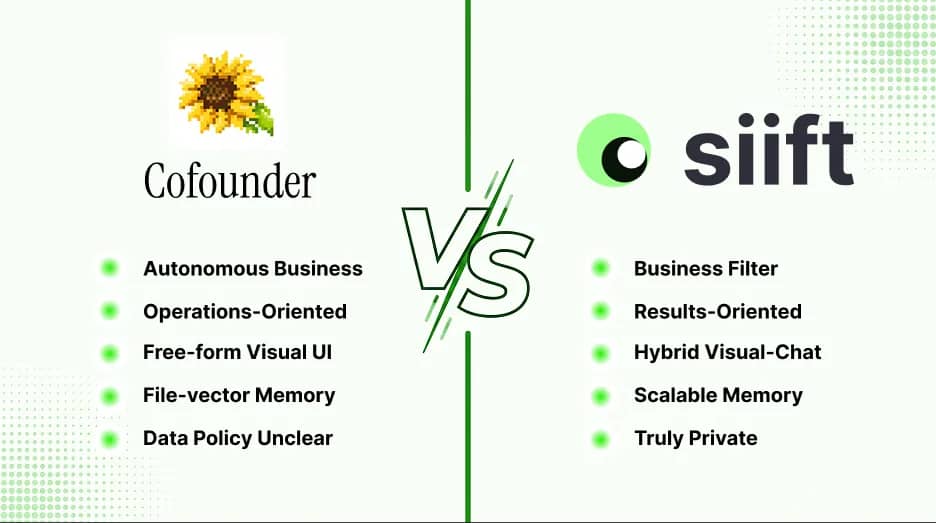
Agentic AI is moving from novelty to infrastructure fast. Gartner’s agentic AI predictions indicate that by 2028, about one-third of enterprise software applications will include agentic AI capabilities, up from less than 1% in 2024, and that 15% of everyday work decisions will be made autonomously through AI agents. Founders have taken notice, and a new category of “AI that runs your company” platforms has emerged to meet this shift.
Cofounder 2, from The General Intelligence Company (GIC), is the most ambitious version of that pitch: orchestrate specialized agents across every department engineering, sales, marketing, design, and operations so a single founder can, in theory, run a company the way a much larger team would. Siift starts from a different premise entirely. Rather than trying to replace the people around a growing business or all their tools, it's built to give founding teams, serious entrepreneurs, and growing startups a shared, auditable AI command center.
Cofounder 2 represents the automation-first bet: hand entire departments to agents. Siift represents the human-first bet: give your team better focus, evidence, visibility, and tool management.
The real question isn't which platform automates the most. It's: which one helps a real team make better decisions together, without losing sight of what their AI is actually doing?
Quick Answer: Siift vs Cofounder 2
What is the difference between Siift and Cofounder 2?
Cofounder 2 is an autonomous multi-agent platform that tries to run entire company departments end-to-end with minimal founder involvement. Siift is an AI operating system built for founding teams that combines validated, evidence-based strategy with auditable, step-by-step execution while keeping humans in control.
The difference is simple:
Cofounder 2 tries to replace your team with a swarm of autonomous agents.
Siift gives your founding team, advisors, and partners a shared, transparent command center without replacing any of them.
What Is Cofounder 2?
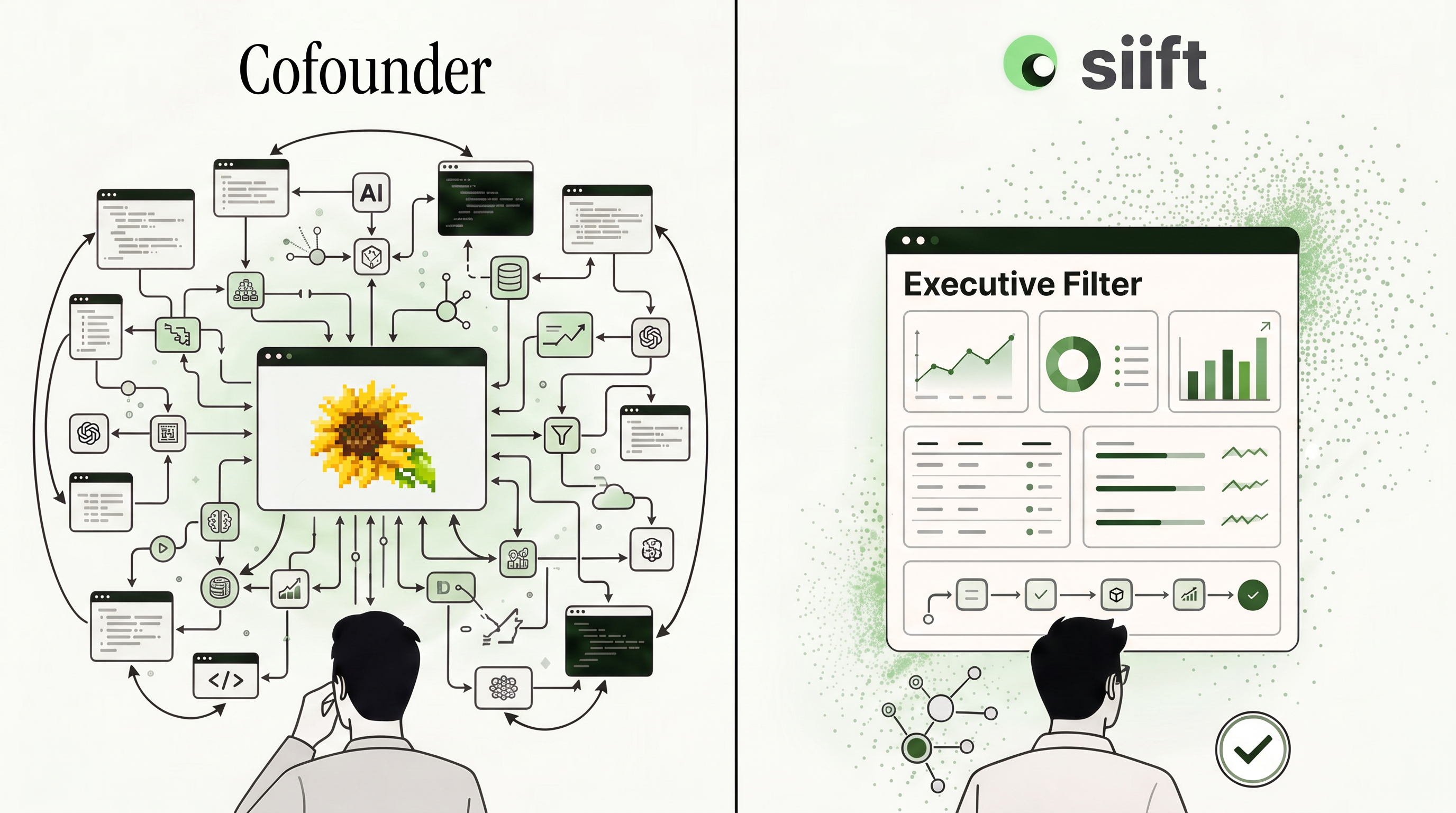
Cofounder 2 is the flagship product of The General Intelligence Company (GIC). Where the original Cofounder helped a single operator manage email, calendar, and CRM workflows, Cofounder 2 expands the scope dramatically coordinating specialized AI agents across engineering, sales, marketing, design, and operations, and breaking the business down into repeatable "Flows" that agents execute using a three-tier working, core, and "long-term" memory system.
The scale behind that ambition is real. By GIC's own published numbers, Cofounder's customer's companies have an average of about 14 autonomous agents running per business. The company's stated mission is to build the infrastructure for the "one person billion dollar company," where agents handle the departments a founder would otherwise have to hire for.
It's a compelling pitch. But running a department is not the same as running a company well, and a bigger Agent swarm creates many problems.
The Problem With Departmental Swarms: Why a Bigger Agent Swarm Doesn't Mean More Progress
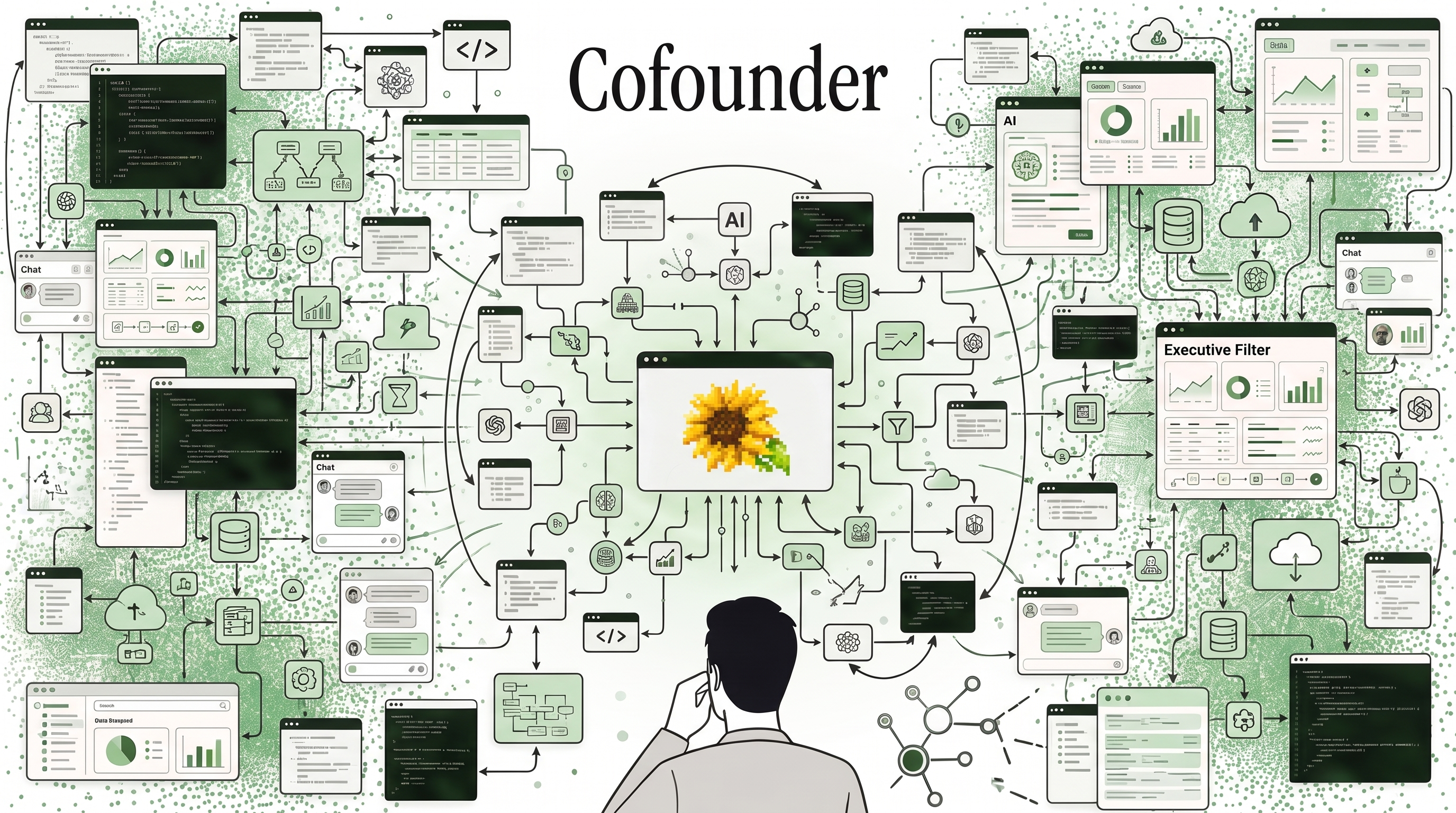
Give an AI system a big enough goal and enough agents, and it will look busy — dashboards fill up, tasks close, logs scroll. But activity isn't the same as progress, and the industry's own data backs this up. Gartner predicts that more than 40% of agentic AI projects will be canceled by the end of 2027, pointing to ballooning compute and coordination costs, murky ROI, and weak risk controls as the top reasons. Those are exactly the three places large agent swarms tend to break down.
High Latency and Unpredictable Credit Burn
Coordinating dozens of specialized agents across five or more departments means constant hand-offs: one agent finishes, passes context to the next, waits on a response, and reconciles the result. Every hand-off adds latency, and every hand-off adds cost. Independent reviewers have already flagged this as a structural risk specific to Cofounder 2 when this many specialized agents are chained together across departments, a small error early in the chain doesn't stay small; it gets passed downstream and compounds by the time it reaches the last agent in the sequence, and the platform doesn't yet have a long production track record to prove that risk is under control.
Cofounder 2's own usage-based pricing reflects this structurally. Plans start with a base monthly usage allowance, but that allowance is drawn from one shared pool covering agent compute, AI model usage, database usage, customer support, ad spend, and data purchasing all together. That's a wide, open-ended cost surface — one where a founder can watch spend climb quickly once more than a department or two is actually running, without a clean way to predict the number ahead of time.
The "Trust Me" Black-Box Execution Model
With an average of about 14 agents coordinating per company, tracing exactly why an agent made a specific call — why it chose one marketing angle over another, or deprioritized one lead over another gets genuinely hard. To be fair, Cofounder 2 does gate certain high-risk actions behind human approval. But approval on a handful of flagged actions isn't the same as visibility into the reasoning behind the hundreds of smaller decisions a swarm makes every day. For a founder trying to understand why the business is moving in a given direction, that gap matters you're often left auditing outcomes after the fact instead of understanding the process as it happens.
Human Isolation: Cutting Founders Off From Relationship-Driven Work
Some of the highest-leverage work in an early business isn't a task an agent can complete it's a relationship. Investor trust, a first enterprise champion, a strategic partnership: these are built through judgment, timing, and rapport, not automated sequences. A platform built around the idea that agents should run entire departments including sales and fundraising-adjacent work risks pulling founders and their teams out of exactly the rooms where they create the most value. Founders don't need to be replaced in those conversations. They need better evidence walking into them.
Jack-of-All-Trades Risks: Trying to replace all other AI tools with a single platform
Cofounder 2 ambitiously attempts to run all company functions like building a website or automating outreach through its system using AI agents, which seems attractive at first glance but in reality results in a system that is not specialized on doing any specific tasks well, due to a lack of focus. This quantity over quality approach unfortunately means that users of these systems will always be behind others who use a combination of specialized tools that are better for each job.
Siift: The Executive Filter Built for Founding Teams
Siift takes the opposite starting position. As more companies get built by small founding teams, or by serious entrepreneurs juggling multiple roles at once, the highest-leverage use of AI isn't replacing the people in the business — it's removing the noise around them so they can focus on what actually moves the business forward. Siift sits on top of task specific tools like cursor, or claude to give you a high-level strategy management system that helps align teammates, ai agents and stakeholders.
That's why Siift is built for founding teams, serious entrepreneurs, and growing startups not a single solo operator disappearing behind a wall of agents. Siift follows an Anti-Slop Stance: it's an executive filter, not a content generator, designed to prevent cognitive overload and aimless "vibe-founding" by keeping a team focused on high-leverage milestones instead of maximizing token output or any other vanity metric.
Fully Auditable Convograms vs. Black-Box Agent Swarms
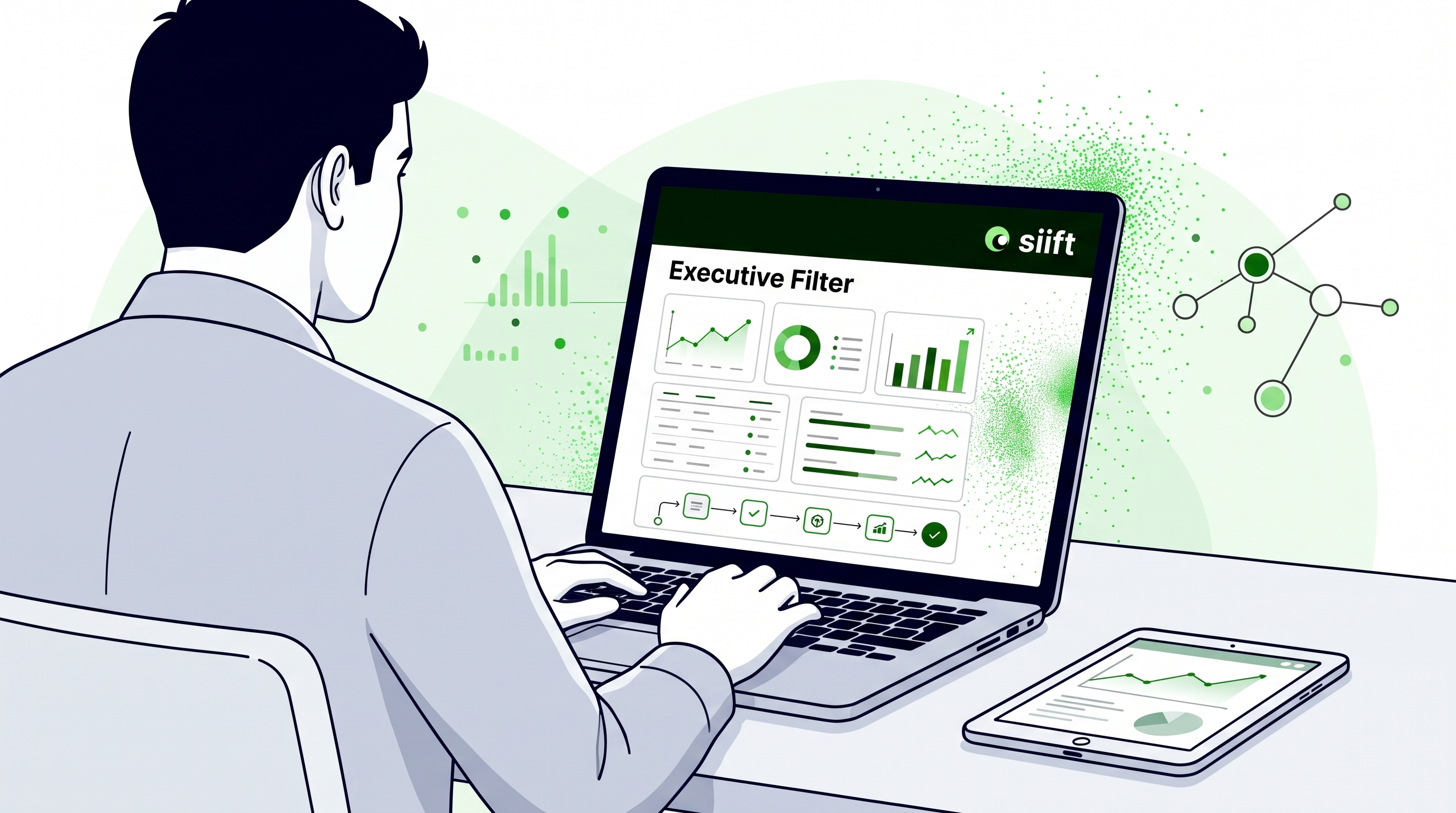
Where Cofounder 2 routes work through a swarm of agents operating mostly out of view, Siift structures work through convograms — intent-defined conversation modes built around a specific business objective, like Idea Validation, Go-to-Market, or Scaling. Every convogram moves through a structured, step-by-step path, and every step stays visible to everyone with access to the workspace.
That structure is what makes Siift auditable in a way a 95,000-agent swarm can't easily be. Instead of digging through multi-agent logs to reconstruct what happened and why, a founding team can look at a convogram and see exactly which milestone it's targeting, what evidence informed the last decision, and what the next action is — measured against objective, real-world metrics instead of how much output the AI produced.
Master Context Engine and Truth Hierarchy: Context That Compounds Instead of Rotting
The bigger an agent swarm gets, the more information it's juggling assumptions, half-finished experiments, customer replies, and confirmed traction, all mixed together with roughly equal weight. Left unmanaged, that's how AI systems end up making recommendations based on stale or unvalidated information, a problem often called context rot.
Siift's Master Context Engine addresses this directly by dynamically rebalancing what the system pays attention to, as a more scalable and dynamic form of agentic memory that is patent-pending. It runs on a Truth Hierarchy that weighs real-world, validated evidence customer feedback, traction metrics, confirmed outcomes — far more heavily than unvalidated assumptions or AI-generated suggestions. As new evidence comes in, Siift's downstream workflows update automatically, so a founding team is always working from what's actually true about their business, not what an agent assumed three weeks ago.
The Intelligent Business Canvas: One Clear View Instead of Workspace Sprawl
Cofounder 2 organizes its work into departments and agent workflows a structure that mirrors an org chart but leaves a founder piecing together the state of the business from scattered agent activity. Siift instead organizes the whole business into the Intelligent Business Canvas, a dense, intuitive view that filters everything into three practical categories:
Insights — validated learnings, market signals, and customer feedback
Actions — the highest-leverage next steps and execution priorities
Assets — the documents, research, and resources worth keeping
All three views sit inside the same AI chat and agentic orchestrator, so there's no separate app to check and no workspace sprawl just one canvas the whole founding team can look at and immediately understand where the business actually stands.
Beyond Customer Feedback: Go-to-Market, Business Strategy, and Team Alignment
It's easy to reduce an "AI business operating system" down to a validation tool something that's good at synthesizing customer interviews and not much else. Siift is built to cover a lot more of the business than that.
Go-to-Market Execution, Without Losing the Founder's Hand
Cofounder 2 tends to fold go-to-market work into its marketing and sales agents, executing outreach and campaigns largely on its own schedule. Siift's go-to-market convograms instead walk a founding team through positioning, channel selection, and launch sequencing as a guided process synthesizing market and competitor research, then handing the team a prioritized plan they can execute themselves, delegate, or automate selectively through connected tools. The AI does the research and structuring; the team keeps the judgment calls on messaging, timing, and channel bets that actually determine whether a launch lands.
Business Strategy Grounded in Evidence, Not Assumptions
Because Siift's business strategy workflows run on the same Truth Hierarchy that powers validation, pricing decisions, competitive positioning, and prioritization calls all get weighed against real traction data instead of whatever a chat window generated that day. That's a meaningfully different approach from an autonomous agent independently "deciding business strategy" on a founder's behalf with no clear record of what evidence the decision was based on.
Keeping Founding Teams, Advisors, and Investors Aligned
This is where Siift's positioning matters most. Cofounder 2 is built around a single operator directing a swarm of agents a structure that leaves little room for a co-founder, an advisor, or an investor to look in and stay current. Siift is built as a collaborative hub: a shared context engine where founders, advisors, and partners work inside the same workspace, see the same Intelligent Business Canvas, and stay aligned on what's validated, what's still assumption, and what's next — without a separate status update or deck. The AI handles the tedious, error-prone mechanics; the humans keep the intuition, the relationships, and the final call.
Top-of-Toolchain Executive Filter: Works With Your Stack, Not Instead of It
Cofounder 2 wants to be the place where the work happens it provisions its own servers, Stripe account, email inbox, and repositories, running departments largely inside its own ecosystem. Siift takes a narrower, more composable position on purpose. It doesn't try to replace the specialized developer, design, or marketing tools a team already trusts. Through MCP and connectors, Siift orchestrates tasks across the existing stack and consolidates what matters back into a single command center so a team keeps the best tool for each job while still getting one unified view of the business.
The Truly Private, Sustainable Token Business Model
Cofounder 2's usage-based pricing bundles agent compute, ad spend, and third-party data purchasing into the same account, and its public documentation doesn't fully spell out how customer and company data is handled once it flows through that many connected services and agents.
Siift's business model is built to remove that ambiguity. Siift makes healthy margins directly on compute tokens, which means it has zero incentive to farm, monetize, or sell a founding team's data. Siift never trains third-party models on a customer's IP, and every workspace runs on hardened, enterprise-grade cloud infrastructure. For teams handling sensitive product roadmaps, fundraising materials, or customer data, that alignment of incentives isn't a minor detail it's the difference between an AI partner and a data liability.
Siift vs Cofounder 2: Feature Comparison
Feature / Capability | Cofounder 2 | Siift (The New Business OS) |
|---|---|---|
Execution Architecture | Black-box, reactive, probabilistic multi-departmental autonomous agent swarms | Deterministic, step-by-step convograms and playbooks |
Operational Visibility | Low — founders must navigate a complex UI and multi-agent logs to find things | High — a simple Intelligent Business Canvas that surfaces priorities in realtime |
Human & Team Role | Largely replaced by autonomous agent counterparts, designed for “one-person billion dollar companys” | Empowered — founding team, advisors, and partners collaborate directly inside the workspace |
Validation Approach | Execution-first; agents act, then adjust | Validation-first; the Truth Hierarchy weighs real evidence before action |
Go-to-Market & Strategy | Folded into generalist marketing/sales agents | Dedicated go-to-market and business strategy convograms |
Tool Integration | Low - Primarily platform-based, inside Cofounder 2's own ecosystem, meant to replace your other tools | Top-of-toolchain orchestration via MCP and third-party connectors to most popular tools |
Resource Efficiency | High token costs, high latency, and unpredictable usage-based credit burn | Highly efficient, predictable token-based execution |
Privacy & Data Model | Data handling & training not fully disclosed, low price suggest strong incentive for data monetization | Truly private, sustainable token model with no incentive to farm, sell, or train on customer data |
Cofounder 2 vs Siift: Which Should You Choose?
Choose Cofounder 2 If You Need:
Fully autonomous execution across many departments at once
A willingness to trade operational visibility for raw automation speed
Comfort with usage-based, open-ended costs as the agent swarm scales
Cofounder 2 can be a fit for a founder who wants to test rapid, hands-off execution and is comfortable auditing results after the fact rather than the process itself.
Choose Siift If You Need:
Team-wide visibility — a shared canvas your co-founders, advisors, and investors can all read
Validation before automation — decisions weighed against real evidence, not assumptions
Go-to-market and strategy support — not just customer discovery, but positioning, pricing, and launch planning
Predictable, private execution — auditable convograms and a token model with no incentive to farm your data
Open Beta Deal — Siift Focus for just $23/month instead of $47. Lock in the 50% lifetime discount while it lasts.
Siift is built for founding teams, serious entrepreneurs, and growing startups who want AI to multiply their judgment, not replace it.
Frequently Asked Questions
Is Siift an alternative to Cofounder 2?
Yes. Siift is a strong alternative for founding teams who want an AI business operating system built around validation, transparency, and human collaboration, rather than a fully autonomous agent swarm running each department on its own.
Is Cofounder 2 good for startups?
Cofounder 2 can help founders who want to test rapid, hands-off execution across multiple departments at once. However, teams that need clear visibility into why decisions were made, or that want advisors and investors to stay aligned inside the same workspace, may find its black-box execution model limiting.
Can a swarm of AI agents really run a company autonomously?
AI agents can execute a large volume of tasks, but running a company well still depends on validated strategy, relationship-driven work like fundraising and partnerships, and judgment calls that current multi-agent systems aren't built to make alone. Gartner's own research points to escalating costs and unclear business value as leading reasons agentic AI projects get canceled.
Does Siift only work for solo founders?
No. Siift is built for founding teams, serious entrepreneurs, and growing startups not just individual solo founders. Its Intelligent Business Canvas and shared workspace are designed specifically so co-founders, advisors, and partners can collaborate on the same validated context.
Should founders automate go-to-market before validating it?
No. Automating outreach and campaigns before validating positioning and demand tends to scale the wrong message faster, not the right one. Siift's Truth Hierarchy is designed to keep go-to-market and strategy decisions grounded in validated evidence before a team invests in automation.
What makes Siift different from Cofounder 2's agent swarm?
Siift combines convograms, a Master Context Engine and Truth Hierarchy, the Intelligent Business Canvas, and top-of-toolchain orchestration into one auditable system built to keep a founding team in control rather than routing every decision through an opaque network of autonomous agents.
Final Verdict: Siift vs Cofounder 2
Cofounder 2 represents the most ambitious version of the automation-first bet: give agents an entire org chart and see how far they can run without you. It's genuinely interesting infrastructure, and for narrow, well-defined tasks, a large agent swarm can move fast.
But building a company isn't only an execution problem, and a bigger swarm doesn't fix that it just makes the busywork harder to see. Siift represents the alternative bet: that founding teams build better companies when AI removes noise and adds evidence, instead of removing the team from the loop entirely.
The best AI operating system isn't the one running the most agents. It's the one that helps a real team make the right call, together, and shows its work along the way.
Compare Siift With Other AI Operating Systems for New Business
Choosing the right AI operating system shapes how founding teams plan, build, and scale. Explore how Siift compares with other AI platforms for business strategy, automation, and startup execution:
Siift vs ChatGPT: Which AI Operating System Is Better for New Business Workflows?
Siift vs Claude: Which AI Assistant Is Better for Entrepreneurs and Startup Operations?
Siift vs Polsia: Which AI Platform Is Better for Autonomous vs. Human-First Execution?
Siift vs OpenClaw: Which AI Platform Is Better for Business Planning and Execution?
Siift vs Hermes Agent: AI Agents vs AI Business OS for Startups
Siift vs. Buildpad: Best AI Operating System for Growing Startups
Build With an AI Operating System That Shows Its Work
Stop trusting a black-box swarm to run departments you can't see into. Siift helps founding teams validate ideas, align every stakeholder around the same evidence, and execute go-to-market and strategy with full visibility without replacing the people who make the business worth building.
Open Beta Deal — Siift Focus for just $23/month instead of $47. Lock in the 50% lifetime discount while it lasts. Explore Siift and start building with clarity, confidence, and a smarter AI business partner.