

TL;DR:
Discovering your strengths involves identifying deeply embedded qualities that energize your best work and provide a competitive edge.
It is essential to distinguish between skills and character strengths, which are intrinsic qualities that feel rewarding to express.
Regularly tracking your energy levels and seeking specific peer feedback help reveal your true strengths and their evolving nature.
Discovering your strengths is defined as identifying the deeply embedded qualities that come naturally to you, energize your best work, and give you a competitive edge. This is not the same as listing what you are good at. Psychologists call these “signature strengths,” a term rooted in the work of Martin Seligman and Christopher Peterson, whose research established that building on what is best about you produces more resilience and life satisfaction than fixing deficits. For founders and career builders alike, this process is the foundation of every smart decision you will make about where to focus, what to build, and who to become.
What does “discovering your strengths” actually mean?
The strengths discovery process starts with a critical distinction most people skip. A strength is not simply something you do well. Signature strengths differ from skills: skills are learned abilities, while character strengths are deeply embedded psychological qualities that feel intrinsically rewarding to express. You can be highly competent at financial modeling and find it completely draining. That is a skill, not a strength.
Peterson and Seligman identified 24 character strengths organized under 6 virtues: Wisdom, Courage, Humanity, Justice, Temperance, and Transcendence. These are not personality traits or job titles. They are patterns of thinking, feeling, and behaving that show up consistently across contexts.
Here is where most people go wrong:
Equating praise with strength. Being told you are great at something does not make it a strength. External validation reflects others’ needs, not your wiring.
Mistaking ease for strength. Some tasks feel easy because you have practiced them for years. That is competence. A strength also feels energizing, not just effortless.
Ignoring the “flow” signal. True signature strengths manifest in activities that produce a flow state, where you lose track of time. Tasks that feel easy to you but challenging for others are your clearest competitive advantages.
Treating strengths as fixed. Strengths evolve as you grow. What energizes you at 25 may shift significantly by 35.
Pro Tip: Ask yourself: “After doing this for two hours, do I feel drained or recharged?” Consistent recharge is the clearest signal of a genuine strength.
How do feedback and energy tracking reveal your real strengths?
Subjective self-reflection alone is unreliable. The most accurate picture of your strengths comes from combining external feedback with personal energy data. Here is a practical two-track method.
Track 1: Structured peer feedback
Experts recommend gathering 5 to 10 pieces of feedback from colleagues, managers, or clients to identify consistent themes that distinguish genuine strengths from situational wins. Consistency across multiple observers is what validates a core strength rather than a lucky moment.
The quality of your questions determines the quality of your data. Avoid open-ended prompts like “What am I good at?” Instead, ask situationally specific questions like “When have you seen me do something that surprised you?” or “What do you come to me for that you would not go to others for?” These questions surface your unique value, not just your general competence.
Track 2: The 14-day energy log
Tracking your energy over 14 days by rating tasks as energizing, draining, or neutral builds a reliable log that reveals which activities align with your sustainable strengths. This is not journaling. It is data collection.
At the end of each workday, list every significant task you completed.
Rate each task: +1 (energizing), 0 (neutral), or -1 (draining).
Note any tasks where you lost track of time or felt unusually absorbed.
After 14 days, look for patterns. Which task types consistently score +1?
Method | What it reveals | Best for |
|---|---|---|
Peer feedback (5–10 people) | How others perceive your consistent value | Validating strengths you may underestimate |
14-day energy log | Which tasks fuel vs. deplete you | Identifying strengths you may overlook |
Flow state tracking | Activities where time disappears | Pinpointing your highest-leverage strengths |
Pro Tip: Pair your energy log with feedback loops from colleagues to cross-reference your internal experience with external perception. The overlap is where your real strengths live.
What are the best strengths assessment tools?
Validated assessments give your strengths discovery process a scientific backbone. They are not a replacement for self-reflection, but they accelerate it significantly.
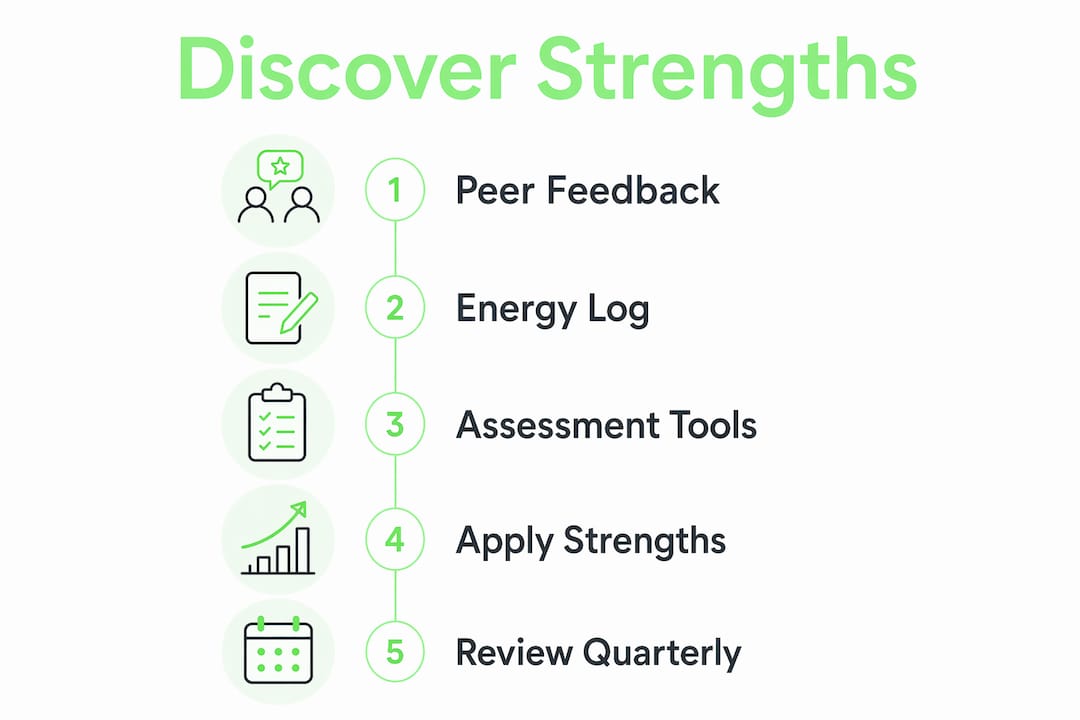
The VIA Character Strengths survey is the most widely used tool in this space. Over 30 million people have completed the 15-minute survey globally to identify their top 5–7 signature strengths. The assessment maps your results across 24 character strengths organized under 6 virtues. That scale of usage also means the research base behind it is substantial.
Here is what the VIA framework covers:
Wisdom: Creativity, curiosity, judgment, love of learning, perspective
Courage: Bravery, perseverance, honesty, zest
Humanity: Love, kindness, social intelligence
Justice: Teamwork, fairness, leadership
Temperance: Forgiveness, humility, prudence, self-regulation
Transcendence: Appreciation of beauty, gratitude, hope, humor, spirituality
Beyond VIA, the Gallup CliftonStrengths assessment (formerly StrengthsFinder) is widely used in corporate and entrepreneurial contexts. It focuses on 34 talent themes and is particularly useful for identifying how your strengths show up in professional settings. Both tools work best when you treat results as a starting hypothesis, not a final verdict.
The research-backed benefit is clear. Intentional application of one signature strength in a new way daily for one week increases happiness and reduces depression for up to six months. That is not a motivational claim. That is a finding from Seligman’s controlled research. Using your strengths is not just fulfilling. It is measurably good for your mental health and performance.
How do you turn discovered strengths into career and business results?
Recognizing your abilities is only half the work. The other half is putting them to use deliberately. Here is how to translate your strengths map into real professional momentum.
Redesign your role around your strengths. Audit your current responsibilities. Which tasks align with your top strengths? Which do not? Negotiate to shift more of your time toward high-strength activities, even incrementally.
Use one strength in a new way each day. This is the specific practice Seligman’s research tested. If “creativity” is a top strength, apply it to a problem you normally solve analytically. The novelty amplifies the benefit.
Build complementary skills around your strengths. Strengths are your engine. Skills are your steering. A founder with exceptional “strategic thinking” still needs to develop communication skills to pitch that thinking effectively.
Make hiring and partnership decisions through a strengths lens. The best founding teams are not collections of similar people. They are complementary strength profiles. Knowing your own strengths helps you identify what you need in a tech cofounder or early hire.
Avoid the avoidance trap. Strengths-based work does not mean ignoring weaknesses forever. It means not letting weaknesses consume your energy when a partner, tool, or system can handle them better.
Pro Tip: Ask yourself quarterly: “Am I spending more than 60% of my work time in my top three strength areas?” If not, something in your structure needs to change.
Strengths also evolve. Consistent patterns of behavior performed with energy, not just competence, define a true strength. As your career or business grows, revisit your energy log and reassess. What fuels you at the seed stage of a startup may differ from what fuels you at scale.
Key Takeaways
The most effective approach to identifying personal strengths combines structured peer feedback, daily energy tracking, and validated assessments like the VIA Character Strengths survey to reveal the qualities that drive authentic, sustainable performance.
Point | Details |
|---|---|
Strengths vs. skills | A genuine strength energizes you and improves with use; a skill may drain you despite proficiency. |
Peer feedback method | Gather 5–10 specific responses using situational questions to validate consistent strength patterns. |
Energy log practice | Rate tasks daily for 14 days to identify which activities consistently fuel rather than deplete you. |
VIA assessment | Over 30 million people have used this free, research-backed survey to map 24 character strengths. |
Daily application | Using one strength in a new way each day produces measurable gains in happiness for up to six months. |
Strengths are a moving target, and that is the point
I have worked with enough founders and career builders to notice a pattern. The ones who struggle most with self-assessment are not the ones who lack self-awareness. They are the ones who found their strengths once, labeled themselves, and stopped looking.
Here is the uncomfortable truth: strengths are not a fixed identity. They are a current reading of how you are wired to contribute, given where you are right now. I have seen founders who were genuinely energized by “doing everything” in year one become completely depleted by the same behavior in year three. The strength did not disappear. The context changed, and the strength needed to be expressed differently.
The other misconception I see constantly is treating a deficit-focused mindset as humility. It is not. Spending 80% of your development energy on your weakest areas is not strategic. It is expensive and slow. The founders who scale fastest are the ones who get brutally honest about their top three strengths and build their entire operating model around expressing those strengths at maximum intensity.
Self-assessment is also harder than it looks because most of us have been trained to downplay what comes easily. If something feels effortless, we assume it does not count. That is exactly backwards. The things that feel effortless to you and difficult to others are your highest-value assets. Treat them that way.
Stay curious about your own evolution. Revisit your energy log every quarter. Ask for feedback from people who challenge you, not just people who like you. The AI tools for solopreneurs available today can help you cut through the noise and surface blind spots you would never catch on your own. Use them.
— Samim
How Siift helps founders build on their strengths
Knowing your strengths is one thing. Knowing how to build a business around them is another. Siift is an agentic AI platform built specifically for founders and entrepreneurs who want to move from self-awareness to validated business strategy, fast. It guides you step by step through ideation, validation, and go-to-market planning, filtering out the biases and blind spots that derail most early-stage ventures. If you have done the work of identifying your core strengths and you are ready to put them to work in a real business context, Siift gives you the structure and intelligence to do that without the guesswork that slows most founders down.
FAQ
What is the difference between a strength and a skill?
A skill is a learned ability that may or may not energize you. A strength is a deeply embedded quality that feels intrinsically rewarding to use and improves your performance and well-being when applied consistently.
How many people should I ask for feedback on my strengths?
Experts recommend gathering feedback from 5 to 10 colleagues, managers, or clients. Consistency across that many observers reliably distinguishes genuine strengths from one-off situational wins.
Which strengths assessment tools are most reliable?
The VIA Character Strengths survey, used by over 30 million people globally, is the most research-backed free option. Gallup CliftonStrengths is widely used in professional and entrepreneurial contexts for its focus on talent themes.
How long does the strengths discovery process take?
A 14-day energy log combined with structured peer feedback gives you a solid initial picture. Treat it as an ongoing practice rather than a one-time exercise, revisiting your results quarterly as your role or business evolves.
Can your strengths change over time?
Yes. Strengths are patterns of behavior tied to your current context and development stage. What energizes you at one career stage may shift as your responsibilities and goals grow.