

TL;DR:
Finding a technical cofounder involves prioritizing trusted relationships and demonstrating market traction. Building with no-code tools and contractors can sustain momentum while searching, and equity offers of 20% to 50% attract committed partners. A trial project provides better insight than interviews, ensuring you select the right long-term technical partner.
A tech cofounder is defined as a full equity partner who owns the product engineering function of your startup, not a contractor you pay by the hour. Finding a tech cofounder is one of the highest-stakes decisions you will make as a founder. Get it right and you have a builder who ships product, challenges your assumptions, and shares the risk. Get it wrong and you lose months, equity, and momentum. This guide gives you the exact channels, preparation tactics, and evaluation frameworks that work in 2026.
What are the most effective channels to find a tech cofounder?
Finding a technical cofounder is closer to recruiting than casual networking. Your goal is to find a product engineer who actively ships code, not a future CTO who manages a team from a distance. That distinction shapes where you look and how you pitch.
Here are the channels ranked by conversion, from highest to lowest:
Former colleagues and classmates. Research on over 10,000 founders shows that prior working relationships produce the most stable founding teams. Trust is already built. You know how they handle pressure. This is your first call, every time.
Accelerator matching programs. Y Combinator’s Co-founder Matching platform is highly active. 75% of matches are accepted on average within 4.5 days. The catch: technical candidates manage nearly 5 simultaneous match requests, so your profile and pitch must stand out immediately.
Sector-specific communities. AI-focused Discord servers, Hacker News “Who wants to be a cofounder?” threads, and domain hackathons are where credible engineers spend time. Show up consistently, contribute real knowledge, and pitch only after you have earned some visibility.
Curated cofounder platforms. Several platforms exist specifically for founder matching. They work, but they require a polished, specific pitch because competition is high.
LinkedIn cold outreach. LinkedIn cold outreach is the lowest-yield channel and should be your last resort. Response rates are poor and the signal-to-noise ratio is brutal.
Pro Tip: Exhaust your personal network completely before opening any public marketplace. Public platforms demand a highly tailored pitch to cut through the noise. If you go in with a generic “I have an idea” message, you will be ignored.
How to prepare and attract a quality technical cofounder
The single biggest mistake non-technical founders make is pitching an idea with no proof. Technical talent rejects idea-only pitches because they carry all the execution risk while you carry none. You need to reduce their risk before you ask them to reduce yours.
Here is what a strong preparation checklist looks like:
Show market validation. Customer interviews, a waitlist, early revenue, or even a no-code prototype signals that you have tested the idea against reality. Learn how to validate your startup idea before you start outreach.
Build an engineer-focused pitch. Lead with the problem, the evidence it exists, your commitment level, and the equity offer. Skip the grand vision slide until they ask.
Be transparent about commitment. Are you full-time? Part-time? Do you have runway? Engineers want to know you are serious, not just experimenting.
Offer meaningful equity upfront. A technical cofounder who sees a lowball offer below 10–15% will walk. Respect their contribution from the first conversation.
Contribute before you pitch. In technical communities, answer questions, share research, and engage genuinely for weeks before you mention your startup.
Pro Tip: Treat your first outreach message like a cold email to a top investor. One clear problem, one line of traction, one direct ask. Founders who write three paragraphs about their vision get archived.
The timeline reality is sobering. The search typically takes 3–6 months, not weeks. Build that into your plan so you are not making a desperate decision at month two.
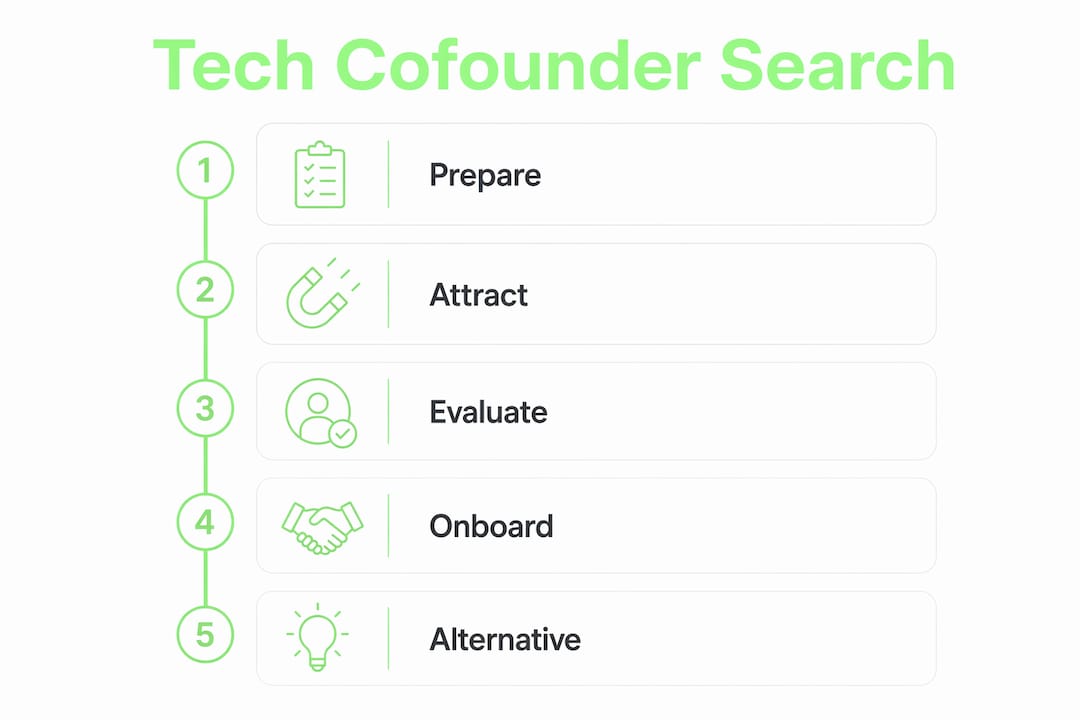
How to evaluate and onboard a technical cofounder

Interviews do not work for cofounder selection. A one-hour conversation tells you almost nothing about how someone codes under pressure, handles disagreement, or prioritizes features when resources are tight.
The better method is a structured, time-bounded trial. Run a paid equity-based project, like a focused hackathon or a two-week sprint, before you sign anything. You learn more in 48 hours of building together than in five interviews.
When it comes to equity, the numbers matter. True technical cofounders typically receive between 20% and 50% equity. Anything below 10–15% signals a hire, not a partner, and top engineers know the difference.
Arrangement | Typical equity range | Best suited for |
|---|---|---|
True technical cofounder | 20%–50% | Full-time partner, pre-revenue stage |
Fractional CTO | 1%–5% | Advisory or part-time technical leadership |
Contractor with IP rights | 0% equity | Short-term build, paid in cash |
Early technical hire | 0.5%–2% | Post-seed, defined role and salary |
Beyond equity, get the legal structure right from day one. Use a standard vesting schedule, typically four years with a one-year cliff. Define roles clearly in writing. Vague responsibilities are the number one cause of cofounder conflict six months in. A partner, not a vendor relationship requires that kind of clarity upfront.
Pro Tip: Never skip the vesting schedule, even with a trusted friend. It protects both of you. If they leave at month three, you are not handing over 30% of your company for three months of work.
What alternatives exist if you cannot find a technical cofounder right now?
A slow search is not a reason to stall your startup. Building with no-code or AI-assisted tools is a legitimate interim strategy, especially if you are pre-traction. The goal is to generate enough proof that a technical cofounder sees a real opportunity, not a blank canvas.
Practical fallback moves that actually work:
Build an MVP with no-code tools. Platforms like Webflow, Bubble, or Glide let you ship a working product without writing a line of code. Traction from a no-code MVP is real traction.
Hire a contractor with clean IP arrangements. Pay a developer to build a prototype. Make sure all intellectual property is assigned to your company in writing before work begins.
Join an early-stage startup as a team member. Spend six months inside a startup. You will build your network, learn the technical vocabulary, and meet engineers who might eventually join your venture.
Use AI-assisted development tools. Tools like GitHub Copilot and Cursor lower the barrier to building functional prototypes even for non-engineers.
The core logic here is simple. Traction attracts cofounders. Every week you spend building evidence of demand is a week that makes your pitch stronger. Founders who arrive at a cofounder conversation with 200 waitlist signups and three paying customers are in a completely different negotiating position than founders with a slide deck.
Key takeaways
Finding a technical cofounder requires starting with trusted relationships, proving market traction, and offering meaningful equity before asking anyone to take a risk on your idea.
Point | Details |
|---|---|
Start with your network | Former colleagues and classmates produce the most stable founding teams. |
Show traction first | Customer interviews, early revenue, or a prototype make your pitch credible to engineers. |
Use trial projects | A paid equity sprint reveals work style and compatibility faster than any interview. |
Offer real equity | True technical cofounders expect 20%–50%; offers below 10%–15% signal a hire, not a partner. |
Plan for 3–6 months | The search takes time. Use no-code tools and contractors to maintain momentum while you search. |
What I’ve learned about finding a technical cofounder the hard way
I have watched founders spend six months on the wrong channels, sending cold LinkedIn messages to engineers who never respond, while their best potential cofounder was a former colleague they were too nervous to call. The fear of rejection from someone you know is real. But the conversion rate from a trusted relationship is orders of magnitude higher than any cold platform.
The other mistake I see constantly is undervaluing the technical role. Founders who offer 5% equity to someone they expect to build the entire product are not being strategic. They are being short-sighted. A great engineer who owns 30% of your company is infinitely more motivated than one who owns 3%. That motivation shows up in the product.
What actually works is treating this like a long-term relationship search, not a transaction. You are looking for someone whose judgment you trust when things go sideways, because they will. The best cofounder conversations I have seen start with “here is what I have already built and proven” rather than “here is my idea.” Traction is the great equalizer. It turns a pitch into an invitation.
One more thing: do not confuse a CTO title with what you actually need. Most early-stage startups need a product engineer who writes code every day, not a manager. Hire for what the next 18 months require, not the org chart you imagine at Series B.
— Samim
Siift can help you build a stronger founding strategy
Before you find the right technical partner, you need a validated business case worth joining. Siift is an agentic AI platform built specifically for founders. It guides you through ideation, market validation, and go-to-market strategy step by step, so you arrive at every cofounder conversation with real evidence, not just enthusiasm. When your opportunity is clearly defined and your traction is documented, attracting a technical partner becomes a much shorter conversation. Start building your founder strategy with Siift and give your tech cofounder search the foundation it deserves.
FAQ
How long does it take to find a tech cofounder?
The search typically takes 3–6 months. Founders who treat it like a structured recruiting process with clear criteria and consistent outreach reach their goal faster.
What equity should I offer a technical cofounder?
True technical cofounders typically receive between 20% and 50% equity. Offers below 10%–15% are generally not competitive enough to attract quality technical partners.
What is the best platform for a tech cofounder search?
Y Combinator’s Co-founder Matching is one of the most active platforms, with 75% of matches accepted within 4.5 days. Personal networks and accelerator programs consistently outperform cold outreach platforms.
Should I hire a contractor instead of finding a cofounder?
A contractor is a valid short-term option for building a prototype, but they are not a substitute for a cofounder. Contractors require cash payment and do not share equity risk or long-term commitment.
How do I evaluate a technical cofounder before committing?
Run a time-bounded trial project, such as a hackathon or two-week sprint, compensated in equity. Working together under real conditions reveals compatibility far better than interviews alone.