

More than 90 percent of startups face early failure, yet every year thousands are launched by people without an MBA or years of management experience. What sets successful founders apart has less to do with credentials and more with a mix of personality, adaptability, and grit. Understanding the real qualities that make up founder material can help you assess your own strengths and chart a smarter path toward entrepreneurial success.
Table of Contents
- Defining Founder Material And Core Traits
- Types Of Founders And Common Pathways
- Essential Skills Every Founder Needs
- Challenges And Pitfalls For New Founders
- Strategies For Developing Founder Potential
Key Takeaways
| Point | Details |
|---|---|
| Diverse Founder Traits | Successful founders exhibit varied personality types and traits, emphasizing resilience, adaptability, vision, risk tolerance, and emotional intelligence as core elements of entrepreneurial success. |
| Entrepreneurial Pathways | Founders typically follow distinct pathways such as corporate escapees or student innovators, highlighting the personal nature of each entrepreneurial journey. |
| Essential Skills Development | Founders must cultivate a comprehensive skill set, including cognitive, emotional, technical, and interpersonal skills, to effectively navigate the startup landscape. |
| Understanding Challenges | Recognizing potential challenges and pitfalls is crucial for founders, enabling strategic preparation and adaptive growth in the face of entrepreneurial obstacles. |
Defining Founder Material and Core Traits
Founder material isn’t about having a fancy degree or hitting predetermined milestones. It’s about possessing a unique constellation of psychological traits and adaptive capabilities that transform ordinary individuals into extraordinary entrepreneurs.
According to research from arxiv.org, successful startup founders aren’t a monolithic group but can be categorized into six distinct personality types: fighters, operators, accomplishers, leaders, engineers, and developers. Each type brings specific strengths to their entrepreneurial journey, suggesting that founder material is less about a universal template and more about leveraging individual psychological strengths.
Research published in PubMed further illuminates this complexity, revealing that founder personality traits significantly influence startup outcomes. The Big Five personality dimensions - openness, conscientiousness, extraversion, agreeableness, and neuroticism - play crucial roles in determining entrepreneurial success.
The core traits of founder material consistently include:
- Resilience: The capacity to bounce back from setbacks
- Adaptability: Quick learning and pivoting in dynamic environments
- Vision: Ability to see opportunities where others see obstacles
- Risk Tolerance: Calculated willingness to embrace uncertainty
- Emotional Intelligence: Managing personal and team dynamics effectively
Ultimately, founder material isn’t about perfection. It’s about having the self-awareness to understand your unique strengths, the humility to recognize your limitations, and the determination to continuously grow. Understanding Founder Market Fit can help you align your personal traits with entrepreneurial opportunities more strategically.
Types of Founders and Common Pathways
Entrepreneurship isn’t a one-size-fits-all journey. Each founder arrives with a unique background, set of skills, and motivational blueprint that shapes their entrepreneurial trajectory.
According to groundbreaking research from arxiv.org, startup founders can be categorized into six distinct archetypes: fighters, operators, accomplishers, leaders, engineers, and developers. These categories aren’t rigid classifications but fluid frameworks that help understand the diverse pathways entrepreneurs navigate.
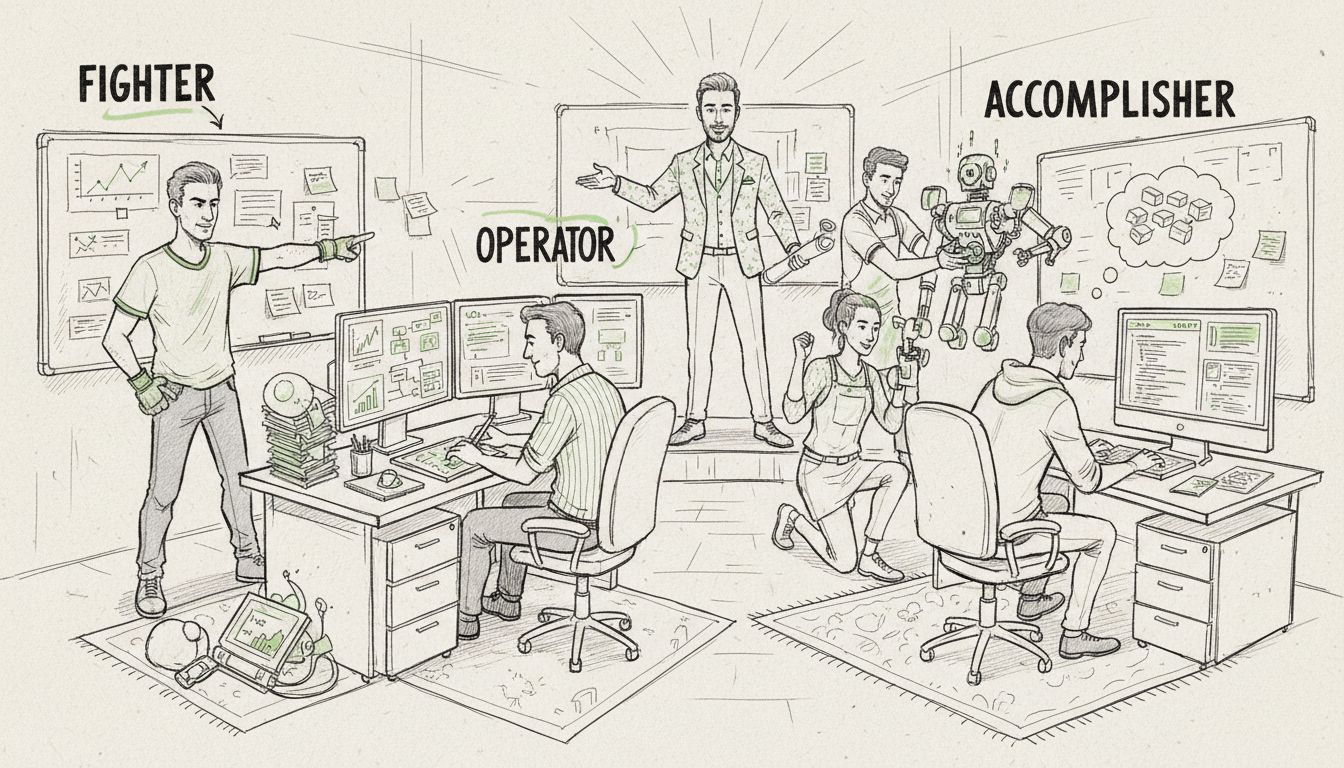
Fighters typically emerge from challenging backgrounds, using entrepreneurship as a mechanism for overcoming systemic barriers. Operators are process-oriented individuals who excel at executing complex strategies with precision. Accomplishers are driven by achievement and measurable outcomes, often transitioning from successful corporate careers. Leaders demonstrate exceptional team-building and vision-casting capabilities, while engineers approach entrepreneurship through technical problem-solving. Developers are adaptable builders who continuously refine their skills and products.
Interestingly, research exploring startup ecosystems reveals that educational backgrounds significantly influence entrepreneurial paths. How to Find Cofounders in 2025 suggests that collaborative networks play a crucial role in determining founder success, with many entrepreneurs leveraging institutional connections and shared academic experiences.
Common founder pathways typically include:
- Corporate Escapee: Professionals leaving stable jobs to pursue entrepreneurial dreams
- Student Innovator: College students launching ventures based on academic projects
- Serial Entrepreneur: Individuals who repeatedly start and scale multiple businesses
- Technical Founder: Engineers and programmers solving industry-specific challenges
- Social Impact Founder: Entrepreneurs driven by mission-oriented goals
While these pathways offer insights, remember that your entrepreneurial journey is deeply personal. No predetermined route guarantees success—only your unique combination of passion, skills, and relentless determination will ultimately define your path.
Essential Skills Every Founder Needs
Founder success isn’t just about having a brilliant idea—it’s about developing a comprehensive skill set that transforms potential into reality.
According to research from innovation-entrepreneurship, technology-based startup founders require a nuanced blend of skills that go far beyond traditional business acumen. The most critical capabilities include problem-solving ability, intellectual flexibility, high pain threshold, strong feedback loops, and customer focus—traits that enable entrepreneurs to navigate the complex and unpredictable startup landscape.
Beyond technical skills, successful founders must cultivate deep emotional and psychological resilience. 10 Essential Habits of Successful Entrepreneurs emphasizes that personal development is equally crucial as business strategy. Continuous learning, effective stress management, and the ability to pivot quickly become fundamental survival skills in the entrepreneurial ecosystem.
The essential skills every founder needs can be categorized into several key domains:
Cognitive Skills:
- Critical thinking and strategic problem-solving
- Intellectual adaptability
- Systems-level understanding
- Rapid learning and unlearning
Emotional Intelligence:
- Resilience under pressure
- Self-awareness
- Empathy and team management
- Stress tolerance
Technical Competencies:
- Basic financial literacy
- Digital tool proficiency
- Data analysis fundamentals
- Communication and storytelling
Interpersonal Skills:
- Negotiation
- Networking
- Conflict resolution
- Inspirational leadership
Remember, no founder is born perfect. These skills are developed through consistent practice, self-reflection, and a willingness to embrace continuous growth. Your entrepreneurial journey is less about having all the answers and more about developing the capacity to find them.
Challenges and Pitfalls for New Founders
Every entrepreneurial journey is a minefield of potential obstacles, where passion meets the harsh realities of building something from scratch. Understanding these challenges isn’t about discouragement—it’s about strategic preparation.
According to Wikipedia’s founder mode research, founders often struggle with several critical internal challenges that can derail their ventures. These include difficulty accepting criticism, building sustainable structures, replacing ineffective talent, maintaining clear communication, and managing complex risks—subtle yet profound barriers that emerge from founders’ own psychological and operational blind spots.
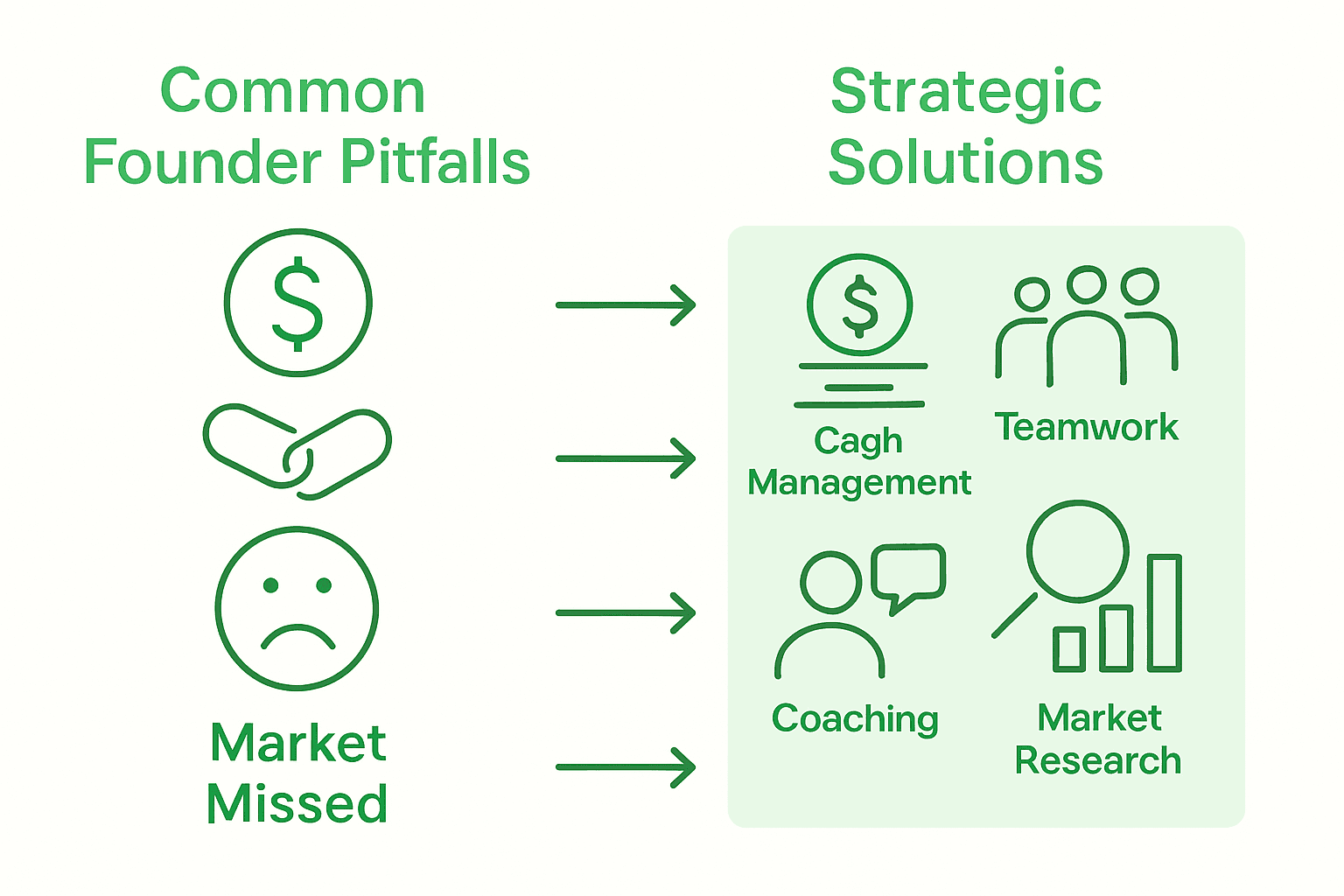
The entrepreneurial landscape is unforgivingly complex. Top Reasons Businesses Fail in 2025 highlights that most startup failures aren’t sudden catastrophes but gradual erosions caused by compounding small mistakes. Founders frequently stumble through predictable patterns: overestimating market demand, underestimating required capital, neglecting customer feedback, and failing to adapt quickly.
Common pitfalls new founders must navigate include:
Financial Challenges:
- Inadequate cash flow management
- Premature scaling
- Misunderstanding burn rates
- Poor financial forecasting
Operational Obstacles:
- Inefficient team communication
- Lack of clear role definition
- Inconsistent product strategy
- Weak operational processes
Psychological Traps:
- Founder’s ego and defensiveness
- Decision-making paralysis
- Imposter syndrome
- Burnout and mental exhaustion
Market-Related Risks:
- Misreading customer needs
- Overcrowded market entry
- Insufficient competitive analysis
- Rigid product development
Remember, recognizing these potential pitfalls isn’t about generating fear—it’s about developing the self-awareness and strategic flexibility that transforms challenges into opportunities for growth and innovation.
Strategies for Developing Founder Potential
Founder potential isn’t a predetermined destiny—it’s a skill set that can be systematically developed, refined, and transformed through intentional practice and strategic self-improvement.
According to research from techplace, founders can dramatically enhance their potential by fostering a culture of continuous learning. This involves actively staying updated through targeted reading, attending specialized workshops, and consistently seeking feedback from mentors and peers—creating an ecosystem of perpetual personal and professional growth.
Understanding Founder Mode suggests that developing founder potential requires a multifaceted approach that goes beyond traditional skill acquisition. It’s about cultivating a mindset that embraces uncertainty, values adaptive learning, and transforms challenges into strategic opportunities.
Strategic approaches for developing founder potential include:
Personal Development Strategies:
- Cultivate intellectual curiosity
- Practice radical self-reflection
- Develop emotional resilience
- Build a growth-oriented mindset
Skill Acquisition Techniques:
- Pursue cross-disciplinary knowledge
- Learn from diverse entrepreneurial experiences
- Master rapid skill adaptation
- Develop systems thinking
Networking and Ecosystem Strategies:
- Build diverse professional relationships
- Seek mentorship from experienced founders
- Participate in entrepreneurial communities
- Engage in collaborative learning environments
Psychological Conditioning:
- Reframe failures as learning opportunities
- Develop mental toughness
- Practice strategic risk assessment
- Cultivate persistent problem-solving approaches
Remember, becoming a founder is less about a single transformative moment and more about consistent, intentional personal evolution. Your potential isn’t fixed—it’s a dynamic landscape waiting to be explored, challenged, and expanded.
Unlock Your Founder Potential with Intelligent Guidance
Becoming founder material means more than passion or a great idea. The real challenge lies in mastering resilience, adapting quickly, and transforming your unique strengths into actionable strategies while avoiding common pitfalls. If you find yourself overwhelmed by the steps from ideation to launch or unsure how to align your psychological traits with business opportunities, you are not alone.
That is where the siift.ai Intelligent Business Canvas comes in. This modern founder’s strategy platform offers personalized feedback and clear prioritized actions tailored to your journey. With intuitive AI guidance through ideation, validation, and go-to-market phases, it helps you de-risk your path without the noise of biases or pressure. Explore how understanding your founder mode connects with systematic growth at Understanding Founder Mode. Struggling to find the right partners or build effective networks? Learn more at How to Find Cofounders in 2025.
Take control of your entrepreneurial future today. Visit siift.ai and start turning your aspirations into a viable, thriving business.
Frequently Asked Questions
What qualities define founder material?
Founder material is characterized by traits including resilience, adaptability, vision, risk tolerance, and emotional intelligence. These qualities help individuals navigate the challenges of entrepreneurship and leverage their unique strengths.
How can I identify my founder personality type?
You can identify your founder personality type by reflecting on your experiences, motivations, and strengths. Research categorizes founders into six types: fighters, operators, accomplishers, leaders, engineers, and developers. Understanding your type can help you align with appropriate entrepreneurial opportunities.
What skills should I develop as an aspiring entrepreneur?
Aspiring entrepreneurs should focus on cognitive skills like critical thinking and problem-solving, emotional intelligence to manage stress and relationships, technical competencies including financial literacy, and interpersonal skills for negotiation and networking.
What common challenges do new founders face?
New founders often encounter financial challenges such as cash flow mismanagement, operational obstacles like team communication issues, and psychological traps such as decision-making paralysis and burnout. Recognizing these pitfalls helps in strategic preparation for entrepreneurship.
Recommended
- blog | siift | Understanding Founder Mode: Your Guide to Entrepreneurship
- blog | siift | How to Find Cofounders in 2025: Proven Steps for Students & Innovators
- blog | siift | Business Plan Essentials 2025: A Beginner’s Guide for New Founders
- blog | siift | Bootstrapping Strategies: Guide for First-Time Founders
- The Essential Guide to the Role of Founder Brand
- Importance Of Mentorship: Complete Guide For Solopreneurs