
Confusion between freelancer and solopreneur roles is common among Millennial developers. The difference matters because it shapes your income, freedom, and long-term growth. Freelancers contribute to innovation and job creation globally, but solopreneurs shift toward building scalable business models and strategic revenue streams. This article clarifies the practical distinctions, helping you choose the path that best fits your vision and goals.
Table of Contents
- Defining Freelancer And Solopreneur Roles
- Key Differences In Business Models And Mindset
- Transitioning From Freelancer To Solopreneur
- Legal, Financial, And Tax Considerations
- Common Pitfalls And How To Avoid Them
Key Takeaways
| Point | Details |
|---|---|
| Understand the Distinction | Freelancers focus on trading time for money, whereas solopreneurs build scalable business systems and products. |
| Focus on Systems | Transitioning from freelancer to solopreneur requires developing automated processes and multiple income streams. |
| Choose the Right Structure | Select a business structure that aligns with your revenue level and liability preference, such as LLC or S-Corp for solopreneurs. |
| Avoid Common Pitfalls | Be wary of underpricing, lack of contracts, and poor client boundaries to ensure sustainable business growth. |
Defining Freelancer and Solopreneur Roles
Before you pick a path, you need to understand what actually separates these two models. They sound similar, but they operate on fundamentally different principles. The confusion is real—and it matters because your choice affects everything from taxes to how you sell your services.
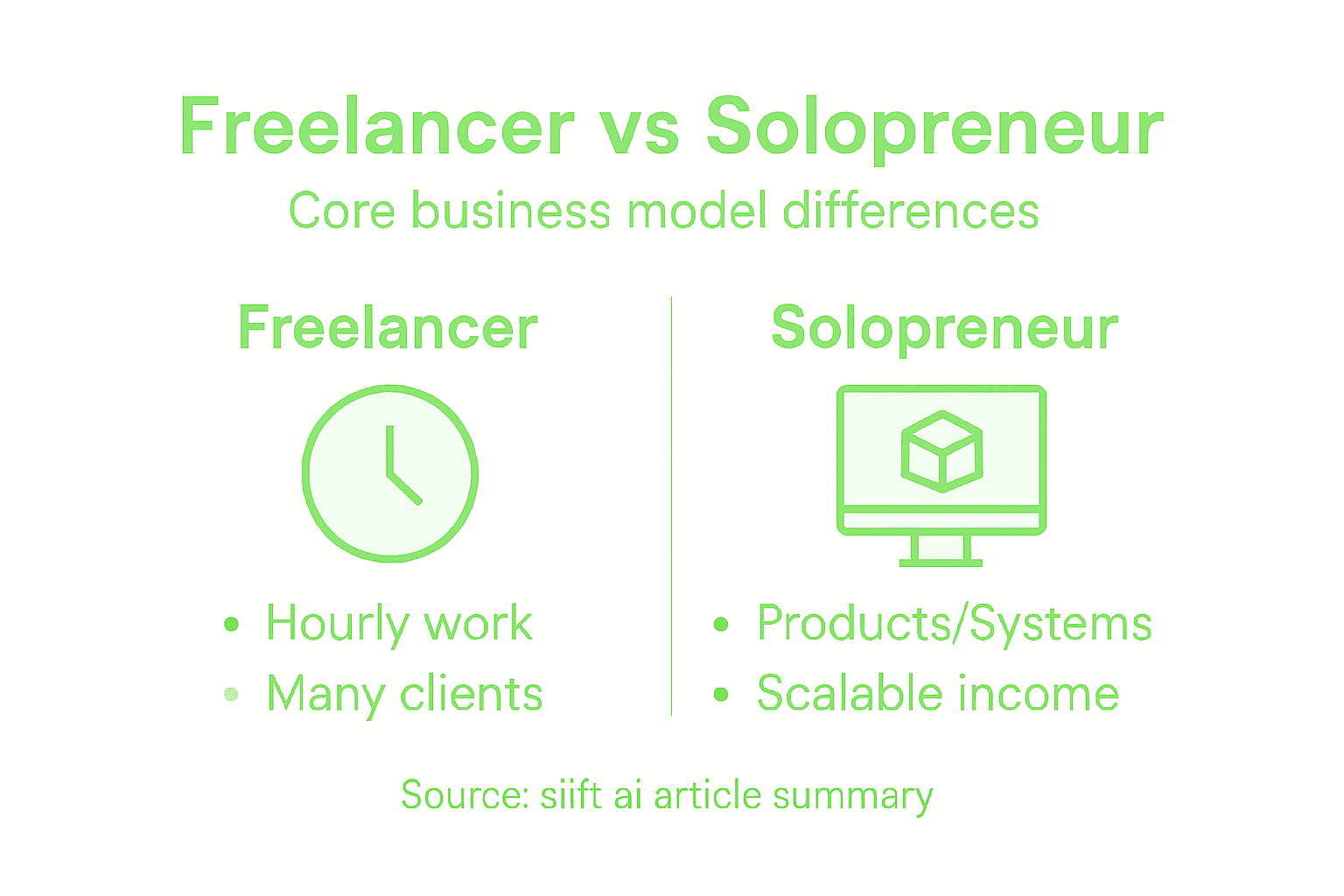
A freelancer is a service provider who works on a project or contract basis for multiple clients. You’re essentially renting your time and skills. This is why freelancers represent a critical segment within modern self-employed workers, contributing significantly to innovation and job creation across industries. Your income depends on the hours you bill or projects you complete.
A solopreneur is a business owner building something of their own. The distinction matters: you’re not just selling hours—you’re building a business that can theoretically run without you trading time for money directly. Understanding the difference between solopreneurs and traditional entrepreneurs helps clarify that solopreneurs build scalable business models, not just service practices.
Here’s the reality check:
- Freelancers have direct client relationships; solopreneurs build scalable systems
- Freelancers exchange time for money; solopreneurs create value products or services
- Freelancers stay in project mode; solopreneurs think in terms of business growth
- Freelancers control hours; solopreneurs control systems and leverage
Freelancing feels comfortable because you already know how to code. You’re just doing it independently instead of at a company. Solopreneurship requires you to think differently—about automation, productization, and sustainable revenue models.
The key distinction: freelancing is a job structure, while solopreneurship is a business mindset.
Most developers transition from freelancing without realizing they’re still operating as glorified contractors. You might call yourself a solopreneur, but if you’re trading 40 hours weekly for fixed project fees with no leverage, you’re still in the freelance trap.
The good news? You can transition. It requires intentional business strategy, not just coding skill.
Here’s how freelancer and solopreneur approaches shape business growth and sustainability:
| Aspect | Freelancer | Solopreneur |
|---|---|---|
| Revenue Ceiling | Limited by available hours | Can scale with systems and products |
| Risk Level | Predictable income, lower risk | Higher growth potential, greater risk |
| Business Assets | Client list and reputation | Brand, systems, intellectual property |
| Time Flexibility | High, control daily schedule | Lower, need to maintain business operations |
Pro tip: Audit your current income streams this week—what percentage comes from trading hours versus automated products, retainers, or scalable services? That number reveals whether you’re actually a freelancer or solopreneur in practice.
Key Differences in Business Models and Mindset
The split between freelancer and solopreneur starts in your head, not your tax paperwork. One is a job title; the other is a business philosophy. Understanding this mental shift is where most developers get stuck.
Freelancers operate on a reactive model. You wait for client inquiries, respond to job postings, and deliver what clients request. Your income is directly tied to hours worked. The business owner mindset prioritizes outcomes over activity, focusing instead on systems and strategic revenue streams that scale beyond personal effort.
Solopreneurs operate on a proactive model. You create demand through your own efforts, build repeatable processes, and design multiple income streams. Your goal is reducing dependency on trading hours.
The practical differences show up immediately:
- Freelancers chase clients; solopreneurs attract them
- Freelancers optimize for flexibility; solopreneurs optimize for leverage
- Freelancers react to market needs; solopreneurs design solutions
- Freelancers measure success by billable hours; solopreneurs measure by business outcomes
Consider your typical week. If you’re responding to emails and delivering client work, you’re in freelancer mode. If you’re building a productized service, creating content that generates inbound leads, or developing scalable systems, you’re thinking like a solopreneur.
The mindset shift is about designing demand instead of responding to it.
Freelancers excel at client responsiveness and flexibility. You can take a month off or adjust your schedule easily. Solopreneurs sacrifice that flexibility for something else: leverage. Your business generates value while you sleep because systems do the work, not you.
This distinction matters because each model requires different financial planning, marketing strategies, and business structures. A freelancer’s income is predictable but capped. A solopreneur’s income has higher upside but requires upfront investment in systems.
Pro tip: Map your current income sources: which come from active client work versus passive systems? The ratio reveals your true business model—and where to invest next.
Transitioning from Freelancer to Solopreneur
The shift from freelancer to solopreneur isn’t automatic. Many developers stay freelancers their entire careers without realizing the option exists. The transition requires deliberate decisions about your business structure, revenue model, and daily priorities.

Start by redefining your role. You’re no longer just a service provider solving client problems on demand. The mindset shift from service delivery to strategic business building means thinking about scalability, positioning, and long-term value creation. Your expertise becomes an asset, not just your time.
Freelancers optimize for client satisfaction. Solopreneurs optimize for business leverage. This changes everything about how you work.
Here are the concrete steps:
- Document your systems - Write down every repeatable process you use in client work
- Build your brand - Create a clear positioning distinct from generic “software developer for hire”
- Productize your services - Convert vague “custom development” into specific, packaged offerings
- Establish value-based pricing - Move away from hourly rates toward outcome-based compensation
- Create inbound channels - Develop content, case studies, or automation that attracts clients proactively
The financial shift matters too. Freelancers track billable hours; solopreneurs track business metrics like customer acquisition cost, lifetime value, and profit margins.
Transitioning means building a business that can survive without you trading hours directly.
Expect resistance from existing clients. They’ve hired you for your time, not your business. When you shift toward productized services or retainers, some will push back. This is actually a feature, not a bug—it filters for clients who value your expertise over your availability.
The emotional challenge is real. You’ll feel less productive initially because you’re not billing every hour. You’re investing in systems, branding, and processes. This investment pays dividends, but not immediately.
Start small. Don’t abandon all freelance work tomorrow. Pick one signature service offering and build systems around it while maintaining other income.
Pro tip: Choose ONE high-value service you enjoy most, document exactly how you deliver it, then offer it as a fixed package with defined outcomes rather than hourly rates.
Legal, Financial, and Tax Considerations
Choosing between freelancer and solopreneur status carries real legal and tax implications. This isn’t glamorous, but ignoring it costs money—sometimes significant amounts. Your business structure determines your liability, tax burden, and compliance obligations.
Freelancers typically operate as sole proprietors. You and your business are legally the same entity. This is simple to set up but exposes your personal assets if something goes wrong. A client lawsuit could target your house, savings, and car.
Solopreneurs often incorporate as LLCs or corporations. This creates a legal boundary between your personal and business assets. Your liability is limited to what’s in the business account. The trade-off is complexity and cost.
Employment classification and withholding obligations vary significantly depending on your jurisdiction and business structure. In the United States, sole proprietors pay self-employment taxes on all income. Corporations have different requirements. This matters because self-employment taxes can add 15% to your bill.
Key differences to understand:
- Sole proprietor - Simple, cheap to start; unlimited personal liability
- LLC - Liability protection; moderate complexity; flexible taxation
- S-Corp - Significant tax savings for profitable businesses; higher compliance burden
- C-Corp - Best for scaling fast; complex bookkeeping; potential double taxation
Tax filing deadlines vary by structure. Sole proprietors file Schedule C with their personal taxes. Corporations file separate tax returns by specific dates. Missing deadlines costs penalties.
Compare common business structures relevant for freelancers and solopreneurs:
| Structure Type | Best For | Main Benefit | Potential Drawback |
|---|---|---|---|
| Sole Proprietor | New freelancers | Simple, low cost setup | No liability protection |
| LLC | Growing solopreneurs | Limits personal risk | Slightly more paperwork and fees |
| S-Corp | Profitable businesses | Potential tax savings | Stricter IRS regulations |
| C-Corp | High-growth firms | Easiest for funding/stock | Double taxation, most complex |
Your business structure is the foundation for everything financial. Get it right before you scale.
Freelancers can often delay this decision. You’re making $3,000-5,000 monthly? Sole proprietor works fine. But once you hit $100,000+ annually, incorporation becomes financially smart. You can save 20-30% on taxes through legitimate structures.
Budget for professional help. A tax accountant costs $1,500-3,000 yearly but saves far more through optimization. A business attorney reviewing your contracts costs $500-1,500 upfront but prevents expensive litigation.
Start tracking everything now. Record all income, expenses, and business mileage immediately. This habit matters regardless of your chosen structure.
Pro tip: Consult a tax professional in your jurisdiction before scaling beyond $50,000 annual revenue—they’ll help you choose the optimal structure and save thousands.
Common Pitfalls and How to Avoid Them
Most developers who attempt the transition from freelancer to solopreneur stumble on predictable mistakes. The good news? These are entirely avoidable if you know what to watch for. Understanding common pitfalls ahead of time saves months of frustration and lost income.
Pitfall #1: Underpricing your work. You’re anxious about landing clients, so you quote low rates. This becomes your market position. Clients remember your pricing, and raising rates later causes friction. Undercharging is one of the most common reasons freelancers fail, creating a perpetual income ceiling that prevents scaling.
The fix is radical honesty. Research market rates for your skill level and geography. Price at the 75th percentile, not the 25th. Some clients will push back—that’s fine. You’re filtering for clients who value your expertise.
Pitfall #2: Skipping contracts. Verbal agreements feel friendly and fast. They’re also legally useless. A client disputes the deliverables, payment timeline, or scope—and you have no recourse. Written contracts protect both parties.
Pitfall #3: Poor boundaries with clients. You respond to Slack messages at 10 PM. You take emergency calls on weekends. You’re never actually off. This path leads to burnout, not a business.
Common mistakes to avoid:
- No written scope of work - Clients expect unlimited revisions
- Scope creep without charging - Free work expands infinitely
- No deposit or milestone payments - You work first, hope for payment later
- Mixing personal and business finances - Impossible to track profit
- Ignoring market research - Pricing blindly; missing positioning opportunities
- Inconsistent communication - Clients feel neglected; relationships deteriorate
Pitfall #4: Unrealistic expectations about timeline. Building a solopreneur business takes time. You won’t make six figures in month two. You’re not failing if month one is quiet. Most businesses take 6-12 months to generate meaningful revenue.
The businesses that fail are usually the ones that expect overnight success and quit when reality differs.
Pitfall #5: Neglecting skill development. The market changes. Your skills become commoditized if you’re not constantly improving. Spend 5-10% of your income on learning, tools, and professional development.
Pitfall #6: Operating alone without feedback. You make decisions in isolation. Join mastermind groups, find a mentor, or hire a business coach. Outside perspective prevents expensive mistakes.
Pro tip: Document your pricing, contract, and scope of work once—then use them consistently for every client to eliminate friction and protect yourself legally.
Find Your Path from Freelancer to Solopreneur with Confidence
Are you ready to move beyond trading hours for dollars and build a scalable business model that works for you 24/7? The article highlights the challenge of shifting mindset from freelancer to solopreneur — breaking free from reactive work, embracing systems, and creating value-based offerings. This transition can feel overwhelming without structured guidance and clarity.
That is where siift.ai steps in. Our Intelligent Business Canvas is designed to help you navigate key decisions like productizing your services, defining your brand, and establishing strategic revenue streams. It offers personalized insights that expose blindspots often overlooked by freelancers trying to become solopreneurs. With tailored actions to accelerate your journey toward product-market fit, you gain the confidence to move from working in your business to working on your business. Start turning your ideas into a viable, sustainable venture now by exploring siift.ai’s founder insights platform. Don’t wait for clients to come to you. Take control and design the business you deserve today.
Frequently Asked Questions
What is the main difference between a freelancer and a solopreneur?
Freelancers provide services on a project basis to multiple clients, focusing on exchanging time for money. Solopreneurs build scalable businesses that can operate without direct exchanges of hours for income, focusing on creating value and systems.
How do I know if I’m a freelancer or a solopreneur?
Assess your income sources. If a significant portion comes from trading hours for fixed project fees without leveraging systems or products, you are likely still operating as a freelancer. Solopreneurs focus on building scalable offerings that generate passive income.
What steps can I take to transition from freelancer to solopreneur?
To transition, start by documenting your work systems, building your brand, productizing your services, establishing value-based pricing, and creating inbound client acquisition channels. This mindset shift requires deliberate planning and execution.
What are the legal considerations when choosing between freelancer and solopreneur status?
Freelancers typically operate as sole proprietors, exposing their personal assets to liability. In contrast, solopreneurs often form LLCs or corporations, which provide liability protection and may offer tax benefits. It’s essential to consult a professional for guidance based on your revenue level and future goals.