
Launching an AI startup can feel thrilling until you realize many elegant solutions flounder because the real customer problem was never validated. For Millennial solopreneurs in North America with tech backgrounds, skipping this early stage often leads to wasted resources and lost momentum. Mastering problem-solution fit helps ensure your innovation solves issues people truly care about. Discover how systematic validation and customer discovery fuel meaningful progress for your AI-driven idea.
Table of Contents
- Defining Problem Solution Fit for Startups
- Types of Problem Solution Fit and Key Criteria
- Steps to Achieve and Validate Problem Solution Fit
- Common Pitfalls in AI Problem Solution Fit
- Risks and Long-Term Impacts for AI Founders
Key Takeaways
| Point | Details |
|---|---|
| Understanding Problem-Solution Fit (PSF) | PSF is crucial for validating a significant customer problem before solution development, ensuring resources are not wasted on unneeded products. |
| Importance for AI Startups | AI founders must validate PSF to avoid building solutions for problems the market does not prioritize, saving on costs and resources. |
| Validation Approach | Customer interviews and observations are essential for uncovering genuine problems and confirming solutions, rather than relying on assumptions. |
| Common Pitfalls | Founders should avoid building without validation, misunderstanding real problems, and mistaking interest for commitment in potential customers. |
Defining Problem Solution Fit for Startups
Problem-solution fit (PSF) is where your startup discovers and validates a real customer problem before building anything. You’re not selling a product yet; you’re confirming that a problem is significant enough to solve.
Think of PSF as the foundation. If you skip this, you’ll pour resources into solving something nobody actually cares about.
The difference between a successful AI startup and one that fails often comes down to this early stage. Too many founders build first, validate second. That’s backward.
The Core of Problem-Solution Fit
Problem-solution fit is validating three interconnected truths:
- The problem exists and matters to real people in your target market
- Your proposed solution genuinely addresses that problem
- There’s viable business demand around fixing it
You’re testing assumptions, not collecting opinions. Assumptions are things you believe to be true but haven’t proven. Validation means customers confirm they’d actually use your solution.
When you reach PSF, customer discovery and iterative validation become your daily practice. You’re testing, learning, adjusting.
Problem-solution fit isn’t a one-time checkpoint. It’s a continuous discovery process where you refine both the problem and your solution based on real customer feedback.
Why This Matters for AI Startups
AI founders face a particular pressure: the technology is cool, so they assume the market will follow. That’s the startup equivalent of building a bridge nobody wants to cross.
AI solutions tend to be capital-intensive early on. Getting PSF right before scaling saves you from burning cash on something the market doesn’t need.

Here’s what happens when you skip PSF: You build elegant AI models that solve problems at scale—but the scale doesn’t exist because the problem isn’t significant.
Validating the Problem Exists
Customer discovery isn’t about surveys or focus groups. It’s about talking to people who actually have the pain.
Key validation activities include:
- Conducting 1-on-1 interviews with 10-20 potential customers about their current workflow
- Observing how they currently solve the problem (or tolerate living with it)
- Asking about the cost of the problem: time wasted, errors, stress, revenue lost
- Testing willingness to pay by gauging reaction to potential pricing
One interview is anecdotal. Ten interviews with consistent themes is a pattern.
You’re listening for phrases like “We lose hours on this monthly” or “This costs us tens of thousands yearly.” Those indicate a problem with business viability.
Confirming Your Solution Fits the Problem
Validating the solution means showing a minimum viable version (rough prototype, mockup, or demo) to customers and gauging genuine interest.
Not “Would you use this?” because everyone says yes. Instead, ask:
- Would you stop your current approach and switch to this?
- Would you pay X for this solution?
- When could you actually start using this?
Fake enthusiasm is cheap. Real commitment (time, money, or willingness to change behavior) proves fit.
One decisive signal: Pro tip: Ask potential customers to commit a small amount—even just agreeing to a paid beta or pilot—rather than relying on verbal interest. Commitment reveals true conviction.
Types of Problem Solution Fit and Key Criteria
Problem-solution fit isn’t one-size-fits-all. Different startup contexts require different validation approaches. Understanding the types helps you focus on what actually matters for your AI business.
The core distinction comes down to how the problem manifests and how your solution addresses it. Some problems are obvious pain points; others are hidden inefficiencies nobody’s articulated yet.
You need to know which type you’re solving for, because your validation strategy depends on it.
Direct Problem-Solution Alignment
Direct fit is when customers clearly articulate the problem, and your solution directly solves it. This is the clearest path.
Examples include:
- A sales team losing 3 hours weekly to manual data entry; your AI automation saves them that time
- Customer support teams drowning in repetitive emails; your AI triage system reduces response load
- Marketers unable to personalize at scale; your AI recommendation engine enables it
Direct fit is testable immediately. Show customers your solution, and they recognize themselves in the problem.
This type moves fastest through validation because the value is concrete and measurable.
Latent Problem-Solution Fit
Latent fit addresses problems customers haven’t fully recognized yet. They’re experiencing the pain but haven’t named it or prioritized solving it.
Think of a manufacturing company losing 15% of output to undetected equipment failures. They don’t say “We need predictive maintenance AI.” They just know downtime costs them money.
Your job is uncovering the hidden problem, then showing how your solution prevents it.
This type requires deeper discovery. Customers won’t hand you the problem on a silver platter. You’re finding it through their workflow observation and asking probing questions about costs and frustrations.
To better understand validation strategies for AI startups, here’s a comparison of direct and latent problem-solution fit:
| Validation Type | Problem Discovery Approach | Customer Awareness Level | Example Scenario |
|---|---|---|---|
| Direct Fit | Customer clearly states issue | High—problem is articulated | Sales team complains of manual data entry |
| Latent Fit | Founder uncovers hidden issue | Low—problem is unspoken | Manufacturing with undetected failures |
Efficiency Versus Transformation
Some solutions optimize what already exists. Others create entirely new capabilities. This distinction matters for positioning and validation.
Efficiency-focused fit:
- Makes current processes faster, cheaper, or less error-prone
- Easier to validate because the baseline is measurable
- Customers understand the ROI immediately
- Lower adoption friction because it fits existing workflows
Transformation-focused fit:
- Enables new business models or revenue streams
- Requires customers to change how they work fundamentally
- Validation takes longer because there’s no baseline to compare
- Higher reward but higher risk
Most AI startups lean efficiency-first. That’s smart. Efficiency is easier to prove.
Key Criteria for Strong Problem-Solution Fit
Regardless of type, PSF must meet these standards:
- Significance: The problem costs customers time, money, or creates friction enough to change behavior
- Specificity: You’ve defined the problem narrowly enough that your solution clearly addresses it
- Problem-solution linkage clarity: Customers see the connection between their pain and your fix without explanation
- Viability: There’s a market large enough to build a business on
- Willingness to pay: Customers would exchange money or resources to solve it
Weak fit happens when any of these breaks. You might have the right solution for the wrong problem, or a big problem with no viable market.
Strong problem-solution fit means customers stop their current approach and adopt yours because the value is undeniable.
Pro tip: Create a simple one-page map showing the specific problem, your solution, and why customers should care. If you can’t fill it clearly, you don’t have PSF yet—keep validating.
Steps to Achieve and Validate Problem Solution Fit
Achieving problem-solution fit isn’t random. It’s a systematic process where you move from hypothesis to validation through real customer interaction. Follow these steps to get there faster.
Speed matters here. The sooner you validate, the sooner you pivot or double down with confidence.
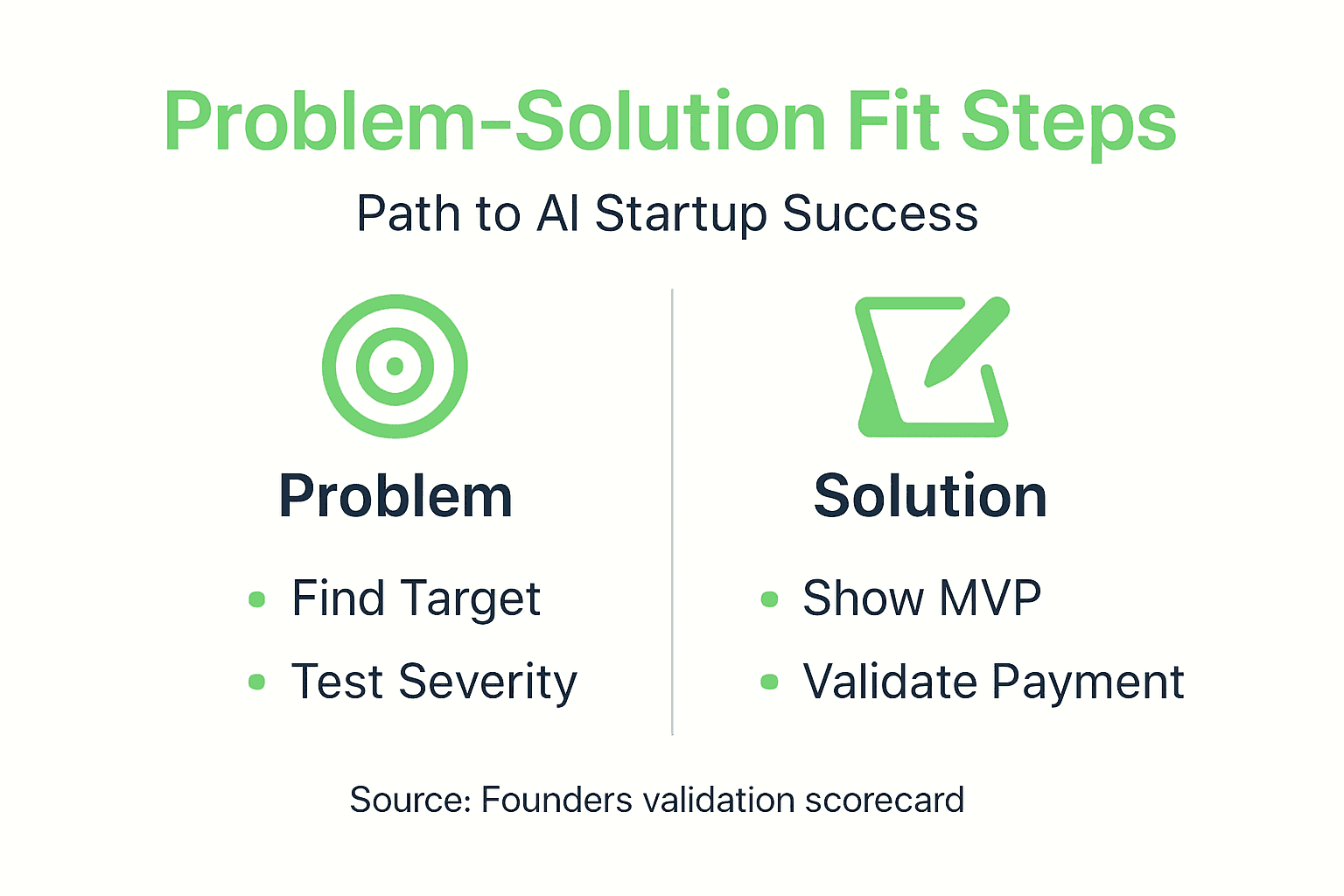
Step 1: Define Your Core Assumptions
Write down what you believe to be true about the problem before you talk to anyone.
Start with these questions:
- Who exactly has this problem?
- How do they currently solve it (or live with it)?
- What would solving it be worth to them?
- Why haven’t they solved it yet?
Your answers are assumptions, not facts. This matters because you’re about to test them.
Be specific. “Small business owners” is too broad. “Millennial solopreneurs running AI startups in North America without technical co-founders” is actionable.
Step 2: Find and Interview Target Customers
Go where your customers are. LinkedIn, Reddit communities, industry forums, coffee shops.
Conduct 10-20 problem discovery interviews. Not sales conversations. Discovery.
Ask open-ended questions:
- What’s your current workflow for [the area you think has a problem]?
- What frustrates you most about this process?
- How much time or money does this cost you monthly?
- Have you tried solving this? What happened?
Listen more than you talk. The goal is understanding their world, not selling them on yours.
Record patterns across conversations. One person saying “This wastes 2 hours weekly” is interesting. Five people saying that is validation.
Step 3: Test Problem Severity
Not every problem is worth solving. The problem must be significant enough that customers would change behavior to fix it.
Listen for emotional signals: frustration, urgency, financial impact. Those indicate severity.
Ask directly: “On a scale of 1-10, how much does this problem impact your work?” People rating it 8+ are your target market.
If customers rate it 4 or 5, you’re chasing a “nice to have.” That won’t drive adoption.
Step 4: Show a Minimal Solution
You don’t need a polished product. You need something that demonstrates how your solution would work.
Options include:
- A low-fidelity prototype or mockup
- A paper-based simulation of the solution
- A video showing how it would work
- Even a detailed description of the workflow
Show it to customers and observe their reaction. Do they see themselves using it? Do they ask clarifying questions or immediately lose interest?
Genuine curiosity signals fit. Polite nodding signals lack of fit.
Step 5: Test Willingness to Pay
This is where theory meets reality. People say they’ll pay for things all the time. Actual payment is different.
Propose a specific price or ask them to commit a small amount (paid pilot, beta access, pre-order). Commitment reveals conviction.
If customers are unwilling to commit even a small amount, you don’t have strong validation yet. Keep iterating.
If multiple customers commit, you have early proof of problem-solution fit.
Step 6: Refine Based on Feedback
You’ll find misalignments. Maybe your problem definition was slightly off, or your solution approach missed the mark.
That’s not failure. That’s the point of validation.
Adjust your understanding of the problem or your solution approach, then test again with new customers.
Repeat this cycle until customer feedback stabilizes and you’re consistently seeing the same patterns.
Problem-solution fit is proven when customers consistently confirm the problem matters, your solution addresses it, and they’d switch from their current approach.
Pro tip: Document every interview finding in a simple spreadsheet: problem severity rating, proposed solution reaction, willingness to pay, and key feedback. Patterns emerge faster when data is organized.
Common Pitfalls in AI Problem Solution Fit
AI founders fall into predictable traps when chasing problem-solution fit. Knowing these pitfalls helps you avoid wasting months on the wrong path.
The difference between founders who find PSF and those who don’t often comes down to recognizing and sidestepping these common mistakes.
Building Before Validating
This is the cardinal sin. You’re excited about the AI potential, so you start building immediately.
But building before validation means you’re optimizing for a problem that might not matter. You’re polishing the wrong solution.
AI models require compute resources and development time. Spend both validating the problem first. Only after customers confirm the problem matters should you invest in building the solution.
Your first conversations should happen before a single line of code.
Misunderstanding the Real Problem
Customers often describe a surface-level symptom, not the actual problem.
A customer might say “Our reports take too long to generate.” The real problem could be:
- They lack the data infrastructure to query efficiently
- Their team doesn’t understand their own data
- The reporting process is one small part of a larger workflow problem
You need to dig deeper. Ask why repeatedly until you understand the root cause, not just the complaint.
Avoiding common pitfalls in AI projects requires careful problem definition before any technical work begins. That’s where most failures start.
Ignoring Data Realities
Your AI solution is only as good as the data it runs on. Yet many founders assume data quality without verifying it.
Common data pitfalls include:
- Data doesn’t exist in the format your model needs
- Historical data is incomplete or inconsistent
- Customers can’t actually access their own data
- Privacy or compliance restrictions prevent using the data
Talk to customers about their actual data situation before designing your solution architecture.
Overfitting to Early Adopters
Your first few customers are often uniquely motivated or have unusual workflows. They’re not representative of your broader market.
If you optimize your solution around their specific needs, it might not work for customer 11.
Validate with at least 10-15 customers before declaring PSF. Patterns emerge with scale, not with one or two success stories.
Confusing Interest With Commitment
People are polite. They’ll tell you your idea is great even if they’d never use it.
Interest means nothing without commitment. The test is simple: Would they pay? Would they change their workflow? Would they commit their time?
If they hesitate on any of those, your PSF isn’t as strong as you think.
Not Tracking Validation Systematically
You conduct interviews and remember them loosely. But memory is selective. You remember the confirms and forget the contradictions.
Problem-solution fit requires systematic validation, not scattered impressions. Document everything so patterns emerge clearly.
Pro tip: Create a simple validation scorecard: problem severity (1-10), solution clarity (yes/no), willingness to pay (yes/no), and follow-up actions. Track this across every customer conversation to spot real patterns versus memorable outliers.
Risks and Long-Term Impacts for AI Founders
Building an AI startup carries risks beyond typical business challenges. Understanding these long-term impacts helps you build responsibly and avoid costly missteps.
The decisions you make now around problem-solution fit don’t just affect your next quarter. They shape your company’s trajectory and your ability to scale sustainably.
The Risk of Bias Amplification
AI models learn from historical data. If that data contains bias, your model will amplify it at scale.
Example: Your AI hiring tool trains on past hiring decisions where certain groups were underrepresented. Your model learns that pattern and perpetuates it, but now at scale across hundreds of companies.
This creates legal liability and reputational damage. More importantly, it causes real harm to real people.
Validate not just that your solution solves the problem, but that it doesn’t introduce new problems for underrepresented groups in your customer base.
Data Quality and Integrity Issues
Weak problem-solution fit often means weak data validation. You’re moving fast, cutting corners on data governance.
Long-term impacts include:
- Customers relying on outputs from biased or incomplete data
- Regulatory scrutiny when your data practices surface
- Loss of trust when customers discover data quality issues
- Inability to scale because your data infrastructure is fragile
Build data governance into your validation process from day one. Know where your training data comes from and what it contains.
Ethical and Compliance Blindspots
Long-term AI impacts extend beyond efficiency to fairness, control, and ethical governance. Founders who ignore these early create liabilities later.
Regulatory frameworks are tightening. What’s unregulated today might be heavily regulated in 18 months.
Your problem-solution fit validation should include questions about:
- Data privacy and customer consent
- Regulatory requirements in your customer’s industry
- Potential misuse of your solution
- Explainability and transparency requirements
If your customers can’t explain why your AI made a decision, that’s a problem.
Over-Reliance on AI as a Silver Bullet
AI founders often believe technology can solve what organizational problems really require.
A customer’s workflow is broken because of process dysfunction, not because they lack automation. Your AI will optimize a broken process.
This leads to solutions that technically work but don’t create the value customers expected.
Validate the entire problem context, not just the technical opportunity.
Here is a summary of key risks unique to AI startups when pursuing problem-solution fit:
| Risk Area | Example Impact | Long-Term Consequence |
|---|---|---|
| Data Bias | Biased hiring recommendations | Legal exposure, lost credibility |
| Poor Data Quality | Inaccurate AI outputs | Customer distrust, regulation |
| Ethical Oversights | Unexplained decision-making | Regulatory penalties, lost users |
| Over-Automation | Optimizing broken workflows | Ineffective solutions, churn |
Market and Trust Risks
If you build something without strong problem-solution fit, you’ll eventually hit a wall when scaling.
You’ll have burned through capital, lost customer trust through overpromising, and created a reputation in your market as a solution searching for a problem.
That’s recoverable, but it costs time and money you could’ve preserved by validating rigorously upfront.
Strong problem-solution fit now prevents regulatory headaches, ethical crises, and market rejection later. The best time to build responsibly is before you’re successful.
Pro tip: Create a risk assessment template during validation: data bias risks, regulatory requirements, ethical concerns, and compliance gaps. Flag these with early customers and address them before scaling, not after.
Unlock Problem-Solution Fit with Confidence Using siift.ai
Navigating the critical phase of problem-solution fit can be overwhelming for AI startup founders. Identifying real customer problems, validating assumptions, and testing willingness to pay demands time and precision. If you find yourself struggling to systematically uncover significant pain points or to prove that your innovative AI solution truly fits your target market, siift.ai’s Intelligent Business Canvas is made for you. It helps eliminate guesswork by guiding you step-by-step through ideation and validation with personalized insights that sharpen your focus on what really matters.
Stop risking valuable resources on solutions without proven demand. Use the siift.ai platform to accelerate your founder’s journey toward validated problem-solution fit. Experience how the Intelligent Business Canvas transforms uncertainty into prioritized actions, ensuring you validate effectively before building. Ready to move from assumptions to verified opportunities? Start your smarter validation process now at siift.ai and unlock success in your AI startup’s early and most crucial stage.
Frequently Asked Questions
What is problem-solution fit in the context of AI startups?
Problem-solution fit refers to the process where a startup validates that a significant customer problem exists and that their proposed solution effectively addresses this problem. It’s crucial for ensuring that resources are not wasted on developing a product that lacks market demand.
How can AI startups validate a customer problem?
AI startups can validate a customer problem through customer discovery activities such as conducting 1-on-1 interviews, observing customer workflows, and discussing the costs associated with the problem. Listening for consistent themes across multiple interviews is key to identifying a significant problem.
What distinguishes direct problem-solution fit from latent problem-solution fit?
Direct problem-solution fit occurs when customers clearly articulate their problem and see how the proposed solution directly addresses it. Latent problem-solution fit addresses issues that customers experience but may not have identified or prioritized, requiring deeper discovery to uncover the hidden problems.
What are some common pitfalls AI founders face when pursuing problem-solution fit?
Common pitfalls include building a solution before validating the problem, misunderstanding the real issue at hand, relying on assumed data quality, overfitting solutions to early adopters, and confusing genuine interest with actual commitment from customers.