
Entrepreneurs constantly chase the next big idea, but generating groundbreaking concepts is not just a stroke of luck. Research from MIT Sloan Management Review found that founders who use structured ideation techniques are far more likely to launch successful businesses. Most people believe inspiration simply strikes, but the truth is that systematic creative thinking often makes all the difference.
Table of Contents
- What Are Ideation Techniques And Why Are They Important?
- The Role Of Creativity In Business Ideation
- Common Ideation Techniques And Their Applications
- Evaluating And Selecting Ideas For Business Success
- Real-World Examples Of Successful Ideation In Startups
Quick Summary
| Takeaway | Explanation |
|---|---|
| Utilize structured ideation techniques | Employ methods like mind mapping and SCAMPER to generate purposeful ideas. |
| Embrace creative thinking | Foster an environment that promotes divergent thinking, challenging assumptions and exploring new perspectives. |
| Evaluate ideas critically | Assess market demand and competitive landscape to validate the potential of business concepts. |
| Learn from successful startups | Analyze real-world examples like Airbnb and Dropbox for insights into effective ideation practices. |
| Adapt ideas for market needs | Ensure that initial concepts remain flexible to continuously address genuine market opportunities. |
What Are Ideation Techniques and Why Are They Important?
Ideation techniques are structured approaches entrepreneurs use to generate, develop, and refine innovative business ideas. These methodical processes help transform abstract thoughts into viable concepts with potential market value. They serve as critical tools that bridge the gap between creativity and strategic business planning.
The Fundamental Purpose of Ideation
At its core, ideation represents a systematic way of exploring potential solutions and opportunities. Entrepreneurs leverage these techniques to overcome mental barriers, challenge existing assumptions, and unlock novel perspectives about potential business ventures. Creative thinking strategies enable founders to move beyond conventional thinking patterns and discover unique approaches to solving problems.
Understanding the Strategic Value
Ideal ideation techniques provide multiple strategic advantages for new entrepreneurs:
- Structured Creativity: Transform random brainstorming into purposeful idea generation
- Risk Mitigation: Systematically evaluate and filter potential business concepts before significant resource investment
- Opportunity Recognition: Develop a repeatable process for identifying promising market gaps
These techniques are not about generating endless ideas but creating a targeted approach to discovering high-potential business concepts. By implementing structured ideation methods, entrepreneurs can significantly increase their chances of developing innovative solutions that address genuine market needs.
Research from MIT Sloan Management Review indicates that successful entrepreneurs don’t just wait for inspiration but actively cultivate environments and practices that stimulate innovative thinking. The most effective ideation techniques transform abstract creativity into actionable business strategies.
The Role of Creativity in Business Ideation
Creativity is the fundamental engine that drives innovative business ideation. It transcends traditional problem-solving by enabling entrepreneurs to imagine possibilities beyond existing frameworks and conventional thinking. Unlike mechanical approaches, creative thinking transforms abstract concepts into tangible business opportunities.
Understanding Creative Thinking in Entrepreneurship
Creative thinking involves more than generating random ideas. It requires a deliberate mental process of connecting disparate concepts, challenging assumptions, and developing unique solutions to complex problems. Master creative problem solving techniques can help entrepreneurs develop a systematic approach to innovative thinking.
Key Elements of Creative Business Ideation
Successful creative ideation encompasses several critical components:
- Divergent Thinking: Generating multiple potential solutions without immediate judgment
- Pattern Recognition: Identifying underlying connections between seemingly unrelated concepts
- Mental Flexibility: Adapting perspectives and reframing challenges from different angles
Entrepreneurs who cultivate creativity understand that innovative ideas rarely emerge through linear thinking. They create environments that encourage experimental thought, embrace uncertainty, and view failures as valuable learning opportunities.
Research from Thunderbird School of Global Management reveals that creative leaders are significantly more likely to successfully navigate complex business landscapes. They possess a unique ability to see potential where others see obstacles, transforming abstract concepts into actionable business strategies.
Common Ideation Techniques and Their Applications
Ideation techniques are strategic methods entrepreneurs use to generate and develop innovative business concepts. These approaches provide structured pathways for transforming abstract thoughts into concrete, actionable ideas with genuine market potential.
Systematic Idea Generation Methods
Entrepreneurs have multiple proven techniques to stimulate creative thinking and explore potential business opportunities. Structured ideation approaches help break through mental barriers and systematically uncover unique solutions. How to find business ideas in 2025 can provide additional context for emerging entrepreneurial strategies.
Key Ideation Techniques for Entrepreneurs
Successful entrepreneurs leverage various ideation techniques to discover innovative business concepts:
- Mind Mapping: Visually connecting related ideas and exploring potential relationships between concepts
- SCAMPER Technique: Systematically modifying existing ideas through Substitution, Combination, Adaptation, Modification, Put to another use, Elimination, and Reversal
- Reverse Brainstorming: Identifying problems by considering opposite approaches and potential challenges
These techniques enable entrepreneurs to approach problem-solving from multiple angles, challenging conventional thinking and uncovering opportunities that might otherwise remain hidden. By employing structured ideation methods, founders can transform abstract concepts into viable business strategies.
Below is a comparison table summarizing key ideation techniques for entrepreneurs, outlining their core method and practical application to help readers quickly distinguish their uses.
| Technique | Core Method | Application Example |
|---|---|---|
| Mind Mapping | Visually connect and expand related ideas | Mapping out user problems to identify new product features |
| SCAMPER Technique | Modify existing ideas using structured prompts (e.g., Substitute, Combine) | Improving a service by combining features from similar businesses |
| Reverse Brainstorming | Examine challenges by flipping problems and seeking opposite solutions | Identifying barriers to adoption and strategies to overcome them |
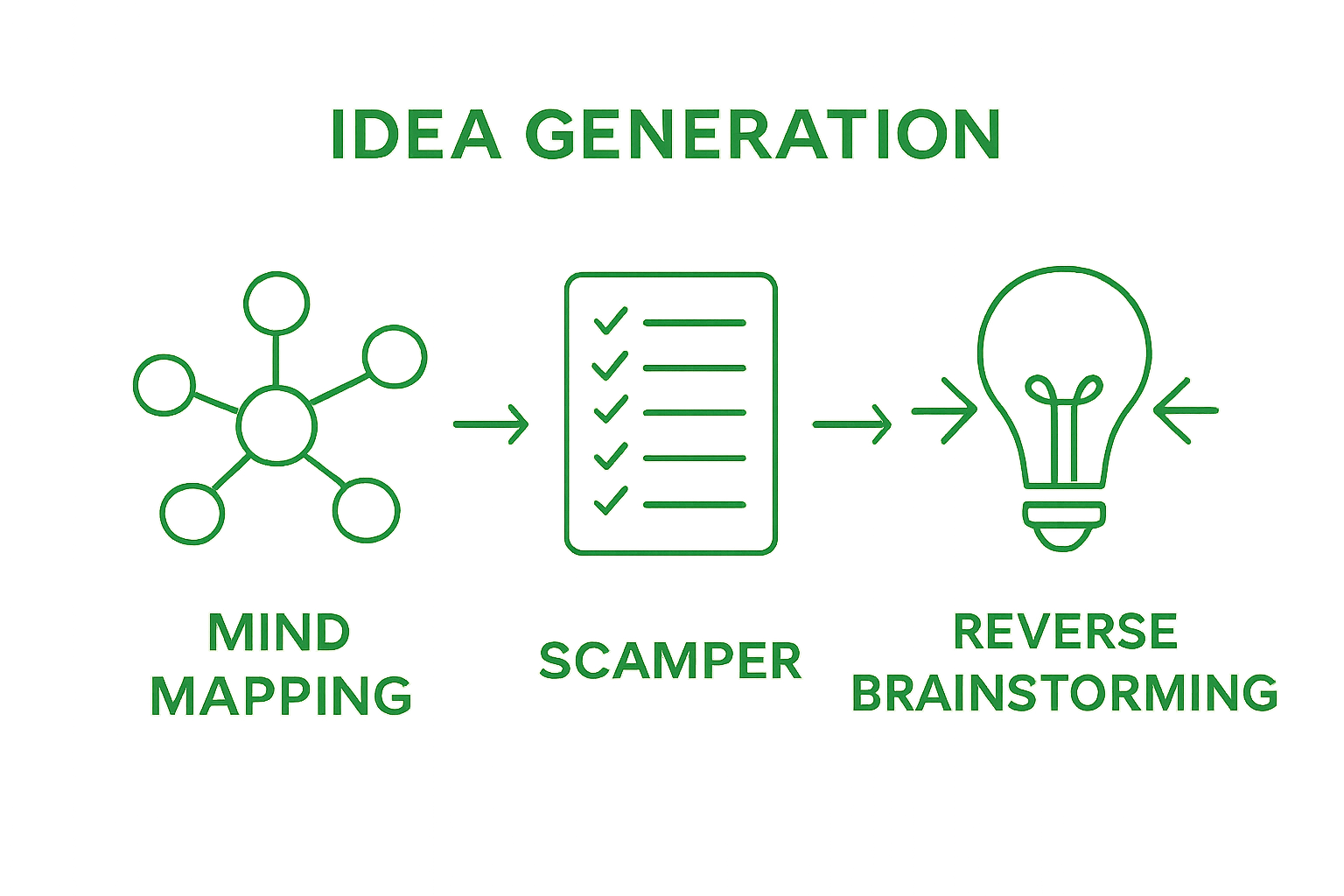
Research from ResearchGate demonstrates that systematic ideation processes significantly improve the quality and originality of business ideas, providing entrepreneurs with a strategic advantage in developing innovative solutions.
Evaluating and Selecting Ideas for Business Success
Successful entrepreneurs understand that not all ideas are equal. Effective idea evaluation is a critical skill that transforms raw concepts into viable business opportunities. This process requires objective analysis, strategic thinking, and a disciplined approach to assessing potential market impact.
The Criteria for Idea Validation
Idea evaluation goes beyond personal enthusiasm. Entrepreneurs must develop a structured framework to critically examine potential business concepts. Understanding the difference between an idea and a true opportunity becomes crucial in this assessment process.
Key Evaluation Parameters
Entrepreneurs should consider multiple dimensions when selecting business ideas:
- Market Demand: Assessing the genuine need and potential customer base for the proposed solution
- Competitive Landscape: Understanding existing alternatives and identifying unique value propositions
- Resource Requirements: Evaluating the financial, technical, and human capital needed for implementation
- Scalability Potential: Determining the idea’s capacity for growth and long-term sustainability
Successful idea selection is not about finding a perfect concept, but identifying a promising opportunity with realistic potential for development and market success. Entrepreneurs must balance creative vision with pragmatic assessment, understanding that promising ideas require both innovation and practical feasibility.
The following table organizes key parameters used by entrepreneurs to evaluate and select business ideas, making it easier to compare evaluation focus and guiding questions at a glance.
| Evaluation Parameter | Evaluation Focus | Typical Guiding Question |
|---|---|---|
| Market Demand | Customer needs and market size | Is there a genuine need and sizable audience for this idea? |
| Competitive Landscape | Position relative to existing solutions | What is the unique value proposition compared to competitors? |
| Resource Requirements | Investment of financial, technical, and human capital | What resources will be necessary to bring this idea to life? |
| Scalability Potential | Growth and sustainability over time | Can the idea be scaled for long-term market success? |

Research from Entrepreneurship Research Journal demonstrates that systematic evaluation methods significantly improve the likelihood of developing successful business concepts, providing entrepreneurs with a strategic approach to transforming ideas into viable ventures.
Real-World Examples of Successful Ideation in Startups
Real-world examples illuminate how strategic ideation transforms abstract concepts into groundbreaking business ventures. By examining successful startup journeys, entrepreneurs can understand the practical application of innovative thinking and systematic idea development.
Breakthrough Startup Stories
Some of the most remarkable companies emerged from creative problem-solving and unconventional thinking. Entrepreneurs who master innovative ideation techniques can turn seemingly impossible challenges into market-disrupting solutions. Learn how to validate your startup idea to increase your chances of success.
Ideation Techniques in Action
Successful startups demonstrate how structured ideation can lead to transformative business concepts:
- Airbnb: Founders Brian Chesky and Joe Gebbia transformed their financial struggles into a global hospitality platform by reimagining spare space as a rental opportunity
- Dropbox: Drew Houston conceived the idea during recurring frustrations with USB drives, identifying a universal need for seamless file synchronization
- Instagram: Kevin Systrom initially developed a location-based app, but pivoted when photo-sharing became the more compelling feature
These examples showcase how effective ideation is not about perfection, but about continuous adaptation and recognizing genuine market needs. Successful entrepreneurs view their initial concepts as flexible frameworks rather than rigid blueprints.
Research from Stanford Technology Ventures Program reveals that breakthrough innovations often emerge from entrepreneurs who combine systematic thinking with creative flexibility, demonstrating that ideation is both an art and a science.
Turn Your Innovative Ideas Into Action With siift
You have just learned how structured ideation can transform abstract thinking into high-potential business ideas. But the journey does not stop at inspiration. Many new entrepreneurs struggle to organize their creativity, evaluate ideas objectively, and build a clear path forward without feeling lost or overwhelmed. The article’s focus on systematic ideation and effective decision-making is your first step, but translating that knowledge into real business progress takes the right guidance and tools.
siift was created to be the support system every founder needs. Our intuitive AI helps you move from brainstorming to execution—step-by-step. Receive personalized feedback and actionable strategies tailored to your unique challenges. Remove doubt, avoid wasted effort, and build your confidence with every decision. Ready to bridge the gap between your ideas and a real business? Start your journey now at siift and see how our platform can walk with you all the way from ideation to launch.
Frequently Asked Questions
What are ideation techniques in entrepreneurship?
Ideation techniques are structured methods used by entrepreneurs to generate, develop, and refine business ideas, transforming abstract thoughts into viable concepts with market potential.
Why are ideation techniques important for new entrepreneurs?
Ideation techniques are critical for overcoming mental barriers, recognizing opportunities, and systematically evaluating ideas, thus increasing the chances of developing innovative solutions that meet market needs.
What are some common ideation techniques that entrepreneurs can use?
Common ideation techniques include mind mapping, the SCAMPER technique, and reverse brainstorming. These methods help entrepreneurs explore ideas from different perspectives and uncover unique solutions.
How can entrepreneurs evaluate and select the best ideas for their businesses?
Entrepreneurs can evaluate ideas by assessing market demand, understanding the competitive landscape, considering resource requirements, and determining scalability potential to ensure they choose the most promising opportunities.
Recommended
- blog | siift | Creative Thinking Exercises for Future Entrepreneurs 2025
- blog | siift | How to Find Business Ideas in 2025: Proven Steps for Students and New Grads
- blog | siift | Building Entrepreneurial Mindset: Steps for Beginners in 2025
- blog | siift | Understanding Idea vs Opportunity: Key Insights Explained