

TL;DR:
- A pitch deck is a concise, visual story designed to secure a follow-up meeting with investors, not to close funding. It should include problem, solution, market, traction, team, and a clear ask, avoiding clutter and unsupported claims. Building it refines your strategy and reveals gaps, making your opportunity appear obvious and trustworthy to investors.
If you’ve ever Googled “what is a pitch deck” at midnight before a big meeting, you’re not alone. Most aspiring founders confuse it with a business plan, a product demo, or a polished sales presentation. None of those are quite right. A pitch deck is a concise, visual story about your business, built specifically to earn one thing: the next conversation with an investor. It’s not meant to close deals on its own. It’s meant to open doors. This guide breaks down exactly what a pitch deck is, what goes in one, and how to make yours work.
Table of Contents
- Key Takeaways
- What is a pitch deck, really?
- Core pitch deck components
- Pitfalls and best practices
- Beyond the slides: your deck as a strategic tool
- My honest take on pitch decks after watching hundreds of them
- Build your pitch deck with Siift
- FAQ
Key Takeaways
| Point | Details |
|---|---|
| Pitch deck vs. business plan | A pitch deck is 10–20 slides, not a long document. It’s a hook, not the full story. |
| The real job of a deck | Your deck’s purpose is to earn a follow-up meeting, not to close funding on the spot. |
| Core components matter | Investors expect problem, solution, market, traction, team, and a clear ask — in that order. |
| Clarity beats design | Signal-rich, low-noise decks outperform visually flashy ones with weak content every time. |
| Building it sharpens your thinking | Creating your deck forces you to confront gaps in your strategy before investors do. |
What is a pitch deck, really?
A pitch deck is typically a 10–20 slide presentation founders use to communicate their business opportunity and funding ask to potential investors. That’s the textbook pitch deck definition. But here’s what the textbook doesn’t tell you: the deck is not your business plan, and it’s definitely not a product walkthrough.
Think of it as a decision funnel. Founders often confuse pitch decks with full business plans or product demos, when the deck’s job is actually narrower and more disciplined. It should contain only what investors need to decide whether to meet with you, pushing deep financial models and product specs to appendices or follow-up data rooms.
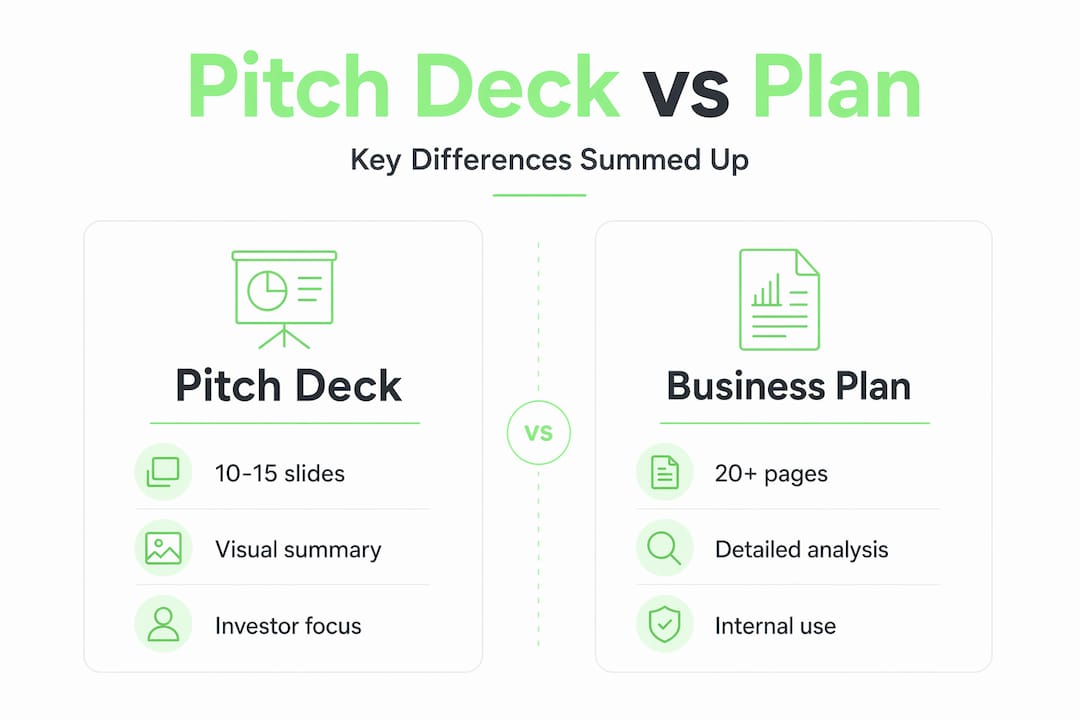
A business plan is a long-form document, rich with projections, operational detail, and market research. Pitch decks are far shorter, acting as the hook while the business plan provides the depth. One earns interest, the other earns trust. You need both eventually, but they serve different moments.
There are two common formats every founder should know:
- Presentation deck: Used live in a meeting, with you narrating each slide. Visuals can be minimal because your voice carries context.
- Standalone PDF: Sent via email to investors who haven’t met you yet. This version must communicate clearly without any narration at all.
Pro Tip: Build your deck in standalone PDF format first. If it makes sense without you in the room, it will work even better when you’re presenting it live.
Core pitch deck components
A standard pitch deck structure covers problem, solution, market opportunity, business model, traction, team, and the funding ask. Here’s what each component actually needs to accomplish:
- Problem. Define the pain point with urgency and, ideally, data. Investors need to feel the weight of the problem before they can appreciate your solution.
- Solution. Introduce your product or service and make your unique value proposition unmistakable. This is not a feature list. It’s one clear answer to one clear problem.
- Market opportunity. Show the size of the prize. Investors want to see a credible Total Addressable Market with a realistic path to capturing a slice of it.
- Business model. Explain how you make money. Subscriptions, licensing, marketplace fees, direct sales — whatever applies, make it concrete.
- Traction. This is where decks either soar or collapse. Traction metrics must align with your business model: SaaS companies should emphasize monthly recurring revenue, while direct-to-consumer brands focus on customer lifetime value versus acquisition cost.
- Team. Why are you and your co-founders the right people to solve this? Relevant experience, domain expertise, and prior wins matter more than impressive job titles.
- Competitive landscape. Show that you understand who else is in the space and articulate your differentiation clearly. A 2x2 matrix works well here.
- The ask. State clearly how much you are raising, what you will use the funds for, and what milestone that investment gets you to.
| Slide | What investors want to see | Common mistake |
|---|---|---|
| Problem | Urgency backed by data | Vague or assumed pain |
| Traction | Metrics aligned to business model | Vanity metrics with no context |
| Team | Relevant expertise and commitment | Generic bios, missing co-founder roles |
| The ask | Specific amount with use-of-funds breakdown | Round number with no justification |
Investors want to see clear problem definition, urgency, market size, traction relevant to the business model, and a clear ask. Notice what’s not on that list: a beautifully branded cover slide and a 30-slide feature roadmap.
Pro Tip: Your traction slide is often the most scrutinized slide in the deck. Even if your numbers are early, show the trend line. Growth direction matters as much as absolute numbers at pre-seed.

Pitfalls and best practices
Here’s the uncomfortable truth about most pitch decks from first-time founders: they’re either severely over-stuffed or dangerously thin. Both kill your chances. Investors review hundreds of decks and favor those that communicate with maximum signal and minimum noise. A deck that requires a phone call to understand is already failing.
The most common mistakes to watch out for:
- Overloading slides with text. A slide is not a paragraph. If you’re writing full sentences all over your slides, you’re writing a business plan in the wrong format.
- Making unsupported claims. “We are disrupting a $500 billion market” without data to back it up reads as hype, not vision. Back every big claim with a credible source or a logical build.
- Ignoring the narrative arc. The best pitch decks tell a story with a beginning (the problem), a turning point (your solution), and a trajectory (traction + ask). Investors remember stories, not bullet points.
- Sending the same deck to every investor. Your core deck stays consistent, but your talk track should shift based on whether you’re speaking to a generalist VC, a sector-specific angel, or a strategic partner.
- Skipping practice. The deck is half the battle. Iterating based on feedback and practicing your pitch delivery, including Q&A readiness, separates founders who get meetings from those who get polite rejections.
Investors often decide in about 3–7 minutes after seeing a deck. That means your opening slides are doing the heaviest lifting. The problem and solution slides need to earn comprehension immediately. If an investor is confused or bored by slide three, the rest of the deck becomes irrelevant.
Beyond the slides: your deck as a strategic tool
Here’s a perspective shift that will change how you approach the whole process. Building a pitch deck is not a design exercise. Creating a pitch deck forces founders to clarify market dynamics, strategy, and revenue models. It is a thinking process that reveals what you know, what you assume, and what you have not yet figured out.
When you sit down to write the problem slide, you’re forced to ask whether you have real evidence that this problem exists at scale. When you fill in the market size, you’re forced to justify the numbers rather than guess. Many founders discover gaps in their own business model while building their first deck. That’s not a failure. That’s the deck doing its job.
A pitch deck should work both as a standalone PDF and as a visual aid during a live presentation. These two contexts demand different things from the same slides. In a live setting, spare visuals and powerful talking points create impact. As a standalone email attachment, each slide needs enough context to be self-explanatory.
One smart way to handle this tension is the appendix approach. Keep your main deck tight at 12 to 15 slides. Then build a rich appendix with unit economics, detailed financial projections, product roadmaps, and technical documentation. When an investor asks a deep question in the meeting, you flip to the appendix. It signals preparation and depth without cluttering your core narrative.
Pro Tip: Tailor your talk track per audience without rebuilding the deck each time. Add one or two audience-specific slides at the end for context, and mentally map which three or four slides you will spend the most time on based on that investor’s known focus areas.
For a deeper breakdown of how to get your pitch strategy investor-ready, the investment readiness guide from Siift is worth your time before you send that first cold email.
My honest take on pitch decks after watching hundreds of them
I’ve seen founders spend three months perfecting their Figma deck and ten minutes thinking about what their traction actually proves. That order is backwards, and it’s one of the most predictable mistakes in early-stage fundraising.
What investors actually focus on is not what most founders expect. The team slide gets more weight than founders realize, especially at pre-seed when there’s minimal traction to evaluate. And the ask slide gets less scrutiny than expected at early stages, because an investor who loves the story will figure out the valuation conversation later.
What I’ve learned is that clarity is an act of respect toward your investors. When you strip your deck down to what they need to decide on a meeting, you signal that you understand how their decision process works. That’s a trust signal before you’ve even walked into the room.
The most effective decks I’ve encountered share one quality: they make the investor feel like the opportunity is obvious. Not oversold. Not complicated. Just obvious. Getting to that place usually takes ten or fifteen drafts, honest feedback from people who will tell you what’s missing, and the discipline to cut what feels good but doesn’t help the investor decide.
The deck that works is the one that earns the meeting. Everything else is noise.
— Samim
Build your pitch deck with Siift
Creating a compelling pitch deck starts well before the slides. You need a validated business model, clear traction evidence, and a story that holds up under scrutiny. That’s exactly what Siift is built to help you do. Siift’s Agentic AI platform guides founders step by step through ideation, validation, and go-to-market strategy, so you’re not walking into investor meetings with assumptions where evidence should be.
Whether you’re a millennial corporate employee testing a side idea or a college student pitching your first startup, Siift helps you de-risk your concept and build the kind of business foundation that makes your pitch deck genuinely credible. You can also explore Siift’s deep-dive resources on pitch deck funding tips and learn how to show traction to investors before your next round. The best pitch deck is backed by real strategy. Let Siift help you build both.
FAQ
What is a pitch deck in simple terms?
A pitch deck is a short visual presentation, typically 10 to 15 slides, that founders use to explain their business idea and funding ask to potential investors. Its goal is to earn a follow-up meeting, not to close a deal on the spot.
How is a pitch deck different from a business plan?
A pitch deck is a concise, visual summary designed to spark investor interest, while a business plan is a long-form document with extensive operational and financial detail. The pitch deck is the hook; the business plan provides the depth when investors want to go further.
What are the most important pitch deck components?
The core pitch deck components are problem, solution, market opportunity, business model, traction, team, competitive landscape, and the funding ask. Investors consistently prioritize traction, team credibility, and a clear, justified ask above everything else.
How long should a pitch deck be?
Most effective pitch decks run between 10 and 15 slides for the core narrative, with a separate appendix for deeper financial and product detail. Going beyond 20 slides risks losing investor attention before you reach the ask.
Can a pitch deck work if you have no traction yet?
Yes, but you need to compensate with strong problem evidence, a credible team, and a clear path to early validation. Show customer discovery data, letters of intent, or waitlist numbers. Investors understand that early-stage decks are vision-heavy, but they still want proof that real people have the problem you are solving.