
A startup idea comes with uncertainties that founders need to investigate before committing substantial resources. For millennial tech employees dreaming of entrepreneurship, risking everything for an unproven concept feels daunting. What if you could use systematic guidance and AI-powered tools to identify hidden threats before investing serious time or money? This guide explains proven de-risking strategies to help global founders turn uncertain ideas into sustainable businesses.
Table of Contents
Key Takeaways
Point | Details |
|---|---|
Understand and Mitigate Risks | Founders should systematically assess technological feasibility, market demand, and internal dynamics to minimize startup risks. |
Implement Structured Validation | Continuous and iterative validation processes, like customer discovery and MVP development, are essential for refining business assumptions. |
Leverage AI for Risk Management | AI platforms enable proactive risk identification and analysis, enhancing decision-making speed and adaptability. |
Avoid Common Founding Mistakes | Regular reflection and adjustment of market validation, team dynamics, and strategic planning can prevent predictable pitfalls. |
De-Risking a Startup Idea Explained
Startup founders rarely get a smooth launch. Success requires systematically understanding and mitigating risks before investing significant time and resources. Researchers analyzing startup ecosystems globally highlight that strategic risk reduction isn’t just about avoiding failure—it’s about transforming uncertain concepts into credible business opportunities.
Risk reduction involves a comprehensive approach targeting multiple dimensions. Founders must assess technological feasibility, market demand, financial sustainability, regulatory compliance, and team capabilities. Business risk emerges from unpredictable interactions between these complex factors. Some risks are external—like market shifts or economic changes—while others are internal, stemming from team dynamics, product design, or execution strategy.
Successful de-risking requires a structured methodology. Systematic startup research demonstrates that startups should prioritize risks sequentially, focusing first on eliminating fundamental barriers to viability. This means validating core assumptions through minimal viable products, customer interviews, and iterative prototyping. Founders must remain flexible, continuously testing hypotheses and adapting their approach based on real-world feedback.
Pro tip: Create a dedicated risk registry where you systematically track, assess, and monitor potential threats to your startup’s success, updating it monthly with new insights and mitigation strategies.
Types of Startup Risks and Blindspots
Startups navigate a complex landscape of potential risks that can derail even the most promising ventures. Comprehensive academic research mapping startup risks reveals that these challenges are not random but fall into structured categories with intricate interdependencies. Understanding these risk dimensions helps founders develop more robust strategies for survival and growth.
Risks typically manifest across four critical dimensions. External risks include market volatility, regulatory changes, and economic shifts that founders cannot directly control. Internal risks stem from organizational factors like product development challenges, operational inefficiencies, and strategic misalignments. Human-related risks involve team dynamics, leadership gaps, and skill mismatches that can undermine startup potential. Capital-related risks encompass funding constraints, investment challenges, and financial management complexities that determine a startup’s financial sustainability.

Empirical research on innovation-related startup risks further breaks down these challenges into granular categories. Financial risks include cash flow problems and incorrect funding strategies. Operational risks involve inefficient processes and scalability challenges. Market risks relate to misunderstanding customer needs or misjudging market demand. Technological risks emerge from rapid innovation cycles and potential obsolescence. Management risks include strategic decision-making errors and leadership limitations.
Here’s a summary of the main startup risk dimensions and typical pitfalls revealed by research:
Risk Dimension | Common Pitfalls | Potential Impact |
|---|---|---|
External | Underestimating market shifts | Reduced market relevance |
Internal | Inefficient operations | Wasted resources, lost momentum |
Human-related | Leadership gaps | Poor team morale, weak execution |
Capital-related | Incorrect funding strategy | Cash shortages, limited growth |
Pro tip: Conduct a quarterly comprehensive risk audit that systematically evaluates your startup across these risk dimensions, creating mitigation strategies for each identified potential threat.
Key Steps in Structured Validation
Systematic startup validation is the cornerstone of transforming a raw idea into a viable business opportunity. Most founders mistakenly believe validation is a single event, when in reality, it’s an iterative process of continuously testing and refining core business assumptions. The goal isn’t to prove yourself right, but to discover the most accurate path to market success.
The validation process typically involves several critical stages. Customer discovery is the first crucial step, where founders directly engage potential users to understand their genuine pain points and needs. This involves conducting structured interviews, creating detailed buyer personas, and mapping out precise problem-solution frameworks. Founders must remain objective, actively seeking evidence that might disprove their initial assumptions rather than looking for confirmation bias.
Comprehensive startup validation research highlights the importance of developing a Minimum Viable Product (MVP). This isn’t about creating a perfect solution, but building the simplest version of your product that allows meaningful customer feedback. Key validation techniques include prototype testing, market sizing analysis, competitive landscape assessment, and iterative product refinement based on real-world user interactions. Successful founders treat each iteration as a learning opportunity, rapidly incorporating insights to improve their value proposition.
Pro tip: Design a structured validation spreadsheet that tracks each hypothesis, its testing method, results, and subsequent action items to maintain systematic and accountable validation process.
How AI Platforms Accelerate De-Risking
Advanced AI risk management technologies are transforming how founders approach startup challenges, shifting from reactive problem-solving to proactive risk anticipation. Traditional entrepreneurial approaches relied heavily on intuition and limited data, but modern AI platforms enable founders to systematically identify, assess, and mitigate potential business risks with unprecedented precision and speed.
AI platforms fundamentally change risk assessment by leveraging machine learning algorithms that can process vast amounts of complex data far beyond human analytical capabilities. These intelligent systems continuously scan multiple information sources—market trends, financial reports, competitive landscapes, and economic indicators—to generate real-time risk insights. Predictive analytics help founders understand potential future scenarios, allowing them to develop strategic contingency plans and make more informed decisions before critical challenges emerge.
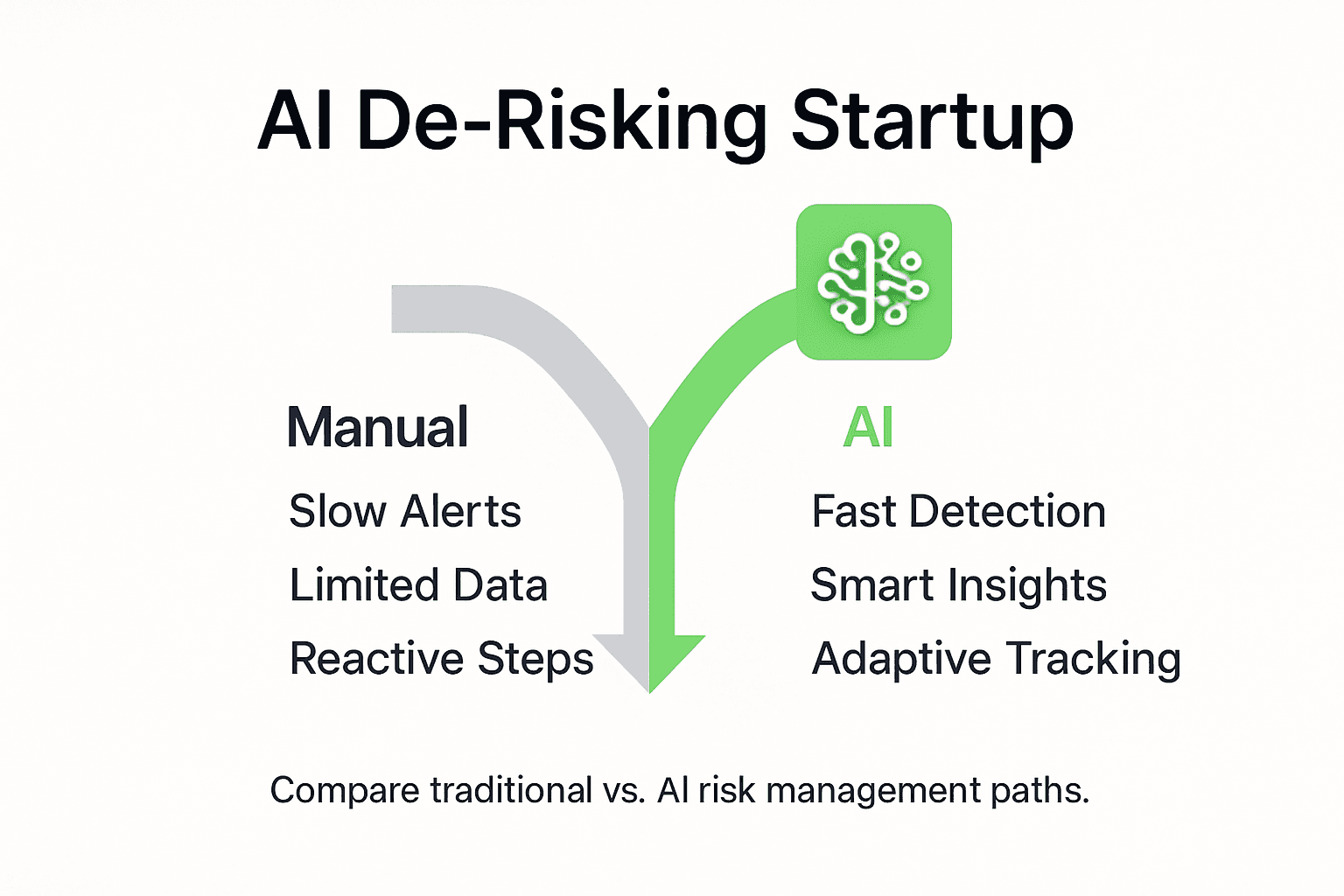
Comprehensive AI risk management research reveals specific ways these platforms accelerate de-risking. By automating complex analysis, AI tools can quickly identify hidden patterns, potential market disruptions, and emerging competitive threats that human analysts might overlook. The technology goes beyond simple data aggregation, using sophisticated machine learning models to provide nuanced, contextual risk assessments that adapt dynamically as new information becomes available. This approach transforms risk from a static, retrospective concept into a fluid, predictive strategic tool.
Below is a comparison of traditional versus AI-driven startup risk management approaches:
Approach | Data Usage | Risk Detection Speed | Adaptability |
|---|---|---|---|
Traditional | Limited, manual | Slow, reactive | Low, static analysis |
AI-driven | Large-scale, automated | Fast, predictive | High, dynamic insights |
Pro tip: Integrate AI risk assessment tools into your monthly strategic review, using their insights to continuously refine and update your startup’s risk mitigation strategies.
Common Mistakes and Effective Solutions
Detailed research on startup failure patterns reveals that most entrepreneurial missteps are predictable and preventable. While founders often romanticize innovation, the reality is that systematic preparation and self-awareness are critical to navigating the complex startup landscape. Understanding common pitfalls provides a strategic roadmap for avoiding potentially catastrophic errors.
Founders frequently stumble in three primary areas: market validation, team dynamics, and strategic planning. Market validation failures occur when entrepreneurs build products without thoroughly understanding customer needs. Team dynamics break down due to misaligned expectations, unclear roles, or inadequate communication. Strategic planning collapses when founders scale prematurely or lack adaptable business models. Comprehensive startup failure analysis suggests these mistakes often interconnect, creating compounding risks that can rapidly undermine even promising ventures.
Effective solutions require a holistic approach. Founders must cultivate dynamic capabilities that enable rapid learning and adaptation. This means developing robust feedback mechanisms, maintaining financial flexibility, building diverse and complementary teams, and maintaining a relentless commitment to understanding market realities. Regular external mentorship, continuous skills development, and structured validation processes can dramatically improve a startup’s resilience and potential for success. The most successful founders view challenges as opportunities for strategic refinement rather than insurmountable obstacles.
Pro tip: Create a monthly founders’ reflection session where you systematically review your startup’s key assumptions, potential risks, and adaptation strategies with complete transparency and openness to constructive feedback.
Take Control of Your Startup Risks with AI-Driven Strategy
The challenges of de-risking a startup idea are real and complex. From uncovering hidden blindspots in market validation to managing capital constraints and leadership gaps, each step demands precise, unbiased insight. This article highlights the critical need for systematic validation and continuous risk management to transform uncertain concepts into viable business opportunities. If you are seeking a smarter path to launch, personalized guidance that helps you track risks, test assumptions, and adapt rapidly can make all the difference.
siift.ai Intelligent Business Canvas is designed to meet exactly those needs. siift is intended to help founders organize assumptions and plan further customer research; founders still need to check suggestions against external evidence. It provides personalized feedback, new insights, and prioritized actions so you can confidently minimize risks in areas like customer discovery, funding strategies, and team dynamics. Don’t let unknown risks undermine your vision. Start de-risking your startup today with siift.ai and experience how structured validation and AI-driven insights accelerate your journey toward success. Visit siift.ai Intelligent Business Canvas now to transform uncertainty into your competitive advantage.
Frequently Asked Questions
What is de-risking in the context of a startup?
De-risking refers to the systematic process of identifying, assessing, and mitigating potential risks that could jeopardize a startup’s success before investing significant time and resources. This involves validating assumptions and ensuring the idea is feasible.
What are the main types of risks that startups face?
Startups face various risks, including external risks (market volatility, regulatory changes), internal risks (operational inefficiencies), human-related risks (team dynamics), and capital-related risks (funding challenges). Understanding these dimensions is crucial for effective risk management.
How can I validate my startup idea effectively?
Effective validation involves a structured process of customer discovery, creating buyer personas, and developing a Minimum Viable Product (MVP). Engage potential users to understand their needs, conduct structured interviews, and iterate your product based on feedback.
How can AI platforms help with startup risk management?
AI platforms enhance risk management by leveraging machine learning algorithms to analyze vast datasets, identify hidden patterns, and provide predictive insights. This shifts risk assessment from a reactive approach to a proactive strategy, allowing founders to anticipate and address challenges more effectively.
Recommended
blog | siift | How to Validate Idea in 2025: A Simple Guide for New Founders
blog | siift | Bootstrapping Strategies: Guide for First-Time Founders
blog | siift | How to Find Business Ideas in 2025: Proven Steps for Students and New Grads
blog | siift | Master Business Idea Validation: Steps to Success in 2025
Top Cloud Native App Development Services for Startups | Singleclic