

TL;DR:
- Market segmentation involves dividing broad markets into meaningful customer groups based on shared traits, enabling tailored messaging. To succeed, founders must layer demographic, geographic, psychographic, and behavioral data, ensuring segments are reachable through existing channels and continuously updated. Focusing on a few well-defined, actionable segments enhances marketing relevance, conversion rates, and product development.
Most marketers think segmentation means splitting customers into neat buckets by age or zip code. That mental model is where the strategy usually dies. Understanding market segmentation at a deeper level reveals something far more powerful: a systematic way to discover which customers will actually respond to your product, and why. Whether you’re building a go-to-market plan from scratch or trying to tighten up messaging that isn’t landing, getting segmentation right is the difference between wasting budget and building real traction.
Table of Contents
- Key takeaways
- What is market segmentation and why it matters
- The main types of market segmentation
- Benefits and challenges of market segmentation
- How to segment a market and apply the STP model
- My honest take on where segmentation goes wrong
- Build smarter segments with Siift
- FAQ
Key takeaways
| Point | Details |
|---|---|
| Segmentation beats mass marketing | Dividing a market into meaningful groups lets you craft messages that resonate with specific buyers. |
| Four core segmentation types | Demographic, geographic, psychographic, and behavioral segmentation each reveal different dimensions of your customer. |
| Segments must be operational | If your CRM can’t target a segment, that segment doesn’t exist in practice. |
| STP ties it all together | Segmentation is only step one. Targeting and positioning must follow to produce real campaign results. |
| Right data beats more data | Weak or outdated data creates segments that predict nothing and cost everything. |
What is market segmentation and why it matters
At its core, market segmentation splits broad markets into smaller groups of people who share meaningful traits. These traits could be age, income, location, buying habits, lifestyle values, or even the technology stack they use. The goal is not to categorize people for the sake of it. The goal is to find groups whose shared characteristics actually predict how they’ll respond to your product and messaging.
Here’s what makes this idea so powerful for founders. A one-size-fits-all marketing approach treats every potential customer as if they have the same problem, the same budget, and the same decision-making process. They don’t. A first-time entrepreneur buying project management software cares about ease of use and price. An enterprise operations director buying the same software cares about security, integrations, and vendor support. Same product, radically different conversations.
Segmentation forces you to have the right conversation with the right person. It’s also the first step in the STP model, a foundational framework every growth-minded marketer should know:
- Segmentation: Divide the broader market into distinct groups based on shared traits.
- Targeting: Evaluate each segment and choose which ones to pursue based on size, fit, and reachability.
- Positioning: Craft the specific message and value proposition for each chosen segment.
Segmentation alone won’t yield effective campaign outcomes without targeting and positioning to follow. Treat STP as one integrated motion, not three separate tasks.
Pro Tip: Before you build any segment, ask: “Can I actually reach this group through my existing channels?” If the answer is no, the segment is a thought experiment, not a marketing strategy.
The main types of market segmentation
Knowing the types of market segmentation gives you the vocabulary and the lens to analyze your customers with precision. Most markets can be sliced across four primary dimensions, with an additional layer for B2B contexts.
| Segmentation type | What it captures | Example |
|---|---|---|
| Demographic | Age, gender, income, education, family status | Women aged 25 to 35 with household income above $75K |
| Geographic | Country, region, city, climate, urban vs. rural | Urban families in the Northeast US |
| Psychographic | Values, lifestyle, attitudes, personality | Eco-conscious consumers who prioritize sustainability |
| Behavioral | Purchase frequency, brand loyalty, usage rate | Power users who log in daily vs. occasional users |
| Firmographic (B2B) | Company size, industry, revenue, growth stage | SaaS companies with 50 to 200 employees in Series A |
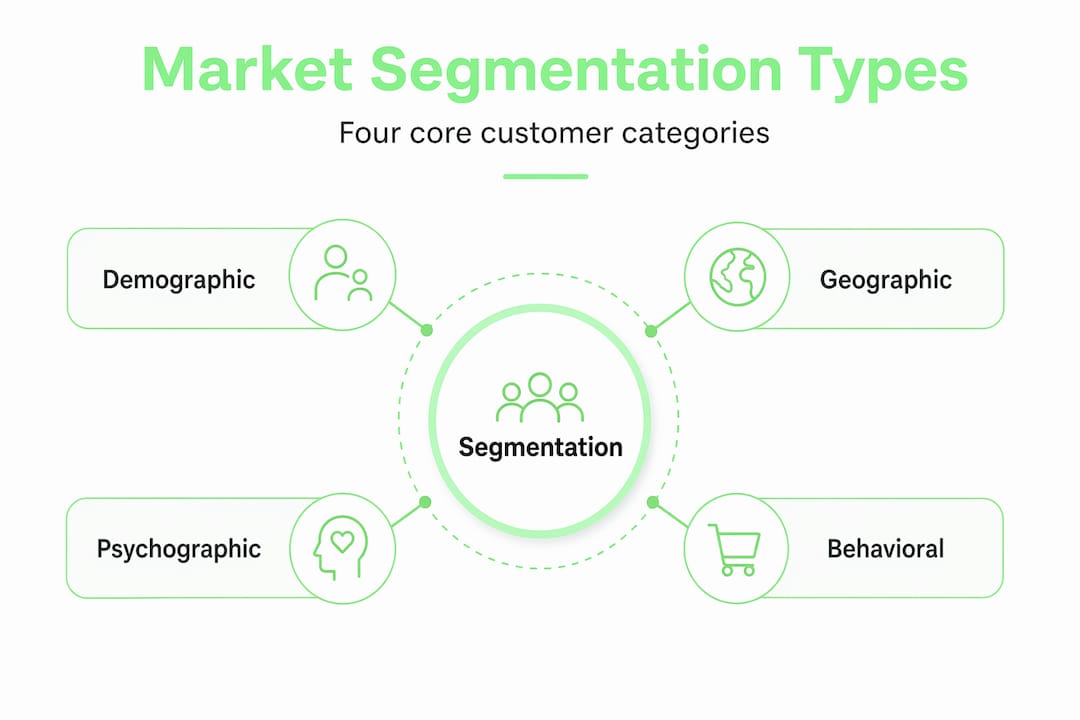
The four main segmentation types each illuminate a different dimension of your customer. Demographic tells you who they are. Geographic tells you where they are. Psychographic tells you why they make choices. Behavioral tells you how they actually interact with products. For B2B founders, firmographic segmentation adds the company-level profile on top of the individual contact.
Here’s the nuance most guides skip: two people can share identical demographics and still respond completely differently. A 34-year-old male with a $90K salary might be a budget-conscious homebody or an aspirational spender. Demographics don’t explain motivation. Psychographic and behavioral data do. This is why the most effective segmentation strategies layer multiple types together rather than relying on any single dimension.
For early-stage founders, combining firmographic with behavioral data is often the fastest path to a usable segment. You might target “B2B SaaS companies with 50 to 200 employees” (firmographic) who have “recently evaluated three or more competitor tools” (behavioral). That pairing creates a segment with real predictive power.

Benefits and challenges of market segmentation
Let’s be honest: the benefits of market segmentation are real, but so are the traps. Most articles tell you about the upside without warning you where teams derail.
The genuine benefits:
- Better messaging relevance, because you’re speaking to a real person’s actual situation instead of a composite fiction.
- Higher conversion rates, because aligned offers reduce friction in the buyer’s decision process.
- More efficient budget allocation, since you concentrate spend on segments most likely to convert.
- Stronger product development decisions, because focused customer feedback from specific segments reveals feature priorities more clearly than aggregated data.
- Competitive advantage through specialization. Owning a niche segment is more defensible than spreading thin across the whole market.
The real challenges:
- Poor data quality. Weak data undermines even the most logical segmentation structure. Garbage in, garbage out.
- Over-segmentation. Too many tiny segments dilute your budget and force inconsistent messaging. More segments are not better segments.
- Static segments. Markets shift. A segment that was accurate 18 months ago may be misleading today.
- Unreachable segments. If your CRM and ad platforms cannot target a segment, that segment exists only on paper.
“The goal of segmentation is not to find every possible slice of your market. The goal is to find the slices where your message lands with enough force to change behavior.”
Pro Tip: Aim for four to six well-defined segments maximum in early-stage go-to-market. Any more and you’re managing a complexity problem, not a marketing strategy.
How to segment a market and apply the STP model
Getting from “we should do segmentation” to “we have operational segments driving campaign results” takes a structured process. Here’s how to do it without drowning in data or overthinking it.
- Start with easy-to-measure variables. Begin with demographic or geographic data, which is the most accessible. This gives you a quick baseline.
- Layer in behavioral data. Purchase history, engagement patterns, and usage frequency tell you how people actually behave, not just who they are. Start simple, then validate with psychographic and behavioral data to refine your segments.
- Validate with psychographic research. Surveys, interviews, and customer conversations reveal the motivations and values that explain why behavior happens. This step is where most founders find their sharpest insights.
- Test operationability. Segments must be reachable through your actual channels. Run a quick check: can your email platform, LinkedIn ads, or CRM apply filters that match this segment? If not, refine the definition.
- Score and prioritize segments. Rank each candidate segment by size, revenue potential, competitive intensity, and how well your product solves their specific problem.
- Select your target segments. You can’t pursue all of them effectively. Choose the two or three that offer the best combination of fit and opportunity.
- Define positioning for each. Craft distinct value propositions and messaging for each target segment, anchored in what they specifically care about.
Here’s a quick look at how STP plays out in a real context:
| Stage | Action | Example |
|---|---|---|
| Segmentation | Group the market by shared traits | Early-career freelancers aged 22 to 32 who use multiple invoicing tools |
| Targeting | Choose the highest-potential segment | Focus on freelancers earning $40K to $80K who invoice more than 10 clients monthly |
| Positioning | Craft the message | “One dashboard. Every client. Zero chasing.” |
The key insight here is that segmentation improves marketing relevance, not just category count. You’re not organizing spreadsheets. You’re building the foundation for every campaign decision, product roadmap priority, and sales conversation your team will have. For founders figuring out how to align product with market demand, this process is non-negotiable.
My honest take on where segmentation goes wrong
I’ve watched founders spend weeks building elaborate segmentation frameworks that never touch a single ad campaign or product decision. The work looks serious. The Notion doc is color-coded. Nothing changes.
In my experience, the number one segmentation mistake isn’t picking the wrong variables. It’s treating segmentation as a one-time deliverable instead of a living practice. Markets evolve. Customer motivations shift with economic conditions, cultural moments, and competitive pressure. A segment that was razor-sharp two years ago can become blurry and inaccurate today without anyone noticing until the conversion rates crater.
What I’ve found actually works is a segmentation loop: start with what’s easy to measure, run campaigns, collect behavioral feedback, and update the segment definition based on what the data tells you. This is especially true for early-stage founders who are still building toward product-market fit. Your segments will evolve as your understanding of the customer deepens. That’s not a failure. That’s the process working correctly.
The other thing I’d push back on is the instinct to go granular for the sake of precision. Micro-segmentation feels rigorous, but it creates operational chaos. You end up with 14 audience variants, inconsistent messaging, and a media budget too thin to prove anything statistically meaningful in any single segment. Bigger, sharper segments with clear behavioral signals beat dozens of tiny ones every time.
Right data beats more data. Always.
— Samim
Build smarter segments with Siift
Understanding market segmentation is one thing. Putting it into practice as a founder with limited time and resources is another challenge entirely. Siift’s AI-powered platform guides you through the full ideation-to-go-to-market process, including segmentation, targeting, and positioning, so you’re not building strategy on guesswork. The platform helps you identify your highest-potential customer segments, validate your assumptions with real market signals, and align your product positioning before you burn budget on campaigns that haven’t been tested. If you’re ready to move from theory to traction, explore Siift and see how structured founder intelligence accelerates the path to product-market fit. You can also dig deeper with Siift’s guide to go-to-market strategy for a step-by-step look at how segmentation feeds into your full launch plan.
FAQ
What is market segmentation in simple terms?
Market segmentation is the practice of dividing a broad market into smaller groups of customers who share meaningful traits, such as age, location, values, or buying behavior. The goal is to tailor marketing messages and offers to each group’s specific needs.
What are the four main types of market segmentation?
The four core types are demographic (who they are), geographic (where they are), psychographic (why they buy), and behavioral (how they interact with products). B2B marketers often add firmographic segmentation based on company characteristics.
How does market segmentation differ from defining a target market?
Market segmentation is the process of identifying and grouping distinct customer segments within a broad market. Defining a target market is the next step: choosing which of those segments to actively pursue based on fit, size, and opportunity.
How many market segments should a startup focus on?
Most early-stage startups should focus on two to three well-defined segments at most. Pursuing too many simultaneously dilutes budget and creates messaging inconsistency that weakens every campaign.
Why do market segments fail in practice?
Segments fail when they’re built on poor data, can’t be reached through available marketing channels, or are never updated as the market evolves. Actionable, measurable segments tied to real CRM and ad platform filters are the ones that actually drive results.