
TL;DR:
- Product-market fit is a continuous, evolving signal, not a one-time achievement.
- Validating PMF requires multiple signals like retention, referrals, and behavioral analysis.
- AI tools can speed up validation, ongoing monitoring, and adaptation toward true market fit.
Most founders believe product-market fit is a finish line. You build, you ship, you hustle, and then one glorious day you “achieve” it. Investors celebrate, growth charts curve upward, and you finally exhale. But that story is dangerously incomplete. Product-market fit is not a trophy you earn and display on a shelf. It’s a living signal, one that shifts as markets evolve, competitors sharpen, and customer expectations quietly rewrite themselves. This guide will break down what PMF actually means, how to measure it honestly, and how to use AI tools to find and defend it faster than you ever thought possible.
Table of Contents
- What is product market fit and why does it matter?
- How to measure product market fit: Repeatability and scale
- Common pitfalls: Edge cases, false traction, and misdiagnosed fit
- Using AI tools to rapidly validate and iterate towards real fit
- Why product-market fit is a moving target and what most guides miss
- Validate, iterate, and win with purpose-built AI solutions
- Frequently asked questions
Key Takeaways
| Point | Details |
|---|---|
| PMF evolves over time | Achieving product-market fit is an ongoing process that must be monitored and defended, not a one-off milestone. |
| True demand is scalable | Isolated wins and edge-case traction often lead founders astray—repeatability and scalability are the real signals of market fit. |
| AI accelerates validation | Smart AI tools can rapidly test and measure your product’s market fit, helping you iterate faster and smarter. |
| Avoid common pitfalls | Don’t generalize from narrow or atypical initial users, and regularly stress test your assumptions as you grow. |
What is product market fit and why does it matter?
Product-market fit, often shortened to PMF, is the degree to which your product satisfies a strong, real, and repeatable demand in a specific market. Simple enough on the surface. But the concept gets murky fast when founders treat it as binary: either you have it or you don’t.
The cleaner way to think about PMF is as a spectrum. Your product can be weakly resonating, strongly resonating, or somewhere in the middle. And critically, where you sit on that spectrum changes over time. A product that fits beautifully today may feel misaligned in eighteen months if a competitor undercuts your core value or if customer needs evolve.
PMF matters enormously because it is the single most reliable predictor of sustainable growth. Without it, marketing spend is wasted, sales cycles drag, and churn quietly kills momentum. Investors know this, which is why early-stage funding conversations almost always circle back to evidence of fit. For startup product-market fit, the stakes are existential. Burn through your runway chasing the wrong customer or solving the wrong problem, and there’s no second chance.
Here are the clearest signs you are moving toward real PMF:
- Customers come back without being nudged
- Referrals happen organically, without incentive programs
- Users express genuine frustration at the idea of losing your product
- Sales cycles shorten as word spreads
- Support tickets reveal product love, not just complaints
And here are the warning signs that you’re missing it:
- You’re constantly discounting to close deals
- Churn is high, even when acquisition looks healthy
- Customers use your product once and go quiet
- You’re explaining your value proposition more than customers are sharing it
“PMF is not always permanent; it can decay as competition increases, customer expectations shift, and categories commoditize, so PMF should be treated as something you monitor and defend over time.”
That last point is worth sitting with. PMF decays. Markets commoditize. What was differentiated last year can become table stakes this year. Avoiding the top startup mistakes means building the habit of treating PMF as an ongoing measurement, not a past achievement.
How to measure product market fit: Repeatability and scale
After understanding why PMF matters, it’s crucial to know how to properly measure and interpret the signals. This is where most founders get tripped up. They see a wave of early enthusiasm and call it fit. But enthusiasm and fit are not the same thing.
The most important distinction here is between repeatability and scalability. Repeatability means that your product consistently satisfies customers across different use cases and timeframes. Scalability means that the mechanics of your business can grow without breaking. You can have one without the other, and both are required for real PMF.
| Signal | What it measures | What it misses |
|---|---|---|
| NPS (Net Promoter Score) | Customer sentiment and loyalty | Behavioral follow-through |
| Churn rate | Retention over time | Reasons for leaving |
| Referral rate | Organic growth momentum | Quality of referred customers |
| Sales cycle length | Market friction | Segment-specific variance |
| Cohort retention | Behavioral loyalty | Economic sustainability |
The metrics for real market fit go beyond a single number. You need a constellation of signals pointing in the same direction. Here’s a practical sequence for measuring PMF honestly:
- Track cohort retention over 90 days. If customers who joined in month one are still active in month three, that’s a meaningful signal. If they’ve churned, dig into why before celebrating early numbers.
- Run a “disappointment survey.” Ask your users: “How would you feel if you could no longer use this product?” If more than 40% say “very disappointed,” you’re in strong PMF territory. Below 20% is a red flag.
- Measure referral velocity. Are customers telling others without being asked? Organic referral is one of the cleanest indicators of genuine fit.
- Analyze your best customers versus your average customers. If your top 10% of users look wildly different from the rest, you may be fitting a niche rather than a market.
- Stress test across segments. Does your product work for customers in different geographies, company sizes, or use cases? Repeatability across segments is what separates local traction from real market fit.
As researchers note, confusing local wins for true PMF is a common and costly mistake, because repeatability and scalability each involve different layers including behavioral, experimental, operational, and economic dimensions.
For founders building on scalable SaaS development frameworks, this layered thinking is especially important. A product that scales technically but fails economically at scale is not truly fit for market. Watch for startup blindspots that can make your numbers look better than they are.

Common pitfalls: Edge cases, false traction, and misdiagnosed fit
Knowing the signals isn’t enough. Many founders misinterpret traction. Here’s how to avoid the most costly traps.
The most seductive trap is the edge case win. You land a customer who is enthusiastic, pays quickly, and refers two friends. You feel the momentum. But this customer is an outlier, someone with a unique workflow, an unusual budget, or a specific pain point that most of your target market doesn’t share. You build features for them. You shape your pitch around their story. And when you try to scale, the market doesn’t respond the way that first customer did.
“Another edge-case risk is building around atypical subgroups that look like ‘fit’ in a narrow setting, then generalizing incorrectly when you expand.”
This pattern shows up across industries, but it’s especially dangerous in healthcare, enterprise software, and any market with high variance in user needs. The customer who loves you most may be the least representative of your actual addressable market.
Here are the most common pitfalls to watch for:
- Story-driven traction. A compelling customer story is not data. One enthusiastic user is an anecdote. Ten consistent users across different segments is a signal.
- Vanity metrics. Downloads, sign-ups, and page views feel good but tell you almost nothing about fit. Focus on activation, retention, and revenue.
- Over-reliance on a single channel. If all your early wins came from one conference or one referral source, you haven’t proven repeatability.
- Premature scaling. Hiring a sales team before you have repeatable demand is one of the fastest ways to burn cash on a misdiagnosed fit.
- Ignoring churn signals. High churn early is not a marketing problem. It’s a product-market fit problem. Solve the fit before spending on acquisition.
Pro Tip: Before expanding to a new segment or geography, run a structured test with at least 20 to 30 customers who match your target profile. If the results don’t replicate your early wins, treat that as a signal, not a setback.
The steps to validate fit should include deliberate stress testing, not just celebrating early momentum. And avoiding these startup blindspots requires a structured approach to validation, not gut instinct. Choosing the right software team pitfalls to avoid also plays a role when your product’s technical foundation can’t support honest iteration.
Using AI tools to rapidly validate and iterate towards real fit
Understanding the risks, now let’s focus on how to use modern tools, especially AI, to work smarter towards real, lasting product-market fit.
AI has fundamentally changed the speed at which founders can test assumptions, gather feedback, and iterate on their product. What used to take months of manual research and customer interviews can now happen in days. That’s not hype. That’s a genuine shift in what’s possible for early-stage founders with limited resources.
Here’s a practical overview of how AI tools map to the key validation steps:
| Validation step | AI application | Example tool type |
|---|---|---|
| Market sizing | Automated research synthesis | AI research assistants |
| Customer interviews | Sentiment and theme analysis | NLP-powered feedback tools |
| Survey design | Adaptive question generation | AI survey platforms |
| Cohort analysis | Pattern recognition in usage data | AI analytics dashboards |
| Competitive mapping | Real-time competitor monitoring | AI market intelligence tools |
| Iteration prioritization | Feature impact prediction | AI product management tools |
The essential AI tools for PMF validation are not about replacing founder judgment. They’re about amplifying it. AI removes the noise so you can hear the signal more clearly.
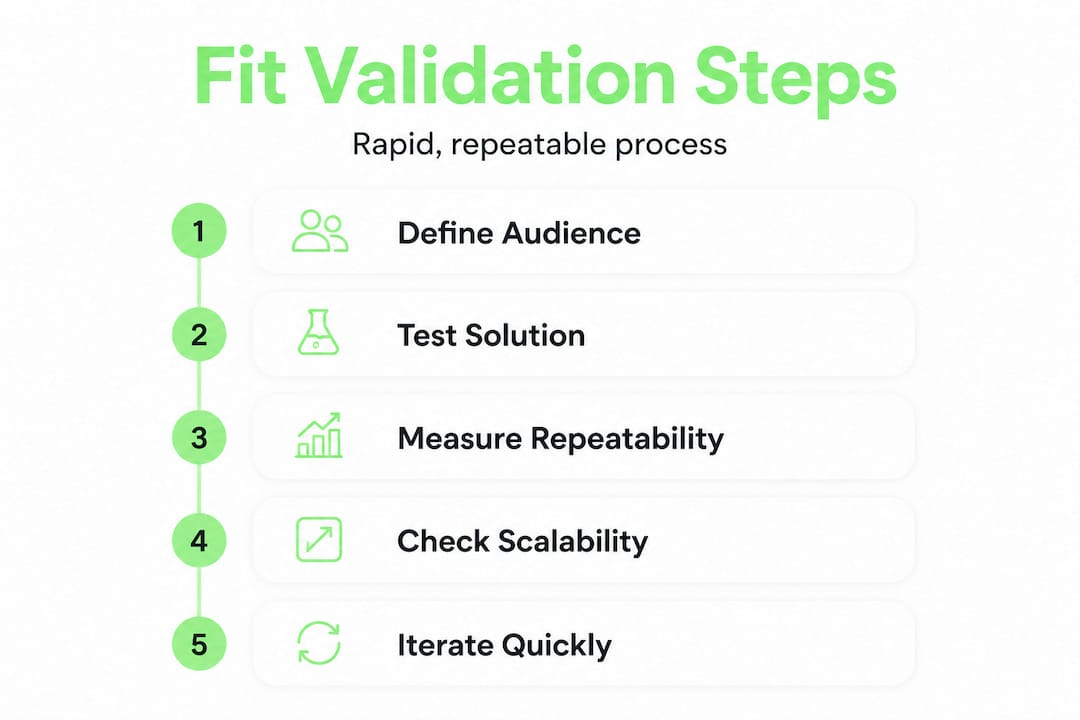
Here’s a step-by-step approach to using AI in your validation loop:
- Define your riskiest assumption. Before touching any tool, write down the one belief about your customer that, if wrong, would invalidate your entire business model. This is what you test first.
- Build a lightweight prototype. It doesn’t need to be perfect. It needs to be testable. AI tools can help you generate wireframes, landing pages, and even simulated user flows in hours.
- Run structured customer conversations. Use AI to analyze transcripts, identify recurring themes, and surface language patterns that reveal real pain points versus polite feedback.
- Measure behavioral signals. Track what users actually do, not just what they say. AI analytics tools can identify drop-off points and usage patterns that manual review would miss.
- Iterate with speed and intention. Use AI to prioritize which changes to make based on predicted impact, then retest. The goal is to shorten your learning loop without losing rigor.
Because PMF can decay over time, the most powerful use of AI is not a one-time validation sprint. It’s an ongoing monitoring system that alerts you when customer sentiment shifts, when churn patterns change, or when a competitor starts eating into your differentiation.
Understanding problem-solution fit is the foundation before you even reach PMF, and AI can help you stress test that foundation before you build too much. Once you’re iterating, a clear framework for product iteration keeps your team aligned and your learning compounding. Pairing this with scalable software approaches ensures your technical architecture can keep pace with what you learn.
Pro Tip: Set up a monthly PMF health check using AI tools. Track NPS, churn, referral rate, and cohort retention together. If two or more of these move in the wrong direction simultaneously, treat it as an early warning that your fit is eroding, not a coincidence.
Why product-market fit is a moving target and what most guides miss
Here’s the uncomfortable truth that most PMF guides skip over: the founders who achieve real, lasting fit are not the ones who found it once. They’re the ones who built an organizational muscle for finding it continuously.
Think about how markets actually move. A competitor launches a feature that eliminates your key differentiator. A macroeconomic shift changes what your customers can afford. A new generation of users enters the market with different expectations and behaviors. Any one of these forces can quietly erode your fit before your metrics catch up. And by the time the numbers turn red, you’ve already lost months of runway.
The most successful founders we’ve seen treat PMF as a habit, not a destination. They schedule regular customer listening sessions. They instrument their product to surface behavioral signals in real time. They create internal rituals around questioning their assumptions, even when growth looks healthy. Especially when growth looks healthy.
The systematic PMF approach that actually works is one built on intellectual humility. It requires founders to stay curious about their customers even after they feel confident about the product. It means resisting the temptation to declare victory and instead asking, “What’s changing in our market that we haven’t fully accounted for yet?”
AI gives you a genuine edge here, but only if you use it with intention. The founders who win are not the ones with the best tools. They’re the ones who combine great tools with a culture of ongoing listening, adaptation, and honest self-assessment. As PMF decay becomes a real risk in fast-moving categories, the founders who monitor and defend their fit will outlast the ones who assumed it was permanent.
Validate, iterate, and win with purpose-built AI solutions
Ready to accelerate your own learning loop? The path to real product-market fit is shorter and more navigable when you have the right tools guiding you at every step. At siift.ai, we built the Intelligent Business Canvas specifically for founders who want to move from idea to validated strategy without the guesswork. siift guides you step-by-step through ideation, validation, and go-to-market, systematically filtering out biases, blindspots, and distractions that slow most founders down. Whether you’re testing your first assumption or defending hard-won fit against new competition, siift gives you the structure and intelligence to move faster and smarter than generic AI tools ever could.
Frequently asked questions
Is product-market fit permanent once achieved?
No, PMF can decay over time as competition intensifies and customer expectations shift, so it requires continuous monitoring and active defense.
How can I tell if my early traction is real product-market fit?
True PMF shows up as repeatable demand across different customer segments, not just isolated wins. As research shows, confusing local wins for true PMF is one of the most common and costly mistakes early founders make.
What is the risk of building for edge cases?
Focusing on atypical users can produce exciting stories and misleading metrics that don’t translate to broader markets. Edge cases can masquerade as real fit, especially in complex industries like healthcare, leading founders to generalize incorrectly when they try to scale.
How do AI tools help with finding product-market fit?
AI tools accelerate validation by automating customer research, synthesizing feedback at scale, and identifying behavioral patterns that manual analysis would miss, shortening your learning loop significantly.
What are signs that I do NOT have product-market fit?
Weak demand, long and painful sales cycles, high early churn, and the constant need to explain your value proposition are all clear indicators that your product hasn’t yet found its market.