
TL;DR:
Effective product iteration relies on continuous, hypothesis-driven iteration rather than the myth of a perfect launch.
Combining Agile, Lean Startup, and iterative design creates fast, user-centered learning cycles that optimize market fit.
Avoid common pitfalls by testing small, measuring meaningful metrics, and addressing edge cases to ensure real user needs are met.
Most breakthrough products you admire today were not born from a single visionary plan. They were shaped by dozens, sometimes hundreds, of small, deliberate adjustments made in response to real users doing real things. The myth of the perfect launch is one of the most expensive beliefs a founder can hold. Product iteration, the structured practice of building, testing, and refining in repeating cycles, is what actually drives startups toward market fit. Core mechanics involve cycles of planning, building an MVP, testing with users, analyzing data, and refining. Understanding this process is the difference between building something people love and burning runway on assumptions.
Table of Contents
Core methodologies: Agile, Lean, and iterative design for startups
Avoiding common iteration pitfalls: What most founders get wrong
Tactical application: Iteration in real startup case studies
Key Takeaways
Point | Details |
|---|---|
Iterate with purpose | Product iteration is a structured, hypothesis-driven process focused on rapid learning and course correction. |
Metrics drive improvement | Set clear metrics and use both data and qualitative feedback to guide every product iteration. |
Handle edge cases early | Address edge cases and real-world usage from the start to build resilient, adaptive products. |
Imperfect launches win | Releasing early and iteratively beats chasing a perfect launch—speed and learning trump perfection. |
What is product iteration? Breaking down the cycle
Product iteration is not a buzzword. It is a structured, repeating process of improvement that treats every release as a learning opportunity rather than a final statement. Think of it less like sculpting a statue and more like tuning an instrument before a live performance. You adjust, listen, and adjust again.
The cycle typically follows five clear steps:
Define your hypothesis. What specific problem are you solving, and what outcome do you expect from the change?
Build the smallest version of the solution that lets you test that hypothesis. This is your minimum viable change.
Ship small. Release to a segment of real users, not the entire market. Controlled exposure limits risk and sharpens signal.
Measure what actually happens. Retention, activation, session length, conversion. Pick the metric that directly reflects your hypothesis.
Decide your next action based on data. Double down, pivot, or discard.
As one product iteration guide describes it, the process follows hypothesis, build, ship small, measure, and decide next actions. Simple in theory. Powerful in practice.
Here is a quick comparison that clarifies the mindset shift:
Build-once approach | Iterative approach |
|---|---|
Long planning cycles | Short hypothesis sprints |
Launch when “ready” | Launch to learn |
User feedback comes late | User feedback drives every step |
High cost of being wrong | Low cost of being wrong |
One big bet | Many small, informed bets |
“The goal of iteration is not to perfect the product. It is to reduce the distance between what you assume and what is actually true.”
Why does rapid feedback matter so much? Because assumptions decay fast. The market shifts, user behavior evolves, and competitors move. Every week you spend building without feedback is a week you are potentially optimizing for a problem that no longer exists. This is especially critical for early-stage startups where runway is finite and every decision carries outsized consequences. Your startup traction guide will tell you the same thing: traction is earned through learning loops, not launch events.
Core methodologies: Agile, Lean, and iterative design for startups
Now that you know the steps, let’s see how proven methodologies shape the way startups iterate. Three frameworks dominate the conversation, and each brings a distinct lens to the process.
Agile is a project management philosophy built around short development cycles called sprints, typically one to two weeks. Teams plan, build, and review in rapid succession. Scrum and Kanban are the most common Agile flavors. Scrum uses defined roles and ceremonies. Kanban focuses on visualizing workflow and limiting work in progress. Both prioritize flexibility over rigid planning.
Lean Startup, popularized by Eric Ries, centers on the Build-Measure-Learn loop. The core idea is to eliminate waste by validating assumptions before committing significant resources. You build the minimum needed to test one idea, measure its impact, and learn whether to persist or pivot.
Iterative design keeps the user at the center of every phase. Prototypes are tested with real users early and often. Feedback is not collected at the end of a project. It is woven into every stage.
Here is how they compare:
Methodology | Core focus | Best for |
|---|---|---|
Agile | Sprint-based delivery | Engineering teams |
Lean Startup | Hypothesis validation | Early-stage founders |
Iterative design | User-centered refinement | UX and product teams |
Key methodologies include Agile with Scrum and Kanban, Lean Startup with Build-Measure-Learn, and iterative design. Most successful startups blend all three rather than picking one exclusively.
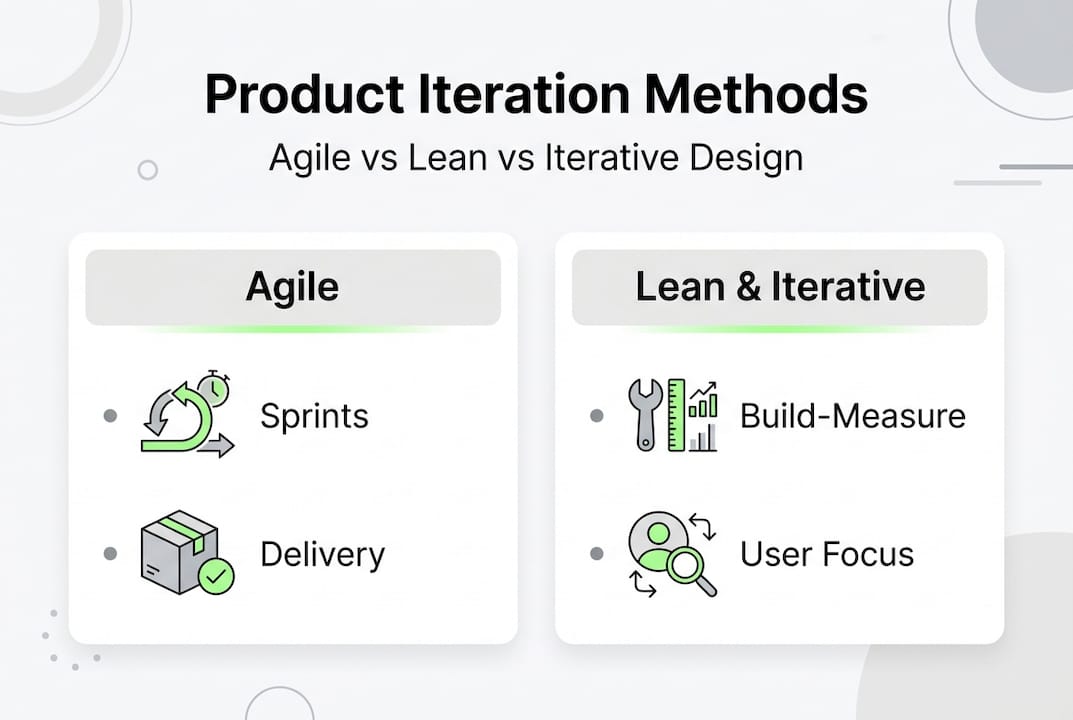
The practical reality? Agile keeps your team moving. Lean keeps you honest about assumptions. Iterative design keeps users from being an afterthought. When you combine them, you get a system that is both fast and grounded. Rapid prototyping for startups is one tangible way to activate all three frameworks simultaneously, turning ideas into testable artifacts in days rather than months.
Pro Tip: Do not wait until you have chosen the “perfect” methodology to start iterating. Pick one framework, run two sprints, and then evaluate what is working. Momentum beats methodology every time.
Understanding which methodology fits your stage is also tied directly to unlocking product market fit. The faster you learn, the faster you close the gap between what you built and what the market actually wants. And validating product demand early, before you over-invest, is the single highest-leverage activity in any startup’s early life.
Avoiding common iteration pitfalls: What most founders get wrong
Equipped with core methods, let’s explore the common mistakes even experienced teams make when iterating. The biggest one? Treating iteration as a synonym for random change.
Iteration without a hypothesis is just guessing with extra steps. Every change you make should answer a specific question. “We believe that simplifying the onboarding flow will increase day-7 retention by 15%.” That is a hypothesis. “Let’s try a new color for the button” is not.
Here are the most common pitfalls:
Designing only for the happy path. Most teams build for the ideal user doing the ideal thing. Real users are messier. They misread instructions, lose internet mid-flow, share accounts, and use your product in ways you never imagined.
Ignoring edge cases. Edge cases like poor internet, user errors, and shared accounts are often the primary user journey, not exceptions. If your product breaks in those moments, you are losing the majority of your real users.
Measuring the wrong things. Vanity metrics like total downloads or page views feel good but rarely correlate with sustainable growth. Focus on best startup metrics that reflect actual user behavior and value delivery.
Over-iterating without direction. Changing too many variables at once makes it impossible to know what caused a result. Isolate your experiments.
Skipping the problem layer. Before you iterate on solutions, make sure you have confirmed problem-solution fit. Iterating on a solution to the wrong problem accelerates you toward the wrong destination.
Pro Tip: Map out your edge cases before you build your next sprint. Ask yourself, “What happens when the user does the unexpected?” Those answers often reveal the most important improvements you can make.
A structured iteration process is what separates teams that improve from teams that just stay busy. The discipline of hypothesis-driven cycles is not a constraint. It is your compass.
Tactical application: Iteration in real startup case studies
Knowing the pitfalls, let’s see what iteration really looks like when startups get it right, with numbers to back it up.
Superhuman, the email productivity startup, is one of the clearest examples. Their team used a simple survey to measure product-market fit, asking users how they would feel if they could no longer use the product. Early results showed only 22% of users would be “very disappointed.” That is below the 40% benchmark considered a signal of strong fit. Rather than rebuilding from scratch, they iterated specifically on the segments that loved the product, doubling down on what resonated. The result? Superhuman moved their PMF score from 22% to 58% through iterative surveys and targeted improvements.

Netflix ran a simple experiment: give users the ability to skip show intros. The feature was tested quietly, measured rigorously, and rolled out only after data confirmed demand. Today, “Skip Intro” is used 136 million times per day. That is the power of one well-measured iteration.
Lenovo ran 36 A/B tests using heatmaps and user data, achieving a 5% conversion lift and a 19% drop in bounce rate. Not through a redesign. Through disciplined, incremental experimentation.
Here is what these case studies share in common:
Company | Method used | Outcome |
|---|---|---|
Superhuman | PMF surveys and segmentation | 22% to 58% PMF score |
Netflix | Controlled feature experiment | 136M daily uses |
Lenovo | 36 A/B tests with heatmaps | 5% conversion lift, 19% bounce drop |
The process these teams followed:
Set a measurable goal tied to a specific user behavior
Design the smallest experiment that tests one variable
Analyze results with both data and user context
Repeat with the next highest-priority hypothesis
You do not need Netflix’s engineering team to apply this. You need clarity on what you are measuring and why. AI tools for product fit can help you move faster through these cycles, and steps to validate product fit give you the framework to structure each experiment properly.
Why true product iteration means embracing imperfection
These examples highlight practical wins, so what does all this mean for your founding journey?
Here is the uncomfortable truth most startup content avoids: the founders who win are not the ones who launch the best product. They are the ones who learn the fastest. Waiting for perfection before shipping is not caution. It is fear dressed up as strategy. Every week you delay is a week of feedback you will never get back.
Iteration works because it creates more learning moments per unit of time. Each cycle, however small, builds your understanding of what users actually need versus what you assumed they needed. That compounding knowledge is your real competitive advantage, not your feature list.
But data alone is not enough. Human judgment is essential for contextual insights beyond data. Numbers tell you what happened. Your judgment, sharpened by direct user conversations and pattern recognition, tells you why. The best founders combine both. They move fast, measure carefully, and stay curious about the gap between the two.
Building founder market fit is part of this equation too. The more deeply you understand your market, the better your hypotheses become, and the more efficient your iteration cycles get.
Accelerate your product iteration with siift.ai
Ready to put these principles to work? The frameworks in this article are powerful, but applying them consistently while managing everything else a founder juggles is where most teams lose momentum. That is exactly where siift.ai comes in.
Siift’s Intelligent Business Canvas is built specifically for founders who want to iterate smarter, not just faster. It guides you step-by-step through ideation, validation, and go-to-market with an agentic AI that filters out bias, blindspots, and noise. Instead of starting from a blank page, you get a structured system that turns your hypotheses into validated strategy. Explore product market fit strategies directly inside the platform and accelerate your path from first idea to repeatable traction.
Frequently asked questions
How is product iteration different from just adding features?
Product iteration is a hypothesis-driven process focused on validated learning, not random or one-off feature additions. Every change is tied to a measurable goal and evaluated against real user behavior.
How do I know if my iteration is working?
Track clear metrics before and after each change. If metrics like retention and NPS improve consistently across cycles, your iteration process is generating real signal.
When should I stop iterating and scale my product?
Scale when key benchmarks show sustained, repeatable results. Superhuman used 40% as their PMF benchmark, moving from 22% to 58% before scaling their growth efforts.
What are edge cases in product iteration and why do they matter?
Edge cases often form the main user journey and should be actively addressed in each cycle, not deferred to a future sprint that never arrives.