
Turning a bold idea into a thriving startup demands more than coding skills or inspiration. Millennial makers and indie founders often discover that startup growth strategy is the backbone of true progress in competitive markets. Building a business around solid strategic alignment—across product, team, and market—offers clarity and improves your odds for long-term success. If you’re searching for a realistic blueprint to move from concept to scalable company, this guide explores how a flexible, robust strategy sets high-performing startups apart.
Table of Contents
- Defining Growth Strategy for Startups
- Key Types of Startup Growth Strategies
- How Successful Growth Strategies Work
- Steps to Achieve Product-Market Fit
- Avoiding Pitfalls and Common Missteps
Key Takeaways
| Point | Details |
|---|---|
| Dynamic Framework | A startup growth strategy is a living document that evolves with market conditions and requires ongoing testing and adaptation. |
| Key Growth Strategies | Consider various strategic pathways like Disruptive, Complementary, Modernization, and Expansion to optimally align with market demands. |
| Focus on Product-Market Fit | Achieving product-market fit is an iterative process that emphasizes customer feedback and rapid prototyping to validate assumptions. |
| Avoid Common Pitfalls | Prevent premature scaling and resource misallocation by validating product-market fit and establishing clear investment priorities. |
Defining Growth Strategy for Startups
A startup growth strategy represents a comprehensive roadmap for transforming innovative ideas into sustainable business models. Far more than a simple plan, it’s a dynamic framework that guides founders through complex market landscapes, helping them navigate uncertainty and maximize their probability of success.
Startup growth strategies fundamentally involve strategic alignment of organizational choices that determine how new ventures compete and expand. These strategies require founders to make critical decisions across multiple dimensions:
- Product Development: Defining core value proposition
- Market Segmentation: Identifying target customer groups
- Resource Allocation: Prioritizing investments and capabilities
- Competitive Positioning: Understanding unique market advantages
- Scaling Mechanisms: Planning sustainable growth pathways
Research indicates that startups with well-articulated growth strategies demonstrate significantly higher performance potential. Systematic evaluation of internal and external factors becomes crucial in developing a robust strategic approach that can withstand market volatility.
Successful growth strategies are not static documents but living frameworks that evolve with emerging market signals. They require founders to maintain flexibility while staying committed to core strategic principles. This means continuously testing assumptions, gathering customer feedback, and adapting tactical approaches without losing sight of the overarching vision.
Pro tip: Develop your growth strategy as a hypothesis-driven document that you systematically validate and refine through real-world experimentation and data collection.
Key Types of Startup Growth Strategies
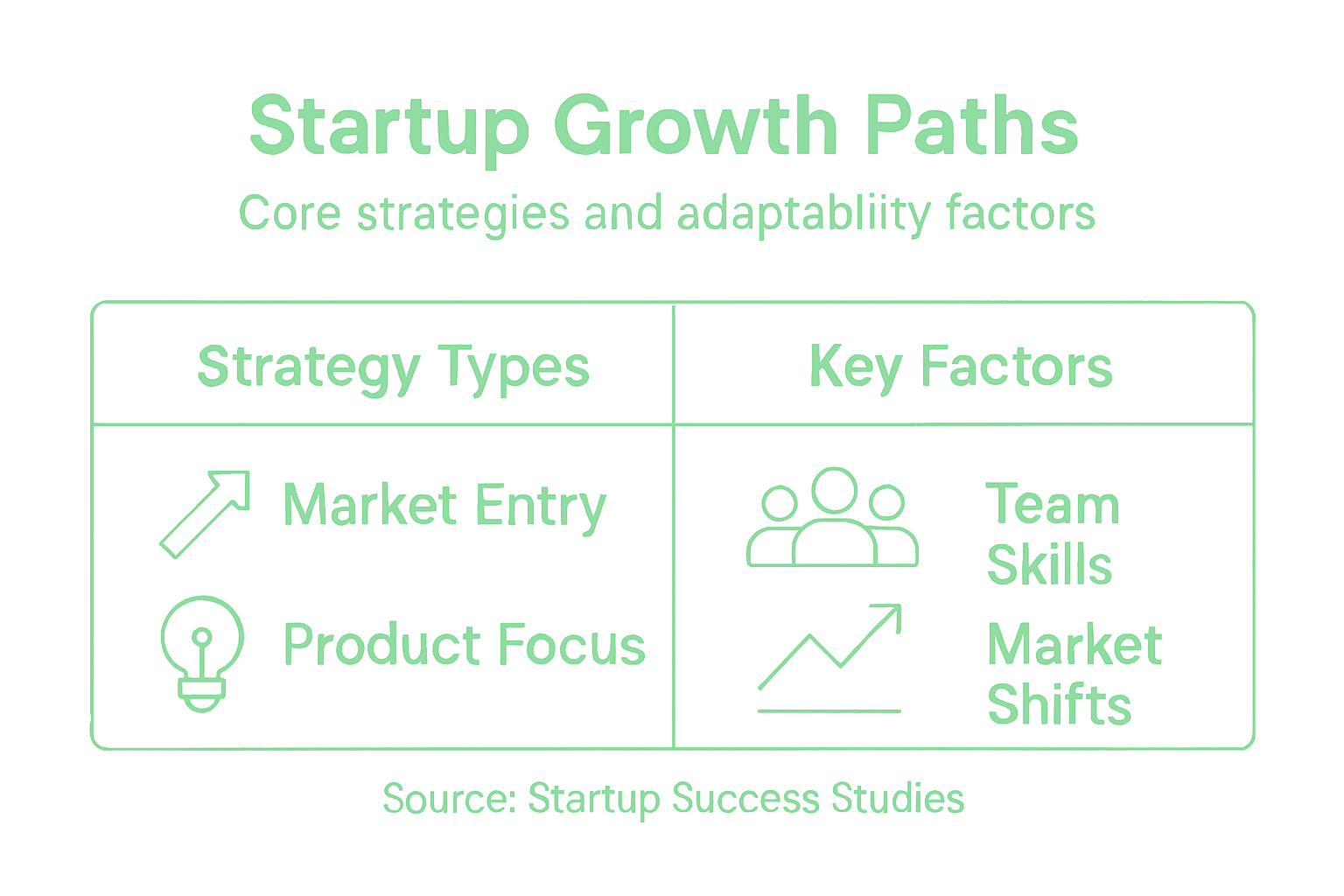
Startup founders have multiple strategic pathways to drive business expansion, each with unique advantages and challenges. Four primary go-to-market strategies emerge as critical approaches for navigating competitive landscapes and achieving sustainable growth.
These strategic approaches can be categorized into distinct types:
- Disruptive Growth Strategy: Targeting underserved market segments or introducing revolutionary solutions that challenge existing industry paradigms
- Complementary Growth Strategy: Forming strategic partnerships to extend market reach and capabilities
- Modernization Strategy: Improving upon existing market solutions without direct confrontation
- Expansion Growth Strategy: Systematically scaling operations across new geographical or demographic markets
Each growth strategy demands a nuanced understanding of market dynamics, competitive positioning, and organizational capabilities. Successful implementation requires founders to carefully assess their unique strengths, market conditions, and long-term vision.
The following table compares four primary startup growth strategies and their typical benefits and risks:
| Strategy Type | Key Benefit | Main Risk | Best Fit For |
|---|---|---|---|
| Disruptive Growth | Creates new market demand | Market resistance | Breakthrough innovations |
| Complementary Growth | Rapid resource expansion | Dependence on partners | Tech integrations |
| Modernization | Lowers market entry barriers | Limited market impact | Incremental improvements |
| Expansion Growth | Increases revenue streams | Operational complexity | Established product-market fit |
The most effective growth strategies are not one-size-fits-all solutions but dynamic frameworks that adapt to changing market conditions. Founders must remain flexible, continuously monitoring performance metrics, customer feedback, and emerging technological trends to refine their strategic approach.
Pro tip: Develop a multi-modal growth strategy that allows for strategic pivots while maintaining a coherent core vision and value proposition.
How Successful Growth Strategies Work
Startup growth strategies are complex, multidimensional frameworks that require careful planning and systematic execution. Successful strategies integrate personal, organizational, and environmental factors to create sustainable business models that can adapt and thrive in dynamic market conditions.
Key components of effective growth strategies include:
- Foundational Learning: Understanding core business model components
- Resource Management: Strategically allocating capabilities and investments
- Entrepreneurial Leadership: Driving innovation and strategic vision
- Market Adaptability: Responding quickly to changing competitive landscapes
- Performance Metrics: Continuously measuring and refining growth approaches
Unit-level profitability and foundational learning emerge as critical precursors to aggressive scaling. Successful startups prioritize deep understanding of their business mechanics before expanding rapidly, which helps prevent fragile growth patterns.

The most powerful growth strategies operate holistically, balancing internal capabilities with external opportunities. This requires founders to maintain flexibility, develop robust learning mechanisms, and create adaptive organizational structures that can pivot quickly in response to market signals.
Pro tip: Develop a systematic learning framework that allows you to gather and integrate market insights before committing significant resources to expansion.
Steps to Achieve Product-Market Fit
Achieving product-market fit represents a critical milestone for startups, transforming innovative ideas into viable business models. Iterative experimentation and customer feedback validation emerge as fundamental strategies for systematically testing and refining market assumptions.
The key steps to achieving product-market fit include:
- Customer Discovery: Deeply understanding target audience needs and pain points
- Value Proposition Design: Crafting a clear, compelling solution to specific market challenges
- Prototype Development: Creating minimum viable product (MVP) versions for testing
- Continuous Feedback Loop: Gathering and integrating user insights rapidly
- Strategic Pivot: Adapting product offering based on market response
Critical early-stage decisions around market segment selection play a crucial role in successfully navigating the product-market fit journey. Founders must meticulously define their customer value propositions and align organizational resources to efficiently validate product utility.
Successful product-market fit is not a destination but a continuous process of learning, adapting, and refining. Startups must maintain extreme flexibility, rapidly iterate their offerings, and stay deeply connected to emerging market signals and customer expectations.
Pro tip: Treat your initial product as a hypothesis and design ruthlessly objective experiments to validate or invalidate your core market assumptions.
Avoiding Pitfalls and Common Missteps
Startup founders navigate an incredibly complex landscape filled with potential strategic missteps that can quickly derail promising ventures. Committing too early to suboptimal strategies represents one of the most dangerous traps that can compromise a startup’s long-term viability.
Common startup pitfalls include:
Here’s a summary of common startup pitfalls and proactive prevention tactics:
| Pitfall | Impact on Startup | Preventive Tactic |
|---|---|---|
| Premature Scaling | Resource drain, loss of focus | Validate product-market fit first |
| Resource Misallocation | Missed key investments | Set clear investment priorities |
| Ignoring Feedback | Product-market disconnect | Establish active feedback loops |
| Leadership Inflexibility | Poor market adaptation | Promote adaptive leadership culture |
| Weak Strategic Vision | Unclear direction, wasted effort | Craft and revisit your roadmap regularly |
- Premature Scaling: Expanding operations before achieving product-market fit
- Resource Misallocation: Investing in non-critical capabilities
- Ignoring Customer Feedback: Developing products in isolation
- Leadership Inflexibility: Failing to adapt to changing market conditions
- Underdeveloped Strategic Vision: Lacking a clear, executable growth roadmap
Systemic approaches to managing internal and external growth factors can significantly mitigate risks that typically derail early-stage ventures. Successful startups develop robust feedback mechanisms, maintain organizational flexibility, and continuously validate their core assumptions against real-world market signals.
The most resilient founders approach risk management as a dynamic, ongoing process. They cultivate a culture of continuous learning, embrace constructive criticism, and remain willing to pivot their strategies when empirical evidence suggests a different approach might be more effective.
Pro tip: Create a quarterly risk assessment framework that systematically evaluates your startup’s strategic assumptions and potential blind spots.
Accelerate Your Startup Growth Strategy with AI-Driven Insights
The article highlights the challenges of defining and executing a startup growth strategy. Common struggles include achieving product-market fit, avoiding premature scaling, and adapting to shifting market signals. These are pain points every founder faces when trying to navigate complex choices like resource allocation, market segmentation, and strategic pivots. Your goal is to build a flexible, validated roadmap that evolves with your business while managing risks and maximizing success potential.
siift.ai’s Intelligent Business Canvas is built specifically to solve these challenges. This intuitive AI platform guides you step-by-step through ideation, validation, and go-to-market strategies with personalized feedback and prioritized actions to minimize blind spots and risk. It acts as a modern founder’s insights engine helping you develop a dynamic growth strategy that adapts in real time. Learn how to systematically test assumptions and refine your startup approach by visiting siift.ai.
Take control of your startup journey today. Explore how the Intelligent Business Canvas accelerates your path from ideation to sustainable scale. Don’t let critical strategic missteps limit your potential—visit siift.ai and start building your validated roadmap now.
Frequently Asked Questions
What is a startup growth strategy?
A startup growth strategy is a comprehensive roadmap that guides founders in transforming innovative ideas into sustainable business models, addressing product development, market segmentation, resource allocation, competitive positioning, and scaling mechanisms.
How can startups achieve product-market fit?
Startups can achieve product-market fit through iterative experimentation, customer feedback validation, deep understanding of the target audience, crafting a compelling value proposition, and adapting the product based on market response.
What are common pitfalls to avoid in a startup’s growth strategy?
Common pitfalls include premature scaling, resource misallocation, ignoring customer feedback, leadership inflexibility, and having a weak strategic vision. Recognizing and addressing these issues can help ensure long-term viability.
What are the different types of startup growth strategies?
The primary types of startup growth strategies include disruptive growth, complementary growth, modernization, and expansion growth, each with its own benefits and risks tailored to different market dynamics.
Recommended
- blog | siift | Top Growth Strategies for Startups in 2025: Practical Steps for Beginners
- Getting Your Startup Off the Ground: Real Steps for Developers | siift
- Top Growth Strategies for Startups in 2026: Practical Steps for Beginners | siift
- 7 Practical Steps to Craft Your Business Growth Strategy | siift
- Tech T Shirts in Startup Culture (2025): Why Every Dev Needs One – Code Culture