
Most american software developers make the leap from full-time jobs to side startups hoping to turn technical know-how into lasting impact, yet fewer than thirty percent ever navigate those crucial early hurdles. Understanding how to get a startup off the ground matters because it’s about more than ideas or code—it’s about creating a business model with real staying power. This guide breaks down strategic phases, common pitfalls, and proven steps so you can build momentum and get personal feedback on your startup journey.
Table of Contents
- What Does Getting a Startup Off the Ground Mean
- Validating Startup Ideas With Real-World Data
- Designing a Scalable Business Model as a Developer
- Navigating Early Legal, Financial, and Technical Hurdles
- Common Pitfalls and De-Risking Your Startup Journey
Key Takeaways
| Point | Details |
|---|---|
| Startup Launching | Transforming an innovative idea into a sustainable business model involves validating concepts and building a Minimum Viable Product (MVP). |
| Validating Ideas | Utilize systematic market research and real-world testing to minimize risks before significant investment. |
| Scalable Business Model | Design flexible frameworks that prioritize user value and can adapt to changing market dynamics. |
| Risk Management | Assess and mitigate technological, market, financial, and operational risks using data-driven strategies to build resilience. |
What Does Getting a Startup Off the Ground Mean
Launching a startup isn’t just about having an innovative idea—it’s about transforming that concept into a sustainable business model with real-world potential. Understanding startup fundamentals requires seeing your venture as more than just a product, but as a scalable system designed to solve meaningful problems.
At its core, getting a startup off the ground means converting raw potential into actionable momentum. This involves several critical stages: validating your core concept, developing a minimum viable product (MVP), securing initial funding, building an initial customer base, and creating operational frameworks that can support growth. Successful founders recognize that launching isn’t a single event but a strategic progression of calculated steps.
The journey typically involves three fundamental phases. First, the ideation stage where founders crystallize their core value proposition. Second, the validation phase where market fit gets tested through prototypes and initial customer feedback. Third, the execution stage where systematic business development occurs—including team building, fundraising, and scaling strategies. Each phase requires different skills, resources, and mindsets, making adaptability a crucial founder trait.
Here’s how the three fundamental startup phases compare in focus and required skills:
| Phase | Primary Focus | Key Skillset | Typical Output |
|---|---|---|---|
| Ideation | Defining core value | Creative thinking | Compelling value proposition |
| Validation | Testing market fit | Analytical research | MVP, user feedback |
| Execution | Building business strategy | Leadership, scaling | Assembled team, growth plan |
Pro-Tip: Build a network of mentors and fellow founders who can provide real-world insights and emotional support during your startup’s early, challenging months.
Validating Startup Ideas With Real-World Data
Validating a startup idea requires more than intuition—it demands rigorous, systematic research and strategic testing. Comprehensive market validation involves a structured approach that transforms hypothetical concepts into data-driven business opportunities. Successful entrepreneurs understand that validation is about minimizing risk and maximizing potential before investing significant resources.
The validation process typically involves multiple strategic steps. First, conduct thorough market research to understand potential customer needs, pain points, and existing solutions. This means analyzing competitor landscapes, surveying target demographics, and identifying unique value propositions. Developers should create detailed customer personas, mapping out specific problems their solution might address. Quantitative research helps establish baseline market interest, while qualitative insights provide deeper context about user motivations and behaviors.
Practical validation requires building a Minimum Viable Product (MVP) that tests core hypotheses with real users. This lightweight version allows entrepreneurs to gather critical feedback without extensive upfront investment. Key metrics to track include user engagement, conversion rates, customer acquisition costs, and potential willingness to pay. Successful founders view each interaction as a learning opportunity, using data to continuously refine their approach and pivot when necessary.
Pro-Tip: Create a structured feedback mechanism that allows potential customers to provide detailed insights, using tools like structured surveys, user interviews, and beta testing platforms.
Designing a Scalable Business Model as a Developer
Designing a scalable business model requires more than technical skills—it demands strategic thinking and architectural vision. Advanced digital business modeling involves creating flexible frameworks that can adapt and grow with changing market dynamics. Developers have a unique advantage in this process, leveraging technical expertise to build intelligent, responsive business structures.

Successful scalable models typically incorporate several key components. Network effects become critical, where the platform’s value increases as more users engage. This means designing systems that inherently grow more valuable with increased participation. Technical architects must think beyond immediate functionality, considering how each architectural decision impacts potential future expansion. Core considerations include modular design principles, API flexibility, automated scaling mechanisms, and potential revenue streams that can evolve alongside user acquisition.
The most effective scalable models prioritize user value over complex technical implementations. This requires deeply understanding user needs, creating intuitive experiences, and building technological infrastructure that can seamlessly adapt. Developers should focus on creating lightweight, extensible architectures that can quickly pivot based on market feedback. Key strategies include microservices architecture, cloud-native development approaches, and implementing intelligent data collection mechanisms that provide continuous insights into user behavior and system performance.
Pro-Tip: Design your initial technical infrastructure with horizontal scaling in mind, using cloud services that allow easy resource allocation and automatic performance optimization.
Navigating Early Legal, Financial, and Technical Hurdles
Startup founders face a complex landscape of challenges that extend far beyond product development. Comprehensive regulatory navigation requires strategic planning and proactive risk management. Developers transitioning from coding to entrepreneurship must understand that technical skills alone cannot guarantee business success—legal, financial, and compliance frameworks are equally critical.
Each hurdle presents unique challenges requiring specialized knowledge. Legal considerations demand careful attention to business structure selection, intellectual property protection, and compliance requirements. This means deciding between sole proprietorship, LLC, or corporate structures based on your specific risk profile and growth objectives. Financial planning involves more than securing initial funding—it requires creating robust financial models, understanding tax implications, and developing sustainable revenue strategies. Founders must also consider critical technical infrastructure challenges, including data security protocols, scalable architecture design, and potential regulatory technology requirements.
Successful navigation requires a holistic approach that integrates technical capabilities with strategic business planning. Developers should invest time in understanding regulatory landscapes, consult with legal and financial professionals, and build flexible systems that can adapt to changing requirements. Key strategies include maintaining detailed documentation, implementing robust compliance tracking mechanisms, and creating modular technical architectures that can evolve with regulatory shifts. Proactive risk management means anticipating potential challenges and building contingency plans before they become critical issues.
Pro-Tip: Allocate at least 10% of your initial budget for legal, financial, and compliance consulting to prevent expensive mistakes in your startup’s early stages.
Common Pitfalls and De-Risking Your Startup Journey
Every startup journey contains inherent risks, but strategic founders learn to anticipate and mitigate potential challenges before they become critical problems. Comprehensive startup risk analysis reveals that successful entrepreneurs don’t just react to challenges—they proactively design systems to minimize potential failure points. Understanding these risks becomes your most powerful strategic weapon in building a resilient venture.
Startup risks typically fall into several interconnected categories: technological, market, financial, and operational. Technological risks involve potential gaps in your product’s functionality, scalability, or technical architecture. Market risks center on misalignment between your solution and actual customer needs. Financial risks relate to cash flow, funding challenges, and unsustainable burn rates. Operational risks encompass team dynamics, regulatory compliance, and execution capabilities. Successful founders develop multidimensional risk assessment frameworks that continuously monitor and adapt across these domains.
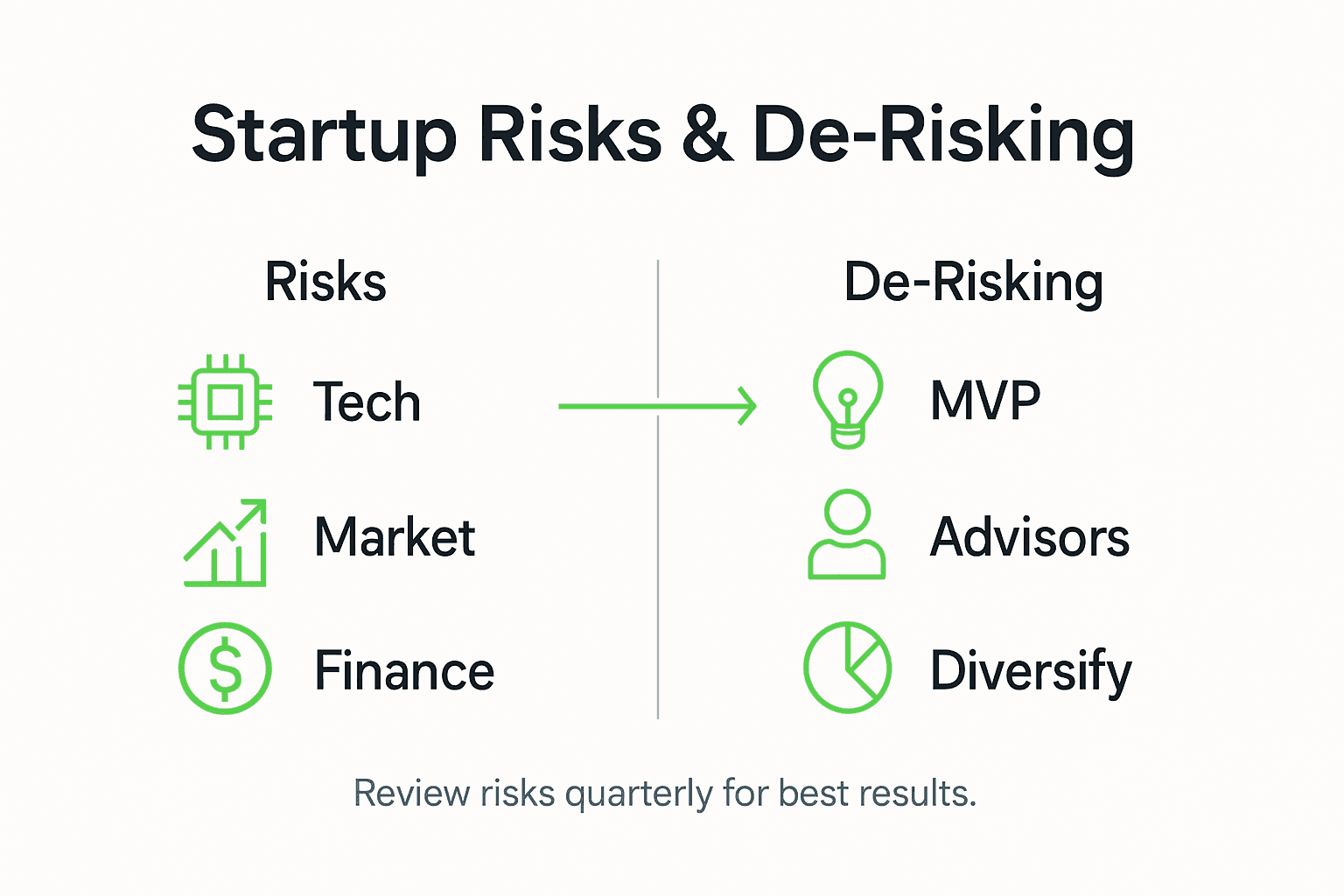
Effective de-risking requires a systematic, data-driven approach. This means building flexible technical architectures, conducting rigorous market validation, maintaining lean operational structures, and creating robust financial models. Developers turned founders should prioritize creating minimum viable products that can be quickly tested and iterated. Key strategies include maintaining low initial overhead, developing multiple revenue streams, building strong advisory networks, and maintaining personal financial resilience during the startup’s early stages.
This table summarizes the main startup risk categories and examples of de-risking strategies:
| Risk Category | Common Issues | Example De-Risking Strategy |
|---|---|---|
| Technological | Scalability bottlenecks | Adopting modular, scalable systems |
| Market | Poor customer fit | Frequent feedback and rapid iteration |
| Financial | Burn rate, cash flow | Diversified revenue and lean budgets |
| Operational | Team, compliance gaps | Detailed documentation and advisors |
Pro-Tip: Create a quarterly risk assessment matrix that scores potential challenges across technological, market, financial, and operational domains, allowing you to proactively address emerging threats.
Turn Your Startup Vision Into Reality With siift.ai
Getting a startup off the ground demands more than passion and coding skills. This article highlights key challenges such as validating your ideas with real data, designing scalable business models, and navigating complex legal and financial hurdles. These early-stage obstacles can feel overwhelming when you try to do everything alone. You need a clear, unbiased, step-by-step guide to structure your efforts and avoid costly pitfalls.
That is where siift.ai Intelligent Business Canvas comes in. This modern founder’s strategy platform offers an intuitive AI-powered experience that systematically guides you through ideation, validation, and go-to-market planning. With personalized feedback and prioritized actions, siift.ai helps you spot blind spots and reduce risks before they grow. Combining technical insights with strategic business planning is easier when you use a tool designed especially for startup founders.
Ready to move beyond ideas and start building a viable business with confidence Learn more about how siift.ai can support your journey by visiting siift.ai today. Take your first step toward turning your startup dreams into actionable progress before challenges slow you down.
Frequently Asked Questions
What are the key phases in getting a startup off the ground?
To successfully launch a startup, you typically go through three key phases: ideation, validation, and execution. The ideation stage focuses on defining your core value proposition, the validation phase tests market fit through prototypes and feedback, and the execution stage involves building out your business strategy, including team development and scaling tactics.
How can I validate my startup idea effectively?
Validating a startup idea requires a structured approach, including thorough market research to assess customer needs and competitor landscapes, followed by creating a Minimum Viable Product (MVP) to gather real user feedback. Utilizing both quantitative and qualitative insights will help you understand your potential market better and refine your offerings accordingly.
What are common pitfalls to avoid when starting a business?
Common pitfalls include technological risks such as scalability bottlenecks, market risks like poor customer fit, financial risks like high burn rates, and operational risks associated with team dynamics. Proactively addressing these risks through effective planning, continuous feedback, and maintaining lean structures can help mitigate potential challenges.
What should I consider when designing a scalable business model?
When designing a scalable business model, focus on creating flexible frameworks that can adapt to market changes. Key components include prioritizing user value, implementing modular design principles, and considering network effects that enhance your platform’s value as more users join. It’s crucial to ensure that your technical architecture can support future growth.
Recommended
- blog | siift | Bootstrapping Strategies: Guide for First-Time Founders
- blog | siift | Top Growth Strategies for Startups in 2025: Practical Steps for Beginners
- blog | siift | Startup Success Stories: Real Paths to Business Wins 2025
- blog | siift | Self Funding a Business: Step-by-Step Guide for Beginners 2025
- Stappenplan webshop starten: van idee tot succesvolle launch | BYTE24