
Launching a tech startup often feels like a guessing game for many Millennial founders across the United States and Canada. The real challenge isn’t building something clever, it’s making sure your product actually solves an urgent problem that real people will pay for—over and over. Achieving product market fit is more than gathering early users or chasing hype. This guide shows you how to define, measure, and reach true product market fit using targeted approaches and actionable metrics, so you create something customers can’t live without.
Table of Contents
- Defining Product Market Fit In Startups
- Key Types And Metrics To Measure Fit
- How To Identify True Market Demand
- Common Pitfalls Founders Must Avoid
- Actionable Steps To Achieve Product Market Fit
Key Takeaways
| Point | Details |
|---|---|
| Understanding Product Market Fit | Achieving product market fit means creating a product that addresses a real problem for customers, leading to sustainable demand and retention rather than mere interest. |
| Metric Focus | Key metrics such as retention rate, net promoter score, and willingness to pay provide critical insights into whether your product truly meets market needs. |
| Customer Validation | Engaging with real customers early to validate assumptions ensures you build what people actually want, minimizing the risk of creating unwanted products. |
| Iterative Approach | Continuous feedback loops and data-driven iterations on your product and messaging are essential to adapt to customer needs and achieve market fit. |
Defining Product Market Fit In Startups
Product market fit happens when your startup’s product resonates so strongly with a specific group of customers that those customers actively want more of it, talk about it, and keep coming back. It’s not just about having a good idea or even building something technically sound. It’s about creating something that solves a real problem for real people, at scale.
Think of it this way: you’ve achieved product market fit when your phone won’t stop ringing with customer requests, when feedback loops back to you organically, and when growth becomes almost inevitable rather than something you have to force. The market is essentially pulling your product from you instead of you pushing it at the market.
Research into how software startups find product market fit shows that the most successful founders skip fancy preparations and instead focus directly on getting their product in front of real users. They test assumptions quickly, gather feedback, and iterate based on what actually works rather than what they predicted would work.
What makes PMF different from just having customers is sustainability. You can sell a few units to anyone. But product market fit means you’ve found a repeatable, scalable system where customers want your solution more than they want alternatives (or the status quo). The demand exceeds your supply, at least temporarily.
Startups pursuing PMF typically fall into different approaches. Some founders take a scientific methodology, testing hypotheses methodically. Others prefer rapid experimentation, throwing multiple iterations at the wall to see what sticks. Some dive deep into market research first, while others build, learn, and adjust on the fly. There’s no single “correct” path, which is why understanding your own founder style matters.
Here’s a summary of founder approaches to achieving product market fit:
| Approach | Description | Strength | Potential Drawback |
|---|---|---|---|
| Methodical Testing | Systematic validation and measurement | High reliability | Slower iteration |
| Rapid Experimentation | Fast trials with frequent changes | Quick learning | May lack focus |
| Deep Market Research | Heavy upfront research before building | Strong understanding | May delay launch |
| Build-Learn-Adjust | Immediate launch and iterative tweaks | Adapts quickly | Can risk missing big issues |
The real insight here: product market fit isn’t something you achieve once and check off. It’s a moving target. Markets shift, competitors emerge, and customer needs evolve. But finding that initial fit is the difference between a startup that gains traction and one that flatlines despite good execution.
Pro tip: Start by defining what product market fit actually looks like for your specific startup right now, including concrete metrics like monthly active users, retention rates, or customer acquisition costs, rather than waiting for some vague feeling of rightness.
Key Types And Metrics To Measure Fit
You can’t manage what you don’t measure. Product market fit lives in the data, and successful founders obsess over the right metrics instead of vanity numbers that make them feel good but don’t tell the real story.
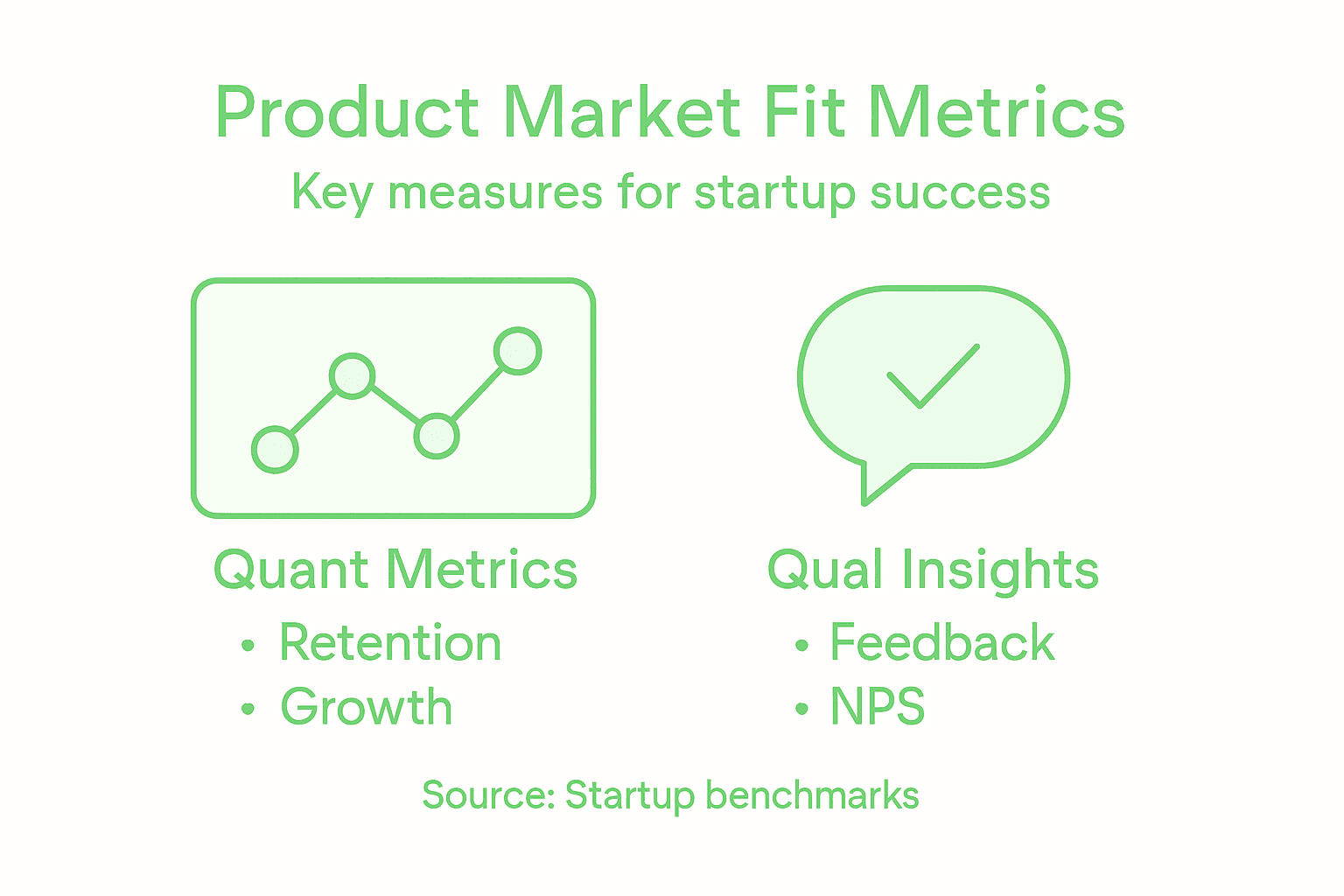
Start with retention rate. This is your north star metric for PMF. If customers are sticking around and using your product repeatedly, that’s proof they see value. A strong retention rate means you’ve solved a real problem, not just created a novelty. Compare this to acquisition: you can buy users cheaply, but retention shows whether those users actually want to stay.

Next comes net promoter score (NPS). This single question, “How likely are you to recommend this product to a friend?”, reveals customer satisfaction and loyalty. High NPS indicates customers love what you’ve built enough to stake their reputation on recommending it. When NPS consistently sits above 50, you’ve hit something special.
Customer willingness to pay directly tells you if you’ve found PMF. Are customers willing to pay your price? Are they converting at acceptable rates? Are they willing to pay more? This metric cuts through all the noise because money doesn’t lie. If people won’t pay, you haven’t achieved PMF yet, no matter what else looks promising.
Then factor in sales volume and growth rates. Real PMF shows organic growth momentum. Your customer acquisition costs should drop as referrals and word of mouth take over. Sales volume that climbs month over month signals the market is pulling your product.
Don’t ignore user engagement metrics either. Daily active users, session frequency, time spent in your product, and feature adoption rates show whether customers actually use what you built or just downloaded it and abandoned it.
Compare how common PMF metrics inform business decisions:
| Metric | What It Reveals | Business Impact |
|---|---|---|
| Retention Rate | Ongoing customer satisfaction | Predicts long-term revenue |
| NPS | Likelihood of word-of-mouth referrals | Indicates brand strength |
| Willingness to Pay | Value placed on solution | Informs pricing strategy |
| Engagement Metrics | Depth of product usage | Guides product development |
The secret: combine quantitative metrics with qualitative feedback. Numbers tell you what is happening, but customer conversations reveal why. A founder who only tracks metrics without talking to users misses critical insights about what’s really driving retention or why churn happens.
Pro tip: Set baseline targets for three to five key metrics right now based on your industry benchmarks, then track them weekly in a simple spreadsheet to spot trends early rather than discovering problems months later.
How To Identify True Market Demand
True market demand isn’t what you think customers want. It’s what they actually need so badly they’re willing to pay for it. The gap between these two things kills most startups before they even launch.
Start by listening to real problems. Talk to potential customers, not your friends or family. Ask them about pain points they experience right now, not hypothetical future problems. Someone complaining about how their current solution wastes three hours every week is showing you demand. Someone saying “that would be cool” is showing you interest, which is different.
Systematic market research combining surveys and interviews reveals whether the problem you’re solving actually matters at scale. Search volume for related terms tells you if people are actively looking for solutions. Customer interviews reveal the emotional weight of their frustration. Together, these tools prevent you from building something nobody wants.
Look for the urgency signal. Does the problem keep your target customer awake at night, or is it a “nice to have”? Real demand comes from problems people can’t ignore. A sales team struggling to track pipeline is urgent. A company wondering if they could improve their process eventually is not.
Analyze willingness to pay early. This is crucial. Ask potential customers directly: “What would you pay monthly for a solution that solves this?” Their answer reveals whether demand is real. If they hesitate or lowball the price, the problem probably isn’t painful enough to justify a purchase.
Check your addressable market size. A massive problem that only affects 100 people won’t sustain growth. A smaller problem affecting millions does. This prevents you from building perfectly for a market too tiny to matter.
Finally, monitor competitive signals. If competitors are already solving this problem and thriving, demand definitely exists. If nobody has tackled it, ask yourself why before assuming you’re the first to see it.
Pro tip: Conduct at least 20 customer interviews before writing a single line of code, documenting the exact problem statement each person describes word for word rather than paraphrasing it yourself.
Common Pitfalls Founders Must Avoid
Most startups don’t fail because they built something bad. They fail because they built something nobody actually needs. Understanding the pitfalls that kill PMF gives you a roadmap to avoid them.
The biggest trap: confusing interest with demand. Your friend saying “That’s cool, I’d totally use that” is not validation. A hundred signups from a Product Hunt launch is not validation. Real demand shows up in retention, repeat purchases, and word of mouth referrals. If users download your app and never open it again, you have interest, not demand.
Building without customer validation comes next. Founders spend months or years perfecting a solution to a problem they think exists, only to discover nobody wants it. Startups fail 42 percent of the time due to lack of market need. This is preventable. Talk to customers first, build second. Validate before you scale.
Scaling too early kills momentum. You feel momentum after getting your first 100 customers. The temptation to hire aggressively, spend on ads, and expand features is intense. Resist it. If your retention is weak, acquisition just means faster failure. Prove your unit economics work with your existing customer base before you press the gas pedal.
Poor positioning and messaging destroy otherwise viable products. Your solution might genuinely solve a problem, but if nobody understands what you do or who it’s for, nobody buys it. Founders often make this mistake by trying to appeal to everyone. Narrow your focus. Be crystal clear about who you serve and why your solution beats alternatives.
Mistaking early traction for true fit happens more often than you think. You land a big customer or hit a revenue milestone. Suddenly everything feels validated. But one customer doesn’t equal product market fit. Watch your metrics over time. Retention, churn, and referral rates tell the real story.
Pro tip: Stop optimizing features you think customers want and instead create a simple feedback loop where you review actual user behavior weekly, killing features with poor engagement rates ruthlessly.
Actionable Steps To Achieve Product Market Fit
Finding product market fit isn’t mystical. It’s methodical. Follow these steps and you dramatically increase your odds of getting there.
Start with deep market research. Understand who your target customer actually is. Not entrepreneurs in general, but specific founders running SaaS companies with between 10 and 50 employees struggling with X problem. The more specific your target market definition, the clearer your path forward. Interview 20 to 30 potential customers in this segment and listen hard.
Use the 5 Whys technique to uncover root problems. When a customer mentions a challenge, ask why five times. “We’re losing deals.” Why? “Our sales team can’t track pipeline.” Why? “Current tools are too complex.” Why? “They require extensive setup.” Why? “They were built for enterprise sales teams, not small businesses.” This reveals the core problem you need to solve, not surface-level symptoms.
Craft a value proposition that directly addresses the core problem. Your messaging should make potential customers immediately recognize themselves in your description. If someone reads your landing page and thinks “That’s exactly me,” you’re on the right track. Test different value propositions with real prospects and watch which messaging gets conversations started.
Build a minimum viable product focused on solving that core problem ruthlessly. Strip away everything else. If your MVP takes longer than 8 to 12 weeks to build, you’ve added too much. Get something usable into customers’ hands fast so you can iterate based on real usage, not assumptions.
Create continuous feedback loops. Reach out to early users weekly. Ask what they love, what they hate, and what they’d pay for. Track retention obsessively. If users churn after one week, your product isn’t solving the problem well enough yet. If they stick around for months, you’re approaching fit.
Iterate based on data, not opinions. Your gut instinct about features matters less than what users actually do in your product. Kill features with poor adoption. Double down on what drives engagement and retention.
Pro tip: Build a simple scorecard tracking customer retention rate, NPS, and weekly active users, comparing these metrics to your original targets every Friday to spot whether you’re actually moving toward PMF or just staying busy.
Achieve Product Market Fit with Confidence Using siift.ai
Struggling to pinpoint what true product market fit means for your startup or how to measure it effectively? The challenge is real. Building a product that customers truly want and are willing to pay for takes more than intuition. You need clear metrics, sharp customer insights, and a proven method to avoid common pitfalls like confusing interest with demand or scaling prematurely.
siift.ai Intelligent Business Canvas was designed to tackle exactly these founder pain points. This AI-powered platform guides you step-by-step through ideation, validation, and go-to-market strategies while delivering personalized feedback and prioritized actions. By using siift.ai Intelligent Business Canvas, you eliminate blindspots and systematically work toward sustainable product market fit.
Don’t let vague feelings or vanity metrics slow you down. Start your journey to real startup success today. Visit siift.ai to explore how an intuitive AI app can help you validate your business model, refine your value proposition, and create the product customers truly want now.
Frequently Asked Questions
What is product market fit and why is it important for startups?
Product market fit is achieved when a startup’s product meets the needs of a specific group of customers so well that they actively seek it out, recommend it, and return for more. It is crucial for sustainable growth and long-term success, distinguishing startups that gain traction from those that fail despite good execution.
How can I measure product market fit effectively?
Measuring product market fit can be done through key metrics such as retention rate, net promoter score (NPS), and willingness to pay. High retention rates suggest that customers find value in the product, while a strong NPS indicates satisfaction and potential for referrals. Tracking these metrics consistently provides insights into your product’s fit with the market.
What common pitfalls should founders avoid when seeking product market fit?
Founders should avoid confusing interest with demand, which can lead to validation based on superficial metrics. Building without customer validation and scaling too early are also significant risks. Effective positioning and messaging, along with continuous user feedback, are essential to avoid these pitfalls.
How can startups identify true market demand?
Startups can identify true market demand by listening to actual customer pain points through interviews, assessing the urgency of the problems they face, and analyzing willingness to pay. Systematic market research, including surveys and interviews, helps clarify whether the solutions being developed resonate with potential customers and address their real needs.
Recommended
- Validate Product-Market Fit: Rapid Steps to Real Demand | siift
- blog | siift | Understanding Founder Market Fit: Key Concepts Explained
- Complete Guide to Founder Market Fit | siift
- 7 Key Steps for a Winning Go to Market Strategy Guide | siift
- The Implementation Stages of a Successful ERP | Singleclic
- Understanding Enterprise Growth Strategies for Success -
- Digital Transformation in Practice: A UK SME Guide to Successful Modernization | Petatec | Petatec Technologies