
Every founder faces a tough reality when chasing growth—choosing the right metrics can mean thriving or stalling out. The difference between simple numbers and core startup metrics is more than a spreadsheet exercise. American research from the U.S. Bureau of Labor Statistics clarifies that meaningful metrics reveal the true health and potential of early-stage companies across finance, customers, and products. Mastering these categories helps millennial solopreneurs transform scattered data into strategic, actionable insight for their AI-driven ventures.
Table of Contents
- Core Startup Metrics Defined and Debunked
- Categories of Metrics: Financial, Customer, Product
- Key Metrics For Validation and Scaling
- Avoiding Vanity and Misleading Metrics
- Common Pitfalls and How to Fix Them
Key Takeaways
| Point | Details |
|---|---|
| Understanding Metrics is Critical | Startups must differentiate between actionable metrics and vanity metrics to make informed decisions. |
| Holistic Approach to Metrics | Metrics should be integrated across financial, customer, and product categories to capture the full business landscape. |
| Avoid Common Pitfalls | Founders should identify and correct systematic measurement challenges to enhance performance tracking. |
| Real-Time Monitoring is Essential | Implementing dynamic dashboards allows for agility in decision-making and strategic pivots. |
Core Startup Metrics Defined and Debunked
Startups navigate complex performance landscapes where defining and tracking the right metrics can mean the difference between success and failure. Understanding core startup metrics isn’t just about collecting numbers—it’s about extracting meaningful insights that drive strategic decisions.
The U.S. Bureau of Labor Statistics reveals critical context about startup performance through foundational entrepreneurship data. Their research demonstrates that metrics go far beyond simple revenue tracking, encompassing broader indicators of business health and potential.
Key startup metrics can be categorized into several essential groups:
-
Financial Metrics
- Monthly recurring revenue (MRR)
- Customer acquisition cost (CAC)
- Lifetime value (LTV)
- Burn rate
-
Growth Metrics
- Customer growth rate
- User retention percentage
- Conversion rates
- Market penetration
-
Operational Metrics
- Churn rate
- Product development cycle
- Response time
- Team productivity
While metrics provide valuable insights, entrepreneurs must avoid common pitfalls. NIST’s research on measurement distinctions highlights the critical difference between raw measures and meaningful metrics. Not all data points translate directly into actionable intelligence.
Successful founders understand that metrics aren’t just about tracking—they’re about understanding underlying patterns, potential constraints, and opportunities for strategic pivot. The most effective metrics tell a story beyond raw numbers, revealing the nuanced health of your startup ecosystem.
Pro tip: Create a dynamic dashboard that tracks your most critical metrics in real-time, allowing for immediate strategic adjustments and rapid learning.
Categories of Metrics: Financial, Customer, Product
Startups navigate complex performance landscapes through strategic metric tracking, categorizing their insights into three fundamental domains: financial, customer, and product metrics. Comprehensive business measurement frameworks provide entrepreneurs with a holistic approach to understanding their business’s health and potential.
Each metric category serves a distinct strategic purpose:
-
Financial Metrics
- Monthly recurring revenue (MRR)
- Gross and net profit margins
- Cash burn rate
- Return on investment (ROI)
- Funding runway
-
Customer Metrics
- Customer acquisition cost (CAC)
- Customer lifetime value (CLV)
- Retention and churn rates
- Net promoter score (NPS)
- Conversion rates
-
Product Metrics
- User engagement levels
- Feature adoption rates
- User retention and growth
- Performance and stability indicators
- User satisfaction scores
These categories are not isolated silos but interconnected systems that reveal complex business dynamics. NIST’s research on measurement strategies underscores the importance of selecting metrics that provide actionable insights rather than collecting data for data’s sake.

Successful startups recognize that metrics are storytelling tools. They transform raw numbers into narrative insights that guide strategic decision-making, helping founders understand their business’s current state and potential trajectories.
Pro tip: Create a dynamic dashboard that integrates metrics across all three categories, enabling real-time strategic insights and rapid, informed decision-making.
Key Metrics For Validation and Scaling
Startup founders face critical challenges when determining which metrics truly validate their business potential and signal genuine scalability. Rigorous empirical validation methodologies provide entrepreneurs with structured approaches to measure and confirm their venture’s genuine market viability.
Key metrics for validation and scaling can be strategically categorized into several crucial domains:
-
Market Validation Metrics
- Customer discovery rate
- Problem-solution fit percentage
- Initial conversion rates
- Potential market size
- Customer feedback volume
-
Growth Readiness Metrics
- Customer acquisition cost (CAC)
- Customer lifetime value (CLV)
- Sales cycle length
- Repeatable sales process
- Scalable revenue model
-
Performance Validation Metrics
- User engagement rates
- Feature adoption speed
- Retention and churn metrics
- Performance consistency
- User satisfaction scores
Understanding these metrics requires more than simple data collection. Comprehensive validation standards emphasize the importance of creating reliable, consistent measurement frameworks that provide actionable insights into startup potential.
Successful scaling demands a holistic approach where metrics are not just numbers, but narrative indicators of business health, potential, and strategic direction. Founders must transform raw data into meaningful stories that guide decision-making and attract potential investors.
Pro tip: Develop a dynamic metrics dashboard that integrates validation indicators across multiple domains, enabling real-time insights and rapid strategic pivots.
Avoiding Vanity and Misleading Metrics
Startup founders frequently fall into the trap of tracking impressive-looking but ultimately meaningless metrics that create an illusion of progress. Research integrity principles reveal critical strategies for distinguishing between genuine performance indicators and superficial vanity metrics that provide no real business insights.
Common vanity metrics entrepreneurs must avoid include:
-
Misleading Digital Metrics
- Total website visitors
- Social media follower count
- Likes and shares
- Raw download numbers
- Superficial engagement rates
-
False Growth Indicators
- Registered users who never return
- One-time purchases
- Free trial sign-ups
- Unqualified leads
- Pageviews without conversion
-
Deceptive Performance Signals
- Theoretical total addressable market
- Unvalidated product interest
- Incomplete customer feedback
- Uncontextualized growth percentages
- Unqualified press mentions
Academic research on measurement credibility emphasizes the importance of selecting metrics that genuinely reflect business health and potential. True validation requires deep, contextual understanding beyond superficial numerical representations.
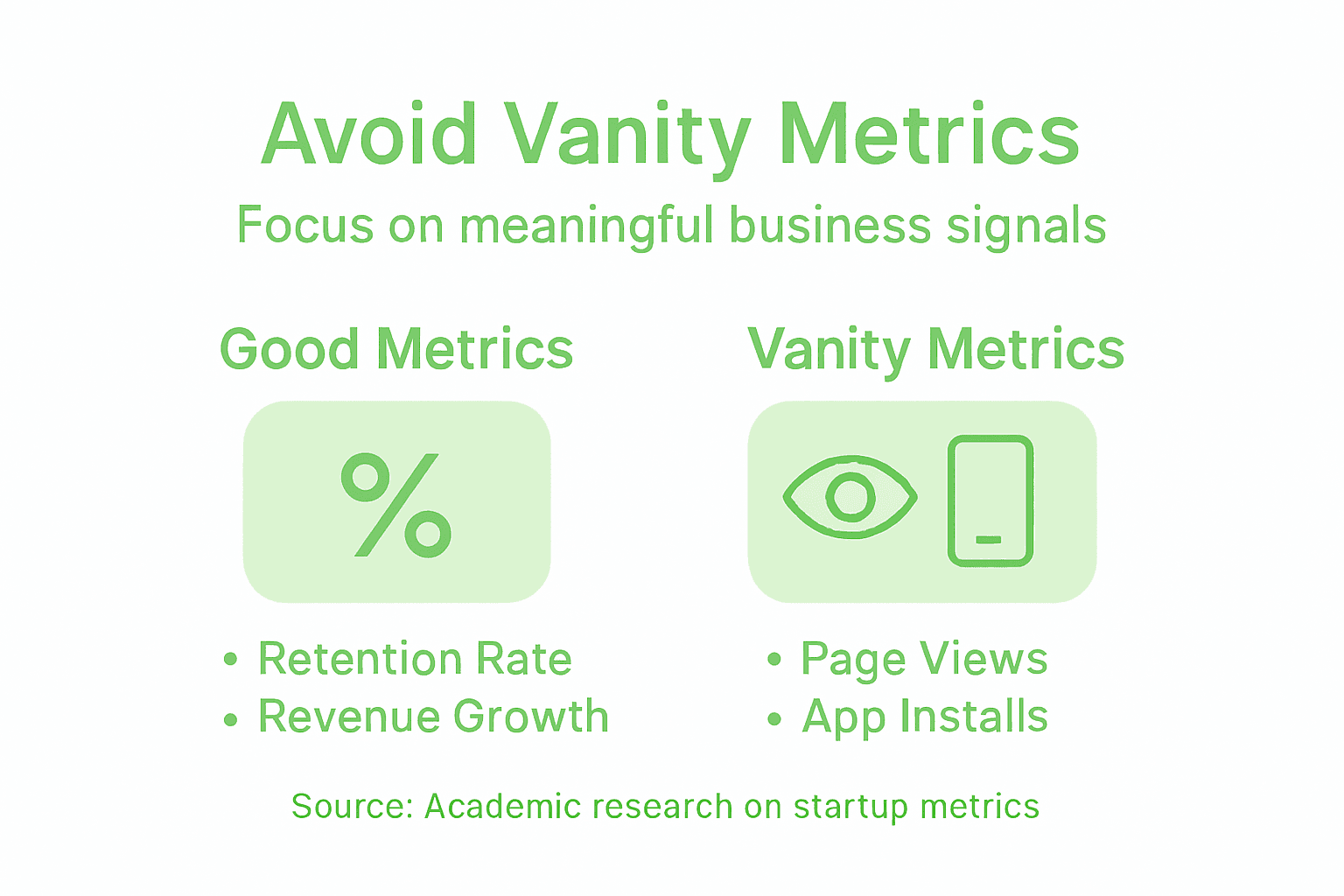
Successful founders recognize that meaningful metrics tell a nuanced story about customer value, product-market fit, and sustainable growth potential. They prioritize quality over quantity, focusing on indicators that demonstrate real user engagement and long-term business viability.
Here’s a quick comparison of actionable vs. vanity metrics for startups:
| Metric Type | Characteristics | Impact on Strategy |
|---|---|---|
| Actionable | Context-rich, tied to outcomes | Guides real decisions |
| Vanity | Surface-level, lacks context | Can mislead growth direction |
| Actionable | Reflects user value and retention | Attracts investors, supports scaling |
| Vanity | Focused on impressions or totals only | Risk of wasted time and resources |
Pro tip: Develop a rigorous metric validation framework that demands multiple corroborating signals before considering any data point meaningful.
Common Pitfalls and How to Fix Them
Startup founders often encounter systematic challenges that can derail their growth and performance tracking. Technology strategy research reveals critical insights into preventing common entrepreneurial mistakes and building robust measurement frameworks.
Key startup pitfalls and their strategic solutions include:
-
Communication Breakdowns
- Misaligned team expectations
- Unclear performance benchmarks
- Inconsistent reporting standards
- Siloed departmental metrics
- Lack of transparent goal-setting
-
Measurement Mistakes
- Over-relying on single data points
- Ignoring context in metrics
- Failing to validate data sources
- Neglecting qualitative feedback
- Misinterpreting statistical trends
-
Strategic Execution Errors
- Reactive instead of proactive planning
- Insufficient stakeholder involvement
- Poor metric selection
- Delayed performance adjustments
- Inadequate feedback loops
Successful startups transform potential pitfalls into opportunities by developing adaptive, holistic measurement strategies. This requires continuous learning, open communication, and a commitment to understanding the deeper narratives behind numerical data.
Founders must cultivate a culture of intelligent metric interpretation, where numbers serve as conversation starters rather than definitive conclusions. By embracing complexity and nuance, entrepreneurs can turn potential obstacles into strategic advantages.
The following table summarizes common startup measurement pitfalls and effective remedies:
| Pitfall | Typical Consequence | Recommended Solution |
|---|---|---|
| Siloed metrics | Fragmented insights | Foster cross-team reporting |
| Overemphasis on one metric | Skewed decision-making | Embrace diverse indicators |
| Responding too slowly | Missed opportunities | Enable real-time monitoring |
| Lack of qualitative feedback | Incomplete understanding | Conduct regular user interviews |
Pro tip: Implement quarterly metric audits that challenge existing measurement approaches and invite diverse perspectives to stress-test your performance tracking.
Master Your Startup Metrics to Drive Real Growth and Validation
Navigating the complex world of startup metrics can feel overwhelming when you’re trying to separate vanity from truly actionable insights. This article highlights common pitfalls like tracking misleading performance signals or overlooking critical validation and growth readiness metrics. You want a clear, unbiased path that turns your data into strategic decisions without the noise or guesswork.
That is where siift.ai steps in. Our Intelligent Business Canvas is designed to guide founders through the entire journey from ideation to product-market fit with personalized feedback, prioritized actions, and real-time insights. It helps you systematically identify and track the metrics that matter most — validating your business potential and accelerating growth while avoiding distractions that can waste precious time and resources.
Ready to transform your startup data into confident strategic moves? Discover how the Intelligent Business Canvas can help you build a metrics-driven, validated business model that attracts investors and drives sustainable scaling. Visit siift.ai now and start turning your smartest ideas into real market success.
Frequently Asked Questions
What are the core startup metrics that should be tracked?
Core startup metrics can be categorized into three essential groups: financial metrics (like Monthly Recurring Revenue and Customer Acquisition Cost), customer metrics (such as Customer Lifetime Value and retention rates), and product metrics (including user engagement and feature adoption rates).
How can vanity metrics impact a startup’s growth?
Vanity metrics can create an illusion of progress and mislead startups into believing they are performing well. Metrics like total website visitors or social media likes do not necessarily reflect genuine user engagement or business health, which can divert focus from more meaningful performance indicators.
What are effective strategies to avoid common measurement mistakes in startups?
To avoid measurement mistakes, startups should ensure clear communication of performance benchmarks, validate data sources, embrace diverse metrics rather than relying on singular data points, and incorporate qualitative feedback to gain a more comprehensive understanding of performance.
How can startup founders effectively track their metrics?
Startup founders can effectively track their metrics by creating a dynamic dashboard that integrates key performance indicators across financial, customer, and product metrics. This allows for real-time insights and helps in making strategic decisions that align with business goals.