
Most American startups that ignore crucial business metrics are far more likely to burn through cash and stall before reaching true market traction. If you want to outlast the majority, learning what to measure and why is a game changer. Tracking the right numbers helps you understand your actual growth potential and avoid common founder mistakes. This guide breaks down essential metrics in plain English so you can build smarter strategies and protect your startup from costly surprises.
Table of Contents
- Core Metrics For Founders Explained
- Types Of Startup Metrics And Key Distinctions
- How Key Metrics Drive Smarter Decisions
- Avoiding Vanity Metrics And Startup Traps
- Tracking Metrics To Support Investor Readiness
Key Takeaways
| Point | Details |
|---|---|
| Focus on Core Metrics | Founders should track Financial, Customer, Operational, and Product Growth metrics for comprehensive insights into startup health. |
| Avoid Vanity Metrics | Prioritize actionable metrics that connect to revenue and customer satisfaction over superficial numbers that offer no meaningful insight. |
| Leverage Data-Driven Decision Making | Use metrics to create adaptive strategies, allowing for quick responses to market changes and optimizing growth potential. |
| Communicate with Investors | Present metrics in a narrative context to demonstrate credible growth potential and the unique value proposition of the startup. |
Core metrics for founders explained
Startup metrics are quantifiable measurements that help founders understand their business performance and potential for growth. Tracking critical startup metrics provides essential insights into user acquisition, revenue generation, and operational efficiency. The right metrics transform raw data into strategic intelligence that guides smart decision making.
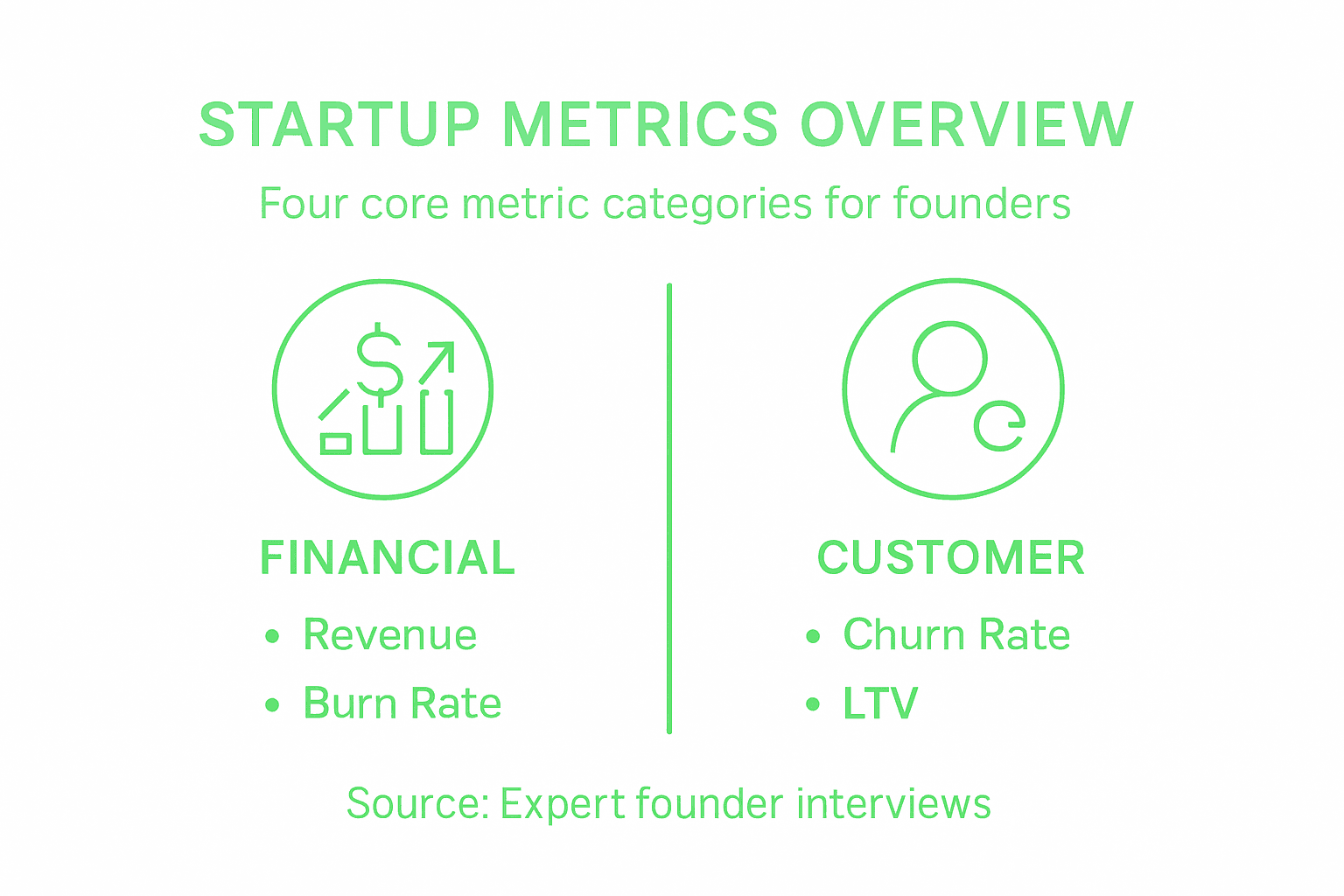
Founders should focus on several core categories of metrics that reveal different aspects of startup health. Financial Metrics track revenue streams, burn rate, and cash runway. Customer Acquisition Metrics measure how efficiently you attract new users, including customer acquisition cost (CAC) and conversion rates. Product Growth Metrics evaluate user engagement, retention, and product performance. Operational Metrics assess team productivity, development cycles, and resource utilization.
The most powerful metrics connect multiple dimensions of startup performance. For instance, comparing customer acquisition cost against lifetime value reveals whether your business model is sustainable. Similarly, tracking monthly recurring revenue alongside user churn helps predict long-term growth potential. By understanding how these metrics interrelate, founders can identify strengths, address weaknesses, and make data-driven strategic choices.
Pro tip: Create a simple dashboard tracking 3-5 core metrics that directly impact your startup’s growth, and review them consistently every two weeks to maintain strategic clarity.
Here’s a summary of core startup metric categories and their main business impacts:
| Metric Category | Main Focus | Key Business Impact |
|---|---|---|
| Financial Metrics | Revenue and costs | Ensures sustainability and planning |
| Customer Metrics | Acquisition and retention | Reveals growth and market traction |
| Operational Metrics | Productivity and processes | Shows efficiency and scaling readiness |
| Product Growth Metrics | Engagement and usage | Supports product improvement and retention |
This comparison highlights meaningful versus vanity metrics for startups:
| Metric Type | Example | Strategic Value | Pitfall |
|---|---|---|---|
| Actionable Metric | Churn Rate | Indicates real customer retention | Motivates strategic adjustment |
| Vanity Metric | Social Followers | May look impressive | Masks true business health |
Types of startup metrics and key distinctions
Startup metrics can be strategically categorized to provide comprehensive insights into business performance. Performance tracking involves multiple metric types that reveal different aspects of organizational health and potential. Understanding these distinctions allows founders to build a holistic view of their startup’s trajectory.
The primary categories of startup metrics include Financial Metrics, which measure monetary performance and sustainability. These encompass revenue growth, burn rate, runway, and profitability indicators. Customer Metrics focus on acquisition, retention, and engagement, tracking crucial indicators like customer acquisition cost (CAC), lifetime value (LTV), churn rate, and conversion percentages. Operational Metrics evaluate internal efficiency, measuring team productivity, development cycles, and resource utilization.
Each metric type serves a unique purpose in understanding startup dynamics. Financial metrics reveal economic viability, customer metrics demonstrate market traction, and operational metrics highlight organizational effectiveness. The most successful founders synthesize insights across these categories, creating a nuanced understanding of their startup’s strengths and potential challenges. By interpreting metrics holistically, entrepreneurs can make data-driven decisions that optimize growth and mitigate potential risks.
Pro tip: Create a balanced scorecard that tracks 2-3 key metrics from each category, ensuring a comprehensive view of your startup’s performance without overwhelming yourself with excessive data points.
How key metrics drive smarter decisions
Data-driven decision making transforms startup strategy from guesswork to precision. Tracking critical business metrics enables founders to make informed choices that reduce risk and optimize growth potential. Metrics serve as objective navigational tools, providing clear signals about business performance and highlighting areas requiring immediate attention or strategic adjustment.

Founders can leverage metrics across multiple strategic dimensions. In financial planning, metrics like burn rate and revenue growth help determine funding needs and sustainability. Customer acquisition metrics reveal marketing effectiveness and potential scaling opportunities. Operational metrics, such as team productivity and development cycle times, expose internal efficiency challenges. Each metric category provides a unique lens through which founders can assess and refine their startup’s trajectory.
The most successful entrepreneurs view metrics as dynamic feedback systems rather than static reports. By establishing benchmark targets and consistently monitoring performance, founders create adaptive strategies that respond quickly to market changes. This approach transforms metrics from passive tracking tools into active decision-making frameworks. Regular metric analysis allows founders to pivot strategies, reallocate resources, and make proactive corrections before minor issues escalate into significant challenges.
Pro tip: Implement a monthly metric review process where you compare actual performance against predefined goals, identifying both positive trends and areas requiring strategic intervention.
Avoiding vanity metrics and startup traps
Founders often fall into the dangerous trap of chasing superficial numbers that look impressive but contribute little to actual business success. Distinguishing between meaningful and vanity metrics is crucial for maintaining strategic focus and making intelligent business decisions. Vanity metrics like total downloads, social media followers, or website visitors can create a false sense of progress while masking underlying performance challenges.
True startup success requires a disciplined approach to metric selection. Instead of celebrating surface-level achievements, founders must prioritize actionable metrics that directly correlate with business growth. Customer retention rates, lifetime value, conversion percentages, and revenue growth provide far more meaningful insights than raw engagement numbers. These metrics reveal the actual health of your business, showing how effectively you’re solving customer problems and generating sustainable value.
Navigating the metric landscape demands ruthless prioritization and critical thinking. Successful founders develop a nuanced understanding of which numbers truly matter, creating a dashboard that reflects real business performance. This means looking beyond immediate gratification and focusing on metrics that demonstrate long-term potential. By avoiding the allure of vanity metrics, entrepreneurs can build more resilient, data-driven strategies that transform initial traction into meaningful, scalable success.
Pro tip: Create a ‘metric hygiene’ protocol where you review and ruthlessly eliminate any metrics that don’t directly connect to revenue, customer satisfaction, or core business objectives.
Tracking metrics to support investor readiness
Investors want hard evidence of potential, not just compelling stories. Startup metrics demonstrate credible growth potential by providing transparent, objective insights into business performance. Smart founders understand that effective metric tracking goes beyond simple number reporting and requires strategic, comprehensive financial storytelling.
The most compelling metrics for investor presentations typically span multiple dimensions. Financial Metrics like monthly recurring revenue, burn rate, and cash runway provide fundamental insights into financial health. Customer Metrics such as acquisition cost, lifetime value, and churn rate reveal market traction and product-market fit. Operational Metrics demonstrate team efficiency, showing investors the startup’s capability to execute and scale effectively.
Successful founders approach investor readiness as a strategic communication challenge. This means not just collecting data, but presenting metrics in a clear, narrative context that connects numbers to broader business potential. Investors seek founders who can translate raw metrics into a compelling vision of future growth. By developing a nuanced, data-driven narrative, entrepreneurs transform metrics from dry statistics into powerful evidence of their startup’s unique value proposition and scalability.
Pro tip: Create a quarterly metric dashboard that tells a consistent, coherent story of progress, focusing on metrics that demonstrate sustainable growth and strategic momentum.
Transform Your Startup Metrics into Smarter Decisions Today
The challenge every founder faces is turning complex startup metrics into clear, actionable strategies that drive real business growth. This article highlights critical pain points like distinguishing meaningful metrics from vanity metrics and maintaining a balanced, data-driven decision-making process without getting overwhelmed. Understanding financial, customer, and operational metrics is essential, but the true test is how you use these insights to confidently validate ideas and refine your approach.
That is exactly where siift.ai excels. Our Intelligent Business Canvas guides you step-by-step through ideation, validation, and go-to-market strategies, providing personalized feedback and prioritized actions that connect your metrics directly to sustainable growth. Avoid common startup traps by leveraging AI-powered insights to eliminate blind spots and focus only on what truly moves your business forward. Ready to shift from raw data to a strategic growth engine? Take the next step now with siift.ai and build your roadmap to success with confidence.
Frequently Asked Questions
What are the key categories of startup metrics?
Startup metrics are typically categorized into Financial Metrics, Customer Metrics, Operational Metrics, and Product Growth Metrics. Each category focuses on different aspects of business performance and health.
How can I differentiate between meaningful and vanity metrics?
Meaningful metrics are actionable and directly correlate with business growth, such as churn rate and customer lifetime value. Vanity metrics, like total downloads or social media followers, look impressive but do not provide insights into actual business success.
Why is it important to track startup metrics regularly?
Regularly tracking startup metrics helps founders maintain strategic clarity, identify strengths and weaknesses, and make data-driven decisions that optimize growth and mitigate risks.
What should I include in my startup’s metric dashboard?
Your startup’s metric dashboard should include 3-5 core metrics from multiple categories that directly impact growth, such as customer acquisition cost, monthly recurring revenue, and churn rate.
Recommended
- Launch a Data-Driven Startup: Step-by-Step Success Guide | siift
- blog | siift | Understanding Growth Metrics for Startups Explained
- Startup Success Stories: Real Paths to Business Wins 2025 | siift
- Data-Driven Founder: Turning Insights Into Actionable Strategy | siift
- 7 Essential Marketing Metrics Every Business Owner Must Track - Jarrod Harman