
More than 60 percent of American startups now credit data analysis as the driving force behind their business decisions. For founders, relying on numbers and evidence often marks the difference between success and costly mistakes. As the role of the data-driven founder grows, understanding this shift becomes crucial for anyone pursuing lasting impact in the modern marketplace. Discover how American entrepreneurs are harnessing information to make smarter choices and carve new paths to growth.
Table of Contents
- What Is A Data-Driven Founder?
- Types Of Data-Driven Founders Today
- Essential Traits And Success Factors
- De-Risking Startup Ideas With Data
- Common Pitfalls And How To Avoid Them
Key Takeaways
| Point | Details |
|---|---|
| Data-Driven Decision Making | Data-driven founders leverage empirical insights to guide business strategies, transforming raw information into actionable intelligence for growth. |
| Diverse Founder Archetypes | Data-driven founders come from various backgrounds, blending technical skills with industry knowledge to innovate and enhance decision-making. |
| Critical Success Factors | Successful data-driven founders exhibit cognitive adaptability, statistical literacy, and risk intelligence, balancing analysis with creativity. |
| Avoiding Common Pitfalls | Founders should be aware of traps like confirmation bias and complexity paralysis, maintaining a balanced perspective that values both quantitative and qualitative insights. |
What Is a Data-Driven Founder?
A data-driven founder represents a new breed of entrepreneurial leader who fundamentally transforms decision-making by leveraging empirical insights and quantitative analysis. Unlike traditional entrepreneurs who rely primarily on intuition or past experiences, these founders systematically collect, analyze, and interpret data to guide strategic choices across every aspect of their business.
According to research on data-driven business model innovation, this approach enables founders to navigate complex systems with unprecedented precision. By embracing data as a strategic asset, they can identify market opportunities, validate product assumptions, and optimize resource allocation more effectively than ever before. The core philosophy revolves around transforming raw information into actionable intelligence that reduces uncertainty and accelerates business growth.
The key characteristics of a data-driven founder include:
- Comfort with statistical analysis and quantitative reasoning
- Ability to extract meaningful insights from complex datasets
- Willingness to challenge assumptions through empirical evidence
- Commitment to continuous learning and iterative improvement
- Strategic use of advanced analytics and AI technologies
Furthermore, data-driven innovation processes demonstrate that this approach is not just about collecting numbers, but about cultivating a systematic mindset that treats information as a strategic lever for creativity and problem-solving. These founders view data not as a passive resource, but as an active tool for uncovering hidden patterns, predicting market trends, and making calculated risks that traditional entrepreneurial methods might overlook.
Types of Data-Driven Founders Today
The landscape of data-driven founders is diverse and complex, with distinct archetypes emerging across different industries and innovation contexts. Recent startup founder research reveals six unique personality profiles that demonstrate the multifaceted nature of entrepreneurial approaches to data-driven decision making.
These data-driven founder types can be broadly categorized into several key personas:
- The Analytical Strategist: Deeply technical founders who view data as a strategic weapon, leveraging advanced statistical models and machine learning algorithms to predict market trends
- The Intuitive Data Explorer: Founders who combine traditional entrepreneurial instincts with emerging data insights, using information as a complementary decision-making tool
- The Technology Disruptor: Tech-savvy entrepreneurs who fundamentally reimagine business models through sophisticated data infrastructure and real-time analytics
- The Domain Expert Innovator: Industry specialists who apply deep sector knowledge with precision data analysis techniques
Interestingly, research examining founder identity demonstrates that data-driven founders are not confined to traditional tech backgrounds. Some emerge from legal, engineering, and entrepreneurial domains, bringing unique perspectives to how data transforms strategic thinking. This diversity suggests that being data-driven is less about technical training and more about cultivating a systematic, evidence-based approach to entrepreneurship.

The most successful data-driven founders share a common trait: they treat data not as a passive resource, but as an active strategic partner in their entrepreneurial journey. They understand that in today’s complex business ecosystem, the ability to translate raw information into meaningful insights represents a critical competitive advantage.
Essential Traits and Success Factors
Data-driven founders distinguish themselves through a unique combination of cognitive flexibility, analytical prowess, and strategic thinking. Entrepreneurial personality research reveals that successful founders demonstrate a remarkable preference for variety, novelty, and consistently high activity levels that set them apart from traditional business leaders.
The most critical success factors for data-driven founders include:
- Cognitive Adaptability: Rapid learning and mental agility to pivot strategies based on emerging data
- Statistical Literacy: Advanced ability to interpret complex datasets and extract meaningful insights
- Technological Fluency: Comfort with cutting-edge analytics tools and emerging technological platforms
- Quantitative Decision Making: Systematic approach to evaluating opportunities through empirical evidence
- Risk Intelligence: Calculated risk-taking informed by data-driven probability assessments
Beyond technical skills, these founders cultivate a unique psychological profile characterized by intellectual curiosity and a relentless drive to challenge existing paradigms. They view data not as a restrictive framework, but as a dynamic tool for continuous innovation and strategic exploration. Their success stems from an ability to balance analytical rigor with creative problem-solving, transforming raw information into actionable business strategies.
Ultimately, the most effective data-driven founders develop an almost intuitive relationship with information. They understand that true innovation emerges not from blindly following data, but from asking the right questions, challenging assumptions, and using quantitative insights to unlock unexplored business opportunities. This approach represents a fundamental reimagining of entrepreneurial decision-making in the digital age.
De-Risking Startup Ideas With Data
Modern entrepreneurs are transforming startup development through systematic risk mitigation strategies powered by data analytics. Sophisticated startup evaluation models now enable founders to predict potential success by analyzing critical features like sector dynamics, founder backgrounds, and initial investment characteristics.
The core methodology of de-risking startup ideas involves multiple strategic approaches:
- Market Demand Validation: Using data to quantify potential customer interest
- Competitive Landscape Analysis: Mapping existing solutions and identifying white spaces
- Financial Projection Modeling: Creating realistic revenue scenarios based on empirical benchmarks
- Customer Acquisition Cost Estimation: Predicting realistic marketing and conversion expenses
- Product-Market Fit Assessment: Measuring alignment between solution and market needs
Data-driven innovation strategies demonstrate that reducing uncertainty is not about eliminating risk entirely, but about understanding and systematically managing potential challenges. Successful founders leverage data as a strategic tool, transforming raw information into actionable insights that illuminate potential obstacles and opportunities.
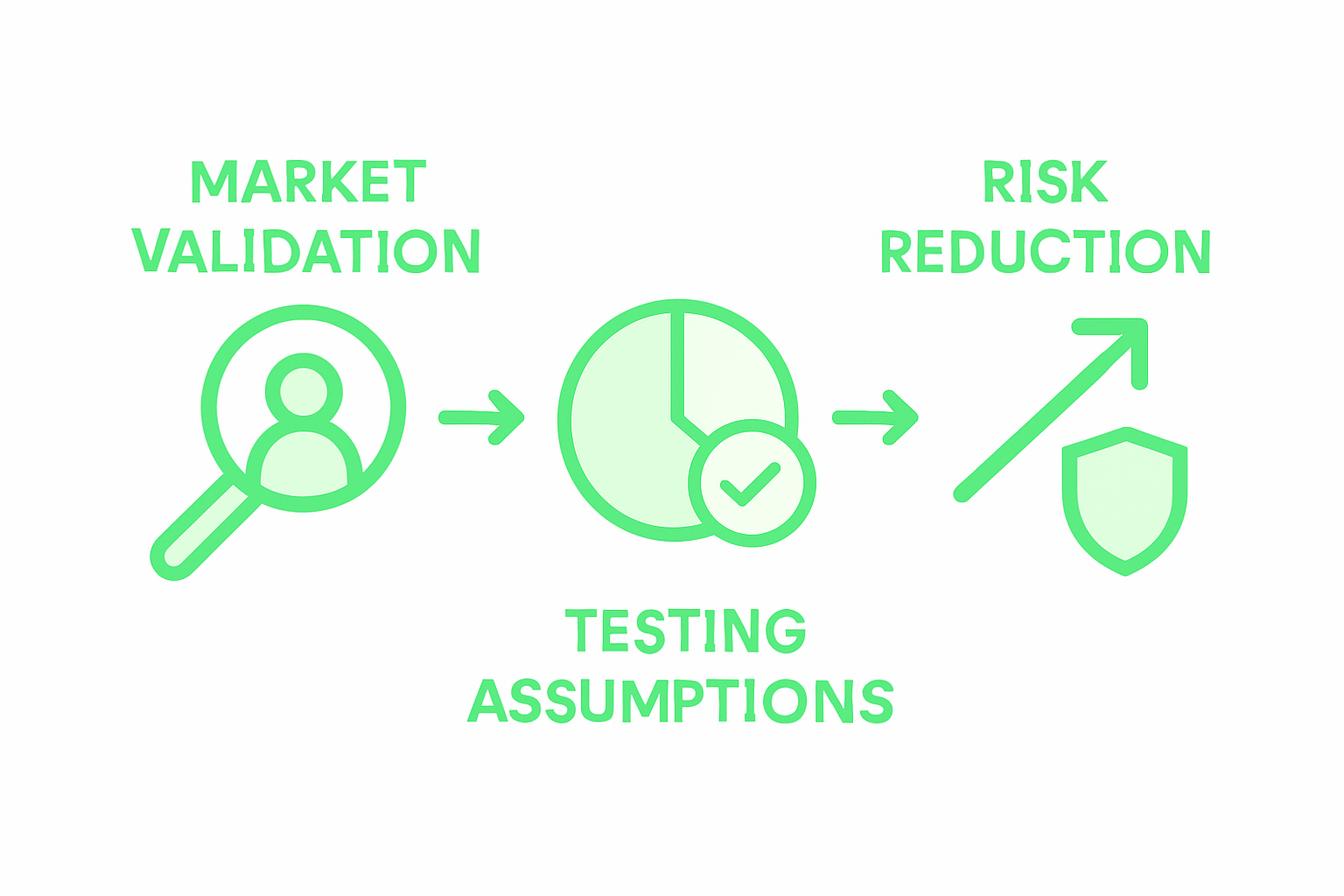
Ultimately, de-risking is an ongoing process of continuous learning and adaptation. The most effective founders view data not as a static predictive tool, but as a dynamic framework for understanding complex market ecosystems. By embracing a systematic, evidence-based approach, entrepreneurs can make more informed decisions, allocate resources more efficiently, and significantly improve their odds of building sustainable, successful businesses.
Common Pitfalls and How to Avoid Them
Data-driven founders face numerous challenges that can derail their entrepreneurial journey if not carefully navigated. Startup evaluation research reveals the complex nature of predicting success, highlighting the critical need for founders to understand and mitigate potential pitfalls through systematic approaches.
The most common data-driven entrepreneurship traps include:
- Confirmation Bias: Selectively interpreting data that confirms pre-existing beliefs
- Overreliance on Historical Data: Assuming past trends precisely predict future outcomes
- Insufficient Data Diversity: Drawing conclusions from narrow or non-representative datasets
- Complexity Paralysis: Getting overwhelmed by excessive data analysis
- Ignoring Qualitative Insights: Treating quantitative data as the sole decision-making metric
Data-driven innovation strategies emphasize that avoiding these pitfalls requires a nuanced, holistic approach to information processing. Successful founders develop a balanced perspective that combines rigorous data analysis with intuitive understanding, recognizing that numbers tell only part of the business story.
Ultimately, the most effective founders treat data as a dynamic conversation partner, not an absolute authority. They cultivate intellectual humility, remain open to contradictory evidence, and understand that true innovation emerges from creative interpretation rather than rigid adherence to statistical models. By maintaining a flexible, critical mindset, entrepreneurs can transform potential data traps into opportunities for deeper market understanding and strategic insight.
Transform Your Data-Driven Insights Into Winning Strategies
The journey of a data-driven founder is filled with challenges such as de-risking startup ideas, overcoming confirmation bias, and turning complex data into actionable strategies. If you want to avoid the common pitfalls discussed in the article and harness the power of data without getting overwhelmed, then leveraging the right tools is essential. Understanding key concepts like cognitive adaptability, quantitative decision making, and market demand validation can make the difference between success and stagnation.
siift.ai Intelligent Business Canvas is THE modern founder’s strategy platform designed to help you turn raw data into prioritized actions that accelerate growth. This intuitive AI app guides you step-by-step through validation, ideation, and go-to-market processes with personalized feedback and no biases. Ready to de-risk your startup journey and unlock your full potential as a data-driven founder Use siift.ai today and start transforming insights into results immediately.
Frequently Asked Questions
What is a data-driven founder?
A data-driven founder is an entrepreneurial leader who utilizes empirical insights and quantitative analysis to make informed decisions across all aspects of their business, rather than relying solely on intuition or past experiences.
What characteristics define a data-driven founder?
Key characteristics include comfort with statistical analysis, the ability to derive insights from complex datasets, a willingness to challenge assumptions, commitment to continuous learning, and strategic use of advanced analytics and AI technologies.
How do data-driven founders de-risk their startup ideas?
Data-driven founders de-risk their startup ideas by employing strategies such as market demand validation, competitive landscape analysis, financial projection modeling, customer acquisition cost estimation, and product-market fit assessment to systematically manage potential challenges.
What common pitfalls should data-driven founders avoid?
Common pitfalls include confirmation bias, overreliance on historical data, insufficient data diversity, complexity paralysis, and ignoring qualitative insights. Successful founders balance rigorous data analysis with intuitive understanding to mitigate these challenges.
Recommended
- blog | siift | Understanding Founder Mode: Your Guide to Entrepreneurship
- blog | siift | Understanding the Best AI Tools for Founders
- blog | siift | Startup Success Stories: Real Paths to Business Wins 2025
- blog | siift | How to Identify Trends for Your Side Business in 2025
- Complete Guide to User Intent in Content Strategy
- Understanding the Purpose of Customizable Branding - Blog