
Over half of American millennials working in corporate settings dream of launching a successful side startup, yet only a small percentage ever achieve meaningful traction. Gaining rapid momentum is more than just having a unique idea—it demands smart strategic moves in today’s crowded global market. If you want to build traction while balancing limited entrepreneurship experience with a demanding career, you need clarity on proven growth methods and the biggest myths stalling first-time founders.
Table of Contents
- Startup Traction Defined And Common Myths
- Types Of Traction Metrics For Early-Stage Startups
- Step-By-Step Validation And Launch Techniques
- Essential Growth Hacking Strategies Explained
- Key Pitfalls And Mistakes To Avoid
- Prioritizing Actions For Rapid, Riskless Momentum
Key Takeaways
| Point | Details |
|---|---|
| Startup Traction is Essential | Real traction involves measurable metrics like user growth and revenue, not just innovative ideas or vanity metrics. |
| Track Core Metrics | Focus on three to five key traction metrics weekly for informed decision-making and to maintain momentum. |
| Validate Before Scaling | Develop a Minimum Viable Product (MVP) and use a structured validation framework to gather feedback before extensive scaling. |
| Avoid Common Pitfalls | Be aware of risks like market misalignment and premature scaling; analyze core assumptions regularly to prevent cascading failures. |
Startup Traction Defined and Common Myths
Startup traction represents the measurable momentum a new business generates toward sustainable growth. While many entrepreneurs romanticize the journey, the reality is far more nuanced. Startup success requires strategic validation and consistent progress, not just passionate ideation.
Common myths surrounding startup traction often mislead founders into ineffective strategies. Many believe that having an innovative product guarantees success. However, research reveals that market fit, customer acquisition, and scalable processes matter far more than pure innovation. The Harvard Business Review highlights that startups frequently derail due to management misconceptions, such as assuming linear growth or overlooking team dynamics.
True startup traction involves demonstrating consistent user growth, revenue increases, and meaningful engagement metrics. Founders must move beyond vanity metrics like website visits and focus on actionable indicators such as user retention, conversion rates, and recurring revenue. This means rigorously testing assumptions, gathering real-world feedback, and iteratively improving your value proposition.
Pro Tip: Track three to five core traction metrics religiously and review them weekly to maintain clear visibility into your startup’s actual momentum.
Types of Traction Metrics for Early-Stage Startups
Early-stage startups must track multiple critical metrics to demonstrate potential and attract investors. Machine learning research reveals sophisticated approaches for evaluating startup potential, highlighting the importance of comprehensive metric tracking beyond traditional financial indicators.

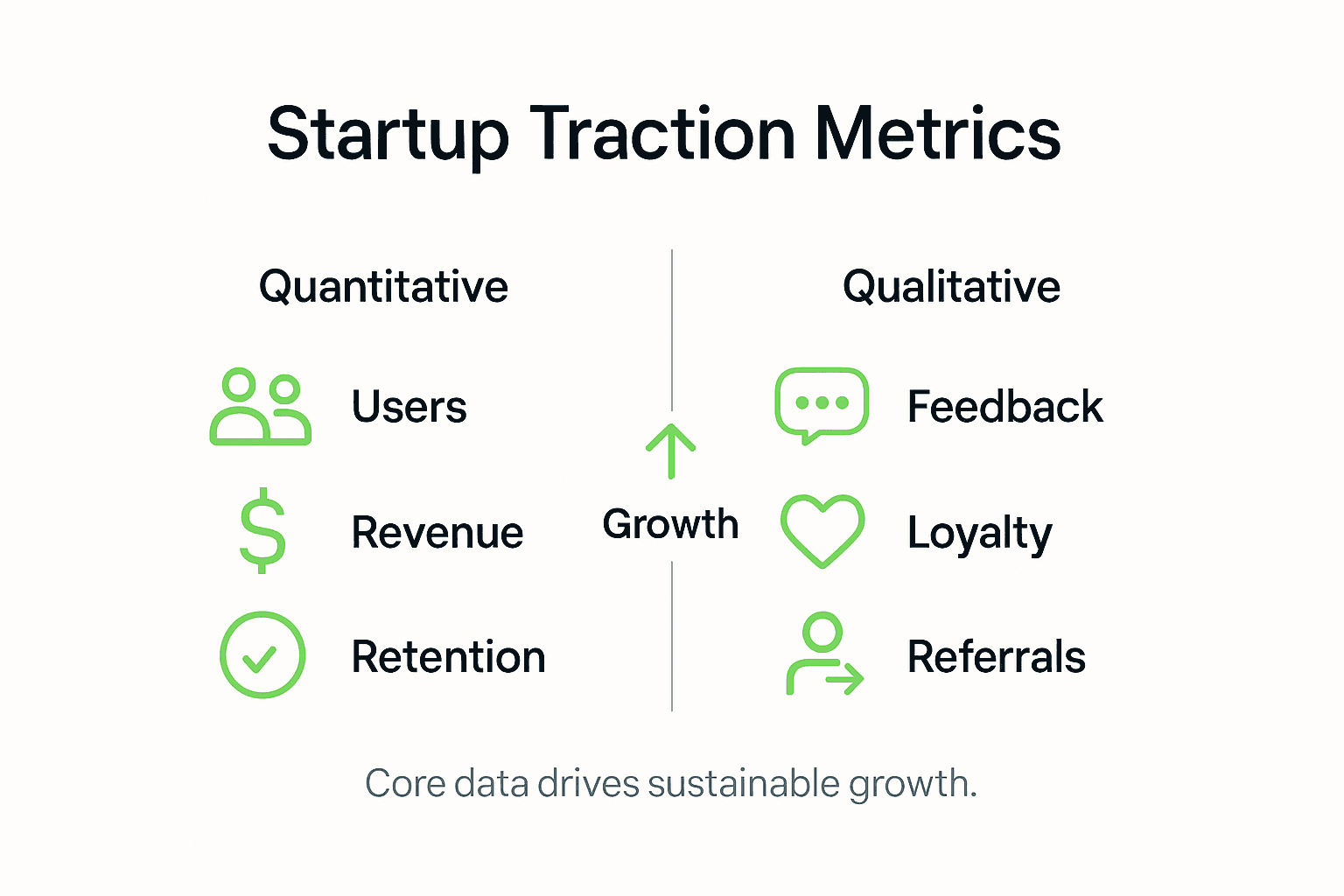
The most crucial traction metrics can be categorized into several key dimensions. User Acquisition Metrics include total sign-ups, conversion rates, and user engagement frequency. Revenue Metrics encompass monthly recurring revenue, customer lifetime value, and average revenue per user. Growth Metrics track expansion rates, including user growth velocity, market penetration, and customer retention percentages.
Beyond quantitative measurements, qualitative traction indicators provide deeper insights into a startup’s potential. These include product market fit validation, customer feedback quality, strategic partnerships, and brand perception. Founders should develop a holistic view that combines hard numbers with nuanced performance indicators. Traction Metrics for Startups: Complete Guide suggests creating a balanced scorecard approach that captures both numerical and strategic progress.
Pro Tip: Create a dashboard that tracks your top five traction metrics weekly, ensuring you have real-time visibility into your startup’s momentum and can make data-driven decisions quickly.
Here’s a comparison of quantitative and qualitative traction metrics for startups:
| Metric Type | Key Examples | Business Impact |
|---|---|---|
| Quantitative | User growth, revenue, retention | Measures progress and scalability |
| Qualitative | Customer feedback, partnerships | Assesses depth of market validation |
Step-by-Step Validation and Launch Techniques
The Lean Startup methodology provides a systematic framework for transforming innovative ideas into market-ready products through a rigorous validation process. Successful startup founders understand that launching isn’t about perfection, but about strategic iteration and continuous learning.
The validation process involves several critical stages. First, founders must develop a Minimum Viable Product (MVP) that tests core hypotheses with minimal resource investment. This means creating a basic version of your product that captures essential functionality without unnecessary complexity. Potential approaches include:
- Prototype development
- Landing page testing
- Manual service simulation
- Limited feature beta releases
Next, founders need to implement a structured validation framework that systematically gathers and analyzes market feedback. This involves setting clear success metrics, conducting targeted customer interviews, and using data-driven insights to refine the product. Effective validation requires comfort with potential pivots and the willingness to dramatically reshape your initial concept based on real-world evidence.
Pro Tip: Allocate 20% of your initial development budget specifically for validation experiments, ensuring you have financial flexibility to test and iterate without exhausting your startup’s resources.
Essential Growth Hacking Strategies Explained
Harvard Business Review highlights the critical importance of rapid experimentation in modern startup growth strategies. Growth hacking is less about traditional marketing and more about creative, data-driven approaches that unlock exponential user acquisition and engagement.
Successful growth hacking requires a systematic methodology. Key strategies include:
- Viral Coefficient Optimization: Designing products with inherent sharing mechanisms
- Conversion Funnel Engineering: Minimizing friction points in user onboarding
- Channel Arbitrage: Identifying underutilized marketing channels with high ROI potential
- Retention Hacking: Creating sticky product experiences that reduce churn
The most effective growth strategies combine technical innovation with psychological insights. Startup traction roadmaps emphasize understanding user behavior, creating scalable acquisition loops, and continuously measuring and refining growth tactics. This means developing a deep understanding of your target audience’s motivations, preferences, and pain points, then systematically designing interventions that drive meaningful engagement.
Pro Tip: Implement a weekly growth experiment protocol, allocating specific resources and tracking measurable outcomes to incrementally improve your startup’s user acquisition strategies.
Key Pitfalls and Mistakes to Avoid
Harvard Business Review reveals critical insights into startup failure mechanisms, highlighting that most entrepreneurial missteps are predictable and preventable. Understanding these potential pitfalls is crucial for founders seeking sustainable growth and long-term success.
The most dangerous startup mistakes typically cluster into several key categories:
- Market Misalignment: Developing products without genuine customer demand
- Premature Scaling: Expanding operations before achieving product-market fit
- Financial Mismanagement: Burning through capital without sustainable revenue strategies
- Talent Recruitment: Hiring generalists instead of specialized, committed team members
Entrepreneurial myth-busting research demonstrates that founders often underestimate the complexity of building a successful business. Overconfidence can lead to critical errors like ignoring competitive landscapes, misunderstanding financing requirements, and failing to adapt quickly to market feedback. Successful entrepreneurs cultivate humility, maintain rigorous learning mindsets, and remain flexible in their approach to building sustainable ventures.
Pro Tip: Conduct a monthly critical review of your startup’s core assumptions, deliberately seeking external perspectives that challenge your current thinking and reveal potential blind spots.
The table below summarizes critical startup mistakes and their long-term impacts:
| Common Mistake | Description | Business Impact |
|---|---|---|
| Market Misalignment | Weak demand or poor customer targeting | Lost revenue, wasted resources |
| Premature Scaling | Growing before achieving market fit | High burn rate, instability |
| Financial Mismanagement | Overspending or poor planning | Funding shortfalls, collapse |
| Talent Recruitment | Hiring for general skills only | Lack of expertise, slow growth |
Prioritizing Actions for Rapid, Riskless Momentum
Startup development requires strategic sequencing of actions to minimize risk while accelerating business momentum. Successful founders understand that rapid progress isn’t about moving fast, but moving smartly with calculated, validated steps.
Prioritizing startup actions demands a structured approach centered on risk mitigation and evidence-based decision making. Key focus areas include:
- Problem Validation: Deeply understanding customer pain points
- Solution Prototyping: Creating minimal viable solutions
- Market Testing: Gathering real-world feedback rapidly
- Iterative Refinement: Continuously adapting based on insights
Effective momentum building requires founders to think like scientific experimenters. This means designing small, low-cost tests that provide maximum learning with minimal investment. Each action should generate actionable data, reducing uncertainty and creating a clear pathway toward sustainable growth. Successful startups treat their initial hypotheses as experiments, not fixed beliefs, allowing them to pivot quickly and intelligently.
Pro Tip: Implement a weekly “risk review” process where you critically examine your startup’s core assumptions and identify potential blind spots before they become critical challenges.
Unlock True Startup Traction with Intelligent Guidance
The journey to sustainable startup traction involves navigating complex challenges like validating your MVP, pinpointing essential growth metrics, and avoiding costly pitfalls. This article highlights how critical it is to focus on measurable progress rather than vanity metrics and to structure your validation and growth hacking strategies thoughtfully. If you find yourself overwhelmed by the need to track multiple traction metrics or uncertain about prioritizing the right actions to reduce risk and accelerate momentum, you are not alone.
siift.ai Intelligent Business Canvas is designed to solve these exact challenges. Our intuitive AI platform guides you step-by-step through ideation, validation, and go-to-market strategies with personalized feedback and prioritized actions. No guesses no biases no blind spots. With siift.ai, you gain a clear, data-driven path to de-risk your startup journey while keeping focus on the traction metrics that truly matter. Don’t wait until you’re stuck with premature scaling or market misalignment. Start transforming your ideas into a viable business today by exploring siift.ai Intelligent Business Canvas and learn how to accelerate your startup traction with confidence.
Frequently Asked Questions
What is startup traction and why is it important?
Startup traction refers to the measurable momentum a new business generates toward sustainable growth. It is crucial for validating business models and attracting investment, as it reflects consistent user growth, revenue increases, and engagement metrics.
What are the key traction metrics I should focus on for my startup?
Founders should track core metrics such as user acquisition (total sign-ups, conversion rates), revenue metrics (monthly recurring revenue, customer lifetime value), and growth indicators (user growth velocity, retention percentages) to assess their startup’s progress effectively.
How can I validate my startup’s product idea effectively?
To validate a product idea, develop a Minimum Viable Product (MVP) that tests core hypotheses with minimal resources. Use structured validation frameworks that include customer interviews, success metrics, and market feedback analysis to refine your product based on real-world evidence.
What are common mistakes startups should avoid to gain traction?
Startups often fall into pitfalls like market misalignment, premature scaling before achieving product-market fit, financial mismanagement, and poor talent recruitment. Avoiding these mistakes is essential for building sustainable momentum and achieving long-term success.