

Most startups fail not from lack of ideas but from missing clear proof of progress. Over 90 percent of startups struggle to show real traction that investors and teams can trust. In the fast-moving world of new ventures, knowing exactly which numbers matter can shape every decision you make. This guide breaks down the most important traction metrics, helping founders focus on what truly signals growth and future success.
Table of Contents
- Defining Traction Metrics For Startups
- Essential Types Of Traction Metrics
- How To Measure Startup Traction Effectively
- Tracking Traction Across Product Stages
- Critical Pitfalls And Common Misconceptions
Key Takeaways
| Point | Details |
|---|---|
| Importance of Traction Metrics | Traction metrics are essential for evaluating a startup’s health, guiding founders in decision-making by revealing insights on customer acquisition, retention, and revenue growth. |
| Categories of Traction Metrics | Startups should focus on three main categories: financial (revenue growth, burn rate), customer (CAC, churn rate), and operational metrics (MAU, conversion rates) to assess overall performance. |
| Effective Measurement Strategies | Establish baseline metrics, conduct regular performance assessments, and utilize both quantitative and qualitative analyses to deeply understand traction. |
| Avoiding Common Pitfalls | Founders should be cautious of vanity metrics and the temptation to prioritize rapid growth over sustainable practices to avoid unproductive scaling. |
Defining Traction Metrics for Startups
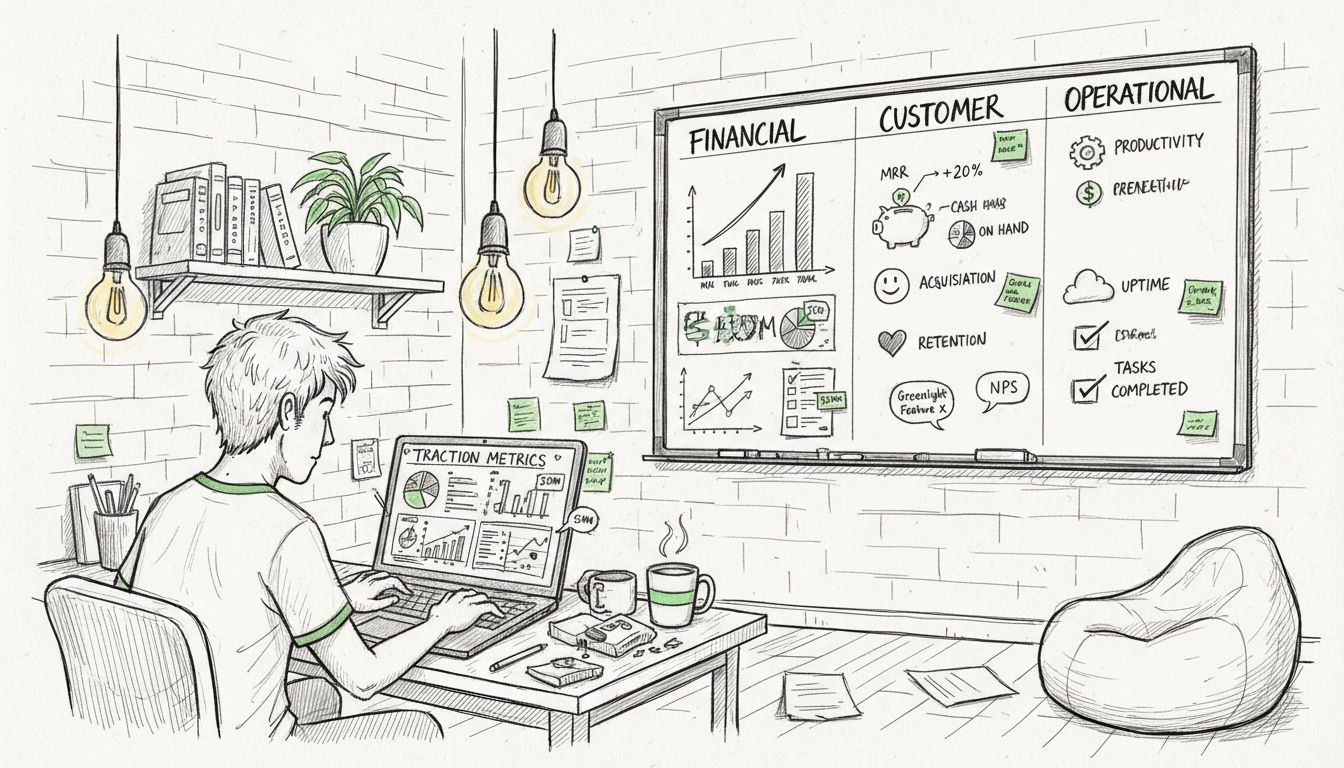
Startup founders navigate a complex landscape, and traction metrics are their compass. According to entrepreneurship.zhaw.ch, traction metrics are quantifiable indicators used to measure the success of an innovative product or service, tracking critical dimensions like customer acquisition, retention, and revenue growth.
In the startup ecosystem, traction isn’t just a buzzword - it’s your proof of concept. Appmaster.io defines traction as the measurable progress a startup makes towards establishing a sustainable market presence and achieving core business objectives. Think of traction metrics like vital signs for your business: they tell you if your startup is healthy, growing, or potentially flatlined.
Key traction metrics typically include:
- Customer Acquisition Cost (CAC): How much you spend to gain each new customer
- Monthly Active Users (MAU): Number of users engaging with your product monthly
- Conversion Rates: Percentage of potential customers who take desired actions
- Churn Rate: Percentage of customers who stop using your product
- Revenue Growth Rate: How quickly your startup is generating increasing income
Understanding these metrics isn’t just number crunching - it’s storytelling. Each metric reveals a chapter in your startup’s journey, helping you make data driven decisions.
 Want a deeper dive into tracking your startup’s progress? Check out our guide on understanding growth metrics for startups, which provides comprehensive insights into transforming raw data into actionable business intelligence.
Essential Types of Traction Metrics
In the high-stakes world of startups, understanding traction metrics isn’t just beneficial - it’s survival. Mariluukkainen.com highlights critical examples of traction metrics that help founders identify areas requiring improvement or strategic investment, including revenue growth, customer acquisition, and market penetration.
According to GoingVC, startups must focus on key traction metrics that provide deep insights into financial health and operational efficiency. These metrics go beyond simple numbers - they tell the story of your startup’s potential and sustainability.
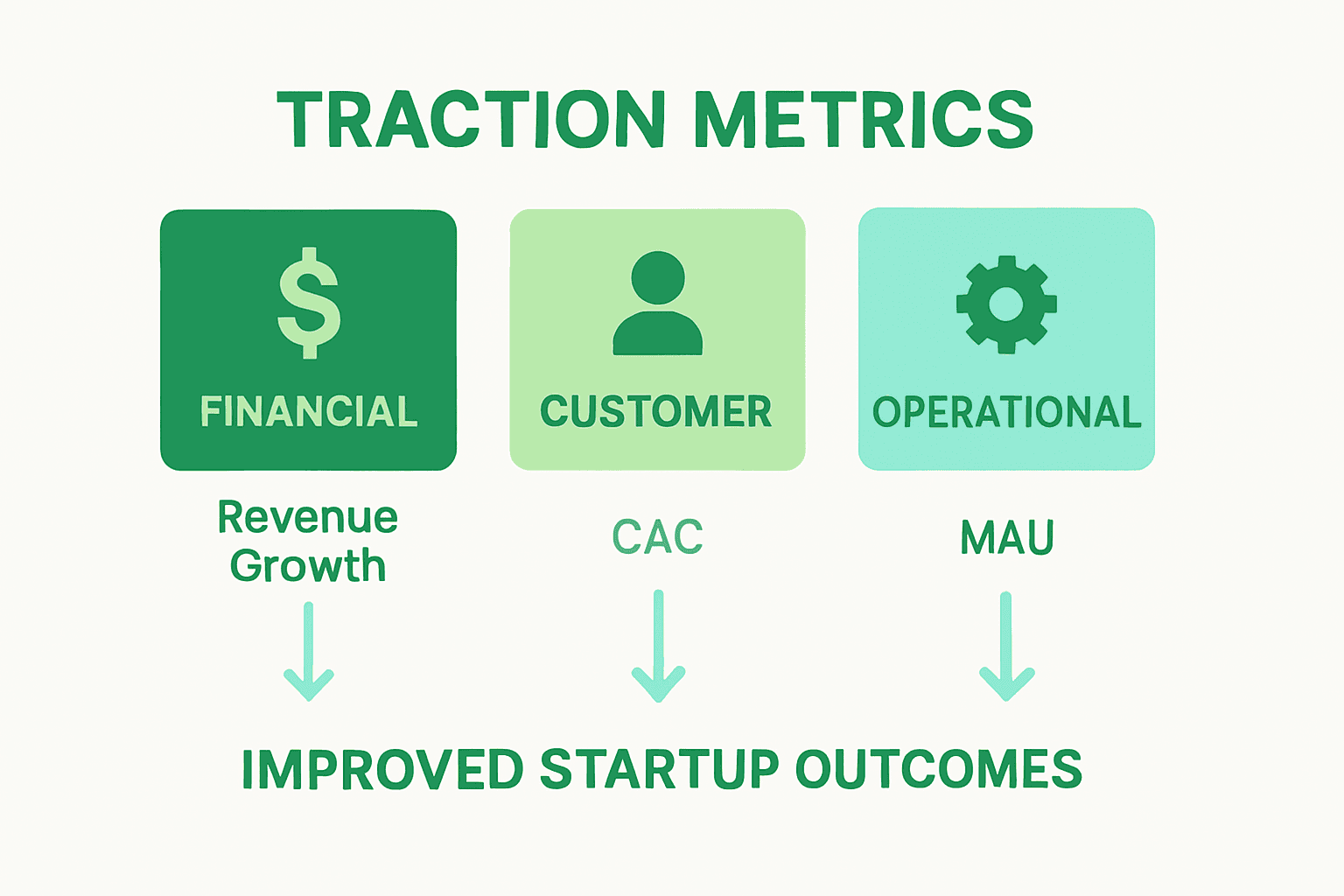
Let’s break down the essential types of traction metrics into three fundamental categories:
Financial Traction Metrics
- Revenue Growth: Total income generated and its rate of increase
- Burn Rate: How quickly your startup is spending capital
- Gross Margin: Percentage of revenue retained after direct costs
Customer Traction Metrics
- Customer Acquisition Cost (CAC): Investment required to gain each new customer
- Customer Lifetime Value (CLV): Total revenue expected from a customer relationship
- Churn Rate: Percentage of customers stopping product usage
Operational Traction Metrics
- Monthly Active Users (MAU): User engagement measurement
- Conversion Rates: Percentage of potential customers taking desired actions
- Product Engagement Score: Depth of user interaction with your product
Want a comprehensive understanding of how these metrics can transform your startup strategy? Dive deeper with our guide on what is business traction, which provides nuanced insights into leveraging these critical indicators for sustainable growth.
How to Measure Startup Traction Effectively
Measuring startup traction is like navigating a complex maze - you need the right map and compass. Pitchdrive emphasizes tracking key performance indicators such as daily active users (DAU) and monthly recurring revenue (MRR) to provide a comprehensive view of user engagement and revenue growth potential.
GoingVC suggests a holistic approach to traction measurement, focusing on financial sustainability metrics that reveal your startup’s true health. This means looking beyond surface-level numbers and diving deep into indicators like burn rate and customer acquisition cost (CAC).
Here’s a strategic framework for measuring startup traction effectively:
Measurement Approach
- Establish Baseline Metrics
- Define clear, measurable goals
- Select relevant KPIs for your specific business model
- Create a consistent tracking system
- Regular Performance Assessment
- Conduct monthly performance reviews
- Compare current metrics against initial benchmarks
- Identify trends and potential areas of improvement
- Comprehensive Metric Analysis
- Evaluate financial health indicators
- Track user engagement and growth
- Analyze customer acquisition and retention rates
Key Measurement Techniques
- Quantitative Analysis: Use hard numbers and statistical data
- Comparative Benchmarking: Compare performance against industry standards
- Predictive Modeling: Use current metrics to forecast future performance
Want to streamline your goal tracking and measurement process? Check out our business goal tracking guide, which offers practical strategies for transforming raw data into actionable business insights.
Tracking Traction Across Product Stages
Startup growth isn’t linear - it’s a dynamic journey with distinct product stages that demand unique traction tracking approaches. Each stage of your startup’s lifecycle requires a nuanced lens for measuring progress, from initial concept to market maturity.
The product lifecycle typically breaks down into four critical stages, each with its own traction measurement priorities:
Ideation Stage
- Validation Metrics
- Customer discovery interviews
- Problem-solution fit assessments
- Initial market interest indicators
Minimum Viable Product (MVP) Stage
- Early Adoption Metrics
- User acquisition rates
- Engagement frequency
- Feature usage patterns
- Feedback volume and quality
Product-Market Fit Stage
- Growth Acceleration Metrics
- Conversion rates
- Customer acquisition cost
- Retention percentages
- Organic user growth
Scale Stage
- Sustainable Growth Metrics
- Monthly recurring revenue
- Customer lifetime value
- Expansion revenue
- Market share progression
To navigate these complex transitions effectively, founders must remain adaptable and continuously refine their measurement approach. Want a comprehensive framework for understanding startup methodology? Explore our guide on lean startup methodology, which provides deeper insights into strategic product development.
Critical Pitfalls and Common Misconceptions
Navigating the startup landscape is treacherous, and traction measurement is fraught with potential missteps. Viktori.co warns that many founders fall into the trap of relying on vanity metrics - impressive-looking numbers that lack meaningful context and can seriously mislead stakeholders about genuine progress.
GoingVC highlights a critical misconception that can torpedo startup success: the dangerous obsession with rapid growth without considering sustainable practices. This shortsighted approach often leads founders down a path of spectacular burnout rather than steady, meaningful expansion.
Top Traction Tracking Misconceptions
-
Vanity Metric Trap
- Prioritizing flashy numbers over meaningful insights
- Counting social media followers instead of engaged users
- Celebrating page views without tracking actual conversions
-
Growth Speed Fallacy
- Believing faster growth always equals better performance
- Ignoring long-term sustainability for short-term gains
- Scaling prematurely before establishing solid product-market fit
Red Flags to Watch
- Metrics without context
- Inconsistent tracking methods
- Focusing on single dimension of performance
- Neglecting customer retention
- Overlooking qualitative feedback
Strategic Approach
- Holistic Measurement
- Balance quantitative and qualitative metrics
- Create a comprehensive tracking system
- Regularly reassess and recalibrate measurement strategies
Want to bootstrap your startup with smarter strategies? Check out our bootstrapping strategies guide, which provides practical insights for sustainable startup growth.
Unlock Real Startup Growth with Precise Traction Insights
If measuring traction feels overwhelming or if you worry about falling into the vanity metric trap detailed in the article, you are not alone. Many founders struggle to track meaningful indicators like customer acquisition cost, churn rate, and revenue growth without losing sight of sustainable progress. The emotional toll of uncertainty and pressure to show rapid growth can stall your startup’s true potential.
That’s where siift.ai steps in. Our Intelligent Business Canvas guides you methodically through ideation to market fit with personalized feedback and prioritized actions tailored to your unique challenges. By focusing on the essential traction metrics and avoiding common pitfalls, you gain clarity and confidence to de-risk your founder’s journey. Ready to master traction measurement and accelerate your startup’s path to success Explore our guide on understanding growth metrics for startups or start transforming your ideas into viable business models today with the siift.ai Intelligent Business Canvas platform.
Frequently Asked Questions
What are traction metrics in startups?
Traction metrics are quantifiable indicators that measure the success and growth of a startup, focusing on areas such as customer acquisition, retention, and revenue generation.
How can I effectively measure traction for my startup?
Effectively measuring traction involves establishing baseline metrics, conducting regular performance assessments, and utilizing comprehensive metric analysis, including financial, customer, and operational indicators.
What are some common pitfalls in tracking traction metrics?
Common pitfalls include relying on vanity metrics that lack context, prioritizing rapid growth over sustainable practices, and neglecting customer retention and qualitative feedback.
How do traction metrics vary across different product stages?
Traction metrics vary by product stage: during the ideation stage, focus on validation metrics; in MVP, look at early adoption metrics; with product-market fit, analyze growth acceleration metrics; and in the scale stage, emphasize sustainable growth metrics.
Recommended
- blog | siift | What Is Business Traction? Essential Guide for New Founders 2025
- blog | siift | Understanding Growth Metrics for Startups Explained
- blog | siift | Business Goal Tracking Made Simple: Step-by-Step Guide
- blog | siift | Top Growth Strategies for Startups in 2025: Practical Steps for Beginners
- Performance Marketing Process for Maximizing ROI Results - Click Thrive Marketing
- The Best Way To Create An Effective Crowdfunding Video For Your Startup - Kicker Video