

A business traction model shows how a startup proves customer demand, measures growth, and demonstrates that its product is gaining real market acceptance. Starting a business sounds thrilling, with big dreams and bold promises filling the air. Yet while excitement runs high, here is the gut check. Nearly 50 percent of startups never make it past their fifth year. That might seem like a harsh reality, but many new founders overlook one lifeline that can guide them away from failure. Understanding business traction and learning how to measure it can help founders make smarter decisions and improve their chances of success.
Table of Contents
Quick Summary
Takeaway | Explanation |
Understand Business Traction | Business traction indicates real market demand and growth potential for startups. |
Focus on Key Metrics | Identify and track KPIs that genuinely reflect your business’s performance. |
Engage Early Customers | Build relationships with initial users to demonstrate traction and gather feedback. |
Develop an MVP | Create a minimum viable product to validate your business concept quickly and efficiently. |
Embrace Continuous Improvement | Use data and customer insights to adapt and refine your business strategy constantly. |
Understanding Business Traction Basics
Business traction represents the measurable progress and momentum a startup gains in proving its market viability and potential for growth. For new founders, understanding this critical concept can mean the difference between survival and failure in the competitive entrepreneurial landscape.
What Exactly Is Business Traction?
At its core, business traction is about demonstrating real-world validation that your business model works. According to Forbes, traction goes beyond mere interest or potential customers it represents concrete evidence that people are willing to pay for your product or service. This could manifest through various metrics such as user acquisition, revenue generation, strategic partnerships, or consistent customer engagement.
Startups typically measure traction through key performance indicators (KPIs) that reflect genuine market acceptance. These might include monthly recurring revenue, customer retention rates, user growth percentages, or the number of successful sales conversations. Harvard Business Review emphasizes that the specific metrics matter less than their consistent upward trajectory.
Why Traction Matters for New Founders
Traction serves as a critical signal to potential investors, partners, and stakeholders that your business concept has real-world potential. It transforms your startup from a theoretical idea into a tangible enterprise with demonstrable market interest. Investors rarely invest in pure potential they want to see proof of concept and market validation.
For founders, tracking traction provides more than external credibility. It offers invaluable insights into your business model’s effectiveness. Each metric acts like a diagnostic tool revealing what strategies work, where improvements are needed, and how close you are to achieving sustainable growth. Our guide on business opportunity analysis can help you understand how to systematically evaluate and improve your startup’s momentum.
Successful traction isn’t about overnight success but consistent, strategic progress. New founders should focus on building meaningful connections with their target market, continuously refining their value proposition, and staying adaptable. Remember that traction is a journey of incremental improvements, not a destination to be reached overnight.
While the path might seem challenging, understanding and actively pursuing business traction transforms your entrepreneurial dream from a hopeful concept into a viable, growing reality. The key is patience, persistent measurement, and a willingness to pivot based on real-world feedback.
Why Business Traction Matters for New Entrepreneurs
Business traction isn’t just a buzzword it’s the lifeblood of entrepreneurial success. For new entrepreneurs, understanding why traction matters can transform their startup journey from a risky venture to a strategic pathway toward sustainable growth.
The Survival Imperative
Startups face brutal odds of survival. According to the US Small Business Administration, approximately 20% of new businesses fail within their first year, and nearly 50% do not survive past the five-year mark. Traction becomes the critical differentiator between those who merely dream and those who actually build successful enterprises.
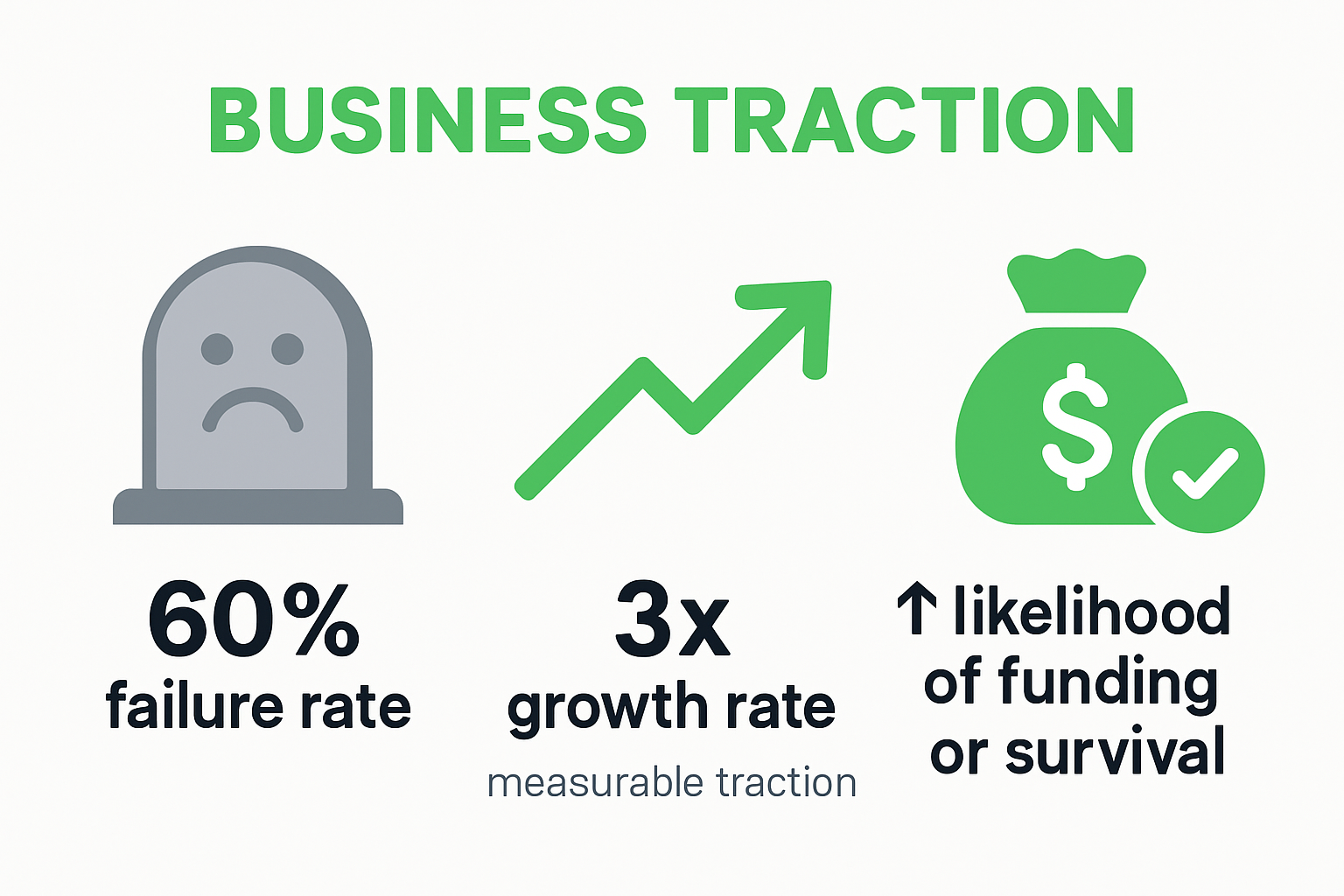
Traction provides entrepreneurs with more than just external validation. It serves as an early warning system and strategic compass. By consistently measuring key performance indicators, founders can quickly identify what’s working, what needs adjustment, and where potential growth opportunities exist. Research from MIT Sloan reveals that companies with strong early traction are 3.5 times more likely to secure long-term funding and achieve sustainable growth.
Here is a table summarizing the key statistics and research findings about startup survival odds and the impact of early traction.
Statistic | Source | Key Insight |
20% of new businesses fail within their first year | US SBA | High early-stage risk; traction is crucial for survival |
Nearly 50% don’t survive past five years | US SBA | Demonstrates need for sustained traction |
3.5x more likely to secure funding with early traction | MIT Sloan | Early traction significantly boosts chances for long-term growth |
Attracting Crucial Resources
Investors, partners, and potential team members are not gambling on your vision they’re assessing your probability of success. Traction speaks a universal language of credibility. When you can demonstrate real user engagement, revenue growth, or market penetration, you transform your startup from a theoretical concept into a tangible business opportunity.
Furthermore, traction helps entrepreneurs make data-driven decisions. Instead of relying on gut feelings or assumptions, founders can use concrete metrics to guide strategy. Our comprehensive guide on business risks highlights how understanding and mitigating risks through strategic traction measurement can significantly improve startup survival rates.
Building Sustainable Momentum
Successful entrepreneurs understand that traction is not a destination but a continuous journey of learning and adaptation. Each metric tracked provides insights into customer behavior, market dynamics, and potential pivots. By maintaining a disciplined approach to measuring progress, founders can create a feedback loop that continuously refines their business model.
It’s crucial to recognize that traction looks different for every business. A software startup might measure user acquisition and retention, while a physical product company might focus on sales volume and distribution channels. The key is selecting meaningful metrics that genuinely reflect your business’s unique value proposition and growth potential.
Navigating the entrepreneurial landscape requires more than passion it demands strategic measurement and continuous improvement. Traction serves as your roadmap, helping you transform innovative ideas into successful, sustainable businesses. By embracing a data-driven approach and remaining adaptable, new entrepreneurs can significantly enhance their chances of long-term success.
How to Measure and Show Real Traction
Measuring and demonstrating business traction requires a strategic approach that goes beyond surface-level metrics. New entrepreneurs must develop a nuanced understanding of how to effectively track and communicate their startup’s progress.
Identifying the Right Traction Metrics
According to Y Combinator, not all metrics are created equal. Founders must focus on metrics that directly reflect their business model and growth potential. For tech startups, this might include user acquisition rate, monthly active users, or customer retention percentages. Service-based businesses might prioritize client conversion rates, repeat business percentages, or average contract value.
Founders often use startup analytics tools, CRM platforms, and AI-powered business planning software to track traction metrics more effectively. The right tools can simplify performance monitoring, customer feedback analysis, and growth measurement, helping founders make faster and more informed decisions.
Key performance indicators (KPIs) should be:
Specific: Clearly defined and measurable
Relevant: Directly tied to your business model
Actionable: Providing insights that can drive strategic decisions
Harvard Business Review emphasizes the importance of selecting metrics that tell a compelling story about your business’s potential. This means going beyond vanity metrics that look impressive on the surface but don’t indicate genuine growth.
The following table provides examples of traction metrics for different business types, as discussed in the section above.
Business Type | Example Metrics | Purpose/Description |
Tech Startup | User acquisition rate, Monthly active users | Measure engagement, growth, and retention |
Service-Based Business | Client conversion rate, Repeat business % | Assess client acquisition and loyalty |
Product Startup | Sales volume, Distribution channel growth | Track market adoption and product reach |
Presenting Traction to Stakeholders
Effective traction presentation is an art form. Investors and potential partners want to see more than just numbers they want to understand the narrative behind those numbers. Create a clear, concise dashboard that demonstrates:
Consistent growth trajectories
Clear understanding of your market
Ability to acquire and retain customers
Potential for scalability
Our comprehensive guide on business opportunity analysis can help you develop a more robust approach to showcasing your startup’s potential.
Continuous Improvement and Adaptation
Traction is not a static concept. Successful entrepreneurs treat their metrics as a living, breathing system of insights. This means regularly reviewing your performance, identifying areas for improvement, and being willing to pivot when necessary. The most successful startups view traction as a continuous learning process.
As startups grow, many founders turn to AI tools for founders to identify trends, organize business insights, and support strategic decision-making. Using technology to monitor traction can reduce guesswork and make it easier to focus on activities that drive sustainable growth.
Implement a quarterly review process where you:
Analyze your current metrics
Compare performance against initial projections
Identify potential areas of improvement
Develop actionable strategies for growth
Remember that traction is about momentum, not perfection. It’s normal for early-stage startups to have ups and downs. What matters most is your ability to learn, adapt, and show consistent progress toward your business goals.
Ultimately, measuring and showing real traction is about telling a compelling story of potential. It’s about demonstrating to yourself, your team, investors, and potential customers that your business is not just an idea, but a viable and growing enterprise with real-world potential.
Simple Steps to Build Business Traction Early
Building business traction early requires a strategic and intentional approach. New entrepreneurs must be proactive, focused, and willing to experiment to gain meaningful momentum in their startup journey.
Develop a Minimum Viable Product (MVP)
According to TechCrunch, creating a minimum viable product is the fastest route to understanding market demand. An MVP allows entrepreneurs to test core assumptions with minimal resource investment. This approach enables rapid feedback collection and iterative improvement.
Successful MVP development involves:
Identifying core user problems
Creating a simple solution
Gathering immediate user feedback
Harvard Business Review emphasizes that the most effective MVPs solve a specific problem concisely. They are not about perfection but about proving fundamental market viability.
Build and Engage Your Initial Customer Base
Customer acquisition becomes critical in demonstrating early traction. Focus on targeted marketing strategies that reach your ideal customer profile. Leverage low-cost channels like social media, content marketing and SEO, and community engagement to build initial interest. For solo entrepreneurs, building traction often requires balancing customer acquisition, product development, and daily operations simultaneously. Understanding the challenges of the solo founder journey can help entrepreneurs prioritize the activities that generate the greatest impact. For startups, establishing organic visibility early creates compounding returns as your content continues attracting qualified leads months after publication.
Strategies for early customer engagement include:
Offering initial users special incentives
Creating referral programs
Providing exceptional customer support
Our guide on growth strategies can help you develop a more comprehensive approach to building your initial customer base.
Leverage Data and Continuous Improvement
Constant measurement and adaptation separate successful startups from those that stagnate. Track key performance indicators meticulously, but remain flexible in your approach. Use each data point as an opportunity to refine your product, marketing strategy, and overall business model.
Effective entrepreneurs understand that early traction is about learning and pivoting. Document every interaction, customer feedback, and performance metric. Look for patterns that indicate potential growth opportunities or necessary modifications to your initial concept.
The following table summarizes the steps for building early traction, based on strategies described above.
Step | Key Action | Purpose/Goal |
Develop MVP | Build minimum viable product | Validate concept and gather rapid feedback |
Engage Initial Customers | Incentives, referrals, early support | Demonstrate traction and collect insights |
Leverage Data & Continuous Improvement | Track, analyze, adapt strategies | Optimize business model for sustainable growth |
Remember that building traction is not a linear process. Some strategies will work brilliantly, while others might fail completely. The key is maintaining a learning mindset, staying resilient, and continuously adapting your approach based on real-world feedback.
Building Digital Traction Through Organic Visibility
Many successful startups build early traction through strategic organic marketing. By optimizing for search engines and AI platforms, founders can attract qualified prospects actively searching for solutions. This approach provides measurable metrics (traffic, conversions, engagement) that demonstrate real market demand to investors.
For startups ready to leverage AI-powered search optimization, specialized agencies can help accelerate visibility while you focus on product development.

Building early business traction requires patience, strategic thinking, and a willingness to experiment. By focusing on creating value, engaging with your target market, and remaining adaptable, you increase your startup’s chances of transforming from a promising idea into a sustainable business.
Frequently Asked Questions
What is business traction?
Business traction refers to the measurable progress and momentum a startup gains in proving its market viability and potential for growth, often demonstrated through key performance indicators (KPIs) like user acquisition, revenue generation, and customer engagement.
Why is traction important for new founders?
Traction is crucial for new founders as it provides evidence of market validation, enhances credibility with investors and stakeholders, and offers insights into the effectiveness of the business model. It can significantly impact a startup’s chances of survival and growth.
How can startups measure traction effectively?
Startups can measure traction by focusing on specific, relevant key performance indicators (KPIs) such as monthly recurring revenue, customer retention rates, and user growth percentages. It’s important to select metrics that reflect the business model and growth potential.
What are some steps to build business traction early?
To build business traction early, startups should develop a minimum viable product (MVP), engage their initial customer base through targeted marketing and incentives, and leverage data for continuous improvement. This approach helps validate the business concept and build momentum.
What tools can help founders track business traction?
Startup founders commonly use analytics platforms, CRM software, and AI-powered business planning tools to monitor customer growth, engagement, and business performance.
Transform Early Traction Into Real Startup Momentum
If you have read about the importance of measuring business traction and feel overwhelmed by choosing the right metrics or turning small wins into sustained growth, you are not alone. Many new founders struggle with this exact challenge. Questions like What does real market validation look like for my business and How can I turn feedback into a roadmap for progress often stop momentum in its tracks. The truth is, each startup journey is unique and finding clarity amid uncertainty is critical to survival and success.
This is where siift can give you a true advantage. Our platform acts as your founder’s compass, taking the confusion out of tracking and building traction. Get step-by-step personalized feedback and prioritized actions, using insights that cut through bias or guesswork. If you want to focus on the most meaningful traction metrics and learn how to adapt with each stage of real-world growth, start exploring actionable guidance on the siift platform. Do not let hesitation or uncertainty hold you back. Take the first step to secure your startup’s place in the market—visit https://app.siift.ai/ and begin charting your path to real traction today.
Recommended
blog | siift | Business Plan Essentials 2025: A Beginner’s Guide for New Founders
blog | siift | Top Reasons Businesses Fail in 2025: A Guide for New Founders
blog | siift | Business Opportunity Analysis for First-Time Founders 2025
blog | siift | Business Resilience Strategies for Beginners 2025 Guide
[ Digital Marketing for Startups: 2025 Guide for US Business Owners](https://peakdigital.pro/2025/07/12/digital-marketing-for-startups-2025-guide-us-colorado365aa210)