
Launching a side project can feel like stepping into unknown territory, especially when the excitement of your tech idea meets uncertainty about building real business traction. Success hinges on connecting with the right market and crafting a message that actually resonates, yet knowing where to start often feels overwhelming. This guide offers actionable steps for defining your audience, building a value proposition, and setting up a clear path from idea to measurable growth, tailored for tech-driven innovators across North America.
Table of Contents
- Step 1: Define Your Audience And Value Proposition
- Step 2: Validate Your Solution With Real Users
- Step 3: Launch Your MVP And Gather Feedback
- Step 4: Optimize Your Messaging And Channels
- Step 5: Track Traction Metrics And Adjust Strategy
Quick Summary
| Key Point | Explanation |
|---|---|
| 1. Define Your Audience Clearly | Create detailed customer personas including motivations and challenges to accurately identify your target audience. |
| 2. Validate Your Solution with Users | Develop a minimum viable product (MVP) and gather user feedback to refine your offering and reduce risk. |
| 3. Optimize Your Messaging Strategy | Craft clear messaging that communicates your value proposition effectively across various channels. |
| 4. Track Key Metrics Regularly | Monitor traction metrics to make data-driven decisions that support your startup’s growth and success. |
Step 1: Define your audience and value proposition
Defining your startup’s target audience and value proposition is the strategic foundation that transforms an idea into a potential business. This crucial step helps you understand who will actually want your product and why they should choose you over competitors.
To nail down your audience, start by creating detailed customer personas that go beyond basic demographics. Consider psychographics like motivations, challenges, and aspirations. Ask yourself: Who experiences the problem my product solves? What specific market segment would benefit most?
Developing a powerful value proposition requires deep understanding of your audience’s needs. Break this down into clear, actionable steps:
- Identify the core problem your product solves
- Understand how your solution is unique
- Articulate the specific benefits customers will experience
- Translate these insights into a concise statement
Your value proposition should clearly communicate what makes your offering different. It’s not just about features - it’s about the transformative impact you deliver. A strong value proposition summarizes why customers should choose your startup over alternatives.
Your value proposition is your startup’s promise to potential customers - make it compelling and crystal clear.
Next, you’ll validate these assumptions through targeted customer research and feedback. This initial definition provides a strategic roadmap for your startup’s positioning and marketing efforts.
Pro tip: Create a one-page document that distills your audience persona and value proposition to keep your team aligned and focused.
Step 2: Validate your solution with real users
Validating your startup solution with real users is the critical bridge between having a great idea and creating a product people actually want. This step helps you gather authentic feedback, uncover hidden insights, and dramatically reduce the risk of building something no one needs.

To effectively validate product features, start by developing a minimal prototype or minimum viable product (MVP). This doesn’t mean creating a fully polished solution, but rather a basic version that allows potential users to interact with your core concept. Your goal is to test core assumptions and gather meaningful user insights without extensive investment.
Use multiple validation strategies to get comprehensive feedback:
- Conduct structured user interviews
- Create quick landing page surveys
- Build low-fidelity product prototypes
- Leverage online user testing platforms
- Invite potential customers for direct product demos
Remember that validation is an iterative process. User feedback is your most valuable asset, so approach each interaction with genuine curiosity. Pay attention not just to what users say, but how they say it and what they don’t express directly.
User validation transforms assumptions into actionable insights that can make or break your startup’s success.
As you gather feedback, look for consistent patterns and themes. These recurring insights will help you refine your solution and prioritize development efforts. The most successful startups are those that listen carefully and adapt quickly.
Pro tip: Record and transcribe user interviews to capture nuanced feedback you might miss during live conversations.
Here is a summary of effective user validation approaches and their unique advantages:
| Validation Method | Key Benefit | Best Used For |
|---|---|---|
| User Interviews | In-depth qualitative insights | Understanding user motivations |
| Landing Page Surveys | Quick quantitative feedback | Testing concept interest rapidly |
| In-App Feedback | Real-time reactions | Gathering usability improvement data |
| Product Demos | Observe user behaviors | Detecting pain points and confusion |
Step 3: Launch your MVP and gather feedback
Launching your minimum viable product (MVP) marks the critical transition from theoretical concept to real-world validation. This step transforms your startup vision from abstract potential into a tangible solution that actual users can experience and evaluate.
To build an effective MVP, focus on creating a stripped-down version of your core product that solves the primary user problem. Your MVP should be lean, functional, and designed to elicit meaningful feedback from early adopters.
Key strategies for successful MVP launch include:
- Select the most critical features that demonstrate your core value
- Design a clean, intuitive user interface
- Create clear onboarding instructions
- Set up multiple feedback collection channels
- Establish metrics for measuring user engagement
User feedback channels are your lifeline during this phase. Implement multiple touchpoints to capture comprehensive insights:
- Direct user interviews
- Online survey forms
- In-app feedback mechanisms
- Social media engagement
- Customer support interactions
Your MVP is not the final product - it’s a strategic learning tool to validate your startup’s core hypothesis.
Remember that successful MVPs are about quality of insights, not complexity of features. Each piece of user feedback is a potential pivot point that could dramatically improve your product’s market fit.
Pro tip: Create a structured feedback template in advance to ensure you capture consistent, actionable insights from every user interaction.
Step 4: Optimize your messaging and channels
Optimizing your startup’s messaging and communication channels is the strategic art of transforming complex ideas into compelling narratives that resonate with your target audience. This step bridges the gap between your innovative solution and potential users’ understanding and engagement.
Developing key communication strategies requires a nuanced approach that combines clarity, authenticity, and strategic targeting. Your messaging must articulate three core communication elements: what you do, why you matter, and how you’re uniquely different from existing solutions.
Effective messaging optimization involves multiple strategic components:
- Craft a clear, concise value proposition
- Identify your ideal customer’s language and pain points
- Develop consistent messaging across all platforms
- Tailor communication for different audience segments
- Test and refine messaging based on audience response
Communication channel selection is equally critical. Different platforms serve different purposes and audience segments:
- Professional networks like LinkedIn for B2B communication
- Twitter for rapid, trend-driven engagement
- Instagram for visual storytelling
- YouTube for in-depth explanatory content
- Niche forums specific to your industry
Your messaging is your startup’s first impression - make it count, make it memorable.
Constantly monitor and adapt your communication strategy. What works today might become less effective tomorrow, so remain flexible and data-driven in your approach.
Pro tip: Create a messaging matrix that maps your core value proposition across different channels, ensuring consistency while adapting to each platform’s unique communication style.
Step 5: Track traction metrics and adjust strategy
Tracking traction metrics transforms your startup’s growth from guesswork to a data-driven science. This critical step helps you understand exactly how your business is performing and where strategic adjustments can unlock exponential potential.
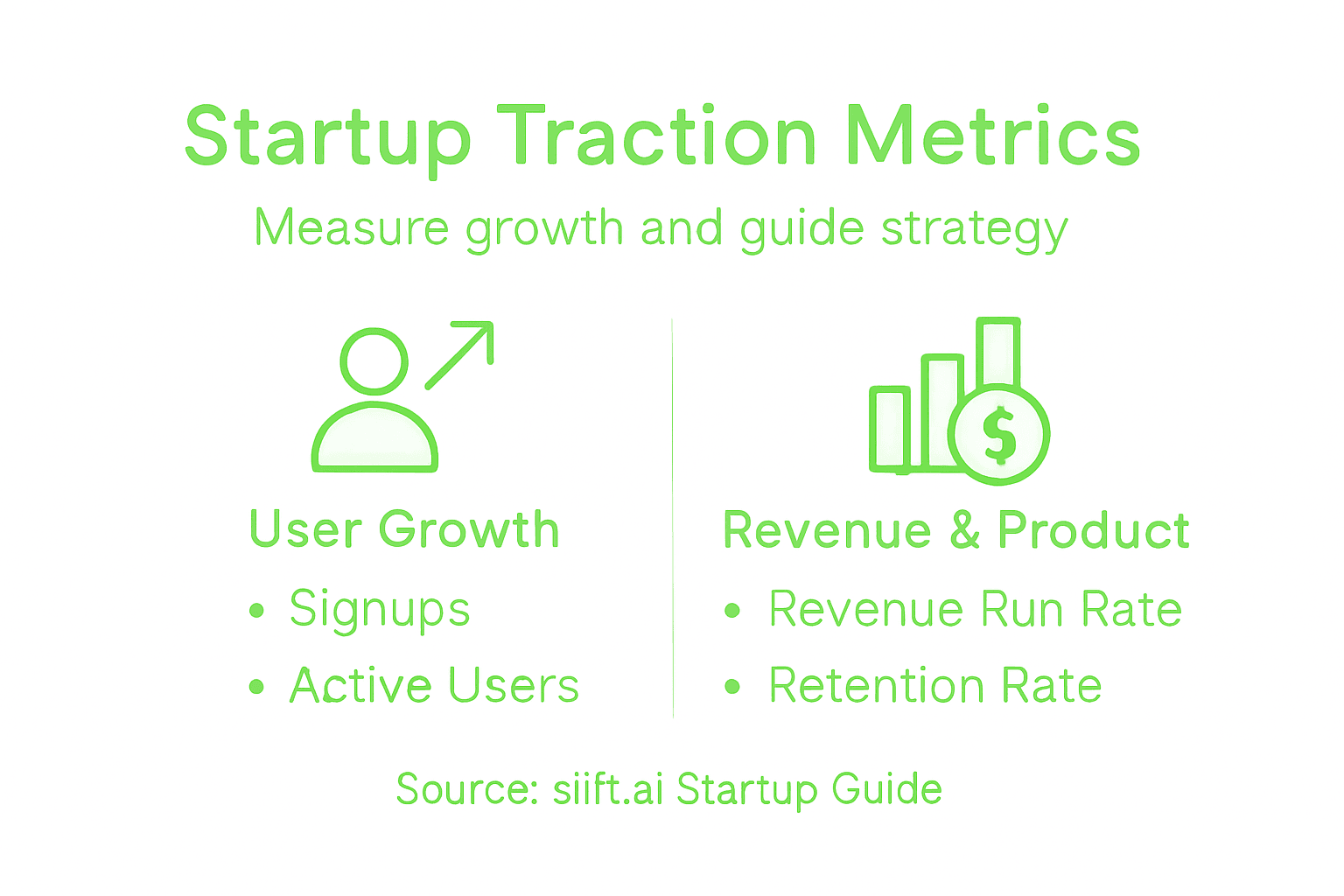
Evaluating professional development metrics requires a systematic approach that goes beyond surface-level numbers. Your key performance indicators (KPIs) should provide actionable insights into your startup’s momentum and market resonance.
Essential traction metrics to monitor include:
- Customer acquisition cost (CAC)
- Lifetime customer value (LTV)
- Monthly recurring revenue (MRR)
- Customer retention rates
- Conversion rates across marketing channels
Strategic metric tracking involves more than just collecting data:
- Set clear, measurable goals
- Establish baseline performance benchmarks
- Implement robust tracking systems
- Review metrics consistently
- Create actionable adjustment plans
Metrics are the compass that guides your startup from uncertainty to strategic growth.
Remember that metrics are tools for learning, not just measurement. Each data point tells a story about your business’s health and potential trajectory. The most successful startups view metrics as a dynamic feedback loop for continuous improvement.
Pro tip: Use a dashboard that visualizes your key metrics, making it easy to spot trends and quickly communicate performance to stakeholders.
Below is a comparison of major traction metrics, what they measure, and why they matter to startups:
| Metric | Measures | Strategic Importance |
|---|---|---|
| Customer Acquisition Cost (CAC) | Cost to gain a customer | Optimize marketing spend |
| Lifetime Value (LTV) | Expected revenue per customer | Identify long-term profitability |
| Monthly Recurring Revenue (MRR) | Predictable monthly revenue | Assess sustainable growth |
| Customer Retention Rate | Customer loyalty over time | Indicates product satisfaction |
| Conversion Rate | Leads turning into customers | Reveals marketing channel efficacy |
Accelerate Your Startup Traction with Intelligent Guidance
Struggling to define your audience or validate your solution effectively Can the complexity of tracking traction metrics and optimizing your messaging feel overwhelming Siift.ai understands these critical challenges founders face when moving from idea to product-market fit. This article highlights the importance of clear value propositions, real user validation, and strategic measurement — all essential steps that can make or break your startup’s success.
With siift.ai’s Intelligent Business Canvas, you gain a modern founder’s insights platform that guides you step-by-step through ideation, validation, and go-to-market strategies. Benefit from personalized feedback that uncovers blind spots and prioritized actions designed to de-risk your journey. Whether you need help refining your value proposition or tracking key performance indicators, this AI-powered tool is built to accelerate your path to product-market fit.
Ready to turn your startup vision into a thriving business Explore how siift.ai can empower your Founder’s Journey today. Visit the Landing Page and start transforming feedback into meaningful traction that propels your growth now.
Frequently Asked Questions
How do I define my target audience as a startup founder?
To define your target audience, create detailed customer personas that consider motivations, challenges, and aspirations. Start by identifying who experiences the problem your product solves and which market segment would benefit most.
What steps should I take to develop a compelling value proposition?
Develop a value proposition by identifying the core problem your product solves, understanding how your solution is unique, and articulating the specific benefits for customers. Write a clear statement summarizing what makes your offering different and why customers should choose you.
How can I validate my startup’s solution with real users?
To validate your solution, develop a minimal prototype or minimum viable product (MVP) and gather feedback through structured user interviews, landing page surveys, and usability testing. Aim to refine your product by observing user interactions and identifying pain points.
What are effective methods for launching my MVP?
Launch your MVP by focusing on the essential features that demonstrate your core value and setting up multiple feedback collection channels. Ensure that you create intuitive onboarding instructions and measure user engagement to gather actionable insights.
How do I track traction metrics for my startup?
Track traction metrics by establishing key performance indicators (KPIs) such as customer acquisition cost, lifetime customer value, and monthly recurring revenue. Set clear goals and establish robust tracking systems to review performance consistently and make data-driven adjustments.
What should I consider when optimizing my messaging for different channels?
When optimizing your messaging, ensure it clearly articulates what you do, why you matter, and how you are unique. Tailor your communication for various audience segments and test different messaging strategies based on audience response for ongoing refinement.
Recommended
- How to Get Startup Traction: Actionable Steps for Fast Growth | siift
- Accelerate Startup Traction: Actionable Steps for Professionals | siift
- blog | siift | What Is Business Traction? Essential Guide for New Founders 2025
- What Is Business Traction? Essential Guide for New Founders 2025 | siift
- Mailly: AI Cold Email Outreach Platform | B2B Deep Research