

TL;DR:
The Lean Canvas is a one-page, hypothesis-driven tool designed for startups to test critical assumptions quickly. It emphasizes problem validation, speed, and honest risk assessment, enabling faster market entry and better decision-making. Entrepreneurs should treat it as a living document, continuously updating it based on customer feedback and new evidence.
The Lean Canvas is defined as a one-page, hypothesis-driven business planning tool built specifically for startups to test critical assumptions before spending serious time or money. Created by Ash Maurya as a startup-focused adaptation of the Business Model Canvas, it replaces broad operational planning with nine focused blocks that force you to confront your riskiest unknowns first. The lean canvas framework is not a polished pitch deck or a five-year forecast. It is a reality check you run on your idea before the market runs one on you. Startups that use it reach market up to 40% faster by obsessing over problem validation before writing a single line of code.
What are the main lean canvas advantages for startups?
The biggest lean canvas advantages are speed, focus, and brutal honesty. Most founders waste months building products nobody asked for. The Lean Canvas stops that pattern cold by forcing you to write down your assumptions about customers, problems, and solutions in one sitting, then immediately ask which of those assumptions could kill the business.

The framework highlights four blocks that traditional business models ignore entirely: Problem, Solution, Key Metrics, and Unfair Advantage. Each one targets a specific failure mode. Problem keeps you customer-first. Solution prevents over-engineering. Key Metrics give you a scoreboard. Unfair Advantage asks the uncomfortable question: why can’t someone just copy this?
Here is what the benefits of lean canvas look like in practice:
Speed to insight. Validation milestones arrive within 30–60 days, not quarters. That compressed timeline saves cash and keeps momentum alive.
Radical honesty. The canvas exposes fundamental flaws early in customer segments or unit economics before you spend on development.
Iterative by design. Updating a Lean Canvas takes 30 minutes versus weeks revising a traditional business plan. That speed matters when the market surprises you.
Shared language. One page aligns co-founders, early hires, and investors faster than any deck.
Risk prioritization. The canvas pushes you to test your highest-risk assumptions first, not your most comfortable ones.
Pro Tip: Fill out your first canvas in under 20 minutes without editing. Speed forces honesty. You can refine later, but your gut answers in round one are often the most revealing.
The lean startup advantages here are not theoretical. Founders who adopt Lean Canvas report 3x higher customer validation rates compared to those who skip structured validation entirely. That gap compounds fast.
How does the Lean Canvas framework differ from traditional business models?
The Lean Canvas framework deliberately swaps out four blocks from the original Business Model Canvas. Gone are Key Partners, Key Activities, Key Resources, and Customer Relationships. In their place: Problem, Solution, Key Metrics, and Unfair Advantage. That swap is not cosmetic. It reflects a fundamentally different purpose.
Traditional business plans and the Business Model Canvas assume you already know your market. They are built for execution planning, not discovery. The Lean Canvas is built for uncertainty. It treats every box as a hypothesis to be tested, not a fact to be documented.
Element | Traditional business plan | Lean Canvas |
|---|---|---|
Primary purpose | Execution roadmap | Hypothesis testing |
Time to complete | Weeks to months | Under an hour |
Update frequency | Annually or rarely | Weekly or monthly |
Focus | Operations and financials | Problem and customer fit |
Risk handling | Assumed away | Surfaced and prioritized |
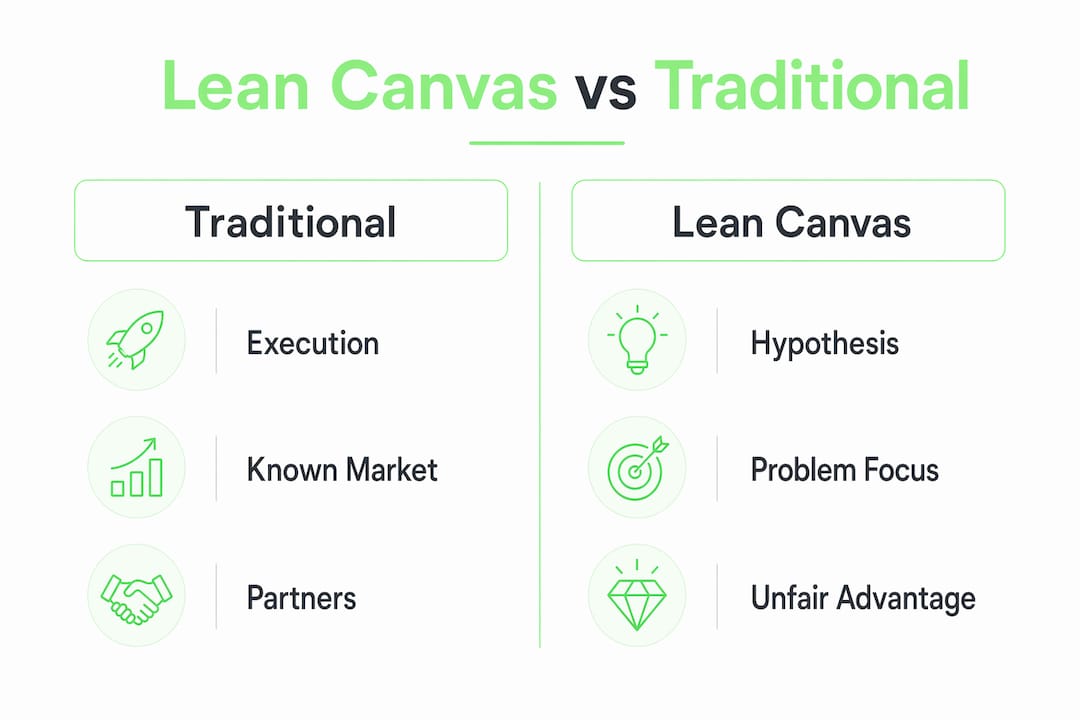
The “Unfair Advantage” block deserves special attention because most founders get it wrong. Real unfair advantages are hard to replicate, things like proprietary technology, exclusive data, or a network that took years to build. Writing “great team” or “passion” in that box is not an unfair advantage. It is wishful thinking. The canvas forces you to either find a real edge or admit you need to build one.
The advantages of the canvas model over static planning also show up in how it handles pivots. When new evidence arrives, you update one block, not an entire document. That agility is the point.
What practical steps should entrepreneurs follow when using Lean Canvas?
Using the Lean Canvas well is less about filling boxes and more about asking the right questions in the right order. Most founders instinctively start with the solution. The canvas insists you start with the customer and their problem. That sequence change alone prevents enormous waste.
Here is a practical sequence that works:
Define your customer segment first. Be specific. “Small business owners” is too broad. “Bootstrapped SaaS founders with fewer than five employees” is a testable segment.
List the top three problems that segment faces. Rank them by severity. The worst problem is your entry point.
Write your unique value proposition. One sentence. It should speak directly to the top problem, not describe your product’s features.
Sketch the minimum viable solution. Not the full product. The smallest thing that tests whether your solution actually solves the problem.
Define your key metrics. Pick one or two numbers that prove the problem is solved. Activation rate, retention, or revenue per user are common starting points.
Identify your channels. How does your customer segment actually find solutions today? That is where you need to show up.
Map your cost structure and revenue streams. Even rough numbers reveal whether the business model makes sense.
Revisit Unfair Advantage last. Be honest. If you cannot name one, that is your next strategic priority.
Pro Tip: Treat the canvas as a living document of assumptions, not a finished plan. Every customer conversation should trigger at least one update. If your canvas looks the same after ten interviews, you are not listening hard enough.
The Lean Canvas turns planning into validated learning cycles aligned with the build-measure-learn loop from Lean Startup methodology. That shift from “Can we build it?” to “Should we build it?” defines the product leadership mindset that separates founders who ship the right things from those who ship a lot of the wrong things.
Avoid the trap of over-perfecting the canvas before talking to customers. A canvas filled with untested assumptions is just creative fiction. Get it to “good enough,” then go validate.
How does Lean Canvas benefit founders in the 2026 AI-driven environment?
AI has changed the startup equation in ways that make the Lean Canvas more valuable, not less. The build phase is faster than ever. An MVP that once took six months now takes a weekend. That speed is exciting, but it also means the bottleneck has shifted entirely to validation and defensibility.
Here is what that means for lean canvas effectiveness in 2026:
AI compresses build-measure-learn cycles. Founders can run multiple experiments in parallel, making the canvas’s hypothesis-testing structure even more critical for staying organized.
Proprietary data is the new moat. AI-powered unfair advantages in 2026 include proprietary training data, fine-tuned models, and compound learning loops. The Unfair Advantage block on your canvas should reflect this reality.
AI lowers barriers to entry. That means more competition, faster. Your canvas needs to answer “why us?” with something more durable than “we got there first.”
Problem validation gets sharper. AI-driven data analysis lets founders validate customer problems with more precision before committing to a build direction.
Lean Canvas adapted for AI startups should treat the model’s training data strategy and feedback loops as core blocks, not afterthoughts.
The AI lean canvas advantages for solopreneurs are particularly striking. A single founder with the right AI tools and a sharp canvas can now move at the speed a small team once required. The canvas keeps that speed from becoming chaos.
Key Takeaways
The Lean Canvas is the most effective early-stage tool for founders because it forces problem-first thinking, surfaces hidden risks, and replaces static planning with testable hypotheses that update as real evidence arrives.
Point | Details |
|---|---|
Problem-first sequence | Always define the customer segment and their top problems before sketching any solution. |
Speed advantage | Validation milestones arrive within 30–60 days, far faster than traditional planning cycles. |
Iterative updates | Updating a canvas takes 30 minutes; treat it as a living document, not a finished plan. |
Unfair Advantage honesty | Real edges are hard to replicate; in 2026, proprietary AI data and models qualify. |
AI amplifies the framework | Faster build cycles make hypothesis testing more critical, not less, for staying focused. |
Why I think most founders misuse the Lean Canvas
Here is the uncomfortable truth I have seen play out repeatedly: founders treat the Lean Canvas as a one-time exercise. They fill it out, feel productive, and file it away. That is exactly backwards from how it works.
The canvas is not a deliverable. It is a diagnostic tool you run continuously. Every customer conversation, every failed experiment, every surprising metric should feed back into it. The founders who get the most out of it are the ones who can point to a canvas that looks completely different from their first draft. That evolution is the proof of learning.
The other mistake I see constantly is faking the Unfair Advantage block. Writing “first-mover advantage” or “experienced team” signals to any sharp investor that you have not done the hard thinking yet. Real unfair advantages are earned, often after you have already gained some traction. It is fine to leave that block honest and incomplete early on. Pretending otherwise just delays the real work.
What the canvas does brilliantly is force alignment. When a co-founder disagrees about the target customer or the core problem, the canvas makes that conflict visible on one page. That is not a flaw. That is the feature. Resolving those disagreements early, before you have spent six months building, is worth more than any planning document.
Mastering the Lean Canvas also signals something important to investors and collaborators: you think in hypotheses, not certainties. That mindset is the foundation of every great founder I have worked with.
— Samim
How Siift helps you put Lean Canvas into action
The Lean Canvas gives you the map. Siift gives you the engine to run it. Siift’s agentic AI platform guides founders step by step through ideation, validation, and go-to-market, translating your canvas hypotheses into real experiments with measurable outcomes. Instead of staring at a blank page or second-guessing your assumptions alone, you get a structured system that surfaces your riskiest bets and helps you test them fast. Siift is built for founders who want clarity and speed, not more busywork. If you are ready to validate before you build and reach product-market fit faster, Siift is where that work happens.
FAQ
What is the Lean Canvas used for?
The Lean Canvas is a one-page tool used by startups to map and test their riskiest business assumptions before committing to full product development. It replaces traditional business plans with nine hypothesis-driven blocks focused on problem, solution, and customer fit.
How long does it take to complete a Lean Canvas?
A first draft takes under an hour. Updating an existing canvas takes roughly 30 minutes, compared to weeks of revising a traditional business plan.
What makes the Lean Canvas different from the Business Model Canvas?
The Lean Canvas swaps four operational blocks for startup-critical ones: Problem, Solution, Key Metrics, and Unfair Advantage. This makes it better suited for early-stage discovery than execution planning.
What is an Unfair Advantage on a Lean Canvas?
An Unfair Advantage is something your business has that competitors cannot easily copy, such as proprietary technology, exclusive data, or a hard-built network. In 2026, fine-tuned AI models and proprietary training data qualify as strong examples.
How often should you update your Lean Canvas?
Update your canvas after every significant customer conversation or experiment. Founders who treat it as a living document of assumptions consistently outperform those who treat it as a one-time planning exercise.