
A Lean Canvas is a one-page model of a business’s key assumptions. It helps a team discuss customers, problems, an offer, delivery, and economics, but filling in the boxes does not establish demand or make the assumptions true. Its main limitation is the gap between a concise model and the external evidence needed to support an investment decision. Use it alongside customer research, appropriately designed tests, and a record of what changed.
Table of Contents
Key Takeaways
Point | Details |
|---|---|
Lean Canvas is a dynamic tool | It should be updated frequently, reflecting the evolving understanding of market and customer needs. |
Focus on nine essential components | Understanding and integrating these components is crucial for creating an effective business model. |
Awareness of limitations | Be cautious of oversimplification and assumption bias; complement the Lean Canvas with additional research methods. |
Explore AI-driven alternatives | Use AI assistance to organize supplied information, while checking sources, uncertainty, and any changes to saved records. |
Defining Lean Canvas and Common Misconceptions
The Lean Canvas is a revolutionary one-page business planning tool specifically designed for startups and entrepreneurs. Developed by Ash Maurya, this strategic framework transforms traditional business planning by focusing on speed, customer problems, and rapid validation.
Both a canvas and a longer business plan need revision when relevant evidence or circumstances change. The Lean Canvas uses a concise visual representation that captures key business model elements like customer segments, problems, solutions, unique value propositions, and potential risks. The methodology encourages entrepreneurs to test assumptions quickly and pivot when necessary.
However, many founders misunderstand the Lean Canvas as a static document. In reality, it’s a living strategy tool meant to be updated frequently as new insights emerge. Dynamic business mapping requires constant refinement, challenging the traditional notion of a fixed business plan. This approach allows startups to remain agile and responsive to market changes.
Pro tip: Review the relevant assumptions when new evidence arrives or a decision approaches. A scheduled review can help, but a monthly update is a working habit rather than a validation rule. Preserve the earlier version and the reason for a change.
Key Components and How It Works
The Lean Canvas is built around nine critical components that provide a comprehensive snapshot of a business model. Strategic planning requires understanding these interconnected elements that help entrepreneurs rapidly validate their startup concepts.
The nine key components of the Lean Canvas include:
Customer Segments: Identifying the specific target audience
Problem: Defining the core challenges your customers face
Solution: Outlining how your product or service addresses those problems
Unique Value Proposition: Articulating what makes your offering different
Channels: Determining how you will reach and engage customers
Revenue Streams: Mapping out potential income sources
Cost Structure: Analyzing the expenses required to operate
Key Metrics: Selecting critical indicators of business performance
Unfair Advantage: Highlighting your competitive edge
For the framework’s purpose and use, see Ash Maurya’s Lean Canvas guide.
The power of the Lean Canvas lies in its ability to condense complex business strategies into a single, actionable document. Unlike traditional business plans that can run dozens of pages, this one-page framework forces entrepreneurs to distill their ideas into the most essential elements. Each component is interconnected, requiring founders to think holistically about their business model and how different aspects influence each other.
Pro tip: Time-box the initial draft so it remains a starting model rather than a writing exercise. Choose the limit for the team and decision; label uncertain entries and select the riskiest assumption for a test.
Drawbacks: Why Lean Canvas Falls Short
The risks below arise when a team relies on a canvas alone. A concise model can leave uncertainty, evidence quality, operating detail, and dependencies outside the visible page. Use additional records and tests rather than treating a completed canvas as validation.
Risks of relying on a canvas alone include:
Oversimplification: Reducing complex business dynamics to a single page
Assumption Bias: Overreliance on unvalidated hypotheses
Limited validation: relying on filled-in boxes without external customer research or tests.
Missing planning detail: long-term commitments and operating dependencies need separate analysis.
Contextual Limitations: Insufficient consideration of broader market ecosystems
A one-page model leaves detailed execution planning outside the template. Keep separate records for delivery dependencies, operating costs, evidence quality, and responsibilities, and revisit the canvas when those records change an assumption.
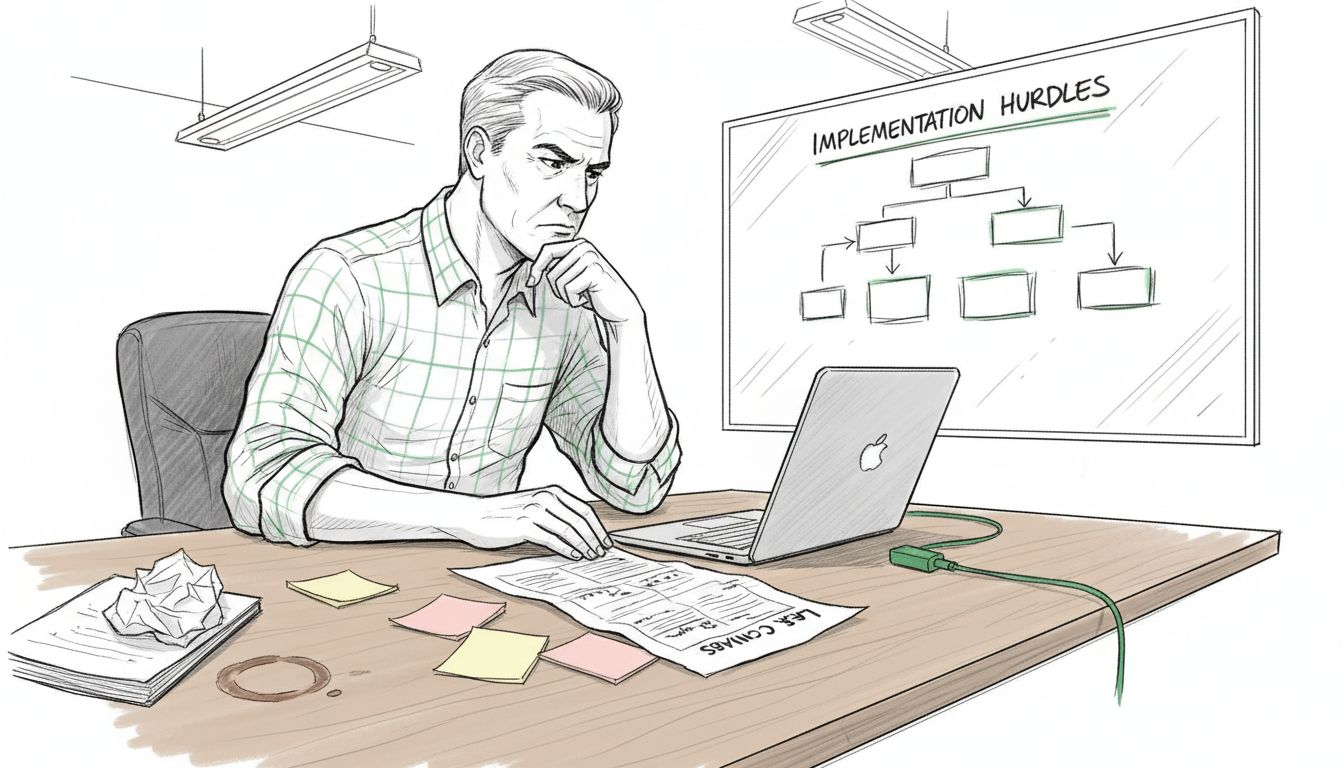
Pro tip: Complement your Lean Canvas with additional research methods, external market analysis, and periodic strategic reviews to overcome its inherent limitations.
Worked example: update the assumption, not just the wording
This is a hypothetical change log. The dates and observations illustrate a review process; they are not a reported Siift test or customer result.
Record | Earlier position | Evidence and revised decision |
|---|---|---|
Assumption recorded — October 1, 2026 | Small agency teams need faster report exports; build export automation first | Status: untested. The entry states a proposed cause, not an established customer problem |
Contradicting observation — October 8, 2026 | Export speed was assumed to be the main delay | In the illustrative workflow observations, the export finished, but review and approval delayed delivery. Preserve those source notes and investigate the approval step |
Canvas change — October 8, 2026 | Problem: slow exports. Solution: export automation | Reframe the candidate problem as unclear review ownership in the observed context; defer the automation build. Do not generalize this to every agency |
Next test — before a product commitment | The team has not yet established demand for a new approval tool | Observe another relevant workflow and test a simple review-owner checklist. Define eligible tasks, completion time, quality guardrails, and a decision rule before the test |
Keep the original assumption, evidence date and source, revised interpretation, affected canvas boxes, owner, and next decision together. A different explanation may still fit the observations. If an AI assistant drafts the revision, reopen the saved artifact and confirm it reflects the reviewed correction before relying on it.
Use the existing evidence worksheet for that record. For a framework choice, see Lean Canvas alternatives; this page focuses on what the canvas cannot establish.
Real-World Uses and Common Challenges
A canvas filled in for a familiar company can illustrate a business model. It is not evidence that the company used that canvas at the time, or that the framework caused its success. Treat the linked Lean Canvas examples as examples to inspect, and distinguish a retrospective reconstruction from an original company record.
Entrepreneurs frequently encounter several critical challenges when implementing the Lean Canvas:
Team Alignment: Ensuring consistent understanding across different team members
Continuous Updating: Maintaining canvas relevance through regular revisions
Market Complexity: Capturing nuanced operational realities within a simple framework
Validation Depth: Conducting rigorous customer interviews and research
Assumption Management: Preventing premature commitment to unverified hypotheses
Practical implementation challenges reveal that the Lean Canvas requires more than just filling out a template. Successful use demands disciplined learning processes, adaptive thinking, and a willingness to challenge initial assumptions. Founders must treat the canvas as a dynamic tool for exploration rather than a static document, continuously refining their understanding of customer needs and market dynamics.
Pro tip: Schedule monthly team reviews of your Lean Canvas, inviting external perspectives and challenging your existing assumptions to maintain strategic agility.
This summary highlights key obstacles startups face when using Lean Canvas:
Challenge Area | Common Issue | Impact on Startup |
|---|---|---|
Team Alignment | Varying understanding of canvas | Reduced strategic cohesion |
Market Complexity | Difficulty capturing nuances | Oversimplified decisions |
Validation Depth | Limited research methods | Risk of ignoring real needs |
Smarter AI-Driven Alternatives for Founders
G2’s emerging AI software directory can suggest products to investigate. A software listing does not establish automatic validation, real-time data, or predictive accuracy. Ask what information a tool actually receives, which claims can be traced to sources, and how a reviewer corrects and retains the analysis.
Evaluate AI-assisted modeling against concrete tasks rather than assuming every product has the same capabilities:
Pattern summaries: Can you trace a proposed theme to the supplied records and inspect counterexamples?
Hypothesis planning: Does the workflow distinguish a proposed test from an experiment that actually ran?
Forecasts: Are inputs, assumptions, uncertainty, and any relevant validation record visible? A generated forecast is not a customer result.
Data handling: Which sources are actually connected or supplied, when were they updated, and what permissions are required?
Review and saved records: Can the team inspect a correction, identify the responsible reviewer, and confirm the saved artifact contains the approved revision?
The linked overview of Advanced research platforms can suggest research tools to investigate, but it is not a benchmark of business-planning accuracy. Test a candidate tool on a real task with matched inputs and inspect its sources, omissions, errors, and correction behavior before deciding whether it improves your workflow.
Pro tip: Start with the smallest workflow that answers the question. Evaluate data access, source traceability, review effort, saved corrections, and cost before choosing integrations or an ongoing subscription.
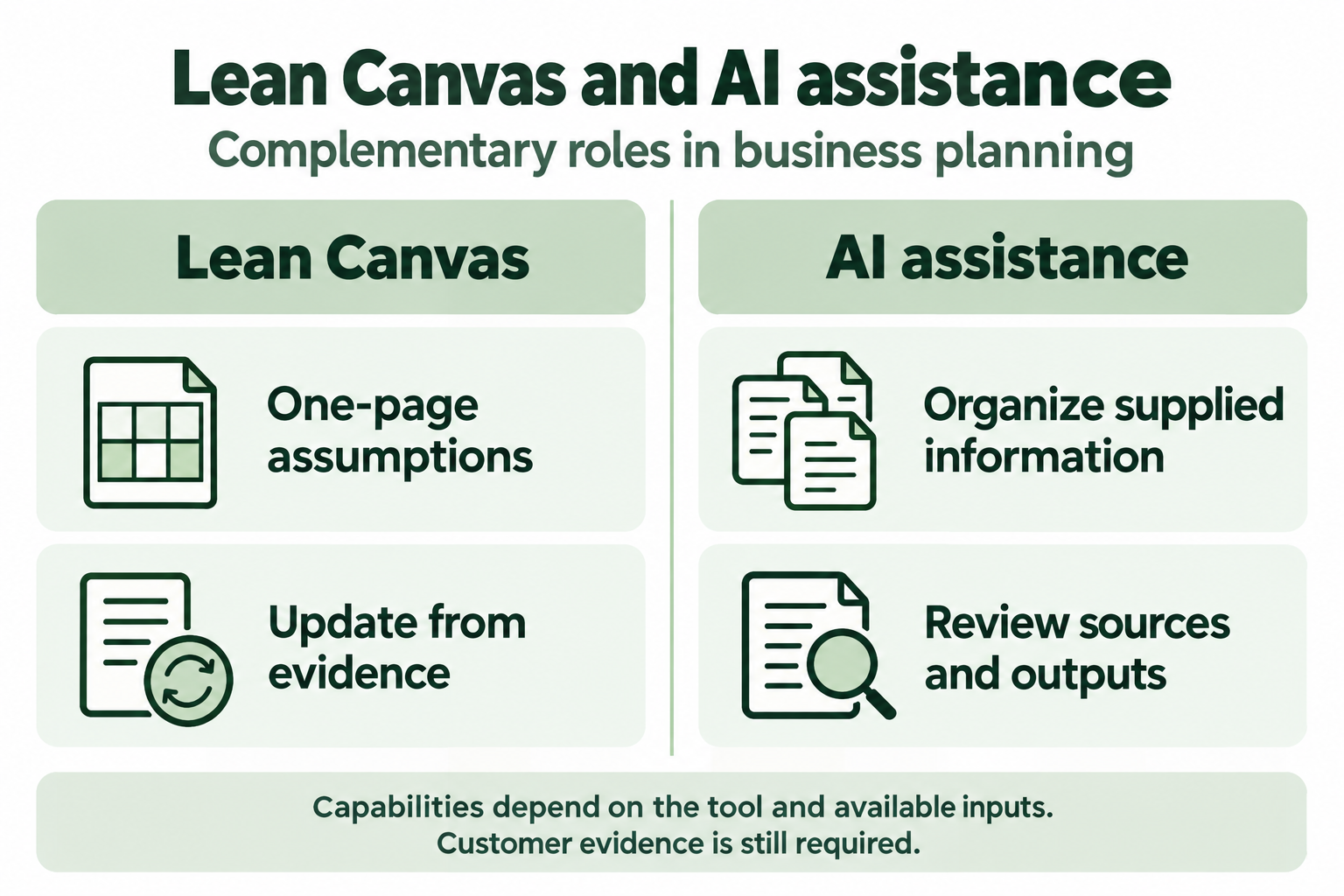
Here’s a comparison of Lean Canvas and AI-driven business planning tools:
Criteria | Lean Canvas | AI-Driven Tools |
|---|---|---|
Approach | Visual, one-page model | Software-assisted organization; capabilities vary by product and configuration |
Update Frequency | Manual updates needed | Updates depend on supplied inputs, actual connections, and review |
Scope of Insights | Focused on nine elements | May organize provided sources; check which sources are actually available |
Decision Support | Relies on founder input | May draft recommendations; verify their evidence and limitations |
Frequently Asked Questions
What is a Lean Canvas?
Lean Canvas is a one-page model for organizing startup assumptions across the core business areas. Its purpose is to make the model discussable and identify what needs testing. It is not a certificate of demand, a complete operating plan, or evidence that the business will succeed. Record the sources and confidence behind important entries.
What are the limitations of the Lean Canvas?
A concise canvas can hide uncertainty, evidence quality, dependencies, and the details needed to deliver the offer. It does not itself collect customer evidence or run experiments. Use separate records for observations, test conditions, economics, risks, and decisions. The limitation is relying on completed boxes as facts, rather than treating them as a model that may need revision.
How do we update our business canvas after customer feedback contradicts it?
Keep a dated copy of the earlier assumption and attach the new observation to its source. Explain why it changes the interpretation, which canvas boxes and decisions are affected, and what remains uncertain. Name an owner and the next discriminating test. If AI drafts an update, check both the response and the reopened saved artifact before using the revision to make a decision.
What are smarter alternatives to the Lean Canvas?
Choose a complementary framework for the decision you need to make, or software for a task it demonstrably supports. Neither a different canvas nor an AI-generated analysis replaces customer evidence. For a comparison of framework inputs, artifacts, and limitations, use the alternatives guide linked above. For a next test, see Siift’s startup idea validation workflow and review its proposed actions against your evidence.
Elevate Your Business Strategy Beyond Lean Canvas with Intelligent AI Guidance
Use a canvas to record assumptions and an evidence log to track what supports or contradicts them. If you add AI assistance, check its sources, interpretations, and saved revisions before using the output in a decision.
Discover how siift.ai Intelligent Business Canvas is designed to help organize business context, feedback, and possible next actions. Experience a strategic platform designed to guide you step-by-step through ideation, validation, and market launch with AI assistance that still needs source checks and human review. Don’t let outdated business planning hold back your startup’s full potential. Take control today with siift.ai and organize the next question and test it against evidence.