
Most American millennials working in corporate roles are searching for ways to break free from the routine and build something on their own. With artificial intelligence now powering smarter business validation, over 60% of new startups in North America use AI tools to refine their ideas before launch. This guide reveals how adopting the AI Lean Canvas approach gives aspiring entrepreneurs rapid access to actionable insights, accelerates risk assessment, and turns bold concepts into well-founded ventures.
Table of Contents
- Defining The AI Lean Canvas Approach
- Core Features Powering Smarter Validation
- Real-World Examples: AI Lean Canvas In Action
- Comparing AI Vs. Traditional Lean Canvas Tools
- Avoiding Biases And Blindspots With AI
Key Takeaways
| Point | Details |
|---|---|
| AI Lean Canvas Enhances Validation | By integrating AI with lean startup principles, entrepreneurs gain real-time insights and predictive analytics for better business model assessment. |
| Automated Tools Increase Speed and Accuracy | AI algorithms streamline research and validation processes, enabling faster identification of market opportunities and reduced risk of failure. |
| Dynamic Adaptability to Market Trends | The AI Lean Canvas allows startups to quickly pivot and adjust strategies based on emerging market signals and real-time data. |
| Reduction of Cognitive Bias | AI tools help minimize biases in decision-making by providing objective analysis and diverse data insights, leading to informed and accurate business decisions. |
Defining the AI Lean Canvas Approach
The AI Lean Canvas represents a groundbreaking methodology for startup validation that integrates artificial intelligence with traditional lean startup principles. By transforming lean processes through predictive analytics, entrepreneurs can now leverage sophisticated algorithms to dramatically accelerate business model development and risk assessment.
At its core, the AI Lean Canvas approach reimagines how startups traditionally validate business concepts. Unlike standard lean canvas models, this AI-enhanced framework uses machine learning algorithms to analyze market data, predict potential challenges, and provide real-time insights about business model feasibility. Founders can now access automated competitive analysis, market trend predictions, and rapid prototype validation that were previously impossible or prohibitively expensive.
The methodology breaks down into several critical components that distinguish it from traditional approaches:
Here’s a summary of how AI Lean Canvas features impact startup validation:
| Feature | Business Value | Startup Impact |
|---|---|---|
| Automated Research | Faster market opportunity discovery | Speeds up idea validation |
| Predictive Risk Models | Early risk identification | Reduces costly failures |
| Scenario Modeling | Real-time adaptability | Enables rapid pivots |
| Bias Reduction | More objective decisions | Minimizes founder errors |
- Automated Market Research: AI algorithms scan massive datasets to identify market opportunities
- Predictive Risk Assessment: Machine learning models evaluate potential business model failures before significant investments
- Dynamic Scenario Modeling: Real-time adjustments based on emerging market signals
- Intelligent Validation Protocols: Automated testing and validation of core business hypotheses
Pro tip: When implementing an AI Lean Canvas, start by clearly defining your core business hypothesis and ensuring your AI tools are trained on high-quality, relevant datasets to maximize predictive accuracy.
Core Features Powering Smarter Validation
The AI Lean Canvas transforms startup validation through advanced technological capabilities that fundamentally reimagine how entrepreneurs test and refine business models. Lean Startup AI integrates machine learning techniques to accelerate the traditional build-measure-learn cycle, enabling founders to make more intelligent and data-driven decisions with unprecedented speed and accuracy.

These powerful features represent a quantum leap in startup validation methodologies. Entrepreneurs can now leverage sophisticated algorithms that provide real-time insights, predictive modeling, and automated analysis across multiple dimensions of business development. The core technological capabilities include advanced data processing, intelligent risk assessment, and dynamic scenario generation that dramatically reduce the time and resources required to validate a business concept.
Key technological features driving this transformation include:
- Real-Time Data Tracking: Continuous monitoring of market signals and business performance indicators
- Predictive Customer Behavior Models: Machine learning algorithms that forecast potential customer interactions and preferences
- Automated Prototype Generation: AI-powered tools that rapidly create and iterate business model prototypes
- Dynamic Market Adjustment: Intelligent systems that recommend strategic pivots based on emerging trends
- Bias Reduction Mechanisms: Advanced algorithms designed to minimize human cognitive biases in decision-making
Pro tip: Integrate multiple AI validation tools and cross-reference their insights to build a more robust and comprehensive understanding of your business model’s potential market viability.
Real-World Examples: AI Lean Canvas in Action
The power of AI Lean Canvas becomes most apparent through concrete startup scenarios where systematic validation transformed business strategies. By integrating artificial intelligence into traditional lean methodologies, entrepreneurs can rapidly test and refine their business hypotheses with unprecedented precision and speed.
Consider the example of a health technology startup that used AI Lean Canvas to validate its remote patient monitoring platform. Traditional market research would have taken months, but AI-powered tools allowed the team to analyze patient behavior patterns, healthcare provider preferences, and potential revenue streams within weeks. The AI algorithms identified niche market segments, predicted potential adoption challenges, and recommended specific product modifications that dramatically improved the startup’s market positioning.
These real-world applications demonstrate the transformative potential of AI-enhanced validation techniques:
- Healthcare Innovation: Rapid market segment identification and personalized solution design
- Fintech Development: Predictive risk assessment and automated compliance checking
- Software as a Service (SaaS): Dynamic pricing model optimization and customer acquisition strategy refinement
- E-commerce Platforms: Intelligent recommendation systems and market trend prediction
- Sustainability Ventures: Environmental impact modeling and resource allocation optimization
Pro tip: Document every AI-generated insight and validation step, creating a comprehensive decision trail that can help secure future investor confidence and track your startup’s strategic evolution.
Comparing AI vs. Traditional Lean Canvas Tools
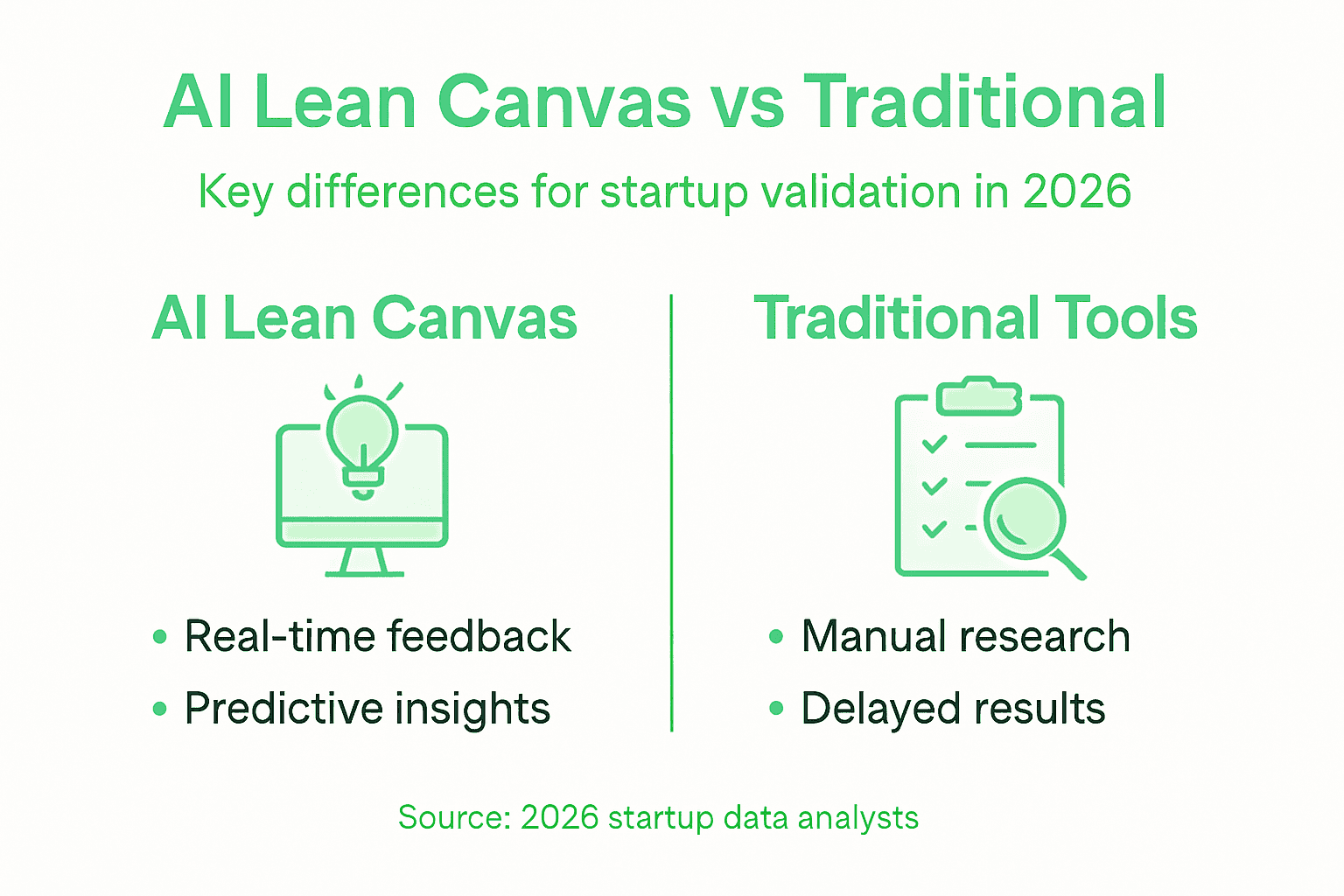
The landscape of business model validation is undergoing a profound transformation, with AI dramatically reshaping traditional canvas approaches. Traditional lean canvas tools have long served as static blueprints for entrepreneurs, providing a structured framework for capturing initial business ideas. However, these legacy tools often fail to adapt to rapidly changing market dynamics, leaving founders working with outdated assumptions and limited insights.
AI-enhanced lean canvas tools represent a quantum leap in startup validation methodology. Where traditional tools offer a snapshot of a business concept, AI-powered platforms provide a dynamic, continuously evolving analysis that learns and adapts in real time. These advanced systems can instantly analyze market trends, predict potential challenges, and recommend strategic pivots based on emerging data. The key difference lies in the tool’s ability to transform from a passive documentation method to an active, intelligent validation engine that grows alongside the startup.
Key comparative dimensions between traditional and AI-powered lean canvas tools include:
This comparison highlights core differences between AI and traditional lean canvas tools:
| Dimension | Traditional Canvas | AI-Powered Canvas |
|---|---|---|
| Data Handling | Manual input | Automated aggregation |
| Adaptation Speed | Infrequent updates | Real-time refining |
| Challenge Prediction | Limited forecasting | Dynamic risk modeling |
| Depth of Insight | Surface-level assessments | Multi-layered market analysis |
- Data Processing: Traditional tools rely on manual input, while AI tools automatically aggregate and analyze massive datasets
- Predictive Capabilities: Static models versus dynamic, real-time predictive modeling
- Bias Detection: Manual bias identification compared to automated cognitive bias recognition
- Adaptation Speed: Slow, manual updates versus instantaneous algorithmic refinement
- Market Insight Depth: Surface-level observations versus multi-layered, contextual understanding
Pro tip: Treat AI-powered lean canvas tools as collaborative partners, not just software, by continuously feeding them high-quality, diverse data to enhance their predictive accuracy and strategic insights.
Avoiding Biases and Blindspots with AI
Human cognitive biases represent a significant challenge in startup development, often leading entrepreneurs down misguided paths. AI helps reduce systematic decision making errors by providing objective, data-driven insights that challenge founders’ inherent assumptions and preconceived notions about their business models.
The most powerful aspect of AI-driven bias detection is its ability to systematically analyze information from multiple perspectives, revealing potential blindspots that human intuition might easily overlook. Unlike traditional validation methods that rely heavily on founder experience and limited personal networks, AI tools can aggregate insights from diverse data sources, cross-reference market signals, and identify potential risks or opportunities that would remain invisible through conventional analysis.
Key strategies for leveraging AI to minimize cognitive biases include:
- Diverse Data Aggregation: Pulling insights from multiple, uncorrelated data sources
- Objective Pattern Recognition: Identifying trends beyond human perceptual limitations
- Predictive Scenario Modeling: Simulating multiple potential business outcomes
- Cognitive Bias Detection: Highlighting potential logical fallacies in business reasoning
- Continuous Learning Mechanisms: Adapting insights based on new market information
Pro tip: Implement a regular “bias audit” process where you intentionally challenge your AI tool’s recommendations and cross-reference its insights with alternative perspectives to maintain a balanced strategic approach.
Unlock Smarter Startup Validation with siift.ai
The article highlights the critical challenge of overcoming biases and accelerating rapid, data-driven validation through AI-enhanced Lean Canvas approaches. If you are seeking a way to de-risk your founder’s journey, avoid blindspots and pivot quickly based on real-time insights, embracing an intelligent, automated validation method is essential. Concepts like predictive risk models, bias reduction, and dynamic scenario modeling are exactly what today’s founders need to turn ideas into viable businesses without traditional guesswork.
Our Intelligent Business Canvas at siift.ai is designed to guide you step-by-step through ideation, validation, and go-to-market planning with personalized feedback and prioritized actions. Unlike legacy tools, siift.ai’s AI-powered platform continuously learns from your inputs and market data to help you identify opportunities, predict risks, and adapt strategies faster and more objectively. Don’t wait for costly failures or miss chances to pivot early. Experience how systematic, bias-free validation can transform your startup journey. Visit https://siift.ai now and start building your resilient business with AI-enhanced insights.
Explore how siift.ai empowers dynamic validation and growth in the AI Lean Canvas era by visiting our landing page and let the AI Business Canvas become your strategic partner in shaping the future of your startup.
Frequently Asked Questions
What is the AI Lean Canvas approach?
The AI Lean Canvas is a methodology for startup validation that combines artificial intelligence with traditional lean startup principles to enhance business model development and risk assessment through predictive analytics.
How does AI improve startup validation compared to traditional methods?
AI enhances startup validation by automating market research, providing predictive risk models, enabling real-time adaptability through scenario modeling, and reducing biases in decision-making, leading to more objective and accurate insights.
What are the key features of the AI Lean Canvas?
Key features include automated market research, predictive risk assessment, dynamic scenario modeling, intelligent validation protocols, and real-time data tracking, which collectively streamline the business validation process.
How can startups avoid cognitive biases using AI tools?
Startups can minimize cognitive biases by utilizing AI for diverse data aggregation, objective pattern recognition, predictive scenario modeling, and continuously updating insights based on new market information.