
Use structured planning to make your assumptions explicit before committing resources. The Business Model Canvas offers a visual way to map the main elements of your idea. Treat that map as a starting point for customer research and testing, then revise it as evidence develops.
Table of Contents
Key Takeaways
Point | Details |
|---|---|
Business Model Canvas Overview | The Business Model Canvas is a visual tool that simplifies business strategy into nine fundamental components, enhancing understanding and adaptability. |
Importance of Continuous Updates | Entrepreneurs should treat their Business Model Canvas as a living document, reviewing it quarterly with real market feedback to refine their strategies. |
Variations and Customization | Different adaptations of the Business Model Canvas, such as the Lean Canvas and Platform Canvas, cater to specific industry needs, encouraging tailored strategic planning. |
AI Integration in Business Planning | Business Canvas AI transforms traditional static models into dynamic systems, offering real-time insights and predictive analysis for effective decision-making. |
What Is a Business Model Canvas?
The Business Model Canvas represents a revolutionary strategic management template that transforms how entrepreneurs visualize and develop their business concepts. Developed as a pragmatic alternative to dense business plans, this visual tool allows founders to map out critical business components on a single page. Business model strategies provide entrepreneurs with a comprehensive framework for understanding how different aspects of a venture interconnect and generate value.
At its core, the Business Model Canvas breaks down organizational strategy into nine fundamental building blocks that capture the essential logic of how a company intends to create, deliver, and capture value. These nine blocks include key components like value proposition, customer segments, channels, customer relationships, revenue streams, key resources, key activities, key partnerships, and cost structure. Think of it like a strategic blueprint that allows you to see your entire business ecosystem at a glance.
The canvas originated from the work of Swiss business theorist Alexander Osterwalder, who sought to create a more dynamic and accessible alternative to traditional business planning. Unlike rigid, text-heavy business plans that quickly become obsolete, the Business Model Canvas offers a flexible, visual approach that can be easily updated and iterated. Strategic management approaches emphasize the canvas as a tool for not just initial planning, but ongoing strategic reflection and adaptation.
Pro Tip - Canvas Mastery: Treat your Business Model Canvas as a living document. Review and update it quarterly, using real market feedback to refine your understanding of how your business creates and delivers value.
Popular Variations and Startup Best Practices
As entrepreneurs seek more dynamic and industry-specific strategic planning tools, several specialized Business Model Canvas variations have emerged to address unique business challenges. The platform canvas represents a prime example, specifically designed for multi-sided marketplace models where value generation depends on complex interactions between different participant groups, unlike traditional linear business models.
These canvas variations reflect the growing recognition that one-size-fits-all approaches rarely capture the nuanced realities of different industries and business types. For instance, specific adaptations have been developed for technology startups, social enterprises, non-profit organizations, and even creative industries. Innovative business modeling approaches demonstrate how the canvas can be customized to reflect sector-specific dynamics and strategic considerations.
Popular variations include the Lean Canvas, which focuses more intensely on startup-specific elements like problem definition, solution hypotheses, and unique value propositions. The Social Business Model Canvas emphasizes social impact alongside financial sustainability, while industry-specific models like the Healthcare Business Model Canvas incorporate specialized components relevant to medical and healthcare entrepreneurship.
Here’s how key Business Model Canvas variations differ in focus and best use:
Canvas Variation | Main Focus | Best For | Unique Benefit |
|---|---|---|---|
Standard Canvas | Holistic business overview | Established companies | All-encompassing, visual summary |
Lean Canvas | Startup risks and adaptation | Early-stage startups | Emphasizes problem and solutions |
Platform Canvas | Multi-sided marketplaces | Digital platforms | Maps value between user groups |
Social Canvas | Social and financial impact | Nonprofits, social ventures | Captures mission and revenue goals |
Pro Tip - Canvas Customization: Treat the Business Model Canvas as a flexible framework, not a rigid template. Experiment with different variations and don’t hesitate to create your own custom blocks that truly represent your unique business model’s complexity and nuances.
Why Traditional Canvases Fail Modern Founders
Traditional Business Model Canvases have become increasingly obsolete in today’s rapidly evolving digital landscape. Methodological limitations in business modeling reveal that many standard approaches fail to capture the dynamic nature of modern entrepreneurship, rendering these tools more like static snapshots rather than living, adaptable strategic frameworks.
The fundamental problem with traditional canvases lies in their inherent rigidity. Startup founders today operate in an environment of constant flux, where business models must pivot quickly and assumptions need continuous validation. Digital transformation challenges demonstrate that industries are experiencing unprecedented complexity, making one-dimensional planning tools woefully inadequate for capturing the nuanced realities of contemporary business ecosystems.

Moreover, these traditional canvases suffer from several critical weaknesses. They typically encourage founders to make long-term predictions in an unpredictable environment, create false certainty around hypothetical business elements, and fail to integrate real-time market feedback. The static nature of these documents means they are often completed once and then forgotten, becoming dusty relics instead of dynamic strategic instruments that evolve alongside the business.
Pro Tip - Dynamic Modeling: Treat your business model as a living, breathing entity that requires constant reassessment and refinement. Commit to reviewing and updating your strategic framework at least quarterly, using actual market data and customer insights to drive meaningful adjustments.
Breaking Free from Vibe-Founding Cycles
Vibe-founding represents a dangerous entrepreneurial trap where founders rely more on intuition and passion than structured strategic thinking. Structured business planning approaches provide a critical framework for transforming fuzzy ideas into actionable business strategies, helping entrepreneurs move beyond gut feelings and wishful thinking.
The core problem with vibe-founding is its fundamental lack of systematic validation. Founders trapped in this cycle tend to build elaborate narratives around their ideas without critically examining the underlying assumptions. Analytical business development strategies reveal that successful entrepreneurs don’t just believe in their vision—they methodically test and validate every component of their potential business model, challenging their own assumptions at every turn.
Breaking free from vibe-founding requires a disciplined approach to entrepreneurship. This means developing a ruthless commitment to evidence-based decision-making, where each hypothesis about your business model is treated as a testable assumption rather than an unquestionable truth. Founders must learn to separate their emotional attachment to an idea from its actual market viability, creating systematic processes to gather real-world feedback and iterate rapidly.
Pro Tip - Hypothesis Testing: Treat your business idea like a scientific experiment. For every key assumption in your business model, design a specific, measurable test that can definitively prove or disprove your hypothesis within a short, predefined timeframe.
Business Canvas AI for Continuous Clarity
Business Canvas AI represents a transformative approach to strategic planning, moving beyond static documentation into a dynamic, continuously evolving framework. Digital solutions for business modeling demonstrate how artificial intelligence can enhance organizational flexibility, providing real-time insights that adapt alongside emerging business challenges and opportunities.
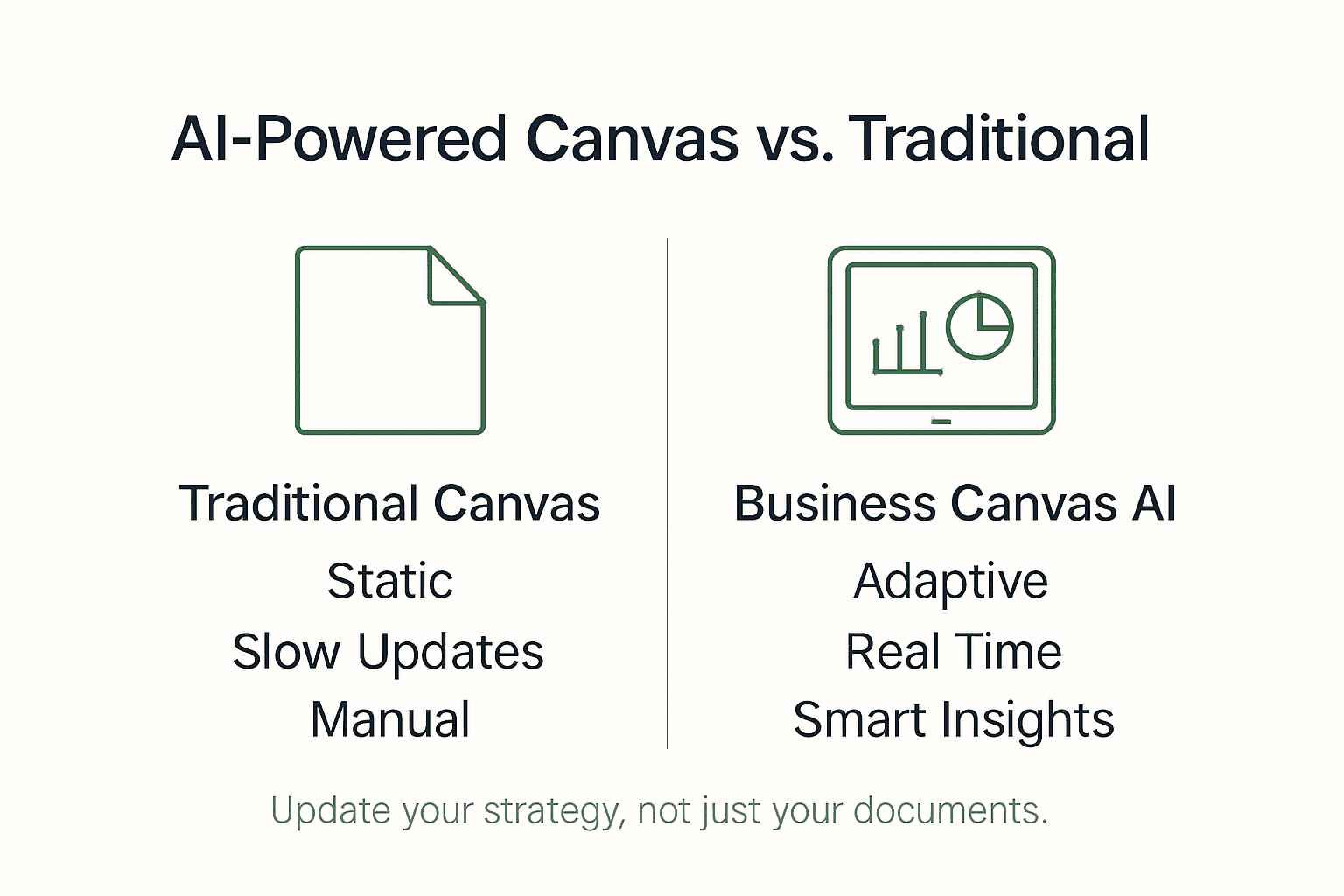
The fundamental breakthrough of Business Canvas AI lies in its ability to transform traditional business modeling from a one-time exercise into an intelligent, responsive system. Unlike conventional canvases that become obsolete almost immediately after creation, AI-powered models can continuously analyze market signals, customer feedback, and internal performance metrics to suggest strategic refinements. Adaptive business model evolution means entrepreneurs can now have a living, breathing strategic document that learns and grows with their venture.
This revolutionary approach goes beyond mere data aggregation. Business Canvas AI integrates multiple data streams, uses machine learning algorithms to identify patterns, and provides predictive insights that help founders make more informed decisions. The system can challenge assumptions, highlight potential blind spots, and recommend specific actions based on comprehensive analysis of industry trends, competitive landscapes, and your unique business context.
The table below contrasts traditional canvases with AI-enhanced models for strategic business planning:
Approach | Adaptability | Data Integration | Decision Support |
|---|---|---|---|
Traditional Canvas | Low, static updates | Manual data input | Limited, one-time use |
Business Canvas AI | High, real-time updates | Automated, real-time feeds | Dynamic, predictive insights |
Pro Tip - AI Canvas Adoption: Treat your AI Business Canvas as an active strategic partner. Schedule monthly deep-dive sessions to review its recommendations, but always maintain human critical thinking as the final decision-making filter.
Unlock the Power of Your Business Model with AI-Driven Clarity
The article highlights the challenges founders face with traditional Business Model Canvases that remain static and detached from real-world dynamics. If you are tired of guesswork and vibe-founding cycles that slow your startup’s progress, you understand the frustration of making critical decisions without actionable evidence. The need for continuous adaptation, dynamic feedback, and proven validation is undeniable to survive in today’s competitive market.
That is exactly where siift.ai steps in. Our Intelligent Business Canvas leverages AI to transform your strategic planning into a living, breathing process. Benefit from personalized feedback, new insights, and prioritized actions designed to de-risk every step of your founder’s journey from ideation to go-to-market success. Say goodbye to outdated assumptions and hello to a clear path forward guided by real data and unbiased recommendations. Learn more about how you can accelerate your startup validation with siift.ai and join the new generation of entrepreneurs who rely on AI-powered precision rather than guesswork.
Ready to break free from static planning and vibe-founding? Discover the future of business modeling today by visiting the Intelligent Business Canvas platform. Take control of your startup’s destiny with continuous clarity and confidence.
Frequently Asked Questions
What is Business Canvas AI?
Business Canvas AI is an innovative approach to strategic planning that uses artificial intelligence to transform traditional business modeling into a dynamic, continuously evolving framework.
How does Business Canvas AI improve startup validation?
Business Canvas AI enhances startup validation by providing real-time insights and adaptability, allowing entrepreneurs to continuously analyze market signals and customer feedback to refine their business models.
What are the benefits of using Business Canvas AI over traditional canvases?
Unlike traditional canvases, which are static and become obsolete quickly, Business Canvas AI offers high adaptability with real-time updates, automated data integration, and dynamic, predictive decision support.
How can entrepreneurs implement hypothesis testing in their business models?
Entrepreneurs can implement hypothesis testing by treating their business ideas like scientific experiments, designing measurable tests for key assumptions to validate or disprove them within a short timeframe.