

Nearly 90 percent of american startups struggle to turn great ideas into lasting businesses. Complicated business plans and outdated models often slow their progress. The Business Model Canvas offers a fresh, visual approach that helps founders simplify strategy and adapt quickly. Understanding how to use this framework can make the difference between a stalled concept and a thriving company ready for growth.
Table of Contents
- Defining The Business Model Canvas Concept
- Comparing Classic, Lean, And AI Canvas Models
- Why Traditional Canvases Fail Modern Startups
- The Power Of AI-Enhanced Business Canvas Platforms
- How siift.ai Drives Continuous Startup Validation
Key Takeaways
| Point | Details |
|---|---|
| Business Model Canvas Overview | The Business Model Canvas is a visual framework that helps organizations map out their business strategy through nine key components. |
| Different Canvas Types | Classic, Lean, and AI canvases cater to different business needs; Lean canvas supports startups while AI canvas incorporates real-time data for dynamic strategies. |
| Limitations of Traditional Models | Traditional business models often fail to accommodate the fast-paced nature of startups, necessitating more flexible and adaptable tools. |
| AI-Enhanced Validation | Platforms like siift.ai use AI to transform business validation from a static process into a continuous, dynamic analysis that adapts to market changes. |
Defining The Business Model Canvas Concept
The Business Model Canvas is a revolutionary strategic management tool that transforms complex business planning into a visual, intuitive framework. Developed by Alexander Osterwalder, this approach simplifies how entrepreneurs and organizations conceptualize their business strategy by breaking down critical components into nine interconnected building blocks.
According to research from the Humboldt Institute for Internet and Society, the canvas covers four primary business dimensions: customers, offer, infrastructure, and financial viability. This comprehensive approach allows businesses to:
- Describe their current business model
- Design innovative strategies
- Challenge existing assumptions
- Pivot quickly in dynamic markets
The nine key building blocks of the Business Model Canvas provide a holistic view of how an organization creates, delivers, and captures value. These blocks include fundamental elements like value proposition, customer segments, revenue streams, and key partnerships. Unlike traditional, text-heavy business plans, the canvas offers a dynamic, visual representation that encourages strategic thinking and rapid iteration.
While the Business Model Canvas has become a popular tool among startups and established companies, it’s not a magic solution. Smart entrepreneurs understand that the canvas is just the beginning of a strategic journey. For a deeper exploration of building robust business models, check out our comprehensive guide on startup business models.
Comparing Classic, Lean, And AI Canvas Models
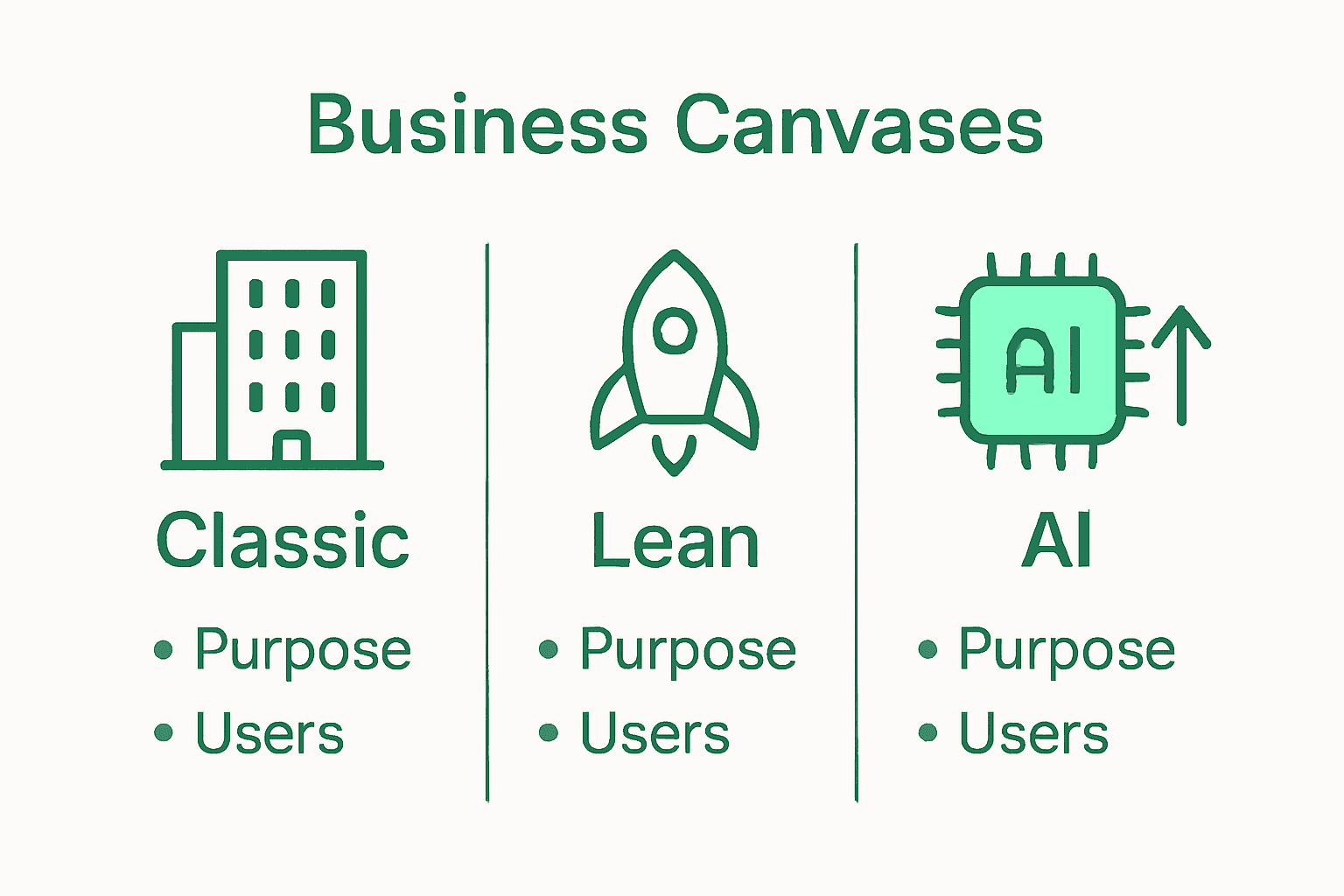
Business model frameworks have evolved dramatically, reflecting the changing needs of entrepreneurs and organizations. According to Miro, different canvas models serve distinct strategic purposes, with each design targeting specific business lifecycle stages and organizational challenges.
Research from Creately highlights the key differences between traditional and lean approaches. While both models contain nine core blocks, their focus varies significantly:
Classic Business Model Canvas:
- Designed for established companies
- Emphasizes comprehensive business structure
- Focuses on broad organizational perspective
- Suitable for complex, mature businesses
Lean Canvas:
- Tailored specifically for startups
- Prioritizes rapid validation and risk assessment
- Includes specific blocks like ‘Problem’ and ‘Solution’
- Enables quick pivoting and iterative development
The emerging AI Business Canvas represents the next evolutionary step, integrating machine learning and real-time data analysis to transform static planning into dynamic, adaptive strategy development. By leveraging artificial intelligence, this model goes beyond traditional frameworks, offering predictive insights, automated market trend analysis, and continuous business model refinement. For entrepreneurs seeking to understand this cutting-edge approach, our guide on understanding lean canvas provides valuable context for navigating modern business modeling techniques.

Why Traditional Canvases Fail Modern Startups
Startup ecosystems move fast. Traditional business planning tools simply cannot keep up with the lightning-speed evolution of modern entrepreneurship. According to research from the Humboldt Institute, classic business model canvases fundamentally fail to capture the dynamic and iterative nature of contemporary startup environments.
Research from Creately reveals critical structural limitations in traditional business modeling approaches. These frameworks typically assume:
- Stable business environments
- Predictable market conditions
- Linear growth trajectories
- Minimal requirement for rapid experimentation
The core problem is that most traditional canvases are essentially static snapshots designed for established businesses with linear strategies. They cannot accommodate the chaotic, non-linear journey of early-stage ventures.
Startups require tools that:
- Surface hidden risks and assumptions
- Enable rapid pivoting
- Support continuous hypothesis testing
- Facilitate real-time strategic adaptation
For founders navigating uncertain terrain, understanding why conventional models fall short is crucial. Entrepreneurs seeking deeper insights into avoiding common startup pitfalls can explore our comprehensive guide on business failure factors, which provides critical context for building resilient, adaptable business strategies in today’s unpredictable market landscape.
The Power Of AI-Enhanced Business Canvas Platforms
Artificial intelligence is revolutionizing how entrepreneurs develop and validate business models. According to the Humboldt Institute, AI-driven platforms can transform static business planning by analyzing massive datasets to identify patterns, predict market trends, and generate actionable insights that traditional methods could never uncover.
Research from Scientific Publications reveals the transformative potential of machine learning in business model development. AI-enhanced platforms offer unprecedented capabilities:
- Automated component identification
- Advanced risk prediction
- Dynamic strategy optimization
- Real-time market trend analysis
The true magic of AI-powered business canvas platforms lies in their ability to move beyond static documentation. These intelligent systems don’t just capture your current business model - they actively help you refine and evolve it. By continuously ingesting market data, analyzing competitor movements, and surfacing potential opportunities or risks, AI transforms the business canvas from a one-time exercise into a living, breathing strategic tool.
Entrepreneurs looking to leverage cutting-edge AI technologies can gain deeper insights by exploring our guide to understanding the best AI tools for founders, which provides a comprehensive overview of how artificial intelligence is reshaping startup strategy and decision-making.
How siift.ai Drives Continuous Startup Validation
Startup validation is no longer a one-time checkpoint but a continuous, dynamic process. According to research from Scientific Publications, siift.ai revolutionizes this approach by leveraging artificial intelligence to provide real-time, data-driven insights that help entrepreneurs systematically validate and refine their business models.
The Humboldt Institute research highlights how siift.ai transforms startup validation through advanced analytics. The platform’s key validation strategies include:
- Continuous market trend analysis
- Real-time customer behavior tracking
- Competitive landscape monitoring
- Empirical assumption testing
The platform’s AI-powered validation engine goes beyond traditional methods by creating a living, breathing business model that adapts in real-time. Instead of static snapshots, siift.ai provides entrepreneurs with a dynamic toolkit that:
- Surfaces hidden market opportunities
- Identifies potential risks early
- Suggests strategic pivots
- Validates core business assumptions scientifically
Entrepreneurs seeking to master the art of business validation can gain deeper insights by exploring our comprehensive guide to business idea validation, which offers a roadmap for transforming innovative concepts into market-ready ventures.
Unlock Startup Success with AI-Driven Business Modeling
The article highlights a crucial challenge every modern startup faces adapting quickly to fast-changing markets and validating business ideas continuously. Traditional static canvases cannot keep up with this dynamic pace which often leads to missed opportunities, hidden risks, and costly missteps. You want clear insights, real-time feedback, and a way to confidently navigate your big ideas toward real market success. This is where the concepts of AI-enhanced business canvases become essential.
At siift.ai, our Intelligent Business Canvas tackles these exact pain points. It guides founders step-by-step through ideation, validation, and go-to-market strategies using personalized AI feedback. This platform de-risks your startup journey by surfacing blind spots, suggesting prioritized actions, and adapting continuously to new market data. Don’t settle for outdated planning methods that leave you guessing. Discover how you can make your startup planning smarter today by exploring our guide to business idea validation and understand how the AI Business Canvas explained fits perfectly with modern entrepreneurship.
Ready to break free from guesswork and take control of your startup’s future? Visit siift.ai now and experience how AI-powered business modeling transforms your strategy into real success.
Frequently Asked Questions
What is the Business Model Canvas?
The Business Model Canvas is a strategic management tool that provides a visual framework for developing, describing, and analyzing a business model. It consists of nine interconnected building blocks that outline how an organization creates, delivers, and captures value.
How does the AI Business Canvas differ from traditional models?
The AI Business Canvas integrates artificial intelligence to enhance business model development by providing predictive insights, real-time data analysis, and continuous refinement, making it more adaptive than traditional models, which are often static.
Why do traditional business canvases fail for modern startups?
Traditional business canvases tend to assume stable environments and linear growth, which do not reflect the dynamic nature of startups. They often cannot accommodate quick pivots, rapid experimentation, or the continuous validation necessary for success in fast-paced markets.
How can siift.ai help with startup validation?
siift.ai aids startup validation by offering real-time, data-driven insights that allow entrepreneurs to continuously monitor market trends, track customer behavior, and test assumptions, ultimately refining and adapting their business models effectively.
Recommended
- blog | siift | Business Canvas Model 2025: Simple Guide for New Entrepreneurs
- blog | siift | Understanding Lean Canvas: A Comprehensive Guide
- blog | siift | What is Lean Canvas? Understanding Its Importance and Use
- blog | siift | Understanding the Startup Business Model: Key Insights
- AI Visibility Technical Audit: Complete Guide | FAII
- 7 Types of Business Models Every Entrepreneur Should Know