
Think your product is so good it will sell itself? Think again. Launching without a structured plan leads to over 60% of new product failures linked to poor go-to-market planning. A go-to-market strategy is the blueprint that brings your product to customers successfully. This guide will explain what a GTM strategy is, why it matters in 2026’s competitive landscape, and how to build one using AI-enhanced approaches to accelerate your launch.
Table of Contents
Key Components And Step-By-Step Framework For A GTM Strategy
Common Misconceptions And Pitfalls In Go-To-Market Strategies
The Role Of AI And Data-Driven Insights In Modern GTM Strategies
Real-World Examples And Case Studies Demonstrating GTM Success
Applying Your GTM Strategy: Practical Tips For Execution And Alignment
Key Takeaways
Point | Details |
|---|---|
GTM unites teams | Cross-functional plan coordinating product, marketing, sales, and customer success for launches. |
Proven impact | Strong GTM accelerates market entry and improves conversions by up to 25%. |
Core steps | Define target market, craft value proposition, select channels, and align teams systematically. |
AI advantage | AI enables buyer intent detection, personalization, and rapid iteration for better results. |
Avoid mistakes | Prevent siloed teams and don’t confuse GTM with ongoing marketing strategy. |
Understanding What a Go-To-Market Strategy Is
A GTM strategy unites sales, marketing, and product teams to launch products successfully and create a coordinated path to market. Unlike ongoing marketing strategies that sustain awareness over time, GTM is a focused, time-bound plan designed specifically for product launches.
At its core, GTM addresses critical launch questions: Who is your ideal customer? How will you reach them? What channels will you use? How will you price your offering? GTM differs from marketing strategy as it is time-bound and product-specific, covering pricing decisions, sales enablement, distribution channels, and customer success integration.
Here’s what sets GTM apart:
Tactical execution focus rather than brand building
Cross-functional collaboration across multiple departments
Product-specific launch timeline with clear milestones
Direct connection between customer insights and sales tactics
Measurable outcomes tied to revenue and market penetration
In 2026’s fast-evolving markets, where competition intensifies daily and buyer preferences shift rapidly, a well-structured GTM becomes your competitive advantage. Companies with clear winning go-to-market strategy steps can increase qualified leads by 30% within six months and achieve product-market fit faster than competitors who skip this critical planning phase.
Pro Tip: Start your GTM planning as soon as your product enters beta testing. Early alignment prevents costly pivots and wasted marketing spend.
Why a Go-To-Market Strategy Matters: Timing and Impact
You might have the best product in your category, but launching without a GTM strategy dramatically increases your failure risk. Over 60% of new product failures are linked to poor GTM planning, regardless of product quality or innovation level.

A structured GTM strategy delivers measurable business impact. Companies that invest in comprehensive GTM planning achieve faster time-to-market, more efficient resource allocation, and stronger early traction. Structured GTM strategies shorten sales cycles and increase conversion rates by up to 25% compared to launches without clear planning.
Consider this reality:
Without a clear GTM strategy, even revolutionary products struggle to find their audience. You might build something customers need, but if they never discover it or understand its value, your innovation dies in obscurity.
The importance of GTM strategy becomes obvious when you look at resource efficiency. Marketing budgets stretch further when targeting is precise. Sales teams close deals faster when messaging aligns with customer pain points. Customer success teams onboard users more effectively when expectations are set correctly from day one.
Timing matters critically. Starting your GTM planning too late forces reactive decisions and creates misalignment across teams. Starting too early without product clarity wastes effort on premature assumptions. The sweet spot? Begin GTM development when your product vision solidifies and customer validation starts confirming real demand.
Pro Tip: Map your GTM timeline backward from your target launch date. Give yourself at least 90 days for proper team alignment, content creation, and channel preparation.
Key Components and Step-by-Step Framework for a GTM Strategy
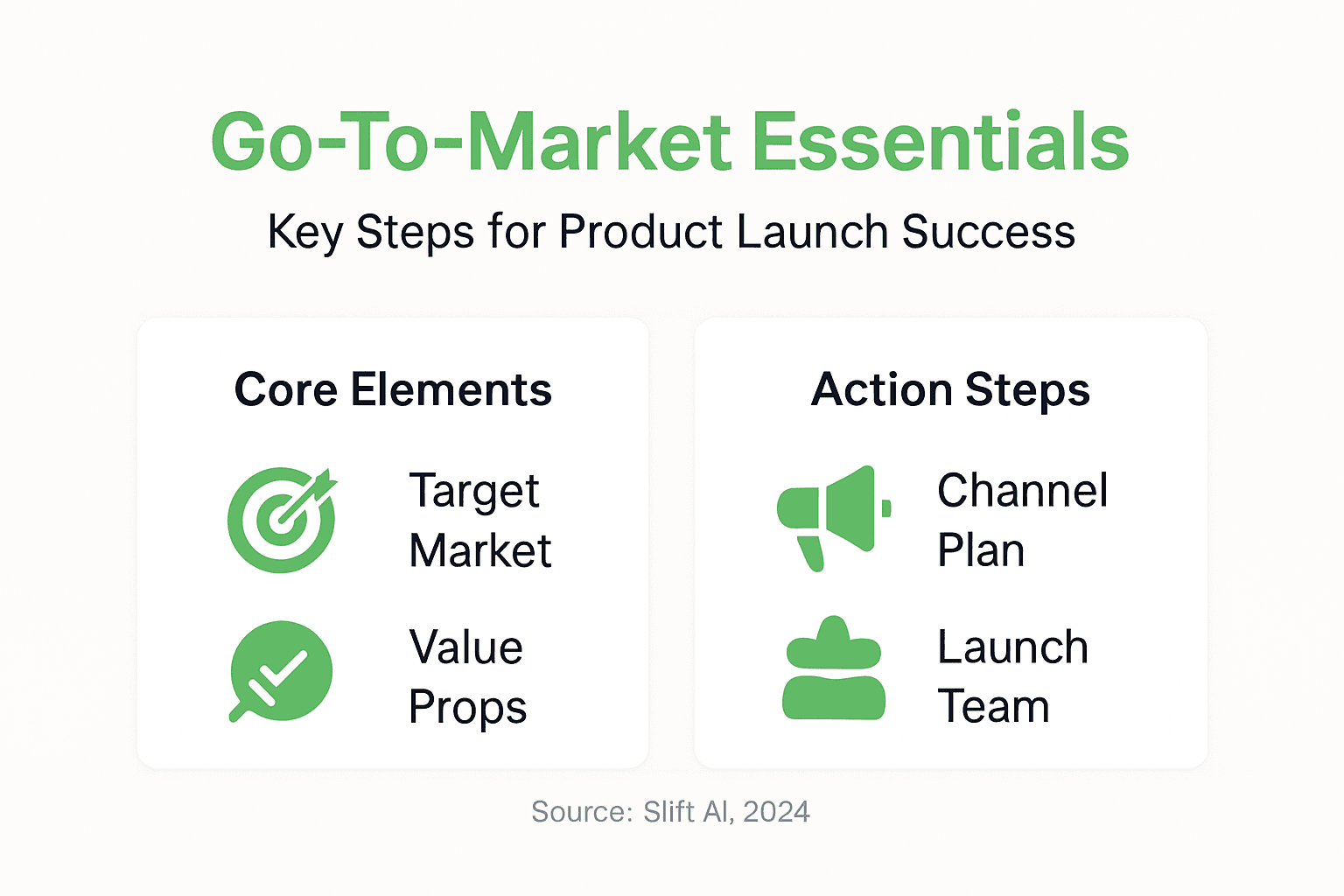
Building a GTM strategy requires systematic progression through interconnected elements. A GTM framework includes defining target market, value proposition, distribution channels, and aligning messaging across all customer-facing teams.
Follow these sequential steps to construct your GTM foundation:
Define your target market and ideal customer profile with precision
Craft a compelling value proposition that addresses specific pain points
Select distribution channels matching where your customers actually buy
Align sales, marketing, and customer success around unified messaging
Establish KPIs and performance metrics to measure success
Integrate AI and data tools for execution agility and continuous optimization
Here’s how each component strengthens your launch:
GTM Component | Strategic Rationale | Practical Implementation |
|---|---|---|
Target Market Definition | Focuses resources on highest-value segments | Create detailed buyer personas with firmographics, pain points, and buying behaviors |
Value Proposition | Differentiates you from competitors clearly | Map features to customer outcomes; test messaging with target users |
Channel Selection | Meets customers where they make purchase decisions | Research competitor channels; prioritize 2-3 primary channels initially |
Team Alignment | Eliminates mixed messages and friction | Hold cross-functional workshops; document shared playbooks |
KPI Framework | Enables data-driven adjustments and accountability | Track qualified leads, conversion rates, CAC, and sales cycle length |
AI Integration | Accelerates learning and adaptation cycles | Deploy intent tracking, predictive analytics, and automated personalization |
Each step-by-step GTM framework element builds on the previous one. You can’t select optimal channels without knowing your target customer. You can’t craft compelling messaging without understanding their pain points. You can’t measure success without clear KPIs established upfront.
The connection to broader business growth strategy steps becomes evident as your GTM matures. Initial launch tactics evolve into sustainable growth engines when executed with discipline.
Pro Tip: Involve representatives from every department in your GTM planning sessions. Sales knows objections, customer success understands onboarding friction, and product teams grasp technical constraints. Cross-functional input early prevents siloed execution later.
Common Misconceptions and Pitfalls in Go-To-Market Strategies
Many founders and corporate teams stumble over fundamental misunderstandings about what GTM strategies actually entail. Let’s clear up the confusion and identify traps that derail even promising launches.
Misconception | Reality |
|---|---|
GTM is just marketing | GTM coordinates sales, marketing, product, and customer success as one integrated system |
Only large companies need GTM | Startups benefit even more from GTM by avoiding costly missteps with limited resources |
GTM is a one-time plan | Effective GTM strategies evolve continuously based on market feedback and performance data |
GTM equals marketing strategy | Marketing sustains long-term brand awareness; GTM executes specific product launches |
These pitfalls sabotage GTM execution:
Team silos where departments work independently with misaligned goals
Ignoring AI and analytics tools that accelerate insight gathering
Skipping detailed market segmentation and targeting everyone at once
Creating generic messaging that fails to resonate with specific buyer needs
Setting unrealistic timelines without accounting for iteration cycles
Neglecting competitor analysis and assuming your innovation speaks for itself
Avoiding GTM pitfalls requires vigilance against these natural tendencies. The pressure to launch fast often tempts teams to skip foundational research. The desire to reach massive audiences encourages broad targeting that dilutes impact.
Pro Tip: Treat your GTM strategy as a living document. Schedule monthly reviews to assess what’s working and what needs adjustment. Market conditions change, customer preferences evolve, and your GTM must adapt accordingly.
The Role of AI and Data-Driven Insights in Modern GTM Strategies
Artificial intelligence transforms how companies execute GTM strategies in 2026. AI-powered buyer intent detection and automation improve GTM precision and speed by analyzing signals humans miss and acting on opportunities in real time.
The shift toward self-serve buying experiences shapes modern GTM design fundamentally. Seventy-five percent of B2B buyers now prefer researching and evaluating solutions independently before talking to sales. This behavior demands GTM strategies that provide instant value through content, tools, and experiences rather than gated information.
Data alignment enables unified customer insights critical for cross-functional GTM execution. When sales, marketing, and customer success share the same customer data platform, everyone sees the complete buyer journey. This visibility eliminates the friction that comes from fragmented information and conflicting assumptions.
AI enhances GTM execution through:
Predictive lead scoring that identifies high-intent prospects before they request demos
Automated personalization that adapts messaging based on industry, role, and behavior
Sentiment analysis that reveals which value propositions resonate strongest
Competitive intelligence gathering that tracks market positioning shifts
Performance forecasting that predicts channel effectiveness before significant investment
Integrating AI in GTM strategies doesn’t replace human judgment; it amplifies it. Your team focuses on strategic decisions while AI handles data processing, pattern recognition, and routine optimization tasks.
The AI tools for entrepreneurs available today offer capabilities once reserved for enterprise companies. Startups can now compete with established players by leveraging AI to punch above their weight in market intelligence and customer targeting.
Pro Tip: Start with one AI application that solves your biggest GTM bottleneck. Master that before expanding to additional tools. Too many simultaneous AI implementations create complexity that slows execution.
Real-World Examples and Case Studies Demonstrating GTM Success
Theory matters, but results prove GTM value. These case studies show quantifiable impacts from properly executed go-to-market strategies across different industries and company stages.
A SaaS startup increased qualified leads by 30% within six months by implementing a targeted GTM strategy. They narrowed their initial focus from five industries to two high-value segments, created industry-specific messaging, and aligned sales and marketing around shared lead quality definitions. The precision eliminated wasted effort chasing poor-fit prospects.
A cybersecurity firm boosted sales conversion rates by 25% in a fiercely competitive market. Their GTM strategy emphasized demonstrating ROI within prospect security audits rather than generic feature comparisons. Sales received detailed battle cards for competitor displacement, and marketing created proof points addressing specific compliance requirements.
An enterprise cloud provider achieved a 40% increase in contract renewals year over year after refining their GTM to include customer success from day one. They mapped customer journey touchpoints, identified friction causing churn, and proactively addressed usage concerns before renewal conversations began.
Key lessons from these outcomes:
Narrow focus beats broad targeting in early GTM phases
Cross-functional alignment delivers compounding returns over time
Customer success integration prevents churn from undermining acquisition efforts
Industry-specific customization resonates stronger than generic value propositions
Measurable KPIs enable rapid iteration and resource reallocation
These GTM case studies share common threads: disciplined targeting, aligned teams, continuous measurement, and willingness to adjust based on data. None succeeded by following their initial plan rigidly. All improved outcomes by treating GTM as an iterative process.
Applying Your GTM Strategy: Practical Tips for Execution and Alignment
Knowing GTM theory is one thing. Executing it effectively is another challenge entirely. These practical tips help you move from planning to results.
Coordinate marketing, sales, and customer success with structured communication protocols. Weekly alignment meetings prevent drift and surface issues early. Shared dashboards keep everyone focused on the same metrics. Collaborative planning sessions ensure buy-in across departments.
Set measurable KPIs that matter:
Qualified lead volume and quality scores
Lead-to-customer conversion rate at each funnel stage
Customer acquisition cost relative to lifetime value
Sales cycle length from first touch to closed deal
Time-to-value for new customers after purchase
Continuously monitor performance and gather market feedback for strategic adjustments. Monthly GTM reviews should examine what’s working, what’s underperforming, and what market signals suggest about needed pivots. Customer interviews reveal messaging gaps your internal team might miss.
Integrate AI-powered analytics tools for real-time insights and execution agility. Modern platforms track buyer intent signals, predict conversion likelihood, and recommend next-best actions automatically. This technological leverage lets small teams compete with larger competitors.
Follow these GTM execution tips to maintain momentum:
Document decisions and rationale to build institutional knowledge
Celebrate small wins to maintain team motivation through long launch cycles
Create feedback loops between customer-facing teams and product development
Test assumptions quickly with small experiments before major commitments
Build contingency plans for your top three launch risks
Pro Tip: Foster a culture where data-driven decision making trumps opinions and seniority. The best insight might come from your newest team member who spots a pattern veterans overlook. Encourage open feedback and reward evidence-based suggestions.
Unlock Winning GTM Plans with Siift’s AI-Powered Tools
Ready to transform your product launch from risky gamble to calculated success? Discover how Siift’s Intelligent Business Canvas streamlines your GTM planning with AI-driven insights tailored for entrepreneurs and corporate innovators.
Our platform guides you step-by-step through market validation, customer targeting, and team alignment using the same winning GTM steps guide outlined in this article. The Intelligent Business Canvas delivers personalized feedback, identifies blindspots, and prioritizes actions to de-risk your launch.
Whether you’re validating a startup idea or launching a new product line within an established company, Siift accelerates your path to product-market fit. Connect the educational insights from this guide with practical tools designed to turn strategy into execution. Start building your winning GTM strategy today.
Frequently Asked Questions
How is a go-to-market strategy different from a marketing strategy?
A GTM strategy is a time-bound, product-specific launch plan coordinating sales, marketing, product, and customer success teams. Marketing strategy is an ongoing effort building brand awareness and demand over time. GTM focuses on tactical execution for specific launches, while marketing sustains long-term customer relationships.
How can AI improve my go-to-market strategy?
AI transforms GTM through predictive lead scoring, automated personalization, buyer intent detection, and real-time performance optimization. It processes vast customer data to reveal patterns humans miss, enabling precise targeting and faster iteration. AI tools help startups compete with larger companies by amplifying small team capabilities.
Why do startups need a go-to-market strategy?
Startups benefit enormously from GTM strategies because limited resources demand precision. A clear GTM reduces launch risks, accelerates customer acquisition, and prevents wasted spending on ineffective channels. Over 60% of product failures link to poor GTM planning, making it essential for startup survival and growth.
What are common mistakes in go-to-market strategies?
The biggest mistakes include treating GTM as solely a marketing function, allowing team silos to create misalignment, ignoring AI and data tools, targeting too broadly, and confusing GTM with ongoing marketing strategy. Another frequent error is creating a static plan without building in continuous iteration based on market feedback.
When should I start developing my go-to-market strategy?
Begin GTM planning when your product vision solidifies and initial customer validation confirms real demand. Starting at least 90 days before your target launch date allows proper team alignment, content creation, and channel preparation. Too early wastes effort on uncertain assumptions; too late forces reactive decisions that undermine success.