
Building a tech startup often feels like solving a complex puzzle where the pieces never quite fit. For Millennial founders with big ideas but little formal business training, the challenge is visualizing how technology, partners, and customers truly connect. By relying on a structured framework like the Business Model Ontology, you can break down this complexity and map out your AI-driven business idea with clarity. This introduction will show how ontological models transform vague strategies into actionable plans, setting a clear path for tech entrepreneurs.
Table of Contents
- Business Model Ontology Explained and Debunked
- Key Types and Core Components Compared
- How Business Model Ontologies Drive Innovation
- Common Pitfalls and How to Avoid Them
- Best Practices for Tech-Driven Startups
Key Takeaways
| Point | Details |
|---|---|
| Structured Framework for Value Creation | Business Model Ontology provides a systematic approach for entrepreneurs to analyze and define their strategies, ensuring clarity in value creation. |
| Dynamic Nature Limitations | While effective, BMO may struggle with capturing the fast-paced changes of digital businesses, suggesting the need for more adaptive frameworks. |
| Innovative Management Practices | Cultivating an innovative culture, forming strategic partnerships, and adopting agile development are essential for tech-driven startups to thrive. |
| Continuous Refinement is Key | Entrepreneurs should consistently evaluate and adapt their business model ontologies based on market feedback and evolving conditions. |
Business Model Ontology Explained and Debunked
Business Model Ontology (BMO) represents a systematic framework for understanding and analyzing how organizations create, deliver, and capture value. Developed through rigorous academic research, BMO provides entrepreneurs with a structured approach to conceptualizing their business strategies.
The core of Business Model Ontology emerges from design science approaches that aim to clarify complex business relationships. At its foundation, BMO identifies nine critical elements that help founders map out their business configurations:
- Value Proposition: What unique problem does your solution solve?
- Customer Segments: Who specifically benefits from your offering?
- Revenue Streams: How will you monetize your solution?
- Cost Structure: What are your primary expense categories?
- Key Resources: What critical assets enable your business?
- Key Activities: What core actions drive your business model?
- Key Partnerships: Who are your strategic collaborators?
- Customer Relationships: How do you engage and retain customers?
- Distribution Channels: How do you reach your target market?
The ontological approach transforms business modeling from an intuitive art into a more systematic science. By breaking down complex business interactions into standardized components, founders can more objectively analyze their strategies.
However, BMO isn’t without limitations. Traditional ontological frameworks sometimes struggle to capture the dynamic nature of modern digital businesses, particularly those leveraging artificial intelligence or platform-based models. Unified Ontology Approaches have emerged to address these evolving complexities, offering more adaptable frameworks for contemporary entrepreneurship.
Pro tip: Treat Business Model Ontology as a flexible diagnostic tool, not a rigid template, allowing you to continuously refine your understanding as your business evolves.
Key Types and Core Components Compared
Business Model Ontologies represent sophisticated analytical frameworks that help entrepreneurs understand complex business interactions. Different ontological approaches offer unique perspectives on mapping organizational strategies and value creation mechanisms.
Researchers have developed multiple reference ontology frameworks to standardize business model understanding. These frameworks typically focus on three primary components:
- Actors: Who participates in the business ecosystem
- Resources: What assets enable business operations
- Resource Transfers: How value moves between different stakeholders
Two prominent business model ontologies stand out in contemporary research: the Business Model Ontology (BMO) and the e3-value ontology. Comparative studies of these models reveal fascinating insights into their strengths and limitations.
The BMO approach emphasizes a holistic view of business configurations, breaking down complex interactions into standardized elements. In contrast, the e3-value ontology concentrates more specifically on economic value exchanges and intricate network relationships between business actors.

Key differences between these ontologies include their primary focus, level of abstraction, and methodological approach. While BMO provides a broader strategic framework, e3-value offers more granular insights into value creation dynamics, making each model valuable for different analytical purposes.
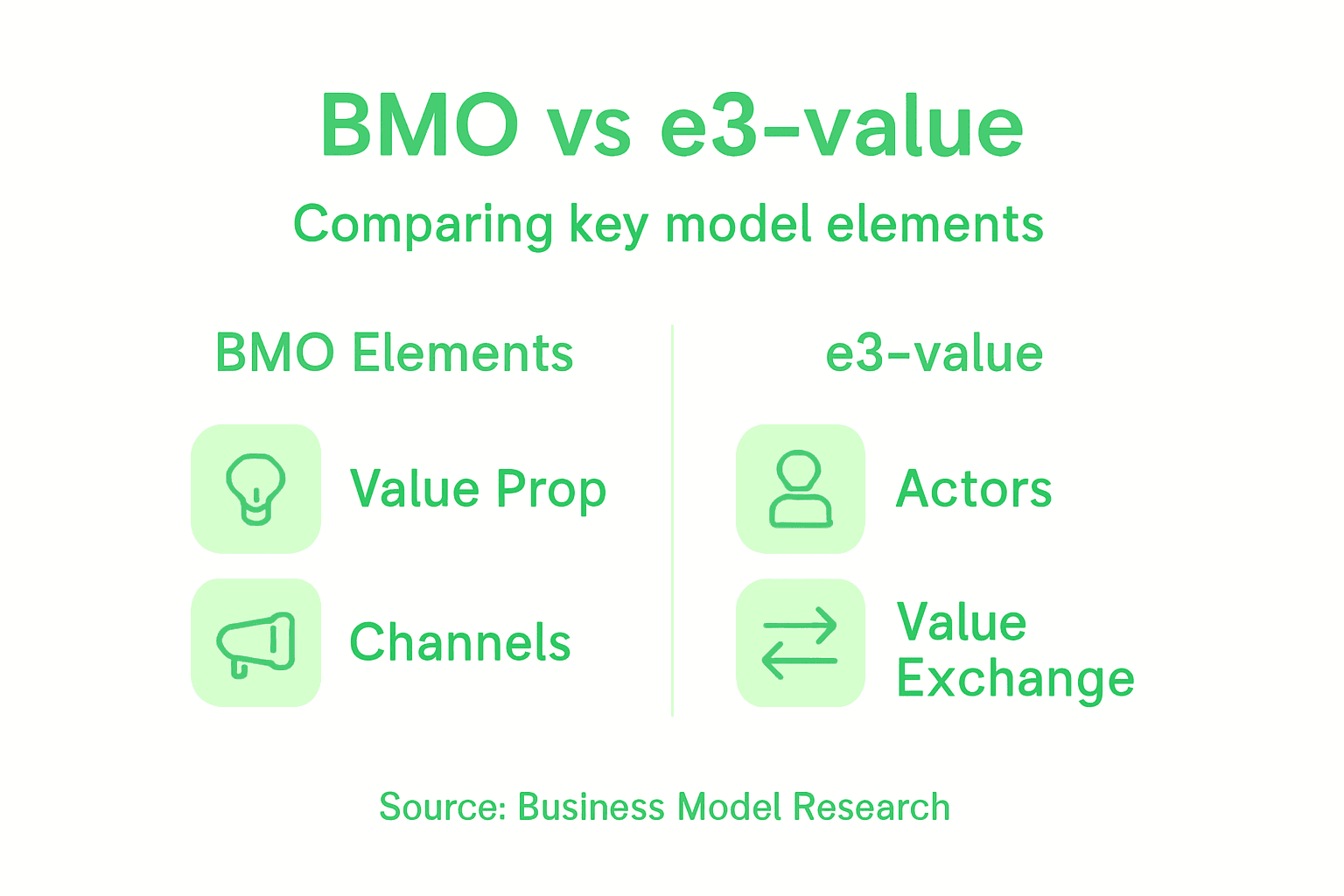
Here’s a side-by-side comparison of the Business Model Ontology and e3-value ontology to highlight their unique strengths:
| Aspect | Business Model Ontology (BMO) | e3-value Ontology |
|---|---|---|
| Main Focus | Holistic business configuration | Economic value exchanges |
| Abstraction Level | Strategic and broad | Granular and detailed |
| Primary Use Case | Strategic planning, diagnostics | Network analysis, value flows |
| Typical Users | Entrepreneurs, business analysts | Economists, network modelers |
Pro tip: Select the ontological framework that best matches your specific business context and analytical needs, recognizing that no single model provides a universal solution.
How Business Model Ontologies Drive Innovation
Business Model Ontologies (BMOs) have emerged as powerful catalysts for organizational innovation, transforming how companies conceptualize and execute their strategic approaches. By providing structured frameworks, these ontological models enable businesses to systematically explore and implement novel value creation strategies.
Research demonstrates that business model innovation processes are critical for firms seeking strategic renewal. These processes encompass three fundamental dimensions:
- Value Proposition: Reimagining product/service offerings
- Value Capture: Developing innovative revenue mechanisms
- Value Chain Organization: Restructuring operational interactions
Modern technological advancements have significantly expanded the potential of business model ontologies. Machine-interpretable ontology tools now enable businesses to compare, analyze, and design complex business configurations with unprecedented precision and adaptability.
The true power of business model ontologies lies in their ability to translate abstract strategic concepts into actionable frameworks. By providing systematic approaches to understanding business ecosystems, these models help entrepreneurs break through traditional thinking barriers and discover innovative solutions.
Tech founders can leverage these ontological frameworks to rapidly prototype and validate business models, reducing time-to-market and minimizing strategic risks. The structured nature of these models allows for more objective analysis of potential business configurations, helping innovators move beyond intuition-based decision-making.
Pro tip: Treat business model ontologies as dynamic exploration tools, continuously updating your model as you gather new market insights and validate your hypotheses.
Common Pitfalls and How to Avoid Them
Business Model Ontology development is fraught with potential challenges that can derail even the most promising entrepreneurial efforts. Understanding and anticipating these pitfalls is crucial for tech founders seeking to create robust, adaptable business models.
Researchers have identified critical ontology development challenges that frequently undermine business model effectiveness. These common pitfalls typically manifest in several key areas:
- Unclear Definitions: Ambiguous terminology that creates strategic confusion
- Improper Relation Mapping: Incorrectly connecting business model components
- Inadequate Property Specifications: Failing to define precise attributes and interactions
- Over-Generalization: Creating models too broad to provide meaningful insights
- Rigid Structural Assumptions: Designing models that cannot adapt to market changes
Tech founders must be particularly vigilant about avoiding ontology design anti-patterns that can compromise their strategic frameworks. The most dangerous pitfalls often emerge from oversimplification or a lack of systematic modeling approach.
Successful business model ontologies require continuous refinement and a willingness to challenge existing assumptions. Founders should view their ontological frameworks as living documents, constantly testing and updating their models based on real-world feedback and emerging market dynamics.
To mitigate risks, entrepreneurs must develop a critical perspective, regularly stress-testing their business model ontologies against potential market scenarios and technological shifts. This requires a combination of analytical rigor and creative flexibility.
Pro tip: Implement a quarterly review process to critically evaluate and recalibrate your business model ontology, ensuring it remains responsive to changing market conditions.
Best Practices for Tech-Driven Startups
Tech-driven startups require a sophisticated approach to innovation and strategic development. Successful entrepreneurial journeys demand more than just groundbreaking ideas - they require systematic execution and adaptive strategies.
Research highlights critical innovation management strategies that distinguish high-performing tech startups. These essential practices include:
The following table summarizes best practices for innovation management in tech-driven startups:
| Practice | Why It Matters | Recommended Action |
|---|---|---|
| Innovative Culture | Fuels adaptation and growth | Promote learning initiatives |
| Strategic Partnerships | Expands resources and expertise | Collaborate with leaders |
| Agile Development | Speeds iterations and market fit | Adopt rapid feedback cycles |
| Network Leveraging | Enhances access to capital and talent | Build advisory connections |
| Uncertainty Management | Prepares for market and tech shifts | Use flexible strategies |
- Cultivate Innovative Culture: Encourage continuous learning and risk-taking
- Strategic Partnerships: Collaborate with industry and research organizations
- Agile Development: Implement rapid iteration and feedback loops
- Network Leveraging: Build strategic connections for resource acquisition
- Uncertainty Management: Develop flexible decision-making frameworks
Founders must recognize that successful tech startups are not just about technological innovation, but about creating robust ecosystems that support sustainable growth. Practical startup success practices underscore the importance of human capital and strategic engagement.
Tech entrepreneurs should focus on building adaptable teams that can navigate complex market landscapes. This requires a combination of technical expertise, market understanding, and the ability to pivot quickly in response to emerging opportunities.
Critical to success is developing a holistic approach that balances technological innovation with strategic business thinking. Founders must continuously challenge their assumptions, remain open to feedback, and maintain a learning mindset.
Pro tip: Create a quarterly innovation assessment process that systematically evaluates your startup’s technological capabilities, market positioning, and strategic alignment.
Accelerate Your Path to Product-Market Fit with Intelligent Business Modeling
The article highlights key challenges tech founders face in navigating complex business model ontologies including maintaining clarity, adapting to market changes, and avoiding rigid frameworks. If you want to overcome obstacles like unclear definitions and static strategies while systematically breaking down your startup’s value proposition, key resources, and customer relationships, you need a smarter approach. The pain of endless cycles of guesswork and missed insights can stall your progress toward faster product-market fit.
siift.ai’s Intelligent Business Canvas offers a powerful solution designed to tackle these exact challenges. This intuitive AI platform guides you step-by-step through ideation, validation, and go-to-market processes with personalized feedback that filters out biases and blind spots found in traditional business model methods. By turning abstract ontological concepts into actionable insights and prioritized actions, siift.ai helps you continuously refine your business model to stay agile and innovative.
Ready to transform your business model from theory into profitable reality? Discover how you can accelerate your founder’s journey today with siift.ai’s Intelligent Business Canvas. Explore the platform and unlock strategic clarity with personalized insights that fuel rapid learning and adaptation. Don’t wait for uncertainty to hold you back, visit https://siift.ai now and start building your path to faster Product-Market-Fit.
Frequently Asked Questions
What is Business Model Ontology (BMO)?
Business Model Ontology (BMO) is a structured framework used to analyze how organizations create, deliver, and capture value. It helps entrepreneurs visualize their business strategies by breaking them down into nine core components.
How can BMO help tech founders achieve product-market fit (PMF) faster?
BMO provides a systematic approach to business modeling, enabling tech founders to prototype and validate their business models quickly. This reduces time-to-market and minimizes strategic risks, which can accelerate the journey to achieving PMF.
What are the key elements of Business Model Ontology?
The nine key elements of Business Model Ontology include: Value Proposition, Customer Segments, Revenue Streams, Cost Structure, Key Resources, Key Activities, Key Partnerships, Customer Relationships, and Distribution Channels.
How does BMO differ from other business model frameworks?
BMO emphasizes a holistic view of business strategies, focusing on the interconnection of various components. In contrast, frameworks like the e3-value ontology focus on economic exchanges and value flows between business actors, offering different insights depending on the analytical needs.