
Over half of new American startups struggle to find a business model that truly connects with their audience. In such a crowded market, standing out requires more than a clever idea or a flashy website. Building a sustainable venture demands a clear value proposition, real understanding of your customers, smart financial planning, and honest feedback. This guide walks you through proven steps that help American entrepreneurs sharpen their strategy and increase their chances of long-term success.
Table of Contents
- Step 1: Define Your Unique Value Proposition
- Step 2: Identify And Assess Your Target Audience
- Step 3: Map Revenue Streams And Cost Structures
- Step 4: Validate Assumptions With Real-World Feedback
- Step 5: Refine Your Business Model Strategy Using Insights
Quick Summary
| Key Message | Explanation |
|---|---|
| 1. Craft a powerful UVP | Develop a unique value proposition that clearly solves customer problems and distinguishes you from competitors. |
| 2. Assess your target audience | Create detailed customer personas that capture motivations, pain points, and behaviors for effective marketing. |
| 3. Map financial structures | Identify diverse revenue streams and delineate costs to ensure sustainable financial planning and resilience. |
| 4. Validate assumptions | Test your business ideas with real customer feedback to confirm your concepts and refine your approach. |
| 5. Refine strategies from insights | Continuously adapt your business strategy based on market feedback to maintain growth and relevance. |
Step 1: Define your unique value proposition
Creating a compelling unique value proposition (UVP) is your strategic foundation for standing out in a crowded marketplace. Your UVP isn’t just a marketing tagline it’s a clear statement that explains how your product solves customers’ problems in a way no other solution can.
To craft an effective UVP, start by deeply understanding your target audience’s most pressing challenges. Customer needs drive the core of a unique value proposition. This means going beyond surface level features and identifying the fundamental pain points your potential customers experience. Ask yourself: What specific problem does my solution solve? How does it make my customers’ lives meaningfully better?
The most powerful value propositions often emerge from a novel approach to market segmentation. A successful UVP can actually expand market demand by creating needs customers didn’t previously recognize. Think about Apple’s iPad revolutionary moment when they didn’t just introduce a new product they created an entirely new category of computing device that customers didn’t even know they wanted.
Pro Tip: Draft at least 10 different versions of your value proposition and test them with potential customers to understand which resonates most powerfully.
Step 2: Identify and assess your target audience
Understanding your target audience is a critical foundation for building a successful business strategy. Your goal is to develop a razor sharp picture of who exactly will benefit most from your product or solution.

Market segmentation helps identify consumer groups that can be efficiently targeted through strategic marketing efforts. This means diving deep into understanding not just demographic information like age or location, but the underlying motivations, challenges, and aspirations of potential customers. One powerful research technique is to visit websites and social media accounts of groups and organizations your target audience might belong to. By analyzing their content, mission statements, and online interactions, you can gain profound insights into what truly matters to them.
Start by creating detailed customer personas that go beyond surface level characteristics. Consider factors like professional goals, personal pain points, lifestyle preferences, and purchasing behaviors. The more specific and nuanced your understanding, the more effectively you can tailor your value proposition and marketing approach to resonate with their exact needs.
Pro Tip: Create at least three distinct customer personas representing different segments within your target market to ensure your strategy has breadth and depth.
Step 3: Map revenue streams and cost structures
Mapping your business revenue streams and cost structures is a critical step in transforming your innovative idea into a sustainable enterprise. This process involves understanding exactly how your business will generate income and what financial investments are required to make your vision a reality.
The business model canvas provides a strategic management template for visualizing your financial architecture, helping you align your activities and understand potential trade-offs. Start by identifying multiple revenue streams beyond just direct product sales. Consider options like subscription models, service fees, licensing, advertising revenue, or affiliate partnerships. Each potential stream should be evaluated for its consistency, scalability, and alignment with your core value proposition.
Compare major types of revenue streams for startups:
| Revenue Stream | Description | Ideal Business Type |
|---|---|---|
| Subscription | Ongoing recurring payments | SaaS, content platforms |
| Licensing | Usage rights to IP | Software, creative works |
| Service Fees | Charges for specific services | Consulting, agencies |
| Affiliate Income | Commissions for referrals | Review sites, influencers |
| Advertising | Revenue from promoted content | Media, apps, blogs |
On the cost side, break down your expenses into fixed and variable categories. Fixed costs might include rent, salaries, software subscriptions, and equipment. Variable costs could encompass production materials, marketing expenses, and transaction fees. Strategic management approaches like the IpOp model can help you draft a comprehensive opportunity analysis that gives potential investors a clear picture of your financial potential. Your goal is to create a model where your revenue streams significantly and predictably outpace your cost structures.
Pro Tip: Create a financial projection spreadsheet that maps out your expected revenues and expenses for the next 36 months, with at least three different scenarios to understand your business’s financial resilience.
Step 4: Validate assumptions with real-world feedback
Validating your business assumptions is a critical step that transforms theoretical ideas into market-ready solutions. Your goal is to test your core hypotheses against real-world perspectives before investing significant time and resources.
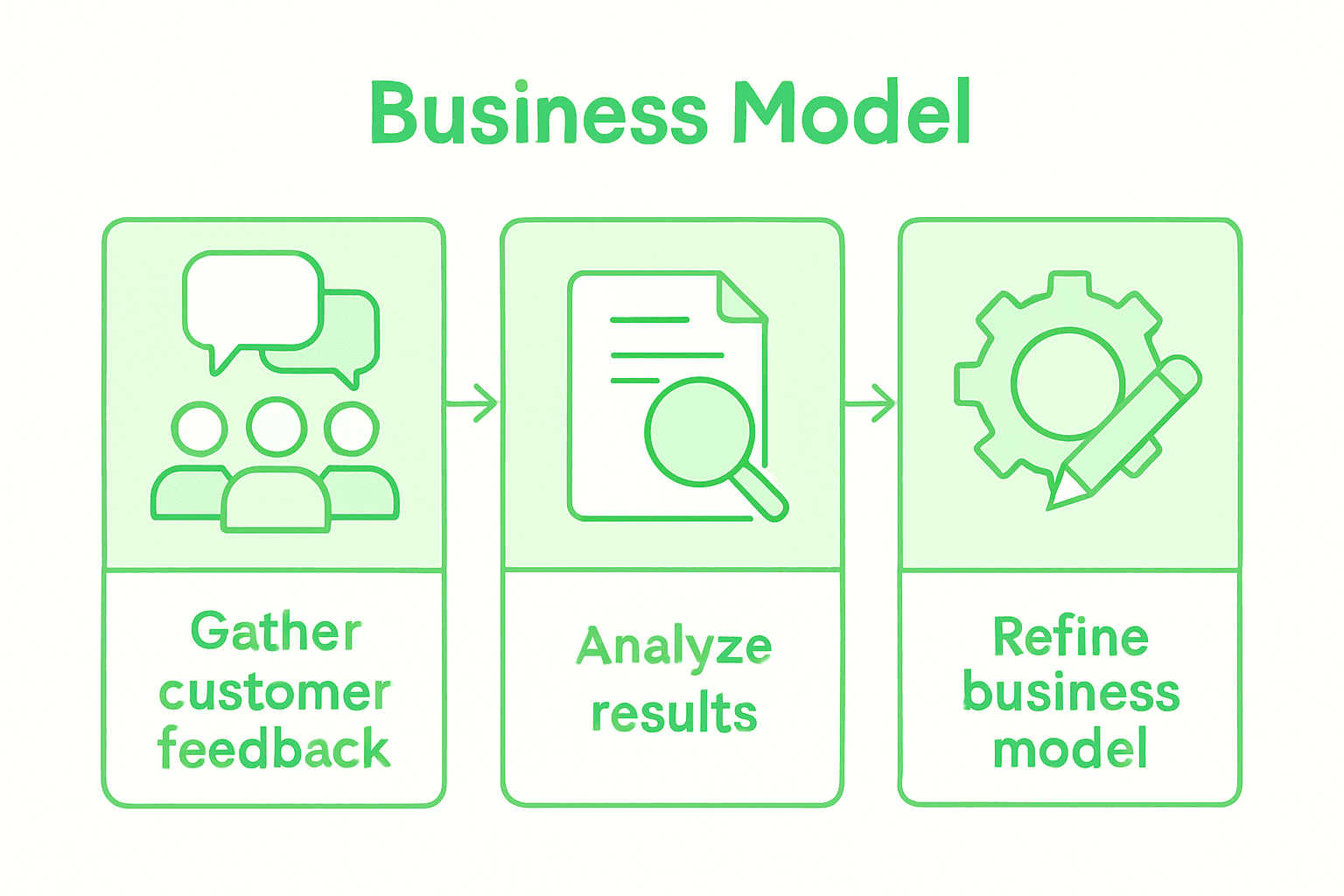
Developing a cognitive mapping technique can help founders elicit and visualize their product hypotheses more systematically. Start by clearly articulating your fundamental assumptions about customer needs, market demand, and product functionality. Then design targeted experiments to challenge these assumptions through direct customer interactions. Conduct interviews, create prototype demonstrations, and gather honest feedback from potential users who represent your target market.
Product market fit emerges when your solution satisfies a strong market demand, which requires rigorous validation beyond initial impressions. Listen carefully to potential customers feedback not just for what they say but for the underlying problems they describe. Look for patterns in their responses that confirm or challenge your original concept. Be prepared to pivot or modify your approach based on genuine market insights. Remember that successful validation is less about proving yourself right and more about understanding your customers deeply.
Pro Tip: Create a structured feedback template with specific questions that probe the core assumptions of your business model, and aim to interview at least 20 potential customers across different segments.
Step 5: Refine your business model strategy using insights
Refined business strategies emerge from thoughtful analysis and continuous learning. Your goal is to transform raw market feedback into a strategic roadmap that positions your venture for sustainable growth.
The Market Opportunity Navigator provides a structured methodology for identifying and selecting the most valuable market opportunities to align your current resources and capabilities. Begin by cataloging all insights gathered from customer interviews, prototype testing, and market research. Look for consistent patterns that reveal underlying customer needs and potential pivots. Pay special attention to feedback that challenges your initial assumptions.
Product differentiation becomes crucial in making your offering more attractive to your target market, distinguishing your solution from competitors. Analyze your collected insights to understand what truly sets your product apart. This might mean refining your value proposition, adjusting your pricing strategy, or reimagining key features. The most successful iterations come from a willingness to adapt based on genuine market signals, not emotional attachment to your original concept.
Pro Tip: Create a monthly review process where you systematically evaluate your business model against the latest market insights, allowing for incremental adjustments that keep your strategy agile and responsive.
Here’s a summary of key considerations at each business model development step:
| Step | Critical Focus | Strategic Outcome |
|---|---|---|
| Define UVP | Identify unique market problem | Clear customer differentiation |
| Assess Audience | Develop detailed personas | Targeted marketing precision |
| Map Finances | Structure revenues and costs | Informed financial planning |
| Validate Assumptions | Test concepts with users | Evidence-based decision making |
| Refine Strategy | Integrate feedback insights | Adaptable business approach |
Transform Your Business Model Strategy with AI-Powered Guidance
Building a clear and resilient business model can feel overwhelming for first-time founders. This article highlights challenges like defining a unique value proposition, mapping revenue streams, and validating assumptions with real customer feedback. If you want to avoid costly blindspots and deliver a strategy that truly resonates, having personalized insights and prioritized actions is essential.
Our siift.ai Intelligent Business Canvas helps you master each critical step systematically. It offers tailored feedback and an easy-to-use platform guiding you through ideation, audience assessment, financial mapping, and validation. Say goodbye to uncertainty and guesswork by leveraging AI to sharpen your business model strategy.
Ready to transform your idea into a viable business with confidence? Discover how siift.ai can help you accelerate your founder’s journey with unbiased, expert guidance today.
Frequently Asked Questions
What is a unique value proposition (UVP) and how do I create one?
A unique value proposition (UVP) is a clear statement that explains how your product solves specific problems for customers in a unique way. To create one, deeply understand your target audience’s needs and draft several versions of your UVP, testing them with potential customers for effectiveness.
How can I identify my target audience effectively?
To effectively identify your target audience, create detailed customer personas that include not only demographics but also motivations and pain points. Conduct research by analyzing social media channels and websites relevant to your audience, gathering insights that will help you tailor your marketing efforts.
What are revenue streams and how do I map them for my business?
Revenue streams are the various ways your business generates income, such as product sales, subscriptions, or service fees. Start by identifying at least three different revenue streams that align with your business model, and consistently evaluate their scalability and effectiveness against your core value proposition.
How do I validate my business model assumptions?
To validate your business model assumptions, conduct direct experiments through customer interviews and prototype testing. Gather feedback on at least 20 potential customers’ experiences and perspectives to reveal whether your assumptions hold true or need adjustment.
How frequently should I refine my business model strategy?
You should refine your business model strategy at least once a month, using insights gathered from customer feedback and market research. By establishing a regular review process, you can make incremental adjustments to keep your business strategy responsive and aligned with customer needs.
What is the importance of creating customer personas for my business?
Creating customer personas is crucial because they help you understand the specific needs, goals, and challenges of different segments of your audience. By developing at least three distinct personas, you can more effectively tailor your marketing messages and value propositions to resonate with each segment.
Recommended
- blog | siift | What Is a Business Model? Simple Guide for Future Entrepreneurs 2025
- blog | siift | Business Opportunity Analysis for First-Time Founders 2025
- blog | siift | Understanding the Startup Business Model: Key Insights
- blog | siift | Bootstrapping Strategies: Guide for First-Time Founders
- 7 Key Examples of Cannabis Revenue Streams Explained - Cannabis Business Minds